The Naming of the Mahatma

Mohandas and Kasturba Gandhi on return to India in 1915
Source: mkgandhi.org

On January 9 1915, SS Arabia, a mail boat from England docked at Bombay port. Among those who disembarked were Mohandas Gandhi and Kasturba Gandhi, returning to settle in India after 21 years in South Africa. Gandhi was already well known in India for his 20 years of work for justice and satyagraha in South Africa. But the South African human rights activist had not yet become the leader of the Indian freedom struggle. However it was in the first few weeks back on his native soil that Mohandas would be bestowed with the title that became an integral part of his name for the rest of his life, and much beyond—Mahatma.

There are different stories about how this came to be, including that it was Rabindranath Tagore who gave him this honorific title in March 1915. In fact, it was three months earlier that the word Mahatma was first used to address him.

Upon return to India, following a week of a series receptions and meetings in Bombay, Mohandas left for Ahmedabad, and then travelled to Kathiawar. On 21 January 1915, Gandhi came to Jetpur where he visited the home of the town’s leading citizen nagarsheth Nautamlal Bhagvanji Kamdar.

The links between Gandhi and Nautamlal’s family had an older, slightly indirect history. Nautamlal’s daughter Manjula (Maya) was married to the son of Dr PJ Mehta, one of Gandhi’s oldest and closest friends.  Pranjivan Mehta, a medical doctor, was one of the first Indians that Gandhi contacted when he landed in England in October 1888, as a young and naïve law student. Dr Mehta eased the shy Mohandas into the life and customs of the new country. The two became close friends, and the bonds lasted through their life. It was Dr Mehta who encouraged Gandhi to return to India in 1915 and supported him in every way as he found his feet on the road that would lead to India’s freedom. By then Dr Mehta had moved to Rangoon where he had a profitable jewellery business. The two friends continued to correspond, sharing ideas, issues and problems, and even visited each other. It was Dr Mehta’s financial support that enabled Gandhi to devote all his time and attention to the freedom movement. Dr Mehta even procured a plot of land in Ahmedabad for Gandhi to recreate the Phoenix Ashram experiment. This became known as Sabarmati Ashram. He also contributed funds for the setting up of Gujarat Vidyapith. Dr Mehta remained Gandhi’s pillar of strength until he passed away in 1932.

Thus the family of Nautamlal Kamdar also became close to Gandhi, and were also generous donors to the Sabarmati Ashram and the Gujarat Vidyapith. But even before these were established, the Kamdar family were among the first to welcome and support Gandhi as he embarked on the long march to freedom, right from the first week of his return to Indian soil.

On January 21, 1915 the family organised a felicitation meeting for Gandhi and Kasturba to be held at Kamri Bai School in Jetpur.  Here both Gandhi and Kasturba were honoured with the presentation of manpatras (citations). It is in the citation to Gandhi that the title of honour of Mahatma was first recorded.

The original manpatra was in Gujarati, but here is an English translation of the same as sourced from https://nautamlalmehta.com.  

To Shriman Mahatma Mohandas Karmchand Gandhi. Barrister-at-law.

Gentleman, You have returned to your native land after leading a fight for many years for the right of Indians. We the residents of Jetpur, are honored and pleased to have you here. We have gathered here to commemorate this auspicious occasion and we heartily present this document of honor to you and to your wife.

You were born in an honorable family of Karmchand Gandhi in Kathiawad and acquired higher education and higher knowledge. You have set a direct example of duty to all the people by way of performing duties rightfully, and we are very proud of it. Your father had brought fame by enjoying an executive post in the states of Porbander, Wankaner, Rajkot, etc. In a similar manner as your father, you have enhanced your father’s fame by taking a leading part in the interest of the country and people as a top priority of your life.

For the people of Indian origin in South Africa, you fought, sacrificed and showed them a new light in their life, in order to fight for their rights, justice, and their dignity. The Indians all over the world know your dedication and your unbounded love for them in their hearts. You also stood against the mighty British Empire with the new weapon of Satyagraha. You have come out a winner in that. We feel very proud and happy about it. The way you handled the British government with skill, determination, will power, undergoing physical and family pains, and imprisonment are all the hardships that you underwent in order to fight for human rights, bring success and were able to change the laws. We Indians are very proud of you. No amount of words can express the deep gratitude we feel for the work you have done in South Africa and in India.

It would be a very long document if we enumerated all the achievements you accomplished in South Africa and in India. Even though you come from a noble family and earned a degree in law and have had biographies written about your achievements, we will not take up much of your time in enumerating them.

You discharged your duties without self-interest and sacrificed money matters. Your behavior is characterized by what is being told in Hindu religious scriptures about saints as to how they should behave and what religious practices they should follow. It is not an exaggeration to honor you with the title of “Mahan Yogi” (Mahatma), it is based upon your self-knowledge of the Mahan soul (atma).

We pray to the creator of world that you may continue the way in which you are trying for the well-being of Hind and that way obliging Hind, and you and your wife remain hail and healthy physically; and the almighty god may bestow upon you a long life; and that you may enjoy all happiness and peace, along with other members of your family.

Jetpur, 21-1-1915 (January 21.1915)                           

This week as we mark the birth anniversary of Gandhiji, it is interesting to discover how Mohandas became Mahatma Gandhi.

–Mamata
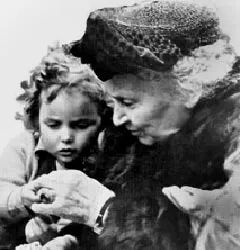
The Montessori Touch

Source: ageofmontessori.org

What do a young Jewish girl and her diary; and a young man and his online encyclopaedia have in common? What is the link between the Google Guys, one of the richest men in the world, and a Nobel Prize winning writer?

It is the name Maria Montessori!

All these renowned names, spanning different periods of time, began their education in a Montessori pre-school. And all of them attribute a large part of who they are, and what they achieved, to the strong roots of the philosophy and practice of the Montessori system of education.

Anne Frank is synonymous with her Diary. The young Jewish girl who penned her experiences and thoughts of two years of hiding from the Nazis in an attic in Amsterdam, died in a Nazi concentration camp in 1945. She was only 15 years old. Her diary remains one of the most poignant pieces of literature from World War II. It is in this diary that Anne recorded how her early education began. I started right away at the Montessori nursery school. I stayed there until I was six, at which time I started 1st grade (Montessori elementary). …My parents never worry about report cards, good or bad. As long as I am healthy and happy and don’t talk back too much they are satisfied. (But) I do not want to be a bad student. …I was supposed to stay in the seventh grade at the Montessori School, but Jewish children were required to go to Jewish schools…”

As a child Anne was always asking questions, and her father felt that the Montessori approach would give enough room for her curious mind to blossom.  She attended the 6th Montessori School of Amsterdam from age 3 to 11. She then attended a year at the Montessori Lyceum (high school) until German authorities prohibited Jewish children from attending school with Christian children. Anne spent the rest of her short life in hiding, where the diary with the red checked cover that her father gave her, became her special secret. Maria Montessori once said: A child without a secret becomes and adult without a personality. Sadly Anne never attained adulthood, but her diary with her attention to detail, her observations and her honesty bears proof of her Montessori education.

What is the first place to check when one is looking for information? Wikipedia! The brain behind the online encyclopaedia is Jimmy Wales. Another curious child, Jimmy used to spend hours perusing the physical tomes of the Britannicas and World Book Encyclopaedias. This passion bloomed into Wikipedia. Jimmy credits his ability to think outside the box to the Montessori method that his school followed. Jimmy was a  true example of an Absorbent Mind that Maria Montessori wrote about in her book of the same title.

Julia Child is known as the woman who popularised French cooking in America with her famous cookbook and her funny TV cookery shows. Julia Child worked at diverse occupations from being a copywriter, to being a research assistant for Secret Intelligence, until she discovered her passion for cooking. 

Julia’s life and work was strongly influenced by her Montessori education. She always claimed that Montessori learning taught her to love working with her hands. Equally important was Montessori’s approach to making mistakes.  “[Maria] Montessori wanted kids to develop ‘a friendly relationship to error,’ – to understand that mistakes are a normal part of learning, and that to learn, you must be willing to make mistakes, and then to move forward.” 

Julia Child’s early Montessori experiences led her to endorse that involving children in the process of cooking did much more than teach them to cook. “Influenced, perhaps, by my early experience at a Montessori school, and surely by living in a clan full of carvers, painters, carpenters, and cooks of all ages, I am all for encouraging children to work productively with their hands. They learn to handle and care for equipment with respect… The small rituals, like the clean hands and clean apron before setting to work; the precision of gesture, like levelling off a cupful of flour; the charm of improvisation and making something new; the pride of mastery; and the gratification of offering something one has made — these have such value to a child. And where are they so easily to be obtained as in cooking?

If using her hands and learning from mistakes was Montessori’s lifelong lesson for Julia Child, it was the spirit of exploration that marked Montessori’s influence on Will Wright. Wright, one of the most famous video game designers in history, is best known for SimCity. His games rarely conclude with The End, rather they let the player tinker towards perfection, with each player defining that perfection.

Wright always claimed that his schooling until sixth grade in a Montessori school “was the high point of my education”. As he wrote “Montessori taught me the joy of discovery. It showed you can become interested in pretty complex theories, like Pythagorean theory, say, by playing with blocks. It’s all about learning on your terms, rather than a teacher explaining stuff to you. SimCity comes right out of Montessori — if you give people this model for building cities, they will abstract from it principles of urban design.”

Gabriel Garcia Marquez, best known for his book One Hundred Years of Solitude won the Nobel Prize for literature in 1982, “for his novels and short stories, in which the fantastic and the realistic are combined in a richly composed world of imagination, reflecting a continent’s life and conflicts.”

As a child he struggled to read, but when he joined a Montessori school his language skills were transformed by the phonetic way of learning. Marquez credited many of his successes to the Montessori form of education. As he said “I do not believe there is a method better than Montessori for making children sensitive to the beauties of the world and awakening their curiosity regarding the secrets of life.”

Montessori acknowledged that the only valid impulse to learn is self-motivation itself. She believed that children possess a natural motivation to learn and absorb knowledge without effort if given the right kind of activities, at the right time of their development.

Perhaps the most famous examples of the success of this approach is the story of Larry Page and Sergei Brin the co-founders of Google. Both have attributed their Montessori education as the foundation of their future professional life. We both went to Montessori school, and I think it was part of that training of not following rules and orders, being self-motivated, questioning what’s going on in the world, and doing things a little bit different that contributed to our success. They specifically credit the curriculum of self-directed learning where students follow their interests and decide for themselves what they want to learn that inspires students to become life-long learners with a love of education.

And last, but certainly not the least, one of the world’s richest men, Jeff Bezos could leap into space from a strong Montessori launch pad. He remembers: I went to Montessori school [for] about a year and a half, starting probably at age 2 1/2. … I have these very clear visual images of tracing out letters on sandpaper. I remember having a little special board that you can use to practice tying your shoes.

His mother remembers: He would get so engrossed in his activities as a Montessori pre-schooler that his teachers would literally have to pick him up out of his chair to go to the next task.

Bezos who started his amazing journey from a Montessori pre-school has come full circle by launching a $2 billion project called Day 1 Families that aims to bring quality early education to those who may not otherwise have access to it through supporting Montessori pre-schools in minority and low-income communities in America.

31 August marks the 151st birth anniversary of Maria Montessori. A century and a half later, her path-breaking philosophy and approach to education remain as relevant, if not more. The Montessori legacy lives on through the generations who have experienced the Montessori touch.

–Mamata

Boring Buzzers: Carpenter Bees

Every few months when we step out onto our little sit-out deck in the morning, we find pockets of sawdust strewn on the floor. Initially we thought that it was termites that had started eating away at the old wooden pergolas over the deck. But a general check could not reveal any other tell-tale signs of termites. So we continued to be baffled about what was responsible for this.

One morning as we sat there we saw a large black bumble bee flying about the pergolas, and then quite mysteriously disappearing somewhere into the wooden beam. A closer examination revealed a hole in the wood, and it seemed to be the one into which the bee had vanished. So now we had a possible suspect, but as yet no confirmation of the link between the sawdust and the bee. The next time there was sawdust, we checked the wood just above it and sure enough we found a neat hole. The next step was to find out if a bumble bee could also be a boring bee!

Some preliminary research confirmed one suspicion—that the drilling in the wood was indeed the work of a bee. But it also refuted the supposition that this was a bumble bee. What we discovered was that this was a bee called the Carpenter Bee, and also many interesting facts. 

To start with, of course, the name. Carpenter bees are aptly named for their habits of drilling into wooden surfaces such as logs and tree branches, or in urban areas, wood used for construction. They drill a neat hole in the wood and tunnel into the wood in order to make their nest and lay their eggs. In a couple of hours the carpenter bee can drill a hole a few inches deep, leaving beneath the debris of sawdust.

Source: en.wikipedia.org

Carpenter Bees (Xylocopa latipes) are one of the largest bees we have here in India. They are big and black with an intimidating appearance. Their wings shine in the sunlight with metallic blue, green and purple colours. The male and the female are more or less similar, but the male has hairier legs.   

Carpenter bees do indeed resemble bumblebees, but while bumblebees usually have a hairy abdomen with black and yellow stripes, carpenter bees typically have a shiny, hairless abdomen. The two bees also have different nesting habits–bumblebees nest in an existing cavity often underground (e.g., in abandoned rodent burrows), whereas carpenter bees tunnel into wood to lay their eggs.

Another distinguishing feature of Carpenter bees is that they are solitary bees, unlike most other honeybees and bumblebees that live in colonies and are known as social insects. The honeybees make hives, while carpenter bees excavate and make well structured tunnels in wood. They vibrate their bodies as they rasp their mandibles against the wood.

After boring a short distance, the bee makes a right angle turn and continues to make a tunnel extending about 30-45 centimetres, parallel to the wood surface. Inside the tunnel, five or six cells are constructed. Each cell houses a single egg, and each one is provided with a wad of pollen collected from flowers, which could serve as nourishment for the larva when the egg hatches. Each cell is then sealed with regurgitated wood pulp and saliva. The larvae feed on the high protein and calorie pollen beebread, and enter hibernation, before they turn into adult bees and emerge from the tunnel. Adult females can live up to three years and can produce two generations of offspring per year, though they never see their offspring!

What an amazing feat of insect architecture was going on, hidden from us, in the single beam of wood right over our head, as we sipped our morning tea!

Equally impressive is the contribution of these bees to the cycle of nature. Carpenter bees typically visit large open-faced flowers which have a lot of pollen as well as nectar. They use vibrations to release the pollen from the flower’s anthers, and are described as buzz pollinators. As they feed on nectar from many flowers, the pollen from the flowers sticks to the underside of the abdomen and the legs, which is transported from flower to flower as they flit and settle to feed, playing a vital role in pollination.

Curiously while I have seen the bee hovering around the wooden beams, I have yet to see one buzzing around the flowers. So the next step in my tracking the bee’s journey still remains incomplete. Even the drilling seems to happen after dusk, as the saw dust appears only in the morning, when the bee appears to be rather ominously hovering around, guarding the entrance to its nesting tunnel, and then flying off into the sunlight.

Interestingly, despite their intimidating appearance, it seems that the males are harmless and do not sting. Female carpenter bees can inflict a painful sting but will seldom do so — unless they are handled or bothered by people– another difference between these solitary bees and other bees and wasps that inflict dangerous stings.

While carpenter bees are have their own place in nature, when they start their drilling activities in wood in houses and gardens, they can become pests. As they hollow out the wood, this can lead to the deterioration or collapse of wooden structures. With our already old and weather-worn wooden beams starting to become favoured nesting sites for Carpenter bees, we had to look for ways to stop these boring buzzers. Research indicated that one option was to inject chemical insecticides or pesticides into the holes. We could not bring ourselves to do this.

We then read that these quiet-loving bees do not like vibration or noise around their nests, but seeing as they were happily drilling right next to our large and loud wind chime, this was obviously not bothering them.

Another thing that these bees are said to be very sensitive to is citrus scents near their nest, and spraying citrus oil into the holes was a recommended way to foist them off. We have arrived at our version of this by plugging the new holes with wedges of lemon. We think that this is playing some part in preventing their access, so one battle at a time is won. But this has certainly not deterred their efforts at drilling new holes; so if the hollowed-out beam collapses on our heads one fine morning, the bees would have won the war! 

–Mamata

‘Flagman’ Pingali Venkaiah

A young boy, very far from home, was fighting an alien war, on foreign land as part of an imperialist army. His name was Pingali Venkaiah. He was a soldier in the British Indian Army fighting for the British in the Anglo Boer war in South Africa, at the end of the 19th century. Around the same time, another young man in South Africa was starting his experiments with what was to become a lifelong crusade for truth, justice and freedom. His name was Mohandas Karamchand Gandhi.

When the Boer War broke out in 1899, while Gandhi’s sympathies were with the indigenous Boers, but as a member of the British crown colony of Natal he felt that he needed to contribute to the British efforts. Gandhi set up an Ambulance Corps of 1100 volunteers, out of whom 300 were free Indians and the rest indentured labourers. Gandhi’s task was to instil in this motley group a spirit of service to those they regarded as their oppressors. Gandhi’s corps placed a significant role as stretcher bearers, carrying the wounded out from the battlefield.

At some time during this period, the 19-year-old Pingali met Gandhi, who had already become known for his mission for justice. He must have seen Gandhi as described by the Pretoria News: Gandhi was stoical in his bearing, cheerful and confident in his conversation and had a kindly eye. Pingali was deeply impressed and influenced, and a bond was formed between the two; a bond that would endure half a century.

Inspired by Gandhi, and the strong urge for freedom from colonial rule, Pingali, on his return from Africa, became a member of the secret revolutionary units fighting against the British Raj and spent time in Eluru. At the same time he began to seriously pursue his interest in agriculture, especially the farming of cotton. He spent a lot of time in experimenting with cotton cultivation. He imported Cambodian variety of cotton seeds from America and crossed them with Indian seeds to create an indigenous hybrid variety of cotton seeds. He acquired a piece of land in the nearby Chellapalli village and planted these seeds. The fine variety of cotton that grew from these, came to the notice of the local British officers during an agricultural exhibition in 1909. The Royal Agricultural Society of London offered him an honorary membership. He became locally famous as ‘Patti (cotton) Venkaiah’.

Along with agriculture Pingali continued to pursue his academic interests, especially in languages. This took him to Lahore to study Sanskrit, Urdu and Japanese in the Anglo Vedic School. He became fluent in all the languages, and in 1913, gave a full length speech in Japanese that earned him the moniker of ‘Japan Venkaiah’.

Pingali joined the railway services as a guard and was posted to Bangalore and Bellary. During those years, Madras was reeling under the plague epidemic. Seeing the plight of those suffering, he quit his job and went there to work for a short time as an inspector of the Plague Disease Eradication Organization.

Pingali continued his commitment to the freedom movement. He attended the sessions of the Indian National Congress. At the Calcutta session in 1906, Pingali’s patriotic sentiments were deeply hurt at seeing the English Union Jack being hoisted. He returned from the session with a new passion—a national flag for India. He started by researching the flags of different countries, even while pursuing his numerous other interests and occupations. In 1916 he published a book titled A National Flag for India which included thirty designs for the flag. From 1916 to 1921, at every session of the Indian National Congress, Pingali raised the issue of the need for a national flag. Gandhi liked the concept, but his vision was that of a flag that would “stir the nation to its depth”, a flag that “represents and reconciles all religions”.

It was in 1921, at the meeting of the Congress at Vijaywada that Pingali showed Gandhi his book with designs of the flags. Gandhi appreciated Pingali’s hard work and persistence. In an article in Young India titled Our National Flag he wrote: “We should be prepared to sacrifice our lives for the sake of our National Flag. Pingali Venkaiah who is working in Andhra National College Machilipatnam, has published a book, describing the flags of the countries and has designed many models for our own National Flag. I appreciate his hard struggle during the sessions of Indian National Congress for the approval of Indian National Flag. When I visited Vijaywada, I asked Mr Venkaiah to prepare a two coloured flag with red and green colours along with a Chakra symbol and obtained it within three hours from him. Later we had decided to include the white colour, also the colour that reminds of truth and non violence”.

Source: en.wikipedia.org

Pingali worked overnight to make a fresh design that would reflect Gandhiji’s vision. The flag, as Pingali Venkaiah designed it, became the blueprint for what would, eventually, become the national tricolour of India. And earned its creator another title: ‘Jhanda Venkaiah’ or Flag Venkaiah.

In 1931, the flag was officially adopted by the Indian National Congress with some changes in design. Pingali Venkaiah’s nationalist mission was fulfilled, but he continued to be a part of Gandhiji’s mission for Swaraj until India gained her Independence on 15 August 1947, when India’s own flag was proudly hoisted, as the Union Jack came down.

After 1947, Pingali Vekaiah withdrew from active politics and settled down in Nellore. He had always had a keen interest in geology, and a sound knowledge of the precious and semi-precious stones in that region. He now seriously embarked on yet another area of study—gemology. He soon became an expert in the field, writing research articles, advising the Government of India and conducting field trips. Thereby adding another title to his repertoire—‘Diamond Venkaiah’.

A humble unassuming man of amazing versatile talents, Pingali Venkaiah lived his life following his inspiration Gandhiji’s motto of simple living, high thinking. So much so that his last days were spent in utter penury. While the young Republic proudly raised its tricolour as the symbol of its growing stature and strength, the man who had dreamed and designed this very symbol was increasingly forgotten.

But for Pingali Venkaiah this flag signified the highest fulfilment of his life. As he wrote in his will, his final wish was that his body be covered with the tricolour before he was put on the pyre, and then be removed and hung on a tree branch. Pingali Venkaiah died on 4 July 1963, and his wish was fulfilled.

This month all Indians have cheered as our tricolour was raised high by our young Olympians. This week we will hold our heads high as we salute our Nation. A good time to also remember the generation of Indians that fought and sacrificed so much to give us these proud moments. And to recall Gandhiji’s words: The national flag is the symbol of non-violence and national unity to be brought about by means strictly truthful and non-violent.

–Mamata

Lepidopt-artist

It is butterfly season again. After a few hot, dry months, it is a treat to see so many different kinds of butterflies fluttering and flitting among the flowers and leaves. Butterflies have inspired art and poetry; and they have also been the subject of the scientific study by lepidopterists. The distance between the art and the science has always been distinct, starting from primary school where children learn about the life cycle of butterflies in Science class and draw and paint these colourful creatures in the Art class.

It is amazing to know that nearly four centuries before there was a woman who successfully and brilliantly combined the art and the science to produce some of the most groundbreaking work on butterflies and other insects. This is her inspiring story.

Maria Sibylla Merian was born in 1647 in Frankfurt at a time when scientific study of life was still in its infancy. Her father was an engraver and publisher, who died when Maria was a baby. When she was three years old, Maria’s mother married Jacob Marrel who was a renowned still-life painter. He encouraged young Maria’s interest in collecting live insects and also taught her the art of flower painting. As she grew, so did her passion for both these hobbies—which became lifelong commitments.

Women of Maria’s class and era collected butterflies as a hobby. Their catches were displayed as pinned specimens. Maria was driven by a different approach. She was not interested in dead specimens. She was fascinated by live insects and wanted to understand not just the insects and their life stages; but also their habits and habitats, the plants that they associated with and fed on, and their interactions with other species.

From the age of 13 she started collecting caterpillars and raising silkworms. She observed how they changed form at different stages, until they developed into butterflies or moths. She not only kept meticulous records and notes of her observations, but also detailed drawings of the process. She often painted by candlelight as she awaited the moment when the caterpillar made its cocoon, or a butterfly emerged from one. She painted caterpillars feeding on their host plants and being fed upon by their predators.

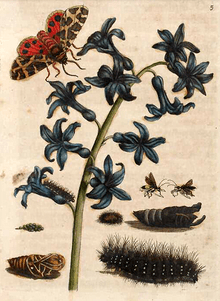
The metamorphosis of the garden tiger moth, its plant host, and parasitic wasp by Maria Merian. Source: https://en.wikipedia.org/

She publishing her first book of illustrations at age 28; this was followed by a two-volume set on caterpillars (published in 1679 and 1683) that showed the metamorphosis and host plants of 186 species.

Maria Merian was the first person to document the life cycle of butterflies. At that time it was widely believed that life originated spontaneously from inanimate matter. For example, that flies arose from rotting meat; other insects, including butterflies formed from mud, and that raindrops produced frogs. Maria’s observations and documentation opened up a new dimension.

This was also an era when most women did not have the opportunity of going to university. Maria was far from a being an academic scientist, nor did she have the freedom to devote all her time and energy to this pursuit. At the age of 18 she married her stepfather’s apprentice, and had two daughters. The marriage was not a happy one, and she left her husband, taking both her daughters, to live in a religious community; eventually getting a divorce. For many years she brought up her daughters as a single mother, supporting the family by teaching paining to daughters of wealthy families; and still making time for her art and scientific studies. By then she had moved to the Netherlands, where she spent the rest of her life.

For the first fifty years of her life, Maria observed and documented hundreds of  European insects, from caterpillars to spiders. She became well known for her work; collectors and art dealers would frequently come to her and show her insect dead specimens for her to observe.

But in 1699, at the age of 52, she embarked on one of the first purely scientific expeditions in history. She sold 255 of her paintings to finance the trip. Her goal was to illustrate new species of insects in Surinam, a South American country which had been recently colonised by the Dutch. After two months of dangerous travel, accompanied by her 20-year-old younger daughter, she reached Surinam.

For Maria Merian this was an entomologist’s paradise. She was itching to collect and paint everything she saw. But the Dutch planters of the island were not willing to accompany the two women into the forests to collect insects. So she forged relationships with enslaved Africans and indigenous people who agreed to bring her specimens and who shared with her the medicinal and culinary uses of many plants. Merian and daughter spent two years in Surinam before Maria’s failing health from frequent bouts of malaria, forced then to return to the Netherlands.

But the compilation of all her work in documenting and illustrating flora and fauna in Surinam resulted in a book titled Metamorphosis insectorum Surnamensium. It was written in Latin, the international language of science, with 60 stunning copperplate engravings that brought the exotic world of the rainforest to the damp drawing rooms of Europe. The book became well known in scientific and artistic circles.

Merian’s eldest daughter, Joanna, subsequently made the journey to Surinam and would send her mother new specimens and paintings until Merian’s death, at the age of almost 70, in 1717.

For a woman of her time, with no university education, Maria Merian’s meticulous scientific and artistic work earned her respect. Karl Linnaeus, famous for developing a system for classifying life, referred heavily to her illustrations in his species descriptions. The grandfather of Charles Darwin, Erasmus Darwin, cited Merian’s work in his book The Botanic Garden. 

Merian also published works in German and Dutch, which allowed lay readers unprecedented access to scientific discoveries, arguably making her one of the earliest science communicators.

Merian was also proved to be a successful businesswoman. She sold her drawings and engravings to finance the printing of her own books, which she would later sell. This financial security also allowed her the freedom her to pursue her interests and ideas.

In the 1800’s, by which time university-trained academics laid stake to “biological knowledge” there was a trend to discredit Maria Merian and her work. As she had no formal scientific training she was written off as a woman with a hobby who painted beautiful – but entirely unscientific – pictures of butterflies. Although her work continued to inspire and influence generations of artists, her contributions as a scientist were largely forgotten. It is only in more recent years that her scientific work has been revisited and revived.

Maria Sibylla Merian was a pioneering naturalist, who also managed a successful career as an artist, botanist, and entomologist. Merian studied the behaviour and interactions of living things at a time when taxonomy and systematics (naming and cataloguing) were still at a nascent stage. She laid the groundwork for the fields of entomology, animal behaviour and ecology. She was the first ever to show the interaction between species, food chains, and the struggle for survival in nature. And how environment affects development and behaviour. She captured the ecology of species, centuries before the term even existed.   

At a time when other scientists were trying to make sense of the natural world by classifying plants and animals into narrow categories, Merian looked at their place within the wider natural world. She searched for connections where others were looking for separation.

Today when there is so much talk of encouraging women in STEM, it is more than worthwhile to remind ourselves of this inspiring woman who not only successfully combined her artistic and scientific work, but also pioneered fields of study that we erroneously believe to have more recent origins.

–Mamata

Concerted Cultivation

Source:kidskintha.com

“Tiger moms’, ‘helicopter parenting’; ‘authoritative parenting or authoritarian parenting’; ‘permissive parenting’ or ‘uninvolved parenting’… In the last decade or more there has been a lot of discussion and debate around ‘parenting styles’. In nuclear families with both working parents, and one or two children, there seems to be a situation where parents are overly conscious about “parenting” in order to give the “best of everything possible” to their children. Paradoxically, this is now beginning to show somewhat alarming outcomes. 

I recently read a thought-provoking book titled The Coddling of the American Mind: How good intentions and bad ideas are setting up a generation for failure. The book’s primary intent is to understand the phenomenon of rising intolerance on college campuses in America. In order to do this the authors attempt to go back to the contemporary practices of child-raising that impact psyche and behaviour of these children as they reach adulthood. Although these premises are based on a study of trends and theories in the Unites States, it was surprising and disturbing that a lot of this applies also to some sections of parents in India.

One of the chapters in the book looks at the changes in parenting styles in America over the last five decades or so. Parents of children born in the nineteen fifties were strongly influenced by Dr Benjamin Spock who taught that “children should be permitted to develop at their own pace, not pushed to meet the schedules and rules of adult life.” Spock encouraged parents to relax and let children be children. Children growing up in the fifties, and through the sixties and seventies roamed freely around their neighbourhood and played without adult supervision. Unsupervised time had many positives in terms of child development—joy, independence, problem solving, and resilience.

But starting from the 1980s, and gaining strength in the 1990s, there was shift in thinking about child upbringing, moving away from Spock’s “permissive parenting” to a new model of “intensive parenting.” Which is what sociologist Annette Lareau describes as “concerted cultivation”. Parents using this style see their task as cultivating their children’s talents while stimulating the development of their cognitive and social skills. They fill their children’s calendars with adult-guided activities, lessons and experiences, and they closely monitor what happens in school. They talk with their children a great deal using reasoning and persuasion, and they hardly ever use physical force or physical punishment.

The main converts to this were educated middle class parents who were reading about new theories of ‘early stimulation’ (such as babies who listened to Mozart would become smarter) and who felt that they needed to give their children every possible advantage in the increasingly competitive race to get into a good college.

Cultivation of such conditions for children requires that parents make a concerted effort to plan their children’s time.  Children have after school activities like music lessons, team sports, tutoring and other structured and supervised activities. Younger children have ‘playdates’. Children are overscheduled, over parented and over monitored.

The race for getting the child into a good college begins even before the child starts school. A telling example of the change in expectations are two checklists of reference indicators for parents to check whether their child is ready for first grade.

Checklist in 1979

–Will your child be six years six months or older when he begins first grade and starts receiving reading instruction?

–Does your child have two to five permanent or second teeth?

–Can your child tell, in such a way that his speech is understood by a school crossing guard or policeman where he lives?

–Can he draw and colour and stay within the lines of the design being covered?

–Can he stand on one foot with eyes closed for five or ten seconds?

–Can he tell his left hand from his right?

–Can he travel alone in the neighbourhood (four to eight blocks) to store, playground, or to a friend’s home?

–Can he be away from you all day without being upset?

–Can he repeat a simple eight or ten word sentence, if you say it once?

–Can he count eight to ten pennies correctly?

–Does your child try to write or copy letters or numbers?

A Checklist from a school, circa 2015, had about thirty items on it, mainly academic standards. This included the expectation that the six-year-old child should be able to:

–Identify and write numbers to100.

–Count by 10’s to 100, 2’s to 20 and 5’s to 100.

–Interpret and fill in data on a graph.

–Read all kindergarten-level sight words.

–be able to read books with five to ten words per page.

–Form complete sentences on paper using phonetic spelling (i.e. journal and story writing).

Kindergarten in the 1970s was devoted mostly to social interaction and self-directed play with some instruction in art, music, numbers and the alphabet. Kindergarten today is much more structured and sedentary with children receiving direct instruction to academic subjects—known as ‘drill and skill’ method of instruction.

In recent years, in addition to over parenting, protective parenting has grown into ‘paranoid’ parenting. Parents want to keep their children ‘safe’ from anything that they perceive might harm them—food, activities, people, words…This is creating a cult of safetyism, where children grow up believing that the world is full of danger.

The authors believe that such parenting, has adverse, rather than supportive effects on children. Overprotected children are also shielded from the small but necessary challenges and risks that they need to face on their own. The children grow up with a sense of fear, anxiety and distrust. They are denied the necessary opportunities to develop important ‘life skills’ such as self-directed learning, cooperation, negotiation, compromise, dispute resolution, decision making, and perspective taking.

 Free outdoor play, a critical component of growing up that develops these skills is increasingly missing from children’s lives today.  Studies in America have found that compared to previous generations, children growing up in the second decade of the 21st century are spending hardly any time in outdoor activities, especially free play; they spend less free time with friends and more time interacting with parents, and much more time interacting with screens.

This is perhaps almost as true now for most other parts of the world. Indeed, much more so in the last year and a half of the pandemic lockdowns. Even while the current conditions deny children many vital experiences and opportunities, it would be important to remember that even well-intentioned over parenting can harm rather than help our children. Children are naturally ‘antifragile’, their brains require a wide range of inputs from their environment in order to configure themselves for these environments. Like the immune system they must be exposed to challenges and stressors (within limits and appropriate to their age) to build resilience as they grow. Overprotection makes them weaker and less resilient later on. Given that risks and stresses are unavoidable parts of life, we may indeed be preparing our children better to cope with these, not by over-protecting them, but by helping them to develop their innate abilities to grow and learn from challenging experiences. As the authors write, you cannot teach your child antifragility directly but you can give your child the gift of multiple experiences they need to become resilient, autonomous adults.

Prepare your child for the road. Not the road for the child.

–Mamata

From Colour to Color

Last week I wrote about the Spelling Bee in America and how the Merriam-Webster Dictionary is the official reference for spellings for this prestigious competition. The challenge for participants in the competition is to know the spellings and meanings of the 7000+ words in the dictionary. But how many know the story about the man behind those words—Noah Webster?

This story begins on a farm in West Hartford, Connecticut where Noah Webster was born on October 16 1758, a time when America still belonged to England. His father farmed the land, and from the time Noah was a young boy, he helped out with agricultural chores; but his mind was restless and he was eager to use it in different ways. Having taken in all that the local school had to offer, and encouraged by his teachers, Noah, aged 16, entered Yale, one of the best colleges in the country then. His father took a loan on the farm to support his education. But when he graduated, his father gave Noah eight dollars and told him that henceforth he was on his own.

The 19 year-old graduate, with a farm loan to pay back, needed to start earning immediately; so he started teaching in a school. The conditions were pathetic.  . Children of all ages were crammed into one-room schoolhouses with no desks or basic supplies, untrained teachers, and a few old school books from England which pledged allegiance to King George. This was also a time when the east coast of America was in the throes of the Revolutionary War against the British. Noah strongly felt that his students should be learning about their own country from American textbooks, in a vocabulary that they identified better with.

In October 1781 after King George’s soldiers were defeated, Americans effectively won their independence. And Noah Webster decided that “I will write the second Declaration of Independence. An American spelling book.”

Noah felt that there was no reason why the newly independent people should continue to spell the way they did in England, where words were often spelt very differently from the way they sounded phonetically. Also within America itself the same word was often spelt in different ways (mosquito, moskito, miscitoe, misqutor, muskeetor…). Noah felt that Americans should spell every word in the same way, every time, everywhere. He felt that this would lead to creating a true United States of America.   

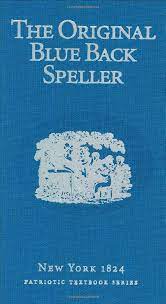
For two years, Noah taught school all day and worked at night on this dream textbook. In 1783 he published this under the title A Grammatical Institute of the English Language. He wanted that his “speller” should look different from other books on the shelves and told his printers to put a blue cover on it. And that is what the book became popularly known as–The Blue-Back Speller. The book not only taught spelling, but also listed important American dates, towns and states. Noah Webster had created the first American textbook! For over 100 years, Webster’s book taught children in America to read, spell and pronounce words. It was the most popular American book of its time, selling nearly 100 million copies. But Noah did not mint money from its sales—while originally the book cost 14 cents, he received one penny for each copy sold, the rest went to the printer.

At the time Samuel Johnson’s 1775 Dictionary of the English Language, introduced by the British, was considered the authoritative English language resource by most Americans. But there was a section of the population that wanted its own national dictionary for the newly declared free states of America. In 1806 Noah Webster took the first step towards this when he published A Compendious Dictionary of the American Language which had 40,600 words.

But he was not satisfied; he continued to work on this project with the aim of creating a reference that would overthrow Samuel Johnson’s dictionary. To accomplish this, Webster learned to read and understand more than 20 languages including Arabic, Sanskrit, and Welsh; and he travelled to France and England to research early dictionaries and books on the origins of words and language.

Noah Webster embarked on this project in 1807, and was still working on it 17 years later. At that point he felt he needed to refer still more books and visit more libraries, so in 1824 he set sail for Europe. He completed his magnum opus by penning the last word Zygomatic, in a shaky hand, in 1825. He then meticulously proof read the two thousand pages that he had complied over 20 years.

Noah was 70 years old when the first edition was printed in 1828 under the title An American Dictionary of the English Language.  It included 70,000 words, definitions, and explanations of words’ origins. In doing so, Noah Webster also created a lexicon of “American” words and spellings.

The idea of reforming spelling had taken hold of him as early as 1789 when he had written in an essay: The omission of all superfluous or silent letters; as in bread. Thus bread, head, give, breast, built, meant, realm, friend, would be spelt, bred, hed, giv, brest, bilt, ment, relm, frend. Would this alteration produce any inconvenience, any embarrassment or expense? By no means. On the other hand, it would lessen the trouble of writing, and much more, of learning the language; it would reduce the true pronunciation to a certainty; and while it would assist foreigners and our own children in acquiring the language, it would render the pronunciation uniform, in different parts of the country, and almost prevent the possibility of changes.”

It took several decades for these early ideas to fructify. In his dictionary Noah Webster did simplify the original English spellings, he took out excess letters, like the ‘u’ in colour and honour, the extra ‘l’ in traveler, the ‘e’ on ax and the ‘ough’ in plow. He also reversed the ‘re’ in theater and center and the ‘k’ in musick. He introduced new words from different sources. From Native Americans came words like wampum, moccasin, canoe, moose, toboggan and maize; from Mexico came hoosegow, stampede and cafeteria; from the French came prairie and dime, while cookie and landscape came from the Dutch. Existing words were combined to make new ones, for example, rattlesnake, eggplant and bullfrog. He also added American words that weren’t in English dictionaries like skunk and squash. Only some of the changes that he wanted didn’t make it, like bred for bread, wimmen for women, dawter for daughter and tung for tongue!

Noah Webster accomplished much more than compiling and creating words. Not only did he fight for an American language, he also fought for copyright laws, a strong federal government, universal education, and the abolition of slavery. In the 1780s he pioneered one of the first workmen’s compensation insurance programmes and helped found the antislavery group the Connecticut Society for the Promotion of Freedom. In between fighting for these causes, he wrote textbooks, edited magazines and worked to advance copyright laws. He went on a national lecture tour and wrote numerous essays promoting education reform and other cultural concerns. He helped found Amherst college, and helped to establish the Federalist newspaper The American Minerva.

Webster had his idiosyncrasies. He counted houses and churches when he travelled through towns, recording his findings in his diary. While travelling across the American territories in 1785 and 1786, he tallied 20,380 houses in 22 cities.  He kept records of practically everything he did and made copious notes in the margins of anything he read. He assumed that every word he wrote would be interesting to someone in the future. He kept copies of letters he wrote to public figures and even kept their replies. By the time he was in his 70s, he had volumes of notes, letters, essays, and diaries that he stored and saved. These he willed to his son-in-law!

When Noah Webster died in 1843, he was an American hero.

In 1847 (four years after his death), George and Charles Merriam gained the rights to Webster’s work and published their first edition of the Merriam-Webster dictionary. Noah Webster’s was a pioneer in many fields, but his name will always be synonymous with the Webster’s Dictionary.

–Mamata

Buzz Words

It is Bee season in America and the media is abuzz with news, not about the winged insects but about words and their spellings. The Spelling Bee is quite an American institution that has grown, over the years, into a noteworthy national event with high stakes. This is a competition in which contestants are asked to orally spell a broad selection of words, with varying levels of difficulty, and the one who can spell the most words correctly wins. What is unique is that the contestants are school children below the age of 14 years.

While it is in the United States that a game or competition involving words became popular, an early mention of this idea can be found in the early nineteenth century book about education of young boys in England titled The Madras School. One passage says of the pupils, “Some of the boys who are brothers, after they have left school in an evening, have spelling matches at home.”  Following this, different terms were used to describe this type of spelling competition, including Trials in Spelling; Spelling School; Spelling-Fight, Spelling Combat and Spelldown. All these terms clearly indicate the competitive nature of the activity.

The practice of spelling matches spread throughout the United States in the 19th century. One reason for this was attributed to the publication of Noah Webster’s Blue-backed Speller which was first published in 1783. Noah Webster, a young school teacher had embarked on an ambitious project to compile and coin words to make a uniquely American-English vocabulary and spelling. The result of two years of work was a book of spellings for school children, which because of its blue cover, became known as the Blue-backed Speller. For the, then, relatively new United States of America, it was felt that the best way to teach children the spellings in this book was through spelling games. 

By the early 20th century, spelling competitions were becoming popular across the country, being seen mainly as an educational tool. With this educational purpose in mind, the first national Spelling Bee as it began to be called, was held by the National Education Association in 1908. It was unusual for those days in that it had some racially integrated teams that competed, drawing the ire and protest from the conservative all-white teams. The competition was also won by a black eighth grader.

The next major national Spelling Bee was not held until 1925. This time it was sponsored by a local newspaper Louisville Courier-Journal which collaborated with eight other newspapers. After a series of state level competitions nine finalists travelled to Washington DC for the finals. The winner was an 11-year-old boy from Kentucky with the winning word gladiolus. Frank Neuhauser received a prize of $500 in gold pieces and was honoured with a parade on his return home.

Since then it was News Services that sponsored the event.  After 16 years of being one of the sponsors, in 1941, the Scripps Howard News Service acquired complete sponsorship and changed the name to Scripps Howard Nation Spelling Bee.

In America the National Spelling Bee has occurred every year since 1925, with the exception of three years due to World War ll. Over the years it has become more and more competitive, as well as commercial, with higher prize money, and other rewards becoming more substantial. The winner’s prize today is $50,000, many zeroes added from the original prize of $500! The scale has also changed, from the nine students who participated in 1925, to over 500 entrants in the last few years.

Starting at the local town and city level, in elementary or middle school, and progressing to the district, state, and then national level, with numerous rounds and eliminations, it is an event that garners a lot of interest, including media attention, even internationally.

Over the years, the words have increased in difficulty, and the competition has added new rules to further the complexity, and test a deeper understanding of spelling, vocabulary, learning concepts, and correct English usage. One thing has remained constant since its inception with Noah’s Blue-backed Speller— Webster’s New English Dictionary is the official dictionary of the Scripps National Spelling Bee, and considered the final authority for the spellings of words. It contains about 473,000 words, any of which, potentially, the participants could be asked to spell.

While the Spelling Bee is popularly considered to be originally and characteristically “as American as apple pie” it is ironic that for the last many years it is children of Indian origin that have won. While Indian-Americans make up about one percent of the total population of the United States, the majority of winners in the past 20 years belong to this group. The first champion was 11-year-old Balu Natarajan who won in 1985. Since 1999, 26 Spelling Bee champions have been Indian-American.

The finals of the 2021 Spelling Bee overturned this trend with 14 year-old Zaila Avant-Garde becoming the first African American to win the Scripps National Spelling Bee.

For an event that is all about words, the most enduring mystery about this is why it is called a Spelling BEE! Most people have for years thought that this must have some association with the industrious and social insect. But scholars feel that the word bee is in fact a derivative from the old English word bene or been, which means “a prayer” or a “favour” referring to “voluntary help given by neighbours towards the accomplishment of a particular task.”

This meaning of Bee describes its traditional reference to a community social gathering at which friends and neighbours joined together in a single activity (sewing, quilting, spinning, logging etc.) usually to help one person or family.

But over the years the event has spawned the kind of cut throat competition that marks all sporting events. Children who are deemed to have potential are “groomed” from the time they start school. They spend years in rigorous “training” under professional coaches. They are under great pressure to “perform” and win at any cost.

The spirit of community, voluntary participation and selfless cooperation that was the root of the Bee in the Spelling Bee seems today to be a far cry from the extremely competitive, and even combative, event that the Spelling Bee has become.

–Mamata


ANGRY WORDS

“I was so mad, I thought I would explode!”

“I really blew my top when I heard about that!”

“If this goes on any longer I will blow a fuse!”

“He was so aggravating, I could have bitten his head off!”

Isn’t it interesting how pent up anger is vented through explosive vocabulary. 

Anger is one of the spectrum of universal human emotions. Different cultures have different names and different symbolism attached to the emotions. 

Although conventions regarding the display of emotion differ from culture to culture, our ability to recognize and produce associated facial expressions appears to be universal. In the 1970s, Paul Ekman conducted one of the first scientific studies of facial expression of emotions. He and his colleague Wallace Friesen devised a system to measure people’s facial muscle activity, called the Facial Action Coding System. Based on this system they analysed people’s facial expressions, across a range of cultures, and identified specific facial muscle configurations associated with specific emotions. They concluded that the most common, and commonly recognised, seven emotions are happiness, surprise, sadness, fright, disgust, contempt, and anger. They also concluded that these emotions are “universal” meaning that they operate independently of culture and language

In Indian culture the nava rasas or the nine emotions are said to depict the emotional state of mind. These are Shringara (love/beauty), Hasya (laughter), Karuna(sorrow), Raudra (anger), Veera (heroism/courage), Bhayanaka (terror/fear), Bibhatsa (disgust), Adbutha (surprise/wonder), Shantha (peace or tranquility).Classical dance forms, especially Bharata Natyam, have a wide repertoire of facial expressions that depict not just these emotions, but also the various things that cause that emotion. Raudram or anger is probably the most violent of the nava rasas

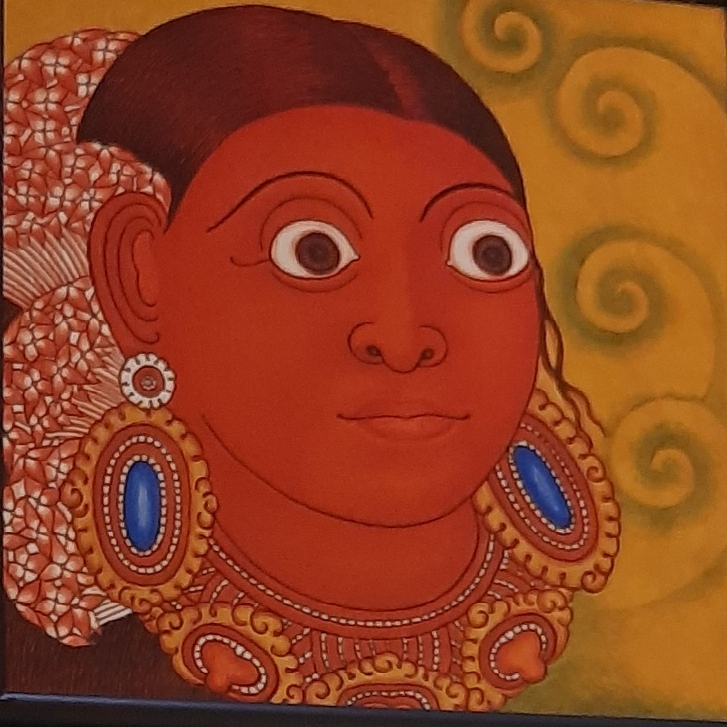
From the Nava Rasas series by Suresh Muthukulam

Our faces and bodies undoubtedly have a role not only in communicating but also in creating and maintaining our feelings. The facial expression is an arrangement of the face, which like a word in a language takes its meaning when seen in the larger context, that is, when attached to a particular body, that of the person who is saying and doing particular things in a particular context. Hence we sometimes feel that even though a person was smiling, their body language (closed fists, tense stance etc.) revealed not quite the same emotion.  

Other scientists who have studied how emotions are expressed in language have found that there is much greater variance in the linguistic use of words that express different emotions, and that there is a great deal of nuance in use of these words in different cultures. Some languages have a wide range of words that express not just the basic emotion but the finer sensitivities of that emotion. 

Take Anger. The English language itself has more than one word for anger-related emotions. In addition to ‘anger’, there are ‘ire’, ‘wrath’, ‘fury’, ‘vengeance’, ‘hatred’, ‘frustration’, ‘resentment’, ‘rage’, ‘bile’, ‘irritation’ and many more. Samuel Johnson’s 1755 dictionary provided an interconnected web of definitions. ‘Fury’ was, first, ‘madness’, and secondly ‘Rage; passion of anger; tumult of mind approaching to madness’. In its turn ‘rage’ meant ‘violent anger, vehement fury’, while ‘anger’ was defined with a quotation from John Locke, as ‘uneasiness or discomposure of the mind, upon the receipt of any injury, with a present purpose of revenge’. Some authors in the eighteenth century, including the Scottish philosopher Thomas Reid, used ‘resentment’ rather than ‘anger’ as their favoured term for a strong and vengeful frame of mind.

Anger seems to have become the predominant emotion of our times. The media leads us to believe that we live in ‘an age of anger’. The anger, in all the definitions, manifests at all levels, from national and international states of war, to civil and social unrest that flares up in violence, to anger at the way systems work (or don’t work), and anger within our closest circles of family and friends. We spend more of ourselves in this emotional state than any other. 

Interestingly, the English language also has a wide repertoire of idioms to help express the degree of anger that we feel. So much more fun that simply saying “I am so angry!”

Here is a sample to choose from:

Hot under the collar.

Up in arms.

Foaming at the mouth.

Steamed up.

Fit to be tied.

Bent out of shape.

Doing a slow burn.

Seeing red.

Ticked off.

Hit the roof.

Go up the wall.

Go off the deep end.

Fly off the handle.

He was angrier than a one armed paper hanger.

Blow one’s top.

Drive me up the wall.

That made my blood boil!

Blow a gasket.

Screaming bloody murder.

Go ballistic.

Would it not be even more interesting to compile anger words and idioms in all our Indian languages? 

“Anybody can become angry — that is easy, but to be angry with the right person and to the right degree and at the right time and for the right purpose, and in the right way — that is not within everybody’s power and is not easy.” Aristotle 

–Mamata

“Politically Correct” Childhood

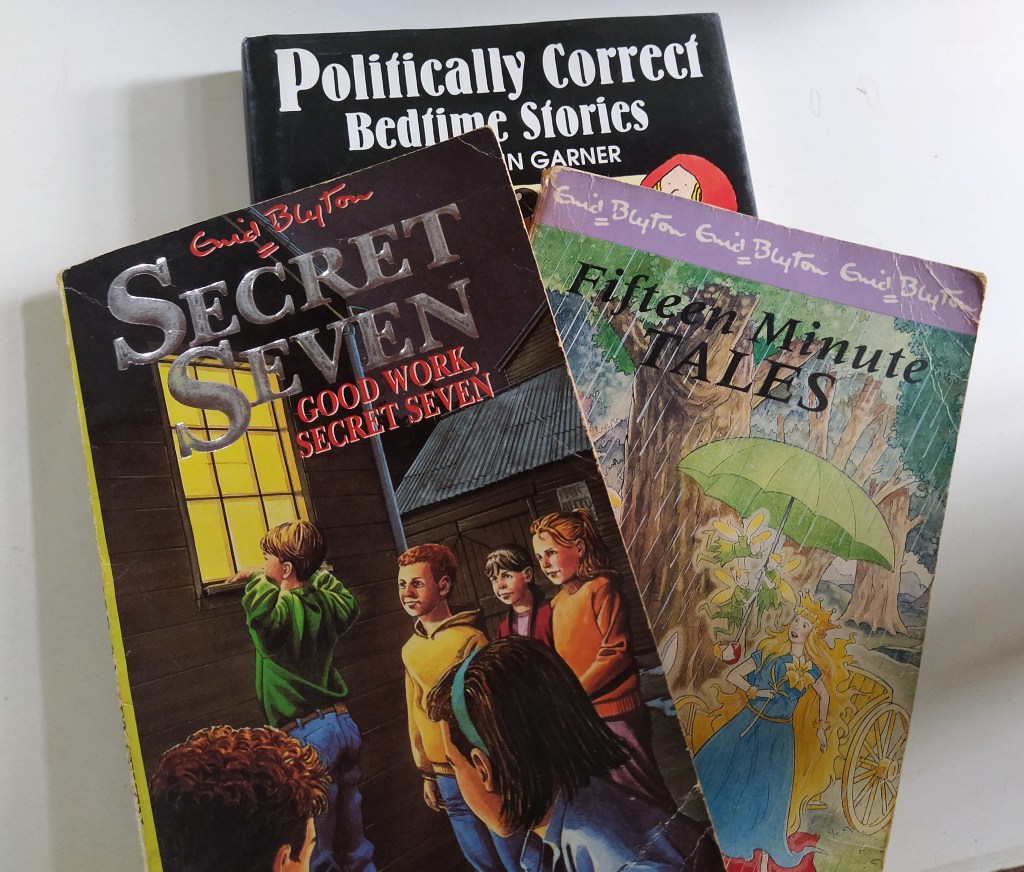
So yet another well-loved children’s author is under the microscope for historical sins of omission and commission. This time it is Enid Blyton whose books at least two generations of children have grown up with. The charges against her are that her books are racist and xenophobic. While this has been raised in England in the context of the Blue Plaque outside the house that she lived in, it is curious how many articles this news has generated in India—perhaps many more than in England itself. And it is interesting to note that most of these pieces are by possibly members of the generation read her books in the 1960s and 1970s. I am one of those, and the flurry that the news has created led me to also think about how different our childhood was as compared with that of children today.

It was a time when we as children were pretty much left to our devices when it came to free-time activities. This was in the ancient pre-digital era; the only audio visual diversion was a couple of hours of family television watching. Our main pastime was reading and reading and reading. And at a time when there was relatively little exclusive publishing for children, our choices were the colourful and well-illustrated Russian books, and the limited “western” authors and titles. Access to these books was through libraries, and the once or twice a year parental gifts, and gifts from friends on birthdays, plus a lot of borrowing and exchanging between friends.

While our parents did not scrutinize nor control our choice of books, they provided a supportive environment for learning about the world, not just through books, but by nurturing values of openness, tolerance of differences, and celebration of diversity. 

I do not remember what brought Enid Blyton into our home, but it was certainly not our parents. It must have been through our friends and classmates that at some point we were introduced to the seemingly endless selection of characters and adventures that changed, and grew, as did we. Growing up in middle class Indian families, even as we lived our (not very adventurous) day-to-day lives–going to school, playing simple but happy indoor and outdoor games, we devoured the stories of children named Georgina, Darrel, Alicia, Gwendoline and Belinda. These children had picnics with hampers full of goodies; they had midnight feasts of scones with clotted cream, eclairs, scotch eggs, and ginger beer; and they roamed the English countryside, visiting castles, having adventures, and solving mysteries through deciphering clues. Somehow we did not find all this “alien” in any way, nor did we yearn for macaroons and meringues. These were stories that we spent all our free time reading, but they were simply that–stories. And they did what all good stories do–they led us to imagine what life was like in places other than ours—different landscapes and climate, different food and clothes, different lifestyles and occupations. In many ways they opened up the world for us; led us to understand that the world was made up of different cultures and customs. At the same time the stories also struck a chord of familiarity and empathy. The names were not like ours, but the characters were like people that we knew—the good friend, the bully, the snitch, the attention-hogger, the teacher’s pet; the teacher we all loved, and the one that we certainly did not! The emotions that they experienced were like ours—uncertainty, nervousness, excitement, jealousy, fights between friends, a sense of adventure and achievement, and pure naughty fun.

And those responses are not time bound. A sixth class child who read a few Enid Blyton books as recently as five years ago, commented about the characters: “They do things. They don’t sit at home watching television and playing on the i-pad like we do.” She added that because the children met freely in the holidays, they didn’t have to rely on parents to co-ordinate classes or times and places to meet (play-dates)”. Indeed every child can relate to the simple joys of doing having unsupervised fun with friends,

Did we consciously notice that there was a black character in one of the books, or that a girl who was a “tomboy” was named George, or that the French teacher in another set of books was subtly pictured as being “not quite British?” Did this leave such a lasting impression on our young minds that we grew up to become racist, sexist, or xenophobic? Did all the strange, but delicious, sounding foreign foods lead us to turn up our noses at the familiar fare that was on our plates? I think that these elements were just part of what we knew was a story. We did sometimes wish that we could go to a boarding school, or spend our summer holidays travelling in a caravan and exploring coves and caves. But those fantasies livened up our imagination and, indeed, increased our vocabulary.

Much has changed in the decades since my generation were nourished (or malnourished, as is now assumed) on such books. My own children, growing up in the early 1990s had a wider menu of choices than I had. And as a parent who was keenly interested in children’s literature, while I facilitated their introduction to more authors that were starting to be available, I did not restrain them from exploring and tasting new flavours on their own. By the time they reached Harry Potter, I did not have the energy nor inclination to be carried away on its blockbuster popularity. But I did strive to give them an upbringing that encouraged opportunities to learn from both fact and fiction, theory as well as practise.

Times have changed so much now. There is the access, literally at one’s fingertips, to literature from around the world, along with a great jump in publishing books with an Indian context, real issues and credible characters. And there is the quantum leap from the print medium to the entire new digital universe with e-books and audio-visual experiences. Children are living so deeply in a virtual world, they have serious problems relating to the real world. At one level parents have become overly conscious about the books their children read (they must be class, caste, gender, profession etc. etc. sensitive). On the other hand they cannot entirely control the insidious reach and power of the virtual world with just as many stereotypes, glorification of violence, latent marketing of products, and blatant push for consumerism.

Children are not so sheltered nowadays that they are not aware of issues, inequalities and unfairness of life, and their attitude to all these is not simply the reflection of something that they have read in a storybook. It is here that parents, and not books, need to be responsible. Responsible not for playing censor, nor for pushing their children into every possible opportunity and exposure to all that they deem “good”, but for giving their children the time and space to learn about the world that they live in, and set examples of how to negotiate it.

It is not “politically correct” books that will automatically create more sensitive readers, but sensible and sensitive parents and teachers who can support and nurture children to be good human beings.

–Mamata