Ada Lovelace: STEM Pioneer

Every Wednesday my newspaper carries a special page about Tech news which has stories about young techies, and especially about women who have made a mark in the field of computer technology. In recent years, there has been a lot of discussion about encouraging girls to engage with STEM, and inspiring stories about women in the 20th and 21st century who have excelled in these fields.

Not many can imagine that one of the pioneers of computing science was born over two hundred years earlier, and that she was a woman! This was Ada Lovelace, a computing visionary who recognised the immense potential of computers. Augusta Ada Byron was born in London on 10 December1815. She was the only child of George Gordon or Lord Byron, the brilliant but eccentric English poet, and Annabella Milbanke, a highly intelligent and educated woman with a flair for mathematics. 

The marriage between the poet Bryon and the “princess of parallelograms” as he called his wife, was tempestuous and short. A month after Ada’s birth, Annabella Byron moved their daughter out of their London house, and away from Lord Byron’s influence. Annabella was afraid that Ada would inherit her father’s ‘poetic’ temperament and erratic traits, and kept her daughter away from the “imaginative” arts, bringing her up in a strict regimen of science, logic and mathematics, as well as music.

Ada’s father Lord Byron himself left Britain forever when Ada was a baby, and he died in Greece when Ada was eight years old. Ada never knew him. Ada herself was largely brought up by her maternal grandmother and servants, and educated by private tutors. She suffered long spells of bad health right from childhood, and through her life.

Ada was fascinated with machines from an early age and devoured the scientific magazines of that time. But she was equally imbued with her father’s imagination. When she was twelve years old, Ada wanted to fly. But she did not stop at dreaming; she methodically studied birds and feathers and experimented with different materials that could serve as wings, and even wrote an illustrated guide recording her research, called ‘Flyology’. She was reprimanded by her mother who saw this as a fanciful project.

In 1833 Ada, as a debutante to London’s high society, attended a party where she was introduced to Charles Babbage who was a renowned mathematician. Babbage spoke to her about his new invention–a tower of numbered wheels that could make reliable calculations with the turn of a handle. He called this the “Difference Machine”. A few days later, Lady Byron took Ada to his home to see him demonstrate the device in his drawing room. Ada was very intrigued by the incomplete prototype. She initiated a correspondence with Babbage about its potential, and her own mathematical studies. This was the beginning of a close and lifelong friendship. Babbage was then a 40-year-old widower and Ada a young debutante, both with very divergent personalities, but the two corresponded and exchanged ideas for many years. Babbage recognised, and encouraged, her potential; in 1839 he wrote to her “I think your taste for mathematics is so decided that it ought not to be checked”.

Babbage spoke highly of Ada’s mathematical powers, and of her peculiar capability, which he described as being higher than that of any one he knew. On one occasion he called her “The Enchantress of Numbers”.

At the age of 19 Ada was married to an aristocrat, William King; and they had three children. In 1838 William King was made Earl of Lovelace, and his wife Ada became Lady Ada King, Countess of Lovelace. But she became generally known as Ada Lovelace.

Along with being a wife and mother Ada continued her independent pursuit of mathematical knowledge. She became friends with one of the finest female mathematicians of her time, Mary Somerville, who discussed modern mathematics with her, set her higher-level mathematics problems, and talked in detail about Charles Babbage’s difference engine. In 1841 she was given advanced work by Professor Augustus De Morgan of University College London. She also continued to learn advanced mathematics through correspondence with Mary Somerville. All the time, she kept Babbage’s difference engine in mind.

Babbage began a new project that he called the “Analytical Engine’. He envisaged this as large heavy machine with thousands of cogwheels that could perform more functions with greater accuracy. Ada Lovelace served as the key interpreter of the project. On a trip to Turin to promote his work, which required considerable financial support, Babbage met a mathematician named Luigi Federico Menabrea, who agreed to write a paper on the machine. It was published in a Swiss academic journal in October, 1842. Ada translated the paper from the French, but also added her own copious and detailed notes, addressing difficult and abstract questions that the paper threw up. While the original paper was about 8000 words, Ada’s annotated English version came to twenty thousand words.

In her paper she clearly described how Babbage’s device would work, with references and illustrations from the silk-weaving Jacquard loom which wove patterns using a set of punched cards which issued instructions to the machine. As she wrote “We may say most aptly that the Analytical Engine weaves algebraic patterns just as the Jacquard loom weaves flowers and leaves”.

She explained how Babbage’s machine could perform a similar function using as sequence of punched cards, or what could be called “machine code”. In her paper, she included the world’s first published computer program, or algorithm – this was the Bernoulli number algorithm, and thereby became what may be considered as the first computer programmer.

Ada Lovelace broke new ground in computing, identifying an entirely new concept. She realized that an analytical engine could go beyond numbers. This was the first ever perception of a modern computer – not just a calculator – but a machine that could go beyond the field of mathematics and contribute to other areas of human endeavour, for example composing music.

Ada’s translation, along with her notes, was published in 1843 with the title “Sketch of the Analytical Engine, with Notes from the Translator”.

Ada Lovelace died of cancer at 36, in 1852. It was more than a hundred years before her notes were discovered, The “Analytical Engine” remained a vision, until Lovelace’s notes became one of the critical documents to inspire Alan Turing’s work on the first modern computers in the 1940s. In 1979, the U.S. Department of Defense named a new computer language “Ada” in her honour.

Today as many more young women enter the field of computer science and technology, it is time to remember Ada Lovelace, a pioneer and path breaker of her time. And to celebrate the power of Imagination. In 1841 she wrote: Imagination is two things: The Combining Faculty which seizes points in common, between subjects having no apparent connection and The Discovering Faculty which penetrates into unseen worlds around us, the worlds of Science.

–Mamata

Pen Friends Through the Years

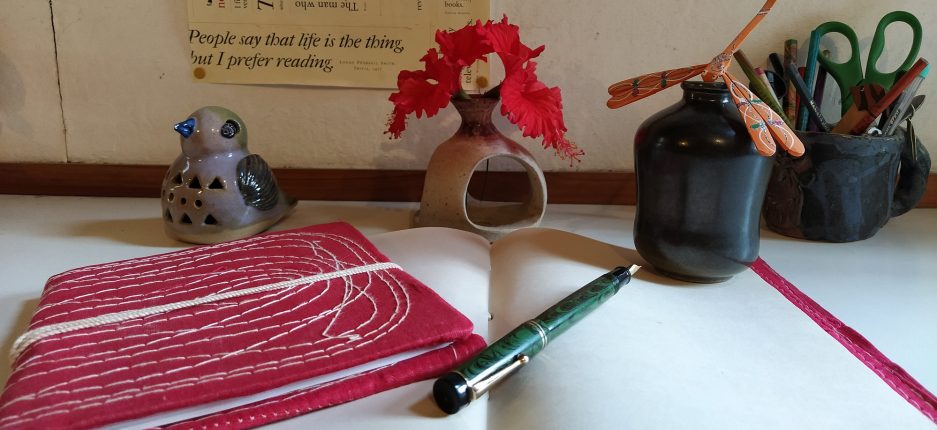
It has been some years now since I used what we called a Fountain pen. All through my schooldays, from the time that we reached the class where we graduated from pencils to pens, the fountain pen was an essential part of our compass box. The pens had a number of accoutrements—ink bottles (think Quink!), plastic ink fillers, rags of cloth to mop up spills, and sometimes even extra nibs. The ritual of filling (and spilling) the ink was as much a part of the evening routine as packing the schoolbags. The fountain pen was an integral part of life, and being gifted a Parker pen or a Waterman pen by someone who came from abroad was a highlight of that life!

I was surprised to learn recently that until the late 1950s India did not manufacture pens; all pens were imported, as also was ink. It was only after Independence, due to the thrust by the government to encourage domestic production that Indian pen manufacturing companies were set up. By the mid-1960s there were 12 Indian manufacturers of which Ratnam and Sons, based in Rajamundry were the most famous. It is believed that the Ratnam pen was the first truly ‘swadeshi’ pen. The story goes that when Gandhi had just launched the Swadeshi movement, he met KV Ratnam in 1921, and advised him to make a product using solely Indian components. When Ratnam asked him what he should make Gandhi said that he could make anything, from a pin to a pen. And Ratnam chose the pen! After studying the intricacies of a fountain pen, Ratnam set about meeting Gandhi’s mandate to make a truly ‘Indian’ pen. After several years of experimenting with local materials and technology, he finally developed one in 1933 and sent it to Gandhiji. Gandhiji was not fully convinced. He sent one of his secretaries to the Ratnam factory to confirm that no imported element was used in the product. It was in 1935 that Gandhiji was satisfied, and he started using the Ratnam pen, which he continued to do till his death in 1948.

For years ink-stained fingertips were the sign of a prolific writer, or a leaky pen! It was to address the issue of leaking ink that in other parts of the world, the path to the invention of what came to be called the ballpoint pen were already underway. The international history of the transition from the fountain pen to the ball pen is interesting.

The first patent for this kind of pen was obtained by an American lawyer John J Loud in 1888. Loud wanted an ink pen which would be able to write on rougher materials such as wood and leather, as well as paper. He experimented with, and developed a pen with a revolving steel ball, which was held in place by a socket—literally a pen with a ball point. Loud’s pen was indeed able to write on leather and wood, but it was too rough for paper. The device was deemed to have no commercial value and the patent eventually lapsed. But inventors continued to experiment with variations on the ball point.

One of these was a Hungarian-Argentinian journalist named László Biro who was frustrated with the leaky pens that he had to use in large numbers. László had realised that the ink used in fountain pens was too slow to dry; what was needed was something more like the quick-drying ink used on newspapers. In his quest for a more suitable ink he turned to his brother, Győrgy, a dentist who was also a talented chemist. Győrgy came up with a viscous ink which spread easily but dried quickly. After a number of trials, the brothers filed a patent, in 1943, for the ballpoint pen. Their pen was originally called a ‘Birome’ but became popularly known as a biro (an example of an eponym!) The pen became an instant hit. The Biro brothers sold their patent to Bic. And Bic pens are known all over the world even today. The ballpoint pen revolutionized the act of writing. Where the fountain pen needed a fixed place for writing where the accompaniments like the inkpot could be kept, the ballpoint pen led to great mobility and flexibility; it could be carried and used anywhere and anytime..

By the time I graduated from school to college, the trend in India had also moved from fountain pens to what we then called ballpoint pens, that later became the ubiquitous ball pens. At the time relatives coming from abroad used to bring Bic pens as gifts, although Milton Reynolds an American entrepreneur had introduced ballpoint pens in India in 1947. While Rajamundari was the cradle of the indigenous fountain pen, it was in Rajkot in Gujarat that the first Indian ballpoint inks and pens were manufactured. It was only in 1962 that Dhirajlal Joshi, after a lot of struggle, got approval to make ballpoint pen ink in India. There were hiccups in terms of quality of ink, nibs etc. but by the 1970s these had been smoothened and many pen manufacturing partnerships were set up, including with countries like Japan and Germany.

From Ratnam pen to Space pen–I value them all!

In the last two decades the market has been flooded with a great variety of pens, transitioning from pens with refills, to use-and-throw gel pens. There is even a Space Pen that is able to write in zero gravity and works upside down, under water, over grease and in extreme temperatures. Today fountain pens have become collector’s items or status symbols. Ink fillers, ink bottles and ink stained rags may soon be seen only in museums. Even refills for ball point pens are not easily available at my local stationary shop, as I painfully steel myself to throw away gel pens when they run out. These are perhaps manifestations of a time, which is almost upon us, when pens themselves, in any form, become redundant in an age of digital technology.

I have, all my life, loved writing by hand, and pens have been an integral part of that process of writing; each transition in the type of pen that I have used, marking also a different phase in my life. Pens gifted with love, pens picked up as souvenirs, pens handed out at meetings and conferences, and pens chosen and bought from stationary shops, and more…I have kept them all. These are my valued pen friends even today.  

–Mamata

Eponyms: When People Become Things

As I wrote last week the evolution of language involves multiple inputs and processes. ‘Clipped’ words often overtake their original abbreviations to take on their own identities. At times, the process goes the other way and words become elongated by being ‘topped’ and ‘tailed’ by other words to gain new meaning and identity.

Place names become words. So when you laugh at a ‘limerick’, drive a ‘limousine’, have a pet ‘alsatian’ or ‘labrador’, play ‘badminton’ or ‘rugby’ or run a ‘marathon’, you are in fact invoking the name of a place that has become synonymous with the object or activity.

Place names may also become easily identifiable product names; as in drinks—Martini, Cognac, Bourbon; or food as in Hamburgers and Frankfurters. 

It is not just names of places but also names of people that have become words in their own right. Today when we use the words, we immediately visualize the object, without having the faintest idea that there was a person that originally gave his or her  name to the thing.

For example the cardigan was named after James Brudenell, 7th Earl of Cardigan, a British Army major general who led the Charge of the Light Brigade at the Battle of Balaclava during the Crimean War. The woollen garment is modelled after the close-fitting knitted wool waistcoat that British officers supposedly wore during the war. The macintosh (or the Englishman’s ubiquitous waterproof coat) was named for Charles Macintosh who invented the waterproofing process that was used in the material for these raincoats. The sandwich is named for an 18th century English aristocrat, the 4th Earl of Sandwich who, as the story goes, ordered his valet to bring him a piece of meat tucked between two slices of bread, so that he would not have to get up from the gambling table for a formal meal.

Perhaps the more commonly known eponyms are the botanical names of plants, many being named after their discoverers. An interesting double link is to be found in the word Nicotine which is named after the tobacco plant Nicotiana tabacum. The botanical name of the plant is derived from the name of the French ambassador Jean Nicot de Villemain, who when visiting Portugal, sent tobacco and seeds to Paris in 1560, presented it to the French King, as something that had medicinal value and protected against illness.

We may not be aware that many other terms in science and technology also reflect the names of their inventors. .

The diesel that powers our vehicles and machines is named after its German inventor-engineer Rudolph Diesel. The ampere is named for French physicist and mathematician André-Marie Ampère (1775–1836), who studied electromagnetism and laid the foundation of electrodynamics. Celsius is named after Swedish astronomer Anders Celsius who first proposed the centigrade scale in 1742, and Fahrenheit is named for the physicist Gabriel Daniel Fahrenheit. The ohm (symbol: Ω) is the SI derived unit of electrical resistance, is named after its discoverer German physicist Georg Ohm. And the more familiar term watt, a unit of electrical power, is named after the Scottish engineer and inventor James Watt.

Similarly in medicine a condition originally named after the doctor who first described it, becomes over time, a noun for the condition. Alzheimer’s disease is named after Dr Alois Alzheimer a German psychiatrist and neurologist who first analysed the brain of a woman who had an unusual mental condition and studied the changes in the brain that caused the issues. Similarly Parkinson’s disease is named after Dr James Parkinson who described the condition in 1817. Today it is commonplace to describe a patient suffering from these diseases as simply having Alzheimers or Parkinsons.

All these are examples of eponyms. An eponym is a person, place, or thing after whom or which someone or something is, or is believed to be, named.

There is one other form of eponym. These are words that were initially the name of a particular brand but now are used to reference entire categories of things. One of the most popular eponyms is a band-aid. While band-aid is the name of the brand that makes adhesive bandages, most people use the term to refer to any adhesive bandage, regardless of who makes it. In India at one time Cadbury was the eponym for any chocolate!

And then there is the world of high fashion where people wear Dior, spray Chanel, carry Prada, and travel with Louis Vuitton! Bata is eponymous in India with sturdy, reasonably priced footwear, and generally thought of as a truly India brand. It is interesting that, in fact, the brand was named after Tomas Bat’a who along with his brothers started a family owned business in Czechoslovakia in 1894 to produce sturdy and affordable shoes.. However, I have not met anyone who proudly says “I am the proud owner of a Bata!”

–Mamata

Stories: The Magic Wand

This week saw children making the headlines. November 14 is celebrated as Children’s Day in India, to mark the birthday of India’s first Prime Minster Jawaharlal Nehru. The day is marked by events that engage children in activities dear to them—of which playing and stories remain all-time favourites.

This year the Gujarat government has recognised the immense value of stories for children and has declared that 15 November will be celebrated as Children’s Stories Day or Balvarta Din.

15 November marks the birth anniversary of Gijubhai Badheka, one of Gujarat’s best known children’s storytellers and educationists, who had been called the Brahma of Children’s Literature. In Gujarat his name is synonymous with a rich treasure of stories for children. Generations of children have grown up with these tales, told and retold by parents and grandparents.

Born in 1885 Gijubhai started his professional life as a Pleader in a district court. In the early 1920s he got deeply involved in the upbringing of his own son. Under the influence of the thinking of Madam Montessori he started experiments in child-centred education, when he joined the Dakshinamurti educational institutions in Bhavnagar. His vision and passion for experimenting in his field led to the setting up of the Dakshinamurti Balmandir—a pre-primary school in 1920. It is in the early says of his interactions with the children here that he realised the importance of stories for children as a means of learning. He started collecting stories for children, writing them, and telling them. He believed that stories were the magic wand that transformed children in many ways.

There was, at that time, not much literature in Gujarati which was specifically written for children. It was Gijubhai who established the child as an individual, and created a special space, and resources for the child, in literature.

As he wrote in his seminal work in Gujarati, on the art and craft of stories titled Vaarta nu Shastra: By calling a story a children’s story does not make it one. Children’s stories are those that children get a special type of enjoyment from. Children like short and simple stories. Reflections of what happens around them, behaviour of birds and animals, small rhymes that can be easily remembered and repeated—these are the characteristics of children’s stories.

But at the time there were no stories available that would fit this bill. Gijubhai delved   into the treasure chest of folk literature. He asked all the teachers and teacher trainees of Dakshinamurti to start collecting folk stories that were still being told in homes, in villages, and in fields, and pick those that would be suitable for children.

As he wrote in Vaarta nu Shastra “If you seek folk literature you will have to leave the city and go to the villages, and from villages, move into the forests and fields. When the toothless grandmother finishes her chores, and rubbing tobacco on her gums, starts to tell stories to the gaggle of children, there springs the magic of folk tales. You will find folk literature in every village chaupal; children will be spreading it freely from galli to galli, and grandmothers will be distributing the prasad in their homes.

Gijubhai and his colleagues went out as seekers of stories and returned with a rich repertoire of tales, songs, rhymes, riddles and sayings. He then retold these for children with his characteristic short sentences, word play, rhyme and dialogues.

And so every morning he told the children a story. In the afternoon the children would enact the stories. Soon they became so adept that they did not need to memorise the words; the rhymes flowed naturally and if they forgot in between, they made up the words as they went along. As he wrote: If you collect a group of children and tell them a story, they will tell you ten more.

Gijubhai’s search for folk tales crossed the boundaries of language and country. He explored and discovered gems in the literature of different countries, and found incredible variety, as well as similarities. He localised and transformed these stories so that they were steeped in the sounds and colours of Gujarat, and over time they became not only Gujarati but uniquely ‘Gijubhai’s stories’.

Gijubhai’s stories are simply told tales with a mixture of prose and rhyme. There is a lot of dialogue and reiteration. The repetition of rhymes makes for lively storytelling in  which listeners can also join in. Many stories follow a sequence of cause and effect, leading to a chain reaction which is reinforced in verse. Children love the repetitive rhymes. Several stories have improbable characters and plots. Children love the absurd, fanciful and nonsensical.

Gijubhai told delightful tales of familiar animals and birds. In many, the animals talk and act in human ways while also reflecting each animals typical characteristics. The stories reflect a deep symbiotic relationship between animals and people with the two often trying to outwit each other. With equal panache Gijubhai told stories of common folk with common trades (tailor, potter, barber, shopkeeper), as well as kings, queens and princesses.  The characters reflect basic human traits—greed, envy, proving physical or mental prowess. Many stories follow the classic fairy tale style, opening with ‘once upon a time’ and ending with ‘happily ever after’. They capture the rustic flavour and pace of the days when travel meant walking from one village to another, and long-distance meant a bullock cart journey; and many encounters and adventures happened en route.

Several generations and a hundred years later, children today may not relate as closely to the settings and the pace of the narrative, and yet, the quirks and foibles of the characters; the silly and the absurd, the funny and the fantastic still touch a cord in the child, and indeed in the child in every one of us.

The initiative to celebrate Gijubhai and his stories by designating a Children’s Stories Day is a welcome one. In a time when children are so hooked into the digital world, perhaps even adults need to be reminded of the simple joys of storytelling. In the words of Gijubhai:

To My Fellow Storytellers

Here are the stories. Tell these to your children. They will listen with ardour and joy, over and over again. Remember, tell these stories beautifully; tell them as stories should be told—tell them with involvement. Read them out if you like. Choose a story that will suit your children’s age and interest.

Don’t tell the stories to bestow knowledge; don’t tell the stories as an objective narrator. Immerse yourself in the stories and take your children with you into the total experience.

You will discover that stories are a magic wand. If you want to build a bond with your children, start with stories.

–Mamata

Winning Words

Language is always evolving. While some words have a history that can be traced back over centuries, new terms and new uses for terms also continue to emerge, and over time find their place in dictionaries. Much of the new vocabulary in 21st century English reflects major social changes and events that have taken place in the real world. New editions of dictionaries have included expressions such as social media, congestion charge, designer baby, flash mob, toxic debt, WMDs (weapons of mass destruction) and wardrobe malfunction.

The major English language dictionaries have an elaborate process of keeping track of new words and their usage, and based on the studies and statistics, announce the winning word or words of the year.

This is the time of the year when Words of the Year are declared by the leading dictionaries. This is the outcome of a process that reviews the ‘usage evidence’ of certain words during the year. The selection of the word/words reflect, as the Oxford English Dictionary explains “the ethos, mood or preoccupations” of the preceding year, while also having “potential as a term of lasting cultural significance.”

It was thus no surprise that the words of the year 2020 were those that dominated the lives and pre-occupations of people around the world. These included Pandemic, Quarantine and Lockdown. These words moved beyond the English language and became part of a universal vocabulary.

A natural progression from these led to the word that has been declared as the Word of the Year 2021 by the Oxford English Dictionary. The winning word is Vax.

The word first appeared as a noun in the 1980s to mean either vaccine or vaccination. But it in this year, that the small but pithy word has been used in so many ways: to denote status—‘vaxed’ ‘double vaxed’ or not ‘vaxed’; attitude—‘vaxers’ vs ‘anti vaxers’, and events—vaxathons, and vaxxies (vaccination selfies!)

In keeping with the trend of abbreviations which pack a punch of meaning, the Merrian Webster dictionary has released its list of new words added to the dictionary in 2021 that reflects the use of language in the age of online communication. Among the words in this category are:

TBH: an abbreviation for “to be honest.” 

Amirite: slang used in writing for “am I right” to represent or imitate the use of this phrase as a tag question in informal speech. An example: “English spelling is consistently inconsistent, amirite?”

FTW: an abbreviation for “for the win” used especially to express approval or support. In social media, FTW is often used to acknowledge a clever or funny response to a question or meme.

And of course these words are the staple of the vocabulary of  the Digital Nomads—a term used to describe persons who perform their occupation entirely over the Internet while traveling; especially if such a person has no permanent fixed home address.

The acceptance of abbreviations as official words that find their place in dictionaries is not a new trend in the English language. In the late 1600s it was linguistically fashionable to shorten words. For example people said ‘pos’ or ‘pozz’ for positive, meaning ‘that’s certain’ or ‘incog’ for incognito in casual speech. Words which were reduced in size in this way were called ‘clippings’. Common examples of words where the ends were ‘clipped’ were ad, doc and prof. Among the words where the beginning was clipped were phone and burger; and words where both the beginning and the end were clipped included flu and fridge. What started as informal usage became the acceptable use, and the full forms were almost forgotten over time; think of fax, memo, exam, vet, pub and bus! And not to forget the Bots whose mechanical messages have all but replaced human voices.

Perhaps the ‘clipped’ word that has dominated the past few decades as much as the word ‘vax’ may do in this decade is ‘app’.

The idea of an ‘application’, a computer function designed to meet specific user requirement had been around since the 1960s. But it was in 1985 that a writer in a trade magazine used the abbreviation ‘apps’ to denote ‘for applications’. The short form immediately caught on. It was ‘phonetically appealing, a short, perky syllable, that seemed to suit the exciting quick fire developments in digital communication of the time.’

Following this came the idea of a ‘killer app’—a function which in the dreams of the multimedia industry, would be so appealing that people would not be able to do without it.

I am not sure if ‘app’ was ever voted the word of the year, but this is one word that has surpassed the boundaries of the English language; it continues to be on everyone’s lips, and fingertips! 

–Mamata

Spark a Match, Light a Lamp

A recent news item caught my eye. It said that the price of a matchbox is to go up after 14 years. And what is the price hike? A whole rupee more—from Rs 1/- to Rs 2/-! The last time the price was revised was in 2007 when the rate went up from 50 paise for a matchbox to Rs1/-. In a time when prices of foodstuff and fuel are in the ‘hundreds’ range, and spiralling every day, it is unbelievable that there is even an item in the market that costs as little as Rs 2/-

Yes, this is the ubiquitous, but not really noticed, little box that we need so many times a day, for so many uses—a matchbox.

The early history of the matchbox, as we know it, in India is not well documented. It appears that one of the early indigenous match manufacturers in India was the Gujarat Islam Match Factory founded in 1895 in Ahmedabad. However there was no commercially successful manufacture of matches in the country till 1921. In fact before World War 1 most of India’s matches were imported, mainly from Sweden, Austria and Japan. In the early 1900s, about half of the total imports of matches came from Japan. After World War I there was a struggle for supremacy in the Indian matchbox market between the Japanese and the Swedish who were represented by the Swedish Match Company

Around the same period some Japanese immigrants settled in Calcutta and began manufacturing matches. The locals also picked up the skills and small match factories came up in and around Calcutta. Following World War I, many manufacturers migrated to the state of Tamil Nadu where the climate was dry, labour was cheap, and raw materials were easily available. Starting as small family-based units, match-making continued as a mainly small-scale cottage industry, but over time, expanded into a booming industry. Today, the Match Kings of South India as they are called, supply the bulk of the country’s matchbox needs, employing around four lakh people, directly or indirectly, of which 90% are women. Sivakasi of the fireworks manufacturing fame is also the home of match production. Fourteen raw materials are needed to make matchsticks and matchboxes, including red phosphorus, potassium chlorate, and sulphur as well as wax, paper board, and splints.

In 1950 a matchbox cost 5 Paise, in 1980 it went up to 25 paise, in 1994 to 50 paise, and in 2008 to Rs 1/-. Considering that the cost of all the raw materials has increased manifold, the matchbox seems to have defied all laws of inflation!

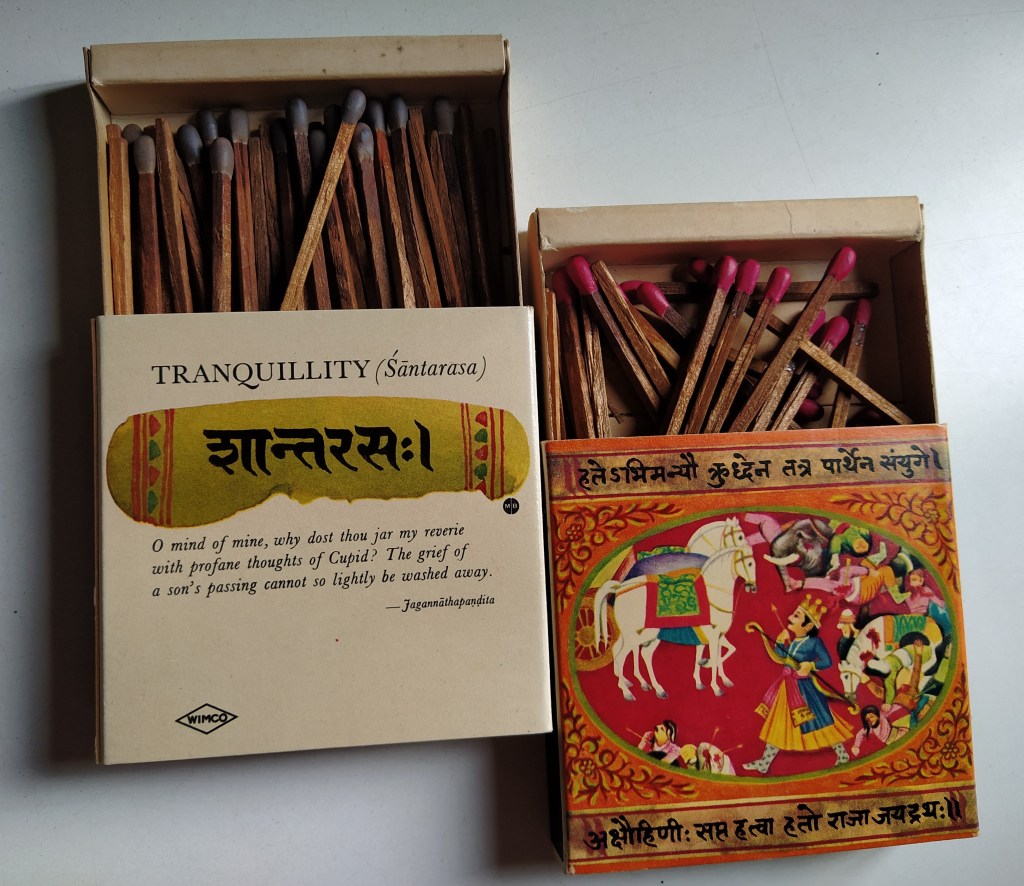
While the economics of the industry is about numbers, the labels of the matchboxes reveal fascinating facets of history and culture. These are the aspects that fascinate matchbox collectors or phillumenists as they are called. It is from their collections that that many interesting stories emerge.

Some early matchbox labels which bore the sign Made in Sweden had pictures of Mughal emperors on the labels. It is believed that the royal family of Bhavnagar in Gujarat commissioned a special matchbox for their personal use during British rule.

During the freedom movement Swadeshi matchboxes appeared in the market, carrying slogans (in different Indian languages) extolling boycott of foreign goods and promoting swadeshi. These were often confiscated by the British. India’s independence was celebrated with matchbox labels carrying the tricolour, and pictures of people who had played a role in the struggle for independence. In the 1960s, popular matchbox labels included pictures of ‘matinee idols’ of the day—popular film stars, as well as a number of sports superstars. Matchbox labels have also carried pictures of brands like Pepsi, Fanta, Thums Up, Pan Parag, Frooti, Parle, Nescafe, Vat 69, Kitkat, Complan, Amul, Lux, as well as of TVs, cameras and computers (most likely not with permission from the companies, but definitely free publicity for them!) to name a few.

A souvenir of my phillumeny phase

Phillumeny or the hobby of collecting different match-related items: matchboxes, matchbox labels, matchbooks, match covers, etc. has its own band of aficionados, perhaps not as large as stamp or coin collectors. I went through a brief period of phillumeny in my college days. In the days when smoking in public places was not taboo, restaurants and hotels had interesting matchbooks, and for us these were great souvenirs of places visited, and memorable events!

Economics and commerce, history and culture–the matchbox has its little niche in many subjects. But perhaps the most innovative use of the matchbox has been in the teaching of basic science. In the words of Arvind Gupta one of India’s pioneering simple science educators who has used the matchbox in an amazing number of ways:  In the seventies a pioneering science programme in India attempted to revitalize the learning of science in village schools which had no science labs. The shift was from the chalk-and-talk method to hands-on, on making things with simple humble material available in the village. The hunt was on for low-cost, locally available very affordable things to do science.

The matchbox surprisingly emerged as a STAR. Being mass produced in a factory the matchbox confirmed to certain standard dimensions. The length of the matchbox is very close to 5-cm (2- inches) – a very good estimate of length. You could put six matchboxes back-to-back to make 30-cm (1-foot). The weight of the new matchbox was very close to 10-gms. Ten new matchsticks (not burnt) weight about 1-gm and the weight of a single matchstick is very close to 0.1-gm! Paint the matchbox drawer with some oil to make it water proof. Fill it with water and the drawer holds roughly 20-ml of water. Pour out 5 drawers of water in a bottle to make 100-ml. The humble matchbox becomes a good measure for volume. So, using a universally available matchbox, children could get a good feel of length, weight and volume – all very basic entities of any science curriculum!

How many things can you fit in a matchbox? 20…. 30…. 100? This exercise was given to children many years back. One child actually managed to pack in a whopping 250 things inside a matchbox! Just look around for small minute things – a mustard seed, hair, thread, cumin, moong dal etc. While doing this project children searched for the smallest artifacts in their vicinity and they came up with surprises which are difficult to imagine! They really had a good peep in the world of small things! Science is all about keeping our eyes open and looking at similarities, forms, patterns in the world around us. Science in short, is the discovery of order.

Source:  https://www.arvindguptatoys.com/arvindgupta/DH-AG-MATCHBOX.pdf

As our markets and homes get flooded with numerous new gadgets and geegaws, we tend to forget some of the simplest but most versatile household items. As we celebrate the festival of lights let us give thanks for the small things that make our life better and easier. Let us spark a match and light a lamp.

Happy Diwali!

–Mamata

Devil’s Tree

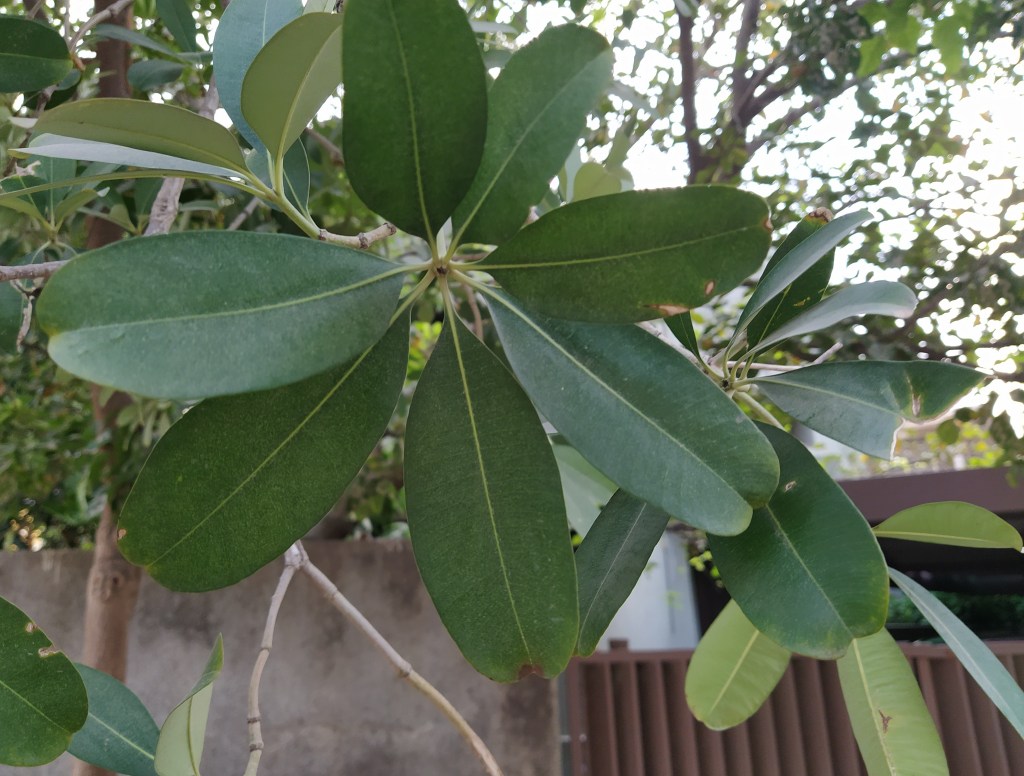
As we go for our walk nowadays, the early October mornings are filled with a heavy sweet fragrance. We look up to see the trees that look as if they have been sprinkled with an overnight flurry of snowflakes. The Saptaparni is in bloom!

The Saptaparni is one of the many names of the tree, but one that most literally describes it. It comes from two Sanskrit words—sapta meaning seven, and parni which refers to leaves. The tree is characterised by its pattern of (generally) seven leaves which grow in a whorl attached around a stem. In addition to Saptaparni which the tree is called in Sanskrit as well as in Gujarati, the tree is known by different names in different Indian languages: Marathi – Satvin, Hindi – Shaitanki Jhur, Chatwan, Chatian, Bengali – Chattim, Tamil – Palai, Elilaippala, Malayalam – Palai, Telugu – Edakulapala, and Kannada – Maddale.

One of the English names of the tree–Devil’s Tree–however refers to the beliefs associated with the tree. Folklore in many parts of India associates the tree as one on which the Devil resides. This association is reflected in the local names such as Shaitan, Chaitan, Chattim etc.

Another English name of the tree is Blackboard tree or Scholar tree. This is because in the past the wood of the tree was used to make slates and blackboards. This is also reflected in its botanical name Alstonia scholaris. The generic name Alstonia commemorates the distinguished botanist Professor Charles Alston of Edinburgh, while scholaris is a reference to its traditional use to make wooden slates for students. 

When leaves are plucked the tree yields a milky sap. The sap is toxic, and in large doses the bitter and astringent extract from its bark can be harmful. But the tree is also known to have a number of medicinal uses, especially in traditional medicine. The famous Ayurvedic physician Charaka used a paste of Saptaparna bark, known as Dita Bark, in ointments for chronic skin problems, and in prescriptions for urinary diseases. Another ancient physician and surgeon Sushruta prescribed the drug internally as well as externally in urinary diseases, poisoning, fever, malignant ulcers, leprosy and other virulent skin diseases and fistula. It is said to be useful in heart diseases, asthma, chronic diarrhoea, and to stop bleeding from wounds. The fresh bark juice with milk is said to be administered in leprosy and dyspepsia as well as to treat ulcers. The bark is also used in Homoeopathy for weak digestion, anaemia, low fever often with diarrhoea, dysentery and as a tonic after exhausting fever. The tree has been used in traditional Chinese medicine to treat headache, influenza, malaria, bronchitis and pneumonia.

However it may be named—by form, by folklore, or by use, this indigenous evergreen tree is found in most parts of India. It has a rough greyish bark, and the branches grow evenly around the trunk giving the tree a beautiful form. The whorled pattern of slightly rounded dark green leaves distinguishes it. The tree is transformed in the flowering season, which is between October and December. A night bloomer, the greenish-white flowers grow in ball-shaped clusters and exude a heady fragrance. Perhaps it is this phenomenon that has led to the belief in many tribal communities that the tree is where the devil resides; and thus people avoid sleeping under the tree, or even sitting under it. The belief could also be related to the fact that some people may be allergic to its pollen or fragrance, irritating eyes, or causing breathing problems. This may have led to the association that sleeping under a saptaparni tree could make a person ill.

This tree does not feature as prominently in art and literature as do some others. But the Soptoporni or Chatim (as it is called in Bengali), has an interesting link with Tagore’s Shantiniketan. The story goes that in 1862, Debendranath Tagore (the father of Ravindranath, and a leading figure in the Indian Renaissance) was on a boat journey. As he was passing the village of Bhubandanga, he saw lush green paddy fields bordered by rows of wild date palms and Chatim trees. He decided to step off the boat to rest; and sat in a glade of chatim trees for his evening prayers. He was filled with such a sense of peace and happiness that he bought 20 bighas of land there to set up a spiritual retreat which he named Shantiniketan (the abode of peace). The place with the grove of Chatim trees was named Chatimtala. Later Rabindranath expanded the retreat and its activities and it became the Vishwa Bharati University, but the Chatim trees became a symbol of the origin and spirit of the great institution. This was also demonstrated in the tradition that at the university’s convocation ceremony, every student was given, along with their degree, a whorl of saptaparni leaves. In recent years, supposedly to prevent excessive damage to environment, this presentation has been made symbolic–the vice chancellor of the University accepts one saptaparni leaf from the chancellor on behalf of all the students.

Going back to its other name—Devil’s Tree, there is a lovely folk tale from Madhya Pradesh.

Once upon a time there was shepherd boy who loved to play the flute. Every day as his goats grazed in the hills, the boy sat in the shade of a Chatian tree and played his flute. In the tree lived a fierce spirit or shaitan who scared away anyone who dared to sit in the shade of its tree. But when the spirit heard the boy playing his flute, he could not help being charmed by the melodious music. He would come down from the tree and dance joyfully to the lively tunes. The shaitan and the boy became good friends and passed the days with music and dance.

One day a prince was passing by and he heard the notes of the flute. He was entranced. He asked the boy to play for him every day. He promised that when he became king, he would make the boy his minister. After he left, the shiatan came down from the tree and warned the boy not to believe rich people who made false promises. But the young and innocent boy was taken in. The prince came every day and the boy entertained him with his music. The shaitan was upset and refused to come down from the tree anymore.

Time passed; the king died and the prince ascended the throne. The shepherd boy was excited; he went to the palace to meet his friend who was now the king. But young king refused to recognise his old friend and drove him away. Heartbroken, the boy returned to the hills and sat dejectedly under the Chatian tree, not even able to play his flute. The shaitan was concerned. He came down and the boy told him his sad saga. The Shaitan was enraged; he put a curse on the king which transformed him into an ugly monster. The palace announced a reward for whoever could break the spell. The shaitan was delighted that he had taught the king a lesson, but the kind hearted boy was very upset and said that he would not play the flute until the shaitan had taken away his spell. Finally the shaitan relented. He told the boy to go to the palace with a branch of the chatian tree, and wave it three times in front of the king, with the words “the spirit of the chatian tree release you from their magic”. This time the boy was allowed in, and he did as the shaitan had told him to. The king was restored to his original form. The king was overjoyed and asked the boy to stay in his palace and become his minister. But the boy was wiser this time. He said “I am only a shepherd, and all I know is to play the flute.” And he returned to his hills and his goats and his favourite chatian tree, to play his beloved flute. And the shaitan joined his friend to dance in joy every day. 

I love this story. We have a Devil’s Tree at our front gate. I would like to believe that the friendly spirit in the tree protects our home, and that it enjoys the music that we play!

–Mamata

Gandhi’s Women Warriors: Poornima Pakvasa

The women of India should have as much share in winning swaraj as men.  …I hope that women all over India will take up the challenge and organize themselves.”

It was in words such as these that the Mahatma appealed to the women of India to join the struggle for freedom.

Among the thousands of women across the country who responded to Gandhi’s call, and who continued to live and practise his message of satyagraha, self-reliance and dedicated service to the people right through their life, was a young woman from Gujarat—Poornima Pakvasa.

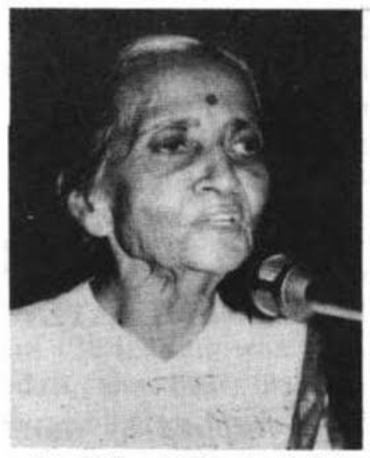
Poornima was born in Ranpur near Limdi in Saurashtra in a family of strong nationalistic beliefs. She first met Gandhi when she was eight years old, and this proved to be the defining moment in her life. By the time she was 18 years old she was an active participant in the Satyagraha movement.

Gandhi’s Dandi March in 1930 had ignited a nationwide fervour. Initially Gandhi had included no women in the Dandi March. But women everywhere protested this decision and insisted that they wanted to be full participants in the protest marches, demonstrations, boycotts, and even imprisonment. Kasturba Gandhi herself was equally adamant on this point. These women went from village to village and town to town, urging other women to come out of their homes and join the movement by picketing liquor shops, advocating the boycott of foreign cloth, and encouraging the spinning and weaving of khadi. Young Poornima was an impassioned crusader in the swadeshi movement and demonstrations of defiance to the British rule. It was during this period that she was arrested and put in prison in Rajkot. As it happened, she was incarcerated in the same cell as Kasturba Gandhi, Maniben Patel and Mridula Sarabhai who became her real-life inspirations and role models. While she was in prison Poornima spent her time teaching English reading and writing to the women inmates, including Kasturba. The two became close, with Kasturba nurturing the young girl, who in turn found in Kasturba the mother that she had lost. It is said that Gandhi was so pleased with Poornima’s efforts that he gave his blessings that she should continue on the path of education. And indeed, this is what was to become Poornima’s life mission.

In the meanwhile Poornima became more deeply involved in the politics of the freedom struggle. She participated in the 51st session of the Indian National Congress at Haripura in 1938. There was a massive turn out, estimated at more than half a million people, and Poornima proved her mettle as a volunteer in managing the crowds.

It was in the same year that Poornima got married to Arvind Pakvasa, the son of Mangaldas Pakvasa who was a close confidante of Gandhi, and who had left a successful practise as a solicitor to devote himself to the freedom struggle. He later became one of the first five governors of independent India. Thus Poornima moved into an active nationalistic family. But she herself took a break from political activism to devote time to her family, and bring up her three children. One daughter went on to  achieve fame as the danseuse Sonal Mansingh. Poornima herself was an accomplished Manipuri dancer, and singer.

Having been a part of India’s struggle for Swaraj, Poornima could not but be drawn back into active engagement with the issues that the Independent India was challenged with. In 1954 she started Stree Shakti Dal an organisation for the cultural, physical and spiritual education of women in Bombay. She encouraged women to become physically and mentally strong; girls were trained in using laathis, rifle shooting, and self defence. She also headed the Bhonsala Military School in Nasik for 25 years.

Through the years, Poornima had been deeply concerned about the condition of tribal girls, and was strongly driven by a passion to do something concrete about this. Poornima remembered how, when she was just a teenager, Kasturba had nurtured her with love and compassion, and also Gandhiji’s belief that she could contribute to the field of education. She pledged that she would live up to the faith of Kasturba and Gandhiji, and strived to give generously of herself to better the lives of young tribal girls.

Her vision and mission fructified with the establishment of the Ritambhara Vishwa Vidyapeeth in the Saputara region of the Dangs district of Gujarat in 1974. The early days were challenging, in a place (a remote hilly area) and time when education for tribal girls was unheard of. Poornima herself went from door to door to convince parents to send their daughters to school. The school started with only 15 girls. Poornima mentored the young girls and inculcated in them a love for education, and classical arts, as well as empowerment through physical fitness and vocational skills. 

Directed by Poornima’s vision and passion the Ritambhara Vishwa Vidyapeeth extended its activities to become a residential school and college for tribal girls of the area, where hundreds of tribal girls are provided free lodging and boarding facilities and education from 6th up to 12th standards. Over the years, thousands of tribal girls have emerged from the Rithambhara Vidyapeeth as self-confident and capable young women.

The Gramin Vikas Trust was set up to complement Poornima Pakvasa’s work in the educational field with overall developmental activities. Her trailblazing work and contribution to the nation was recognised by conferring on her the Padma Bhushan in 2004. But for the people of the Dangs, she was simply “Didi”– the big sister who was a mentor, a steady supporter, and an inspiration.

Poornima Pakvasa continued to live and work in Saputara until she passed away at the age of 102 on 25 April 2016. Her legacy lives on through the thousands of lives that she touched.

–Mamata

Gandhi’s Women Warriors: Perin Captain

This month as we remember the Father of the Nation Gandhi, it is also a good time to remember some of the many women warriors who played significant parts in the march for Indian independence. Among these was Perin Naoroji Captain.

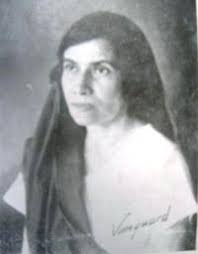
Perin was the granddaughter of the ‘Grand Old Man of India’ Dadabhai Naoroji. She was born on 12 October 1888 in Mandvi in the Kutch district of Gujarat. Her father Ardeshir, Dadabhai Naoroji’s elder son was a medical doctor and her mother Virbai Dadina a home maker. Perin’s father died when she was only 5 years old. She did her schooling in Bombay and moved to Paris for higher studies where she did a degree in French language.

It was while she was a student at the Sorbonne in Paris that Perin met Madam Bhikaji Cama who was living there in self-exile. Bhikaji had gone to Europe, and then to London in1902, to rest and recover from the bubonic plague of 1896 which she had caught while volunteering to work with the victims in Bombay. Though she recovered, the disease left her in poor health. While she was in London Bhikaji met Dadabhai Naoroji who was a strong critic of the British economic policy and she began working for the Indian National Congress. She also was a close associate of Veer Savarkar. It was while she was in London that Bhikaji was informed that she would not be allowed to return to India unless she signed a statement that she would not take part in nationalist activities. Bhikaji Cama refused to do so, and remained in exile in Europe from where she continued to support the revolutionaries in every possible way.

At the time when Perin met Madam Cama, the latter was deeply involved in trying for the release of Savarkar who was imprisoned in London for defying the British. During her Paris student days Perin was actively involved in a number of ‘revolutionary’ causes including the conspiracy to get Savarkar out of jail, and working with Polish émigré organisations who were opposing the Tsarist rule in Russia. During these interactions, Perin and her sister Gosi also learned how to use firearms and assemble bombs.  

Perin returned to India in 1911. An opportunity to meet Gandhi transformed her ‘revolutionary’ zeal into a lifelong belief in the power of non-violent protest as an effective weapon. By 1919 she was fully committed to the Swadeshi movement and started wearing khadi. In 1920 she helped to establish the Rashtriya Stree Sabha, a women’s’ movement based on Gandhian ideals. She married the eminent lawyer DS Captain in 1925. The couple did not have children. 

The countrywide civil disobedience movement that Gandhi launched with the Salt March in 1930 marked the first time that women, en masse, became active  participants in the country’s struggle for freedom. Thousands of women, in cities and villages, demonstrated their support by joining the protest marches, picketing of foreign goods, and manufacturing and selling salt. In the first ten months of 1930 as many as 17,000 women were convicted for these activities.

 Perin Captain, along with other women leaders like Kamaldevi Chattopadhyay was on the forefront of the protests in Bombay. Every day they led groups of satyagrahis, singing national songs, to the seaside to bring sea water which was dried in cement pans. The salt was packed in small packets and the ladies went to different places to sell the packets. Sometimes the salt packets were auctioned and sold to the highest bidder (at one place the highest bid was two rupees). Perin and Kamaladevi addressed a number of public meetings encouraging people to show their solidarity and join the peaceful protests. This was all under the watchful eyes of the British police. The name of Perin Captain features frequently in the Daily Reports of the Police Commissioner of Bombay submitted to the Secretary to Government of Bombay Presidency. The police intelligence was keeping a close watch on the unfurling movement of civil disobedience, as well as its leaders.

As an active member of the Congress party Perin was also trusted by Gandhi to ensure that the protests remained scrupulously non-violent and passive. On 4 July 1930 Perin was arrested as she was setting out for the Congress office. As a newspaper reported “she cheerfully submitted to the officers who came to her home”. Once the news of her arrest spread, the Municipal Corporation of Bombay adjourned, the Sugar Merchants’ Association passed a unanimous resolution to boycott British refined sugar.

Perin Captain’s leadership qualities saw her playing an active role in many other areas, but the Civil Disobedience Movement was a defining episode in her public life.

Perin was a trusted and active member of the Congress party in the state. In 1932 she became the first woman president of the Bombay Provincial Congress Committee. In 1937 the Congress Party came to power in eleven provinces in the provincial elections. In order to prepare for the future responsibilities that such developments would lead to, the Indian National Congress formed a National Planning Committee with Jawaharlal Nehru as Chairman. The Committee was clear that in such a future, women would be on an equal footing with men, and any planning should be based on this premise. Perin was a member of the sub-committee on Women’s Role in a Planned Economy. This committee debated and planned policy for issues such as women’s social, economic and political status, education, marriage, maternity and succession.

Over time smaller Gandhian bodies were merged into what became the Gandhi Seva Sena. Perin became its Honorary General Secretary, a post she held until her death. The Gandhi Seva Sena promoted khadi by selling rural and khadi products from their stores.

Even after independence Perin continued to work actively in the field of social work and welfare.  Perin was appointed Chief Commissioner of Bharat Guides. She was honoured with the Padma Sri in 1954, the first batch of civil awards presented in independent India. She died in Jahangir Nursing Home, Pune in 1958.

Perin Naoroji Captain was not only the granddaughter of the Grand Old Man of India, she was a true daughter of India’s swadeshi movement who boldly carried the message of the Mahatma to thousands of her fellow sisters.

–Mamata

Gandhi’s Women Warriors: Usha Mehta

Here is a mantra, a short one that I give to you. You may imprint it on your hearts and let every breath of yours give expression to it. The mantra is ‘Do or Die.’ We shall either free India or die in the attempt; we shall not live to see the perpetuation of our slavery. Every true Congressman or woman will join the struggle with inflexible determination not to remain alive to see the country in bondage and slavery.

These words spoken by Gandhi on 8 August 1942 launched the Quit India movement. Although Gandhi and many other leaders were arrested within hours of his speech, with the expectation that without their leadership the resistance movement would be rudderless, the effect was the opposite. Thousands of Indians, young and old, heeded this call and plunged into the movement, each contributing in their own way.

Source: en.wikipedia.org

Among the crowd that directly heard the words from Gandhi on that day was a 22 year-old woman who took on the onus of spreading his message far and wide through unconventional means—secret radio broadcasts. This was Usha Mehta.

Usha Mehta was truly a daughter of the freedom movement, growing up as Gandhi led India each step forward on the road to independence. She was born on 25 March 1920 in a village called Saras near Surat in Gujarat. She first saw Gandhiji when she visited his ashram as a five-year old. She was just eight years old when she took part in her first protest. This was against the Simon Commission, when the young girl joined in the shouts of “Simon Go Back”. She mobilised her young friends and organised prabhat feris (dawn marches with songs and slogans). As a teenager she responded to Gandhi’s call to defy the salt tax, and joined in the various acts of civil disobedience from picketing of British goods to spinning cotton. She also took the vow of wearing khadi, and continued to do so all through her life. 

Usha’s father was a judge in the British Raj and did not support his daughter’s nationalistic leanings and activities. In 1933 her father retired as a judge and moved to Bombay, where Usha continued her schooling. It was in 1942 when Usha was studying in Wilson College in Bombay that she heard Gandhiji speak at the historic meeting of the Congress party. Moved by Gandhi’s words, Mehta – with the help of a few other young independence activists – planned to set up an underground radio station which would share news about the real situation on the ground, and spread Gandhi’s message far and wide. In the face of many challenges, the group raised some resources, and for technical help they contacted a friend who was running classes in radio mechanics. The transmitter was ready by 13 August, and the first broadcast was on 14 August 1942 opening with the words: “This is the Congress Radio calling on 42.34 from somewhere in India.”

In a time when the press was supressed, and news censored, these radio broadcasts spread the message of Quit India to the remotest corners of the country, urging people to join the mass civil disobedience movement. The broadcasts carried all sorts of news, especially news that was censored or banned to be spread by the regular media, such as merchants refusing to export rice to arrests of leaders and civilians. The broadcasts reported on police atrocities, mass protests and strikes. Prominent leaders also gave radical speeches on the broadcasts. The team got news from messengers across India, as well as from the office of the All India Congress Committee.

In the beginning, the broadcasts were once a day, in Hindi and English; then they were increased to twice a day. Usha and her fellow broadcast conspirators (along with their transmitter) had to constantly evade the police who were on their trail. As Usha recalled in an interview many years later (Police) vans used to chase us regularly and very often it was merely a question of touch and go. It is believed that the team moved locations six to seven times in the three months that they broadcast.

The broadcasts on 42.34 became extremely popular with the people across the country. There were also specific programmes for different groups like students, women, workers and lawyers.  

On 12th November 1942, based on information leaked by one of the technicians, the police raided the hideout from where the radio station was operating in Bombay. Usha Mehta was in the building when the police came. She quickly took the broadcast material and rushed to the recording studio which was elsewhere, and with the help of some colleagues set up a new transmitter for a final broadcast. As Usha Mehta recalled that day: We played Hindustan Hamara, then we relayed some news bulletins and a speech. Just when we were at the end of the programme, playing ‘Vande Mataram’, we heard hard knocks on the door. The authorities broke down the door and entered. They ordered us to stop playing ‘Vande Mataram’. We did not oblige them.

The authorities seized all the equipment and photos and film footage of Congress party sessions. Usha along with four of her colleagues, was arrested, kept in solitary confinement, and intensely interrogated for almost six months, but she refused to betray her colleagues. Usha and three of her colleagues were sentenced to four years in jail. She was released in March 1946. As she said: I came back from jail a happy, and to an extent, a proud person because I had the satisfaction of carrying out Bapu’s message, ‘Do or die’, and of having contributed my humble might to the cause of freedom.

After India became independent the following year, Usha Mehta went back to her old Wilson College to pursue a doctorate in Gandhian thought; and spent the remaining years as an academic, teaching in her own college for the next 30 years, and continuing to spread the Gandhian ideals through her writing and talks. Like a true Gandhian, she led a spartan life, waking at 4 am every morning and working late into the evening. Her diet, dress and habits were simple and frugal.

Usha Mehta was honoured with Padma Vibhushan in 1998. She continued to spread the philosophy of Gandhi until she passed away in August 2000 at the age of 80.

Today, more than ever, we need to be reminded of such feisty women whose lives were driven by a passion for a cause, and who demonstrated their commitment with courage and conviction.

–Mamata

.