Mama Miti Wangari Maathai: Mother of Trees

The first week of July is celebrated in India as Van Mahotsav or Forest Festival. It is marked by the planting of thousands of trees, through community events. It is a reminder of the critical role that vegetation plays in the conservation of water and soil, and thus of life itself. This week brings to mind the story of another greening movement that was the brainchild, and life-long passion, of an incredible woman named Wangari Maathai.

Wangari Muta Maathai was born in Nyeri, a rural area in the central highlands of Kenya in 1940. Her parents were farmers, and she was the third of six children. Wangari’s childhood was spent in the outdoors, playing in the fig trees and the stream around her home, and helping her mother collect firewood for the household. She always saw herself as “a child of the soil”, growing up with her mother’s belief that trees were ‘God’ and should be respected accordingly, something she made the foundation of her life’s work.

Wangari started her education at St. Cecilia Intermediary, a local mission school. She was always a star student; she won a scholarship to study biology at Mount St. Scholastica College in the United States, and graduated in 1964. She went on to earn a Master of Science degree from the University of Pittsburgh. But as she wrote in her memoir Unbowed: The spirit of freedom and possibility that America nurtured in me made me want to foster the same in Kenya, and it was in this spirit that I returned home.

After she returned to Kenya, Wangari continued her studies and obtained a doctorate in veterinary anatomy at the University of Nairobi, becoming the first African woman in East or Central Africa to hold such a degree. She then joined the university as an associate professor, and went on to become chairwoman of its veterinary anatomy department in the 1970s.

Wangari was however more than just an academic. She was very aware of the changes in her native country’s landscape stemming from the legacy of the British rule—massive deforestation and overexploitation of resources. As a member of the National Council of Women of Kenya (NCWK), she was also becoming engaged with women’s issues. She heard, and saw, rural women who were facing immense hardship due to water sources drying up, and degradation of the soil; women who had to walk miles each day in search of firewood to cook their meals.

By then I understood the connection between the tree and water, so it did not surprise me that when the fig tree was cut down, the stream where I had played with the tadpoles had dried up. I profoundly appreciated the wisdom of my people, and how generations of women had passed on to their daughters the cultural tradition of leaving the fig trees in place. I was expected to pass it on to my children, too.

Wangari remembered her mother’s words about trees. She realised that the only way to prevent the further deterioration of the land was to plant trees. Now, it is one thing to understand the issues. It is quite another to do something about them. But I have always been interested in finding solutions….It just came to me: ‘Why not plant trees’? She first approached foresters to urge for more intense and extensive tree planting. But they derided her by saying what could a veterinary scientist know about plants and plantation? Wangari was undeterred. She decided to go directly to the local women and started explaining to them about the links between tree cover, soil and water conservation, and availability of firewood to cook nutritious meals for the family. She urged that women themselves should take on the mission of planting trees.

Wangari set the example by starting a small tree nursery in her backyard and giving women saplings to plant. As I told the foresters, and the women, you don’t need a diploma to plant a tree. After the women had planted seedlings on their farms, I suggested that they go to surrounding areas and convince others to plant trees. This was a breakthrough, because it was now communities empowering one another for their own needs and benefit.

This simple formula was to snowball into one of the largest grassroots tree planting movement—Kenya’s Green Belt Movement. Wangari’s approach was practical, holistic and deeply ecological—the tree roots helped bind the soil, halting erosion and retaining ground water when it rained. This water replenished the streams needed for cultivation of food crops. The trees also provided food, fodder, and fuel which were the mainstay of the communities.  Initially the government did not pay much attention to these nurseries, but as thousands of nurseries began to be created the Government began to see the potential threat that such mobilization could pose to the status quo and vested interests, and it began to harass the Green Belters. By then the movement had attained its own momentum and mobilized thousands of women and men to plant tens of millions of trees across the country. The movement also did more than get women to plant trees; it empowered them to stand up for themselves even in the face of domineering husbands and village chiefs, as well as political and social pressures.

As the movement grew, Wangari Maathai was also becoming more convinced in her understanding that environmental changes alone were not sustainable unless they were linked to issues of governance, peace, and human rights. She used the movement to also address abuse of power like land-grabbing, and human rights issues like illegal detention of political opponents. This led the Green Belt Movement to be labelled as ‘subversive’ during the 1980s.

Wangari felt that these issues could not be fought only through activism. She herself entered the political fray. She was elected as an MP in 2002, and also served as an assistant minister in the Ministry of Environment and Natural Resources. She used her position to fight for women’s rights, democratic processes, and questioned corruption and abuse of power. This also led her to be seen as a threat to the powers that be; she was threatened, harassed, beaten and even jailed. In 2008 she was pushed out of government.

In the meanwhile Wangari Maathai and her Green Belt Movement were attracting international attention. She travelled across the world campaigning for change; urging action to be taken on environmental justice, climate change, and championing the cause of participatory democracy, good governance and women’s rights. Her key message was: It is the people who must save the environment. It is the people who must make their leaders change. And we cannot be intimidated. So we must stand up for what we believe in. Meanwhile in Kenya, the Green Belt Movement continued to grow and spread with over 6000 grassroots nurseries and tens of millions of trees planted across Kenya.

In 2004, Wangari Maathai was awarded the Nobel Peace Prize, becoming the first African woman to be awarded the Prize.

In presenting her with the Peace Prize, the Nobel committee hailed her for taking “a holistic approach to sustainable development that embraces democracy, human rights and women’s rights in particular” and for serving “as inspiration for many in the fight for democratic rights.”

Wangari Maathai passed away in 2011. Even her last wish to be buried in a casket made of hyacinth, papyrus, and bamboo, echoed her life’s mission to save trees. Mama Miti or ‘ mother of trees’ as she was fondly called in Swahili left behind an inspiring legacy of millions of trees that sustain their land, planted and nurtured by the thousands of women whose lives she touched, and changed in many ways. She exemplifies how one woman can be a powerful force for change.

–Mamata

 .
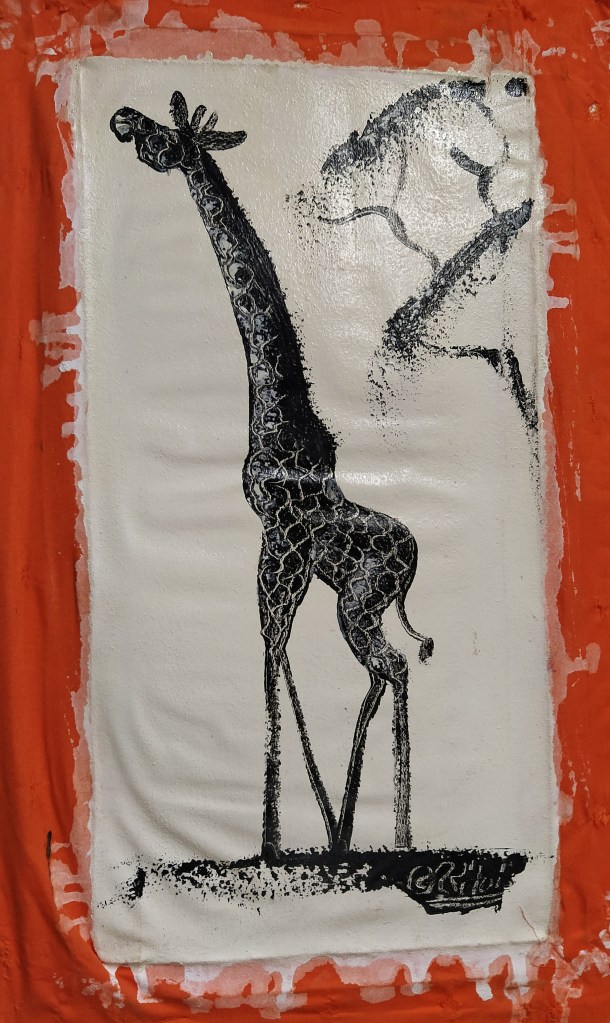
Twiga’s Tales of the Giraffe

One of the most majestic sights while on safari in East Africa is not necessarily the lion nor the elephant, but that of a ‘tower’ (what better way to describe this group!) of giraffe silhouetted against the setting sun, as they stride gracefully across the flat grassland. For animals that at first glance seem somewhat ungainly with their long stilt-like legs and outstretched necks, the Twiga as they are called in Swahili, move like a bevy of tall ballerinas.

Giraffes are an integral part of the landscape in the semi-arid savannah and savannah woodlands in sub-Saharan Africa, and also occupy a unique place in the cultural landscape of the African continent. They are highly regarded throughout the continent, and the giraffe spirit animal is seen as a being who can connect the material world to the heavens. In Botswana they call the giraffe Thutlhwa which means ‘honoured one’. Cave paintings from early civilizations in Africa depict giraffes, and giraffes feature in a lot of mythology and folklore of the different tribes. These indicate a high regard for this unique animal, as well as delightful tales that link to the origins of the characteristic features of the giraffe.

The name ‘giraffe’ itself has its earliest origins in the Arabic word zarafa, (fast walker), which in turn may be have been derived from the animal’s Somali name geri. The Italian word giraffa came up in the 1590s, and the modern English form developed around 1600 from the French word girafe. The history of the word follows the history of the European’s exposure to this unusual animal.

This animal has always fascinated people through history. The Greeks and Romans believed that this creature was an unnatural hybrid of a camel and a leopard and called it a Camelopardalis (which also became its scientific name). Julius Caesar is believed to have brought and displayed the first giraffe in Rome in 46 BC. In the Middle Ages Europeans knew about giraffes through contact with the Arabs. A giraffe presented to Lorenzo de Medici in 1486 caused a great stir on its arrival in Florence. In the early 19th century a similar gift to the Charles X of France from Egypt caused a sensation. He loved this animal, and it was something he showed to special guests for 18 years. His palace featured many paintings of his beloved giraffe.


In 1414 a giraffe was taken on a ship to China along with precious stones and spices. It was placed in a zoo where it was a source of fascination for the Chinese people who saw in it a beast that represented the characteristics of various animals and identified it with the mythical Quilin which is a part of Japanese, Chinese and Korean mythology. 

What makes the giraffe so unusual? To start with, it is the tallest mammal on earth, reaching a height of up to 18 feet. The height is achieved by its very long neck and legs.

African folklore has a number of tales that explain why the giraffe has such a long neck. Here is a delightful Twiga tale from East Africa.

In the beginning the Creator gave the same legs and neck to all the animals. One year there was a terrible drought, and all that could be grazed and browsed was eaten by the grazers and browsers, until only a hot and dusty expanse spread before their hungry eyes. One day Giraffe met his friend Rhino, and they walked hungrily and thirstily in search of a water hole. Giraffe looked up and sighed “Look at the fresh green leaves on the acacia trees. If only we could reach them we would no longer be hungry”. Rhino said, “Maybe we can visit the wise and powerful magician and share our troubles.” The two friends trudged on till they reached the place where the magician lived. He told them to return the next day. The next day Rhino forgot all about this and did not show up, but Giraffe was there. The magician gave him the magic herbs that he had prepared for the two animals. Giraffe greedily ate up both the portions. Suddenly he felt a strange tingling in his legs and neck, and felt giddy, so he closed his eyes. When he opened them he saw that the ground was way beneath, and his head was way up, close to the fresh green leaves on the high branches of the tall acacia trees. Giraffe looked up at the sky and down at his long legs, and smiled as he feasted. Meanwhile Rhino finally remembered, and went to the magician. But the magician said he was too late! Giraffe has eaten all the magic herbs! Rhino was so angry, that he charged at the magician, and continued to do so at everyone he encountered. And so, they say, the rhino remained bad tempered, while the giraffe retained his gift of height.    

Interestingly, the giraffe’s long neck has only 7 vertebrae, the same as other mammals. The long neck enables the giraffe to browse on the leaves and shoots of thorny acacia trees in the flat grasslands that it inhabits. This is helped by the strong, long (45-50 cm) and dexterous tongue which is bluish-purple in colour, and the ridged roof of their mouth.

The long neck with eyes located near the top of the head also provides it with a vantage view of the surroundings. The giraffe can spot approaching danger well before the other grazing animals, who are usually found around the giraffe. If they sense any nervousness on the part of the giraffe, they take it as a cue to stay alert or flee.

Curiously, once the height of the legs is added, the long neck is too short to reach the ground. Thus in order to drink from a water hole giraffe have to splay their forelegs and/or bend their knees. This is also the time when they are the most vulnerable to predators like lions. However as giraffes do not need much water, this exercise is not needed very often.  

The long slender legs make the giraffe a very fast runner. Although initially the gait may seem stiff-legged, once they get into rhythm they are a graceful sight. The legs provide more than momentum, they are also a giraffe’s only means of defense. A powerful kick from its hind legs has been known to kill a lion, and its front legs with sharp hooves can come down just as hard.

Female giraffe give birth standing up, which means that the new born has a fall of about 2 metres before it touches ground. And yet the calf can stand up within an hour of its birth; but this is the time when it is most vulnerable to attack by predators.

Giraffe have very thick skin, and they are distinguished by their reddish brown coats with irregular patches divided by light coloured lines. While they may look alike at a glance, each of the different species of giraffe have very different types of spot patterns. In fact, just like human fingerprints, no two giraffe have the same spot pattern.

Certainly an animal that “stands out in a crowd!” But where once they stood tall and strode majestically across their land, giraffe are numbers are declining alarmingly. As with all wildlife, the loss, degradation, and fragmentation of their habitat, poaching, disease, and encroachment of human settlements into their home range and competition for resources is endangering this unique animal. In 2016, according to the IUCN Red List of Threatened Species, the status of giraffes was changed to ‘vulnerable to extinction.’

In response, the Giraffe Conservation Foundation has dedicated 21June to raising awareness about giraffes by celebrating World Giraffe Day. A day to remind ourselves that the loss of the Twiga is not only a loss for biogeography, but equally a significant cultural loss.

–Mamata

Walk, Don’t Run!

What is this life if, full of care
We have no time to stand and stare?

These words were penned by the Welsh poet W.H. Davies over a hundred years ago. Even as the world continues to progress rapidly in every way, and along it, also the pace of life, in every age there have been some voices that remind us about what we are losing as we rush headlong through our daily lives, in our quest to make a living. But as they remind us, are we, along the way not missing out on the simple joys of living?

One of the simplest joys is that of walking. Walking not as in getting from point A to point B, but walking for the sheer pleasure of it, with the senses attuned to the very act of moving while also imbibing the sights, smells and sounds around. And this sort of moving even has a word that defines it. The word is ‘saunter’.

The Merriam-Webster dictionary defines the verb ‘saunter’ to mean ‘to walk along in a slow and relaxed manner without hurry or effort’; and the noun ‘saunter’ to mean a ‘leisurely stroll’. According to the Cambridge dictionary, ‘to saunter’ is to ‘walk in a slow and relaxed way, often in no particular direction’. Saunter probably derives from the Middle English word santren, which meant ‘to muse’. The first modern use of the word ‘saunter’ in its current form was in the 17th century.

Definitions aside, the concept of a walk such as this was best described and promoted by Henry David Thoreau an American author, poet, and natural philosopher, in the mid-nineteenth century. While he wrote about the joys of a simple life in nature, Thoreau’s essay Walking focuses on the spiritual importance of walking in nature. The essay was first published in 1862, after his death. For Thoreau, the goal or destination of walking is less important than the meditative state of mind which walking induces. He argues that walking cultivates curiosity and wonder, qualities which are often discouraged or undervalued in society.

The walking of which I speak has nothing in it akin to taking exercise, as it is called, as the sick take medicine at stated hours–as the swinging of dumb-bells or chairs; but is itself the enterprise and adventure of the day. If you would get exercise, go in search of the springs of life. Think of a man’s swinging dumbbells for his health, when those springs are bubbling up in far-off pastures unsought by him!

As Thoreau describes it, the genius of walking lies not in mechanically putting one foot in front of the other en route to a destination but in mastering the art of sauntering.

Many years after Thoreau, and at a time when the pace of life had become much faster, and preoccupations with “getting there” propelling every kind of journey, some people felt that it was necessary to remind ourselves that “stopping to smell the roses” along the way was not a waste of time.

Among these was an American WT Rabe who was concerned about the growing popularity of jogging as a fitness trend in the mid-1970s. Rabe was a Public Relations professional who combined his skills and concerns to encourage people to slow down and appreciate the world around them. Rabe was then working as a PR person for the Grand Hotel on Mackinac Island in Michigan, which was famous for having the longest porch in the world. Rabe organised an event inviting people to spend a day taking a leisurely walk, free of stress and strain, focusing on the pure joy of the act. In other words–to saunter. Sauntering, as Rabe described it ‘is going from point X to point Z which means you don’t care where you’re going, how you’re going or when you might get there’. In response to this, thousands of people descended on the Grand’s famous front porch, simply to saunter (upon paying a fee of two dollars each). As Rabe’s idea caught on, and his followers increased, he went on to propose that there should be an annual day to celebrate the concept and the act. And so 19 June was designated as World Sauntering Day! 

While this may be a successful PR gimmick, sauntering has its advocates among some of my favourite writers. Thoreau’s conviction was that walking should involve a ‘connection’ with our natural world and approached with the mind set of becoming ‘fully present’. He believed that ‘busy’ was a conscious decision. He spoke of returning to his ‘senses’ after a saunter in the wild.

These sentiments are beautifully echoed in a recent essay by Pico Iyer, a contemporary essayist and novelist known for his travel writing. The essay describes the same walk that he has taken for over twenty-five years in Nara a small town near Kyoto in Japan.  

For years I used to take this walk as a break after five hours at my desk, a small reward, perhaps, for forcing myself to stay sitting through sunshine and mist. But then I began to notice something: walking shook things loose in me. The very act of ambulation sent my thoughts down different tracks. Movement in some ways—because I had no destination and didn’t have to notice where I was going—allowed my mind to run off the leash like a dog on a beach. If I was stuck at my desk, walking could unstick me.

As he further says, A wise friend from New York sent me his paraphrase from the American naturalist John Burroughs last year: To learn something new, take the same path you took yesterday.

Although this is not a day that is very well known, for most of us who spend a large part of our life with no time ‘to stand and stare’, World Sauntering Day is indeed a good reminder that it is important sometimes to be “pointless on purpose”. This Sunday, let’s celebrate the day with a saunter.  

–Mamata

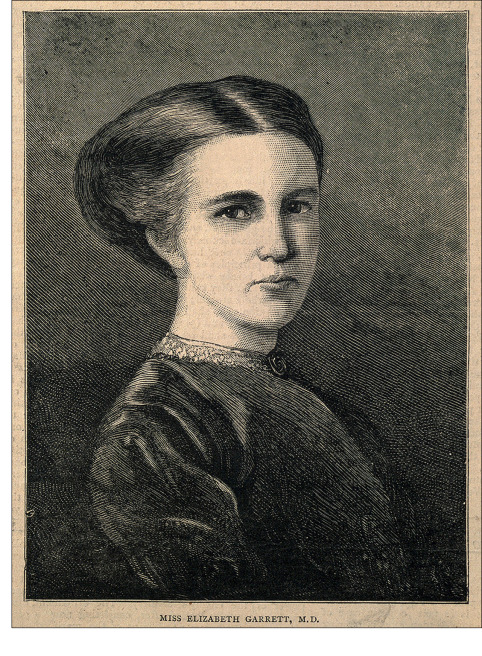
Elizabeth Garrett Anderson: Path-breaking Victorian

This past week I was reading about the grand Platinum Jubilee celebrations to mark 70 years on the throne of Queen Elizabeth II of the United Kingdom. This is the longest reign of a monarch of Great Britain; the closest being the rule of Queen Victoria who reigned for 64 years—a period called the Victorian Era.

Coincidentally the same week I read two accounts about women in the Victorian Era, and could not help but wonder how much things have changed. The first was fiction–a ‘murder mystery’ which featured some women who attempted to defy the existing norms,  and the other was the true story of a woman who was a pathbreaker in changing how the role and status of women was perceived in that era. 

The reign of Queen Victoria was an extended period of peace, prosperity, progress, and essential social reforms for Britain; however, it was also characterized by widespread poverty, injustice, and social discrimination. There was a very strictly defined ‘class system’ that determined every aspect of social life.

There was also a very strong perception (and application) of gender roles. A woman’s place was clearly considered to be in the home, and domesticity and motherhood were considered by society at large to be a sufficient emotional fulfilment for females. Even the upper class women who were educated to some degree by private tutors were not encouraged to use their minds in any way that would distract them from their assigned roles. A telling paragraph in the novel: “Did you read it in a newspaper?” “Oh no” she lied immediately. She had not yet forgotten that ladies of good society would not do such a thing. Reading the newspaper overheated the blood; it as considered bad for health to excite the mind so much, not to mention, bad for the morals.

The rights which the women enjoyed were similar to those which were enjoyed by young children whereby they were not allowed to vote, sue or even own property. But these rights were to be questioned, and changes demanded by a group of women who pioneered the suffrage movement. Among these was Elizabeth Garrett Anderson, who broke many glass ceilings in her day.

Elizabeth Garrett was born on 9 June 1836 in Whitechapel, London, to Newson Garrett and his wife Louisa; the second of twelve children. Her father was originally a pawn broker who went on to become a successful businessman. The family moved to Aldeburgh in Suffolk when Elizabeth was very young. As a child, Elizabeth got her basic education from her mother and a governess. When she was 13 she was sent to a private boarding school near London where she was taught languages and literature, but not sciences and math. Unusual for the time, her parents encouraged their daughters to travel and pursue their ambitions. After completing school Elizabeth, although engaged in domestic duties, continued to study Latin and arithmetic, and read widely. It was accepted that she would marry and live the life of a lady.

When she was 22, a group of women started a magazine for women, English Woman’s Journal. Among these women was one Emily Davies, who became a dear friend. She invited Elizabeth to hear a lecture given by Elizabeth Blackwell, the first American woman physician. Elizabeth was so inspired by her namesake and her lecture that she decided that she wanted to become a doctor. A female studying medicine was unheard of at that time. But her father was supportive. She was denied admission in any medical school, so she enrolled as a nursing student at Middlesex Hospital and attended classes intended for male doctors. She also employed a tutor to study anatomy and physiology. But after complaints from the other students she was barred from the hospital; however Elizabeth continued to study on her own. She was determined to secure a qualifying diploma that could entitle her to put her name on the Medical Register. Unless a person’s name was listed on the Medical Register, that person could not legally practice medicine in England.

Elizabeth found a loophole: she registered to pursue a degree of Licentiate of the Society of Apothecaries which did not specifically forbid women from taking their examinations. In 1865 she passed their exams and gained a certificate which enabled her to practise as a doctor. This was a shocking step; the Society subsequently changed its rules to prevent other women entering the profession this way. However Elizabeth obtained her licence to practise medicine in 1869; the first woman in Britain qualified to do so.

Even though she now had a licence, Elizabeth still could not get a medical post in any hospital. With her father’s financial backing, in 1866 she opened her own practice in London. A little later, towards her goal to establish a hospital for women staffed by women, Elizabeth set up St. Mary’s Dispensary for Women and Children. Initially people were reluctant to consult a female physician, but an outbreak of cholera saw patients teeming to her clinic.

It was during this period that Elizabeth was also getting engaged with the issue of women’s rights. Her younger sister Millicent Fawcett was active in this growing movement; the two sisters with a group of like-minded women set up a discussion group that strongly influenced the battle for women’s education and empowerment.

Although Elizabeth had already obtained many ‘firsts’ she was still determined to achieve her original dream of a formal degree in medicine. So she taught herself French and successfully earned her MD degree from the University of Paris in 1870. The British Medical Register refused to recognize her qualification.

In 1870 Elizabeth became Visiting Medical Officer for the East London Hospital for Children. In 1872 Elizabeth transformed the St Mary’s Dispensary for Women and Children into the New Hospital for Women in London. The hospital specialised in women’s health and all of the staff were women. It was renamed the Elizabeth Garrett Anderson Hospital in 1918 and continued to appoint only female staff until the 1980s. Elizabeth also co-founded the London School of Medicine for Women, the first place in Britain specifically intended to train women as doctors.

In 1871 Elizabeth married a businessman James Anderson, in a  wedding ceremony in which she did not take a ‘vow of obedience’;  she continued with her pioneering work even as she ran her own household and brought up her three children. 

Elizabeth’s determination paved the way for other women.  In 1876 an act was passed permitting women to enter the medical professions and the Medical Register. Today over 48 per cent of licenced doctors in UK are women.

Elizabeth continued to lecture at the London School of Medicine for Women for 23 years, and from 1883 she was also the School’s Dean. She was Senior Physician of the New Hospital of Women for 24 years and in 1896–97 she was President of the East Anglian branch of the British Medical Association. She also found time to write on medical topics, including a textbook for students.

In 1902, Elizabeth retired from her medical career and moved to the town of Aldeburgh in Suffolk. In 1908, at the age of 72, she became the Mayor of Aldeburgh; she was the first female mayor in England. In her final years, Elizabeth was a prominent member of the women’s movement and campaigned for equal rights for women. Elizabeth Garrett Anderson died in Aldeburgh on 17 December 1917 at the age of 81, just two months before the Representation of People Act extended the right to vote to women over 30.

Elizabeth Garrett Anderson, with quiet determination and persistence, opened many doors, and paved the path that women take for granted today. 

–Mamata

Taking Stock in Stockholm

When I started my journey as an environmental educator in the mid-1980s, my orientation began with an introduction to the key milestones in the global environmental movement. The first milestone was the Stockholm Declaration which put forward a vision, as well as a set of principles on the way forward in the shared management of the global environment. The Declaration was promulgated at the conclusion of the United Nations Conference on the Human Environment held at Stockholm in June 1972, which became popularly known as the Stockholm Conference. 

Why was this conference such an important milestone? Among many other firsts this was the first-ever UN conference with the word “environment” in the title. The Stockholm Declaration provided the first agreed global set of principles for future work in the field of the human environment.

What was the road that led to this? The world had seen unprecedented scientific and technological progress since the end of World War II. But a fallout of the resulting development was the deterioration of the environment. In the 1960s, several scientists and thinkers began to express concern about the negative environmental and societal effects of the rapid industrialization. The shortcomings of the UN system to deal with the new developments were also becoming evident, but at the time environment was not high on the agenda of national and international politics. What was the way forward in a world polarised by the Cold War, and also the increasing gap between the ‘developed’ and the ‘developing’ countries?

It was a small Scandinavian country, Sweden who took the initiative. It urged that the time was ripe for a collective, substantive discussion at the global level about environmental problems. In 1967 it proposed to convene a UN conference on the human environment to increase awareness, and to identify environmental problems that needed international cooperation.

The response was unexpected. Despite Cold War politics, the Soviet Union and other members of the Eastern bloc joined the United States and most Western European countries in supporting the Swedish initiative. However many developing countries were uneasy that Northern interests would dominate the proposed conference and that “green issues” would be an excuse to restrict their national development. But by and large Sweden’s proposal was positively received.

In May 1968 Sweden sent an official request to the Secretary General of the UN making their case.  ‘Environmental issues … have not yet been given the prominence in the deliberations of the competent organs of the United Nations… Furthermore, as the problems of human environment grow more serious every day… there is, therefore, an indisputable need to create a basis for comprehensive consideration within the United Nations of the problems of human environment.’

In 1968 the United Nations General Assembly adopted a resolution which called for a conference on the relationships between environmental, social, and economic issues to be convened in 1972. The conditions were that the conference would not take decisions. Any recommendations arising from it would have to be formally adopted by the General Assembly. Maurice Strong, a businessman and, at the time, the head of the Canadian International Development Agency (CIDA), was appointed to be Secretary General of the Conference.

In May 1969, the United Nations accepted Sweden’s offer to host the conference in Stockholm. So it came about that in 1972, “For the first time nations came to consider the state of the planet Earth, habitually taken for granted, treated as an unchanging backdrop to human drama. For the first time we were integrating the scenery into the action of the play.” (Shridath Ramphal Commonwealth Secretary General)

The Stockholm Conference was held in the first week of June 1972. It saw the participation of the representatives of 114 of the UN’s 132 member states. The Soviet Bloc did not participate in the main event but took active part in the preparatory process. This was the first major international event in which the People’s Republic of China participated as a new member of the United Nations. In addition to government representation, 250 non-governmental organizations came to the conference—an unprecedented achievement at the time.

Only two heads of State attended–Mr Olaf Palme the Prime Minister of Sweden, and Mrs Indira Gandhi the then Prime Minister of India. Indira Gandhi emerged as a figurehead to represent developing countries’ fears and priorities, stressing the issues of war, poverty, and development. She made an impassioned plea “We do not wish to impoverish the environment any further and yet we cannot for a moment forget the grim poverty of large numbers of people. Are not poverty and need the greatest polluters?”  This has been a key point in international deliberations in the five decades since Stockholm.

The Stockholm Conference produced three major sets of decisions: The Stockholm Declaration which provided the first agreed global set of principles for future work in the field of the human environment. The second was the Stockholm Action Plan comprising 109 recommendations for governments and international organizations on international measures against environmental degradation. The third was a group of five resolutions. The resolutions called for: a ban on nuclear weapon tests that may lead to radioactive fallout; an international databank on environmental data; the need to address actions linked to development and environment; international organizational changes; and the creation of an environmental fund.

The Conference had several outcomes that we today take for granted. Environment ministries and agencies were established in more than 100 countries to implement the recommendations of the Conference. It also led to a great increase in non-governmental and intergovernmental organizations dedicated to environmental preservation.

The Conference was used as a model for a series of similar UN events to try and come to grips with interlinked cross-sectoral issues from gender to human rights.

The United Nations Environmental Programme (UNEP) was set up as mark of the UN’s commitment to carry forward the Action Plan of the Conference. It was headquartered at Nairobi in Kenya, the first UN body to be located outside of the industrialized world. 5 June was designated as World Environment Day.

The Stockholm Conference was indeed a milestone in many ways. It stressed that environmental issues are inherently political—not just scientific and technical, as many policymakers previously thought, and therefore need political negotiations and decision-making. The Stockholm Conference demonstrated how global cooperation could take place. It identified a theme that has been at the centre of international environmental discourse: Sustainable Development.

This week it is exactly fifty years since this vision for a sustainable future for mankind was discussed and deliberated in a spirit of international cooperation. In the half century since, our planet has seen changes—for good and the bad. We are far from achieving the vision. Rather our planet faces a looming triple threat from climate change, pollution and waste, and loss of nature and biodiversity. The alarm bells are growing louder and closer. 

Once again, this week, Stockholm will host concerned world leaders, and a wide range of stakeholders in the Stockholm+50 event—a high-level gathering convened by the United Nations, and hosted by Sweden with support from the government of Kenya. They will meet in an effort to take stock of the achievements and failures of the past five decades, as well as with the hope to accelerate a transformation that leads to sustainable and green economies, more jobs, and a healthy planet for all, where no one is left behind.

As citizens of Planet Earth this is a good time for each of us to take stock of our own lifestyle, and remind ourselves that a healthy planet for the prosperity of all is our collective responsibility, and our collective opportunity.

The fate of Planet Earth lies largely in our own hands and in the knowledge and intelligence we bring to bear in the decision making process. In the final analysis, however, man is unlikely to succeed in managing his relationship with nature unless in the course of it he learns to manage better the relations between man and man.

Opening statement by Maurice Strong, Secretary-General of the Stockholm Conference June 1972.

–Mamata

It’s a Dog’s Life!

At the outset let me start with a disclaimer. I have nothing against dogs. In fact I love dogs and my family has had pet dogs right through my childhood and adolescence. And thus any dog-related story catches my eye. The most recent one was a story in my local newspaper that perhaps really takes the cake.

The story that covered several column inches mourned the passing away of a Saint Bernard dog who had been purchased at a premium price, and translocated from the alpine heights to a home in arid Gujarat. The tiled floors of the home had been replaced with wooden floors for the ease of walking of the big dog. The much pampered ‘son’ of the family was fed on milk, curd and paneer from the best Gir cows, as well as seasonal fruits like papaya and melon. The dog was also celibate, which the owners claimed added 4 extra years to his life [sic]. The dog’s recent passing away was marked with full Vedic rites.   

As an avid (physical) newspaper reader it is the news that does not make the headlines that attracts my attention, and provides me not only with wonder and amusement, but also in some ways, provides a window into ‘trends’, as it were.

Prominent among these has been the increasing amount of space being taken up by pet stories, with particular reference to dogs. In the past one usually found a small news item about the annual dog show, with a few pictures of prize winning dogs with their proud owners. Then came dog trainers, followed by dog sitters and dog walkers; these were usually found through word of mouth, or were duties of the domestic help or the children who had a roster of turns to take the dog for its little ‘routine’.  

In the last couple of years one has been seeing from a quarter to a half page of glossy newsprint with dog-related information. This is in the form of advice and tips for “pet parents”. This includes not just diet and grooming, but also a gamut of psychiatric support (which grew exponentially during the pandemic). These can make up a best-selling Dr Spock for canines!  How to handle ‘sibling’ jealousy when your (human) baby is born; How to handle separation anxiety when you return to office after a long stretch of WFH; How to keep your dog from joining the zoom call (without making it feel left out!). There is a whole new profession of pet therapists, psychiatrists, and even ‘pet psychics’ who claim to have telepathic powers to communicate with pets to understand what they are going through and offer support on mental health issues.  

Then of course there are grooming tips galore. Starting with exclusive brands to pamper your pet; these are offered through “pawsome” spa treatments which include luxurious shampoo and bath, hair trimming and styling, and nail clipping, but also offer services like aromatherapy and acupressure massages. One such service even claims: “We offer a unique microbubble spa therapy, with high-density ozone bubbles for cleaning the pets’ coats. Apart from being an absolute fun session for them, it helps deal with rashes and irritation. We also have an automatic pet cabin dryer for noiseless and quick drying,” Bow Wow Wow!

I remember well the weekly struggle I had to put up with to just quickly pour one bucket of water over my very recalcitrant dog. And I still have a scar from when he bit me on a particularly difficult bath day! It will take a wild jump of fantasy to imagine my Bosky wallowing in microbubbles!  I marvel at the ‘new age’ canines who presumably sink gracefully into a bubble bath as they politely extend their paws for a perfect ‘pawdicure’.

But why stop at an afternoon at a Spa? In the highly stressed world that they inhabit, don’t dogs need some ‘time out’ too? Well the travel and leisure industry is all set to make this happen. There are dog resorts, and even luxury hotels for staycations and weekend getaways. Making news is Critterati a luxury pet hotel in Gurugram India which offers ‘air conditioned room; premium beds with luxury bedding, soft padded floors that are easy on paws, three meals for small buddies, and two meals for medium, large and X-large buddies; four times potty break; a nightcap treat before bedtime; TV lounge access; pampering sessions; socializing, vet visit, daily hair brushing to improve blood circulation.’ I kid you not! Check out their website.

Between vacations, for the occasional ‘doggy dine out’ there are dog cafes in many cities that offer a wide menu for the discerning pooch palates—from specially brewed beer to designer dishes. For the more politically correct canines there are sustainable vegan and gluten free options. For a change from the urban jungle there are pet event planners that offer ‘bespoke’ picnic experiences amidst nature.  

I think back to my dogs who lived a middle-class life as did we, doing very well thank you, on roti and milk. The highlight of my Bosky’s gourmet experience was being indulged by my old aunts with the traditional Gujarati snack of ganthia!

From food to accessories the race is on to offer something new, different, unique, and basically ‘pawsome’! A recent half page article in my newspaper described how to help pets beat the heat an array of cool accessories. These included a dog umbrella, a self-filling water bowl and a water bowl that keeps water cool, cooling collars and cooling mats.

With millennials as pet parents it sure is not a dog’s life anymore!

No wonder then that the pet care market is booming as never before. While it has been on the upswing in other countries, India is fast catching up. It is the world’s fastest-growing market, expanding at around 17% annually and is expected to be valued at around $500 million by the end of 2022. Among the growing affluent  generation of aspirational millennials who have the means to indulge their pets as they do themselves, there are also enterprising millennials who are smartly cashing in on the rapidly growing demand by creating and offering a tantalising menu of pet services and products.

If every dog has his day, this indeed is the day and age for every dog!

–Mamata

A Dolls House

At a recent get together with my sisters we were reminiscing about how we used to spend our childhood summer holidays in Delhi. In addition the many simple DIY activities that we devised, one of the highlights was the visit to the BC Roy Memorial Children’s Reading Room and Library. In an age when reading and books were the main pastime, this exclusive library for children, with its wide selection of books, and a welcoming ambience was a perfect place to be.

The library was housed in the building of the Children’s Book Trust. One summer, when we used the library we also discovered another fascinating display in the same building. This was the Dolls Museum which became not only our favourite destination, but also an essential visit for friends and relatives who visited Delhi.

All the three unique institutions were the brainchild of Keshav Shankar Pillai, popularly known as Shankar, who was India’s most celebrated political cartoonist before and after India’s Independence. The Children’s Book Trust which he founded in 1957, was among the pioneer publishers of children’s books in independent India. CBT continues even today with its mission to promote the production of well-written, well-illustrated and well-designed books for children at prices within the reach of the average Indian child. The BC Roy Library which was set up in 1967 was to become the largest library exclusively for children.

From books to dolls—how did that happen? The story has earlier roots. Shankar used to publish a political satire magazine called Shankar’s Weekly. In 1949, under the auspices of the magazine Shankar announced a competition inviting paintings and writings from children across India. It got an overwhelming response. The following year the competition was thrown open to children from all over the world. It was called Shankar’s International Children’s Competition. Today, the competition receives about 160,000 entries from over 160 countries. The entries are judged by an international jury.

In the early 1950s Shankar received a doll from the Hungarian Ambassador to be given away as a prize for this competition. Shankar with his childlike fascination for unusual things fell in love with the doll which was dressed in a traditional Hungarian costume. He asked the Ambassador if he could keep the doll for himself. The little doll triggered in Shankar the itch to collect more costume dolls. As a journalist who often accompanied the then Prime Minister Jawaharlal Nehru on his trips abroad, Shankar had the opportunity to visit many countries where he began to pick up dolls in the traditional national and regional costumes, made by local craftsmen.

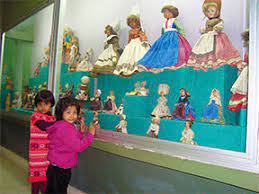
Shankar’s collection grew rapidly and soon he had a collection of nearly 500 dolls. He decided to exhibit these dolls in different parts of India along with the children’s paintings from the competitions. The frequent packing and unpacking began to damage the dolls; this worried and upset Shankar. An exhibition put up in Delhi was visited by Prime Minister Jawaharlal Nehru and his daughter Indira Gandhi. As they appreciated the collection, Shankar also shared his concern about the frequent moving of the displayed dolls. Indira Gandhi suggested that the exhibition should have a space of its own. The most natural place for it was in the building then being put up for the Children’s Book Trust in Delhi. And there the dolls found their permanent home. The International Dolls Museum as it became known was inaugurated on 30 November 1965 by the then President of India Dr S Radhakrishnan.

The Museum opened with a collection of a thousand dolls. Between 1965 and 1987 another 5000 were added, a vast majority coming as gifts. Today the Museum has a display of 7000 exhibits from almost eighty-five countries, giving it a truly international character. One section has exhibits from European countries, the U.K., the U.S.A, Australia, New Zealand, and the Commonwealth of Independent States, and the other from Asian countries, the Middle East, Africa and India. The dolls cover a wide range, both geographical and historical. The oldest exhibit is of a Swiss woman lying in bed dating back to 1781. There are dolls from the Queen of England’s Collection, Samurai and Kabuki dolls from Japan, Spanish flamenco dancers, ballet characters from South Korea, and nomadic singer dolls from Turkmenistan, among many others spanning the globe.  In addition to Shankar’s original collection, the collection has grown mainly from dolls gifted by dignitaries from different countries visiting India, as well as ambassadors of different countries to India. The dolls stay on as continuing little ambassadors of their countries, each telling its own story.

The section on Indian costume dolls showcases the incredible diversity of culture, heritage and traditions of our country. The dolls are meticulously handcrafted based on research that focuses on an accurate representation of physical attributes, dress, ornaments, and accessories like farming equipment, musical instruments, baskets and bags. There is a collection of bride and groom dolls depicting wedding traditions of different parts of India, and one of dolls in different dance costumes. Some of the dolls are arranged as group installations depicting markets, farming activities, household and festival scenes which demonstrate a sense of community.

The Indian dolls are made at a workshop attached to the museum. In addition to display the dolls are given in exchange for gifts to the museum from other countries, or sold to collectors. Apart from this workshop, there is also a ‘clinic’ where damaged dolls are repaired and restored.

Unlike other museums that one usually associates with ancient relics and artefacts, the Dolls Museum is a vibrant and living experience. It provides a rich panorama of the incredible diversity of the human race and cultures; it sparks imagination and curiosity; it transports the child into a ‘doll-filled’ world of its dreams, and the adult back to the innocent joys of childhood.   

Although my association with the Children’s Book Trust has continued over the years—from reader to contributing writer, it is many years since I visited the Dolls Museum. But as we mark International Museum Day on 18 May, it is a good time to remember and celebrate this special museum. As an educator now, I see the tremendous potential of this museum to help children explore, discover, and celebrate the diversity of cultures. As the International Council of Museums puts it “Museums are important means of cultural exchange, enrichment of cultures and development of mutual understanding, cooperation and peace among peoples.”

–Mamata

LABURNUM: MOLTEN SUNSHINE

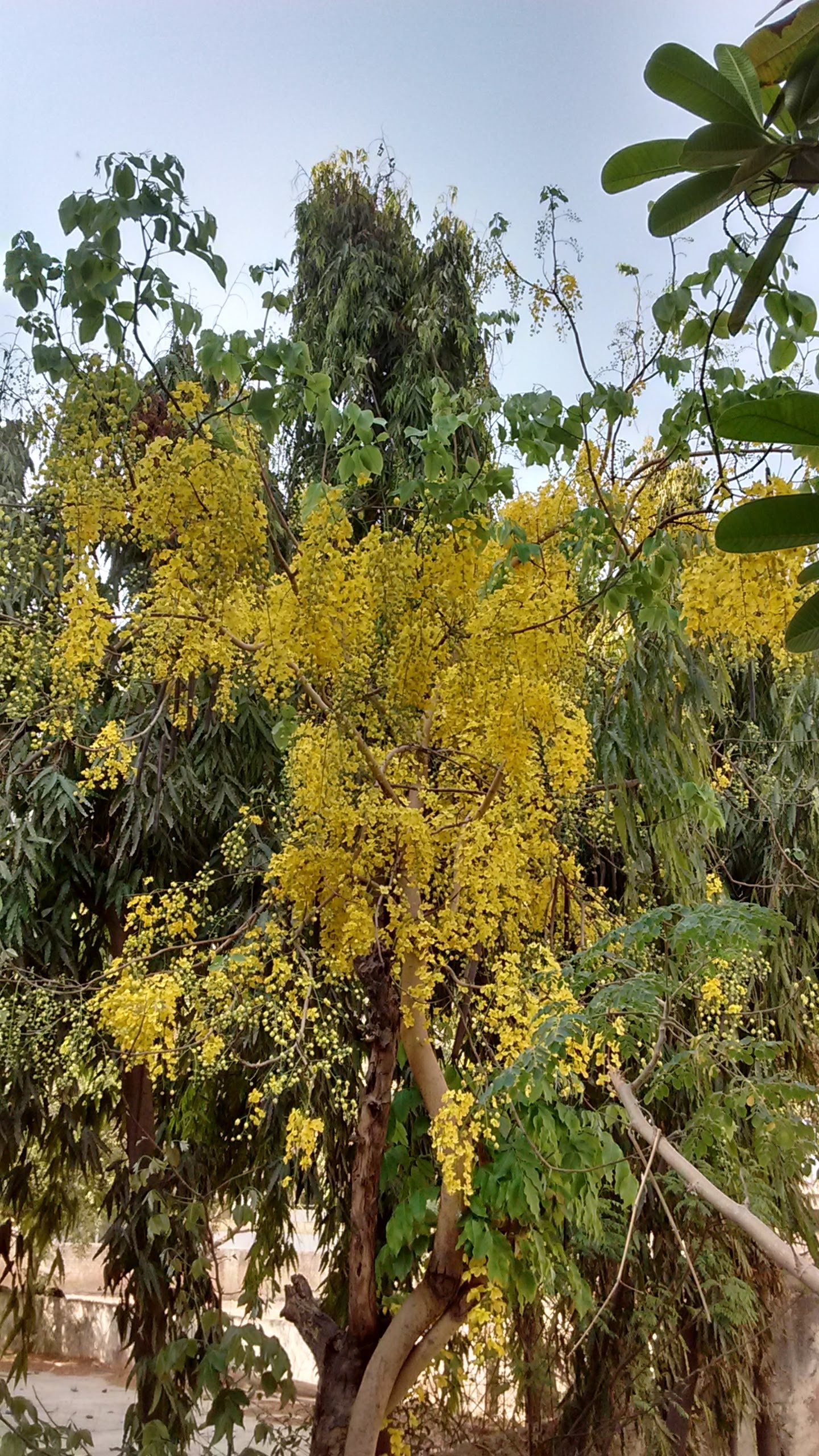
As the late April heat intensifies and the scorching sun begins to wilt and melt all that it beats down upon, it is time for the golden showers. The Indian laburnum or Golden Shower tree is in bloom. Its masses of yellow blossoms cascade from the tree like waterfalls of molten gold. Indian summer is really here!

laburnum

Indian laburnum or Cassia fistula gets its genus name from the word Kasia which was given by an ancient Greek botanist Pedanius Dioscurides, and its species name fistula meaning pipe, which refers to its tube-like pods.  

C. fistula is widely grown as an ornamental plant in tropical and subtropical areas. It is native to Southeast Asia and is found in Sri Lanka, Nepal, Bhutan, South and SW China, Myanmar, Malaysia, Indonesia, Pakistan and other tropical Asian countries, some parts of Australia and tropical Africa.

The Amaltas as it is commonly called in Hindi, is one of the most widespread of Indian trees and occurs throughout the country including the Andamans, and thus it has a vernacular name in all Indian languages. Many of the names refer to the long stick-like pods which appear almost alongside the blooms.

The Indian Laburnum is the common English name of this moderate-sized, deciduous tree. Its bark is greenish-grey and smooth on young trees, but with age it becomes brown and rough. This is not a tree that attracts attention for the large part of the year. It has a nondescript branching pattern and scant foliage. Between February and May the leaves get dull and ragged and many of them fall. New leaves are a beautiful fresh green sometimes tinged with pink, or a rich copper colour, and covered with a soft down; they remain folded and hang loosely downwards until they are fully grown.  It is with the onset of the summer that the laburnum bursts into full glory with sprays of golden flowers. It is the profuse mass of colour that attracts immediate attention. But a closer look reveals the delicate distinct beauty of the individual flowers that make up the mass. Each flower has five spoon-shaped petals of unequal size and ten yellow stamens of which three are long and curve gracefully upwards, the next four are shorter and curve the opposite way, while the remaining three are even shorter and straight. All are crowned with large, brown anthers where pollen is produced.

Around the same time, the long hanging cylindrical pods that give the tree some of its common names like Pudding Pipe tree appear in large numbers, making a striking picture of brown with yellow. At first the pods are green and soft, then they turn brown, and eventually become black and very hard. The pods contain large numbers of shiny brown seeds arranged in small compartments surrounded by a sticky brown pulp. 

In the scorching sun, the blooming flowers are a magnet for a wide range of insects and birds, which in turn creates dynamic ecological interactions. Bees and butterflies are important pollinating agents. The laburnum is specially connected to the Carpenter bees; the vibrations generated by the bees as they hover near the flowers cause the pollen grains to break out of the stamens, and attach to the bee’s body, and therefrom travel far and wide. Weaver Ants lurk around the flowers to pounce and prey on pollinators that visit the flowers. While flowers are the star attraction, the leaves too play important supporting roles. Greater Short-nosed Fruit Bats consume the leaves of the Golden Shower Tree, which are rich in protein and calcium. Butterflies like Mottled Emigrant, Common Emigrant and Common Grass Yellow, lay eggs on the leaves, which also provide the first food for the caterpillars as they emerge from the eggs. The ripe pods also attract mammals like monkeys, jackals, bears and pigs who break these open to eat the pulp, thereby helping to scatter the seeds that lie within, either directly or through their ingestion and excretion.

For humans, the Indian Laburnum also provides much more than sheer aesthetic pleasure. Its leaves, fruits and flowers are known to have medicinal relevance in Ayurveda and other traditional systems of medicine. In fact, in Sanskrit, the tree is revered as Aragvadha or ‘disease killer’. The fruit pulp is known to have laxative properties, while its flowers are used in certain folk remedies. The leaves have also been used as fodder to supplement the diets of domestic cattle, sheep, and goats, and as green manure. The flowers are also eaten by some tribal communities, and more recently, new age chefs are creating innovative ‘Amaltas’ recipes of teas, chutneys, jams, and salads using the flowers.

As with most indigenous trees, the Amaltas finds a place in culture and tradition. The tree finds mention in literature from the epics like the Ramayana and Mahabharata, to folk literature, and is depicted in paintings and pictures. The Indian Postal Department issued a stamp in its honour, and some cities in India have beautiful avenues of Laburnum trees, original planted by the British.

In Kerala, the Kondrai or Kannikona flower as it is locally known has great cultural and religious significance. According to traditional belief it is very auspicious to have a first sighting of the flowering tree at dawn on Vishu, the New Year’s Day. The Vishukanni (literally the first sight on the day of Vishu) ritual includes an offering of all the ‘golden items of seasonal harvest’ like jackfruit, golden cucumber, mangoes and cashews, on this day. In fact the Kannikona flower is the state flower of Kerala.

Several countries of South East Asia also honour this beautiful tree. The golden hues of the Laburnum flowers signify royalty in Thailand where this has been designated as the national flower, and there is an annual flower festival is named after this tree.  In Sri Lanka where it is called Ehela, this tree is planted around Buddhist temples. In Laos the blooming flowers known as Dok Khuan are also associated with their new year when the flowers are offered at temples and also hung in homes in the belief that they will bring happiness and good luck to the house and family.

As I look out from my window at the glorious golden cascade of the Amaltas, I too wish that the auspicious sighting will bring the same to my home.

–Mamata

A Beauty With Brains: Hedy Lamarr

From Hollywood to Bollywood, a beautiful face is what defines the world of cinema and glamour. And along with that, the clichéd belief that beauty and brains inhabit two different worlds, “and never the twain shall meet!”

I recently read about a movie superstar who combined a career in films with a lifelong passion for invention. This was Hedy Lamarr who was once known as the most beautiful woman in the world.

Hedwig Eva Maria Kiesler was born on 9 November 1914 in Vienna, in what was then Austria-Hungary. The First World War had just begun. Hedy was the only child of her Jewish parents. Her father was a Bank director, who adored his daughter and encouraged her curiosity. They often took long walks and he would discuss with her the working of different mechanical objects—from printing press to street cars. Hedy’s young mind was fascinated with the mysteries of machines. When she was five years old she took apart and reassembled her music box to find out how it worked. Her mother was a concert pianist who introduced her daughter to the arts; and she started ballet and piano lessons from a young age. Hedwig thus grew up in an environment that nurtured both her scientific as well as artistic temperament. She was also endowed with stunning looks.

Before the young girl could further explore her scientific interests, it was her beauty that attracted the attention of a film director Max Reinhardt who invited her to Berlin to study acting. She got her first small role in a German film when she was just 16 years old. In 1932, her role in a controversial film Ecstasy, drew wider attention to Hedy as an actress.

In 1933 she married Austrian munitions dealer Fritz Mandl. It was an unhappy alliance; Hedy felt trapped under her husband’s total control, and in her role as hostess to his circle of friends who included unscrupulous businessmen and members of the Nazi party. But even as she played the beautiful wife and hostess, Hedy’s sharp mind was following the dinner conversations and absorbing knowledge of arms and ammunitions.

Desperate to escape the stifling life, she managed to reach Paris, disguised as a maid, and then made her way to London in 1937. An introduction to Louis B Mayer of the famed MGM Studios was the stepping stone to Hollywood. Hedwig transformed into the European beauty Hedy Lamarr, who charmed American audiences with her accent, and mystical grace.

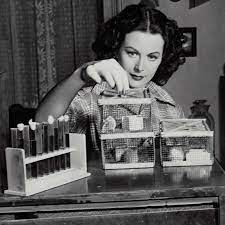
Hedy soon found herself in the famous Hollywood social circuit. Among the many illustrious people she met was Howard Hughes. Hughes was a high-flying American business magnate, investor, record-setting pilot, engineer, film director, and philanthropist. The two became good friends. Hedy’s attraction to Hughes was not so much for his wealth and name, but for his interest in innovation that appealed to her bottled-up inventive streak. Hughes took Hedy to see his airplane factories, showed her how the planes were built, and introduced her to the scientists behind process. He also recognised Hedy’s passion for the mechanical and encouraged her in this. He gifted her a set of equipment that she kept in her trailer on the film sets and tinkered with between takes. She continued to have her own ‘inventing table’ at home.  Hughes shared with Hedy his dream to make faster planes that he could sell to the US military. Hedy got deeply engaged in the project, researching fish fins and bird wings to understand how they were designed for maximum speed and efficiency, and she made engineering sketches for a new wing design for Hughes’ planes. Howard Hughes was very impressed with the designs, and called Hedy a “genius”.

Hedy Lamarr continued to live two parallel lives as it were. She was a celebrated Hollywood star in public, but was also a tinkerer and inventor who often spent evenings at home studying research texts and working at her drafting table to create inventions to improve current designs. She claimed that “improving things comes naturally to me”. Rather than star-studded parties she enjoyed being among a small group of friends discussing ideas.

It was at the start of the 1940s when the United States was on the brink of being pulled into World War II that Hedy felt the strong urge to put her innovative mind to work overtime. One story goes that her Jewish mother who had managed to escape from Austria to London was waiting to cross the Atlantic to the US, and at the time the American ships were in danger of being torpedoed by the enemy forces. Another version is that Hedy was deeply disturbed by the fact that children had perished in torpedo attacks while on board ships intended to take them to safety.

She knew that the Nazis were hacking the radio systems of the Allies ships so that they could track and attack them. Hedy drew upon her knowledge of war weapons to work on inventing a remote controlled torpedo, and develop a method to improve the United States’ weak torpedo guidance systems. She knew that radio frequencies were the key to the solution—but the single radio frequencies that were being employed for torpedo guidance at the time were ineffective in escaping Nazi surveillance. She worked to create ‘a secret communication system that could not be hacked’. The system utilized changing radio frequencies to prevent enemies from decoding messages. Multiple radio frequencies were used to broadcast a radio signal, which changed frequencies at split-second intervals in an apparently random manner. To anyone listening, it would just sound like noise. But the signal would be clear if both the sender and receiver hopped frequencies at the same time.

Hedy worked on this system with an unlikely partner. This was music composer George Antheil who was known for his experimental compositions. Antheil, like Hedy, was an inventor at heart. As the war loomed the two began sharing concerns, and once when playing the piano together, the idea of the extraordinary new communication system emerged. The torpedo and the guiding vessel would change radio frequencies very rapidly in an identical pattern, controlled by a device similar to a paper roll in a player piano. In this way, the vessels could communicate with each other in a secure manner that could not be intercepted by the enemy thereby allowing the torpedo to find its intended target. And thus Frequency Hopping Spread Spectrum Technology was born.

After its creation, Lamarr and Antheil sought a patent and military support for the invention. They were awarded a Patent in August 1942, but the US Navy decided against the implementation of the new system. The Patent remained  classified until 1981, and during that time was only used in military technology such as sonar or satellite communications. Lamarr was disappointed, but she continued to support the war efforts of her adopted country by using her celebrity status to sell war bonds. She became an American citizen in April 1953.

Hedy Lamarr continued with her passion for invention, and even till she passed away at the age of 85, she was inventing things: a fluorescent dog collar, modifications for the supersonic Concorde, and a new kind of traffic light, among many others.

It is believed that Lamarr’s Frequency Hopping innovation was the forerunner of today’s wi-fi technology and other wireless communications like GPS and Bluetooth. Difficult as it is to relate a famous movie star and acclaimed musician with the same technology that now brings movies and music to our very fingertips.

Hedy Lamarr’s name will always be primarily associated with her beauty on the silver screen. But so much more interesting and inspiring is her other side that illustrates that beauty and brains can coexist productively. As her son said after her death, “She would love to be remembered as someone who contributed to the well-being of humankind.”

–Mamata

A Wordy Adventure

 “I’m bored!” How many little boys and girls, across the world, echo the same words. More than ever before, the last two years when the pandemic confined families within four walls, this was the refrain. But this is nothing new.

There once was a boy named Milo who didn’t know what to do with himself not just sometimes but always.

That is the opening line of The Phantom Tollbooth, first published in 1961, which went on to become a classic of children’s literature.

The Phantom Tollbooth is the story of Milo, a 10 year-old boy who is utterly bored with everything around him. One day he comes home to finds a mysterious package with a bright blue envelope which reads “For Milo. Who has plenty of time.”

When unpacked it reveals a magical toy tollbooth which he sets up in his room. Having nothing better to do, he drives his toy car through it and there begins his whacky journey through the different realms of language. He is accompanied on his travels by a “watchdog” named Tock—a large dog with an alarm clock for a body. 

Crossing Expectations and going through the Doldrums, Milo heads for Dictionopolis, ruled by King Azaz the Unabridged–Monarch of Letters, Emperor of Phrases, Sentences and Miscellaneous Figures of Speech. He is welcomed by five tall thin gentlemen who introduce themselves as The Duke of Definition, The Minister of Meaning, the Earl of Essence, the Count of Connotation, and The Undersecretary of Understanding.

We offer you the hospitality of our country, nation, state, commonwealth, realm, empire, palatinate, principality.

Do all those words mean the same thing? asked Milo.

Of course, certainly, precisely, exactly, yes, they replied in order. They also explain: Dictionopolis is the place where all the words in the world come from. They’re grown right here in our orchards.

Milo wanders around the marketplace of words where there are thousands of words on sale, with the vendors trying their best to sell theirs. It is here that he meets the giant Spelling Bee, that can spell any word, and who joins him on his travels.

Finally he meets the king who asks him what he can do. Milo has no answer. The King thinks:”What an ordinary little boy. Why my cabinet members can do all sorts of things. The duke here can make mountains out of molehills. The minister splits hairs. The count makes hay while sun shines. The earl leaves no stone unturned. And the undersecretary hangs by a thread.”

And thus Milo embarks on a wordy adventure where the characters indulge in a riot of word play that initially throws Milo into deep confusion, but gradually his curiosity leads him not only to learn new things, but eventually to join in the pun-fun as it were. 

From Dictionopolis to Digitapolis, from the Foothills of Confusion, and over Mountains of Ignorance; through the Valley of Sound and the Forest of Sight; the Sea of Knowledge and Island of Conclusions (he had to jump to get there!), and the Kingdom of Wisdom, Milo encounters an army of new words as he is roped in to rescue the captured princesses of Rhyme and Reason imprisoned in the Castle in the Air, while fighting the fearsome Hate and Malice.

The Phantom Tollbooth is an absolute delight for word lovers such as me. The word play is clever and stimulating, reminding one of the adventures of Alice in Wonderland. When the book was published, several reviewers wondered whether children would even understand so many new and unfamiliar words, and whether they had the ability to really enjoy the play on words. These apprehensions were vindicated when the book sold millions of copies; and continues to remain a favourite even 60 years after it was first published in 1961.

Years later the author Norton Juster explained his approach: My feeling was that there is no such thing as a difficult word. There are only words you don’t know yet, the kind of liberating words that Milo encounters on his adventure. Today’s world of texting and tweeting is quite a different place, but children are still the same as they’ve always been.

The story of how the book came about is equally interesting. Norton Juster was a young architect working in New York. He had received a Ford Foundation grant for a book on cities for children, and spent months researching it. One day, in a restaurant, he overheard a boy asking the question   “What’s the biggest number there is?” That put him on a totally different path.

I started to compose what I thought would be about a child’s confrontation with numbers and words and meanings and other strange concepts that are imposed on children,” he wrote. “I loved the opportunity to turns things upside down and inside out and indulge in all the bad jokes and puns and wordplay that my father had introduced me to when I was growing up.

The grant never fructified into the intended book, but there began the story of The Phantom Tollbooth. Norton recalled: When I wrote the book I really didn’t write it with any sense of mission. I wrote it for my own enjoyment. The book in no way was written to any sense of what it was that children needed or liked.

However, under all the word play is just what children need–a feeling that navigating the world can be an exciting adventure in itself. As Norton puts it: And I think what kids do — it’s a fairly universal kind of thing – I think the general sense of the book – the feeling of it is something most kids experience one way or another. They’re at times disconnected, or they don’t know what to do with themselves. They don’t know why anything is happening. All the things that they’re learning don’t connect to other things. One of the things that happens in your life is you start out learning a million facts and none of them connect to any other facts. As you get older you gradually realize that something you learned over here connects to something you experienced over there. And you start drawing sort of mental lines, and after a while, like when you get to my age, there’s almost nothing that you learned that doesn’t connect with 80,000 other things. So it all has some kind of a meaning and context to it, and I think kids slowly begin to feel that too.

In an age when children have so many distractions, and yet are always “bored” this book encourages them to look anew at the world around them. You have to constantly look at things as if you’ve never seen them before. Or look at them in a way that nobody has ever seen them before. Or turn them over and look at the other side of everything. That is the magic formula.

Serendipitously, at the time Norton was writing the book, his illustrator friend Jules Feiffer, who was also his upstairs neighbour, read some of it and spontaneously produced a bunch of perfectly-suited drawings that brought the characters to life. And The Phantom Tollbooth continues to be loved by children even six decades later.  

I seem to have missed reading this book in my childhood, but I am delighted to have discovered it in the sixth decade of my life. Thank you Evan for sharing this, a favourite childhood read of yours, with me!

–Mamata