A Day for Donkeys: Vautha Fair

For an animal that is usually the brunt of jokes, or the joker on the animal pack, this is the one occasion when the donkey is in the limelight. The Donkey Fair revolves around donkeys, and marks an important event in the local calendar of Gujarat. Held annually at Vautha, the fair goes back hundreds of years, and even today attracts large crowds.

The event occurs on the full-moon night of the lunar month of Kartik (October-November), which begins after Diwali. Kartik Purnima is considered as an auspicious day and is celebrated by different communities in India in different ways. A common ritual is taking a holy bath in a river. As per Hindu mythology, it is believed that this is the day on which Hindu Gods came down to earth to take a dip in a river, and even today, those who take holy dips in rivers receive the blessings of all gods, and their sins are washed away.

One such site is at Vautha in Gujarat, located near Dholka, about 50 km from  Ahmedabad. Vautha is located at the confluence of the rivers Sabarmati and Vatrak. The confluence is also called sapta sangam, which means the meeting of seven rivers. It is at Vautha that the Vatrak river merges with the smaller rivers Meshwo, Hathmati, Shedhi, Majum and Khari with the Vautha, which in turn merges with the Sabarmati.

The history of the fair goes back almost five hundred years. There are many local legends associated with it. One legend attributes the fair’s origins to the time when the sage Vashishta is believed to have performed a yagna at the confluence of the rivers. Another one claims that Vautha is one of the sites that the Pandavas stopped by at during their exile.

Legend also has it that Kartikeya or Kartik, the son of Lord Shiva and the Goddess Parvati visited this site on this full moon night. To mark this, an annual fair dedicated to Kartikeya is held on Kartik Purnima. Thousands of pilgrims from all castes and communities and professions throng here for a holy dip, and the festive atmosphere is highlighted by a fair.

The fair is a vibrant event with numerous stalls selling local food, handicrafts, and lots of other attractive ware. It is enlivened by music and local theatre performances and folk dances. There are rides and varied exciting activities. This is a major social and cultural event that villagers from far and near look forward to all year.

What makes this fair unique is that this is the major animal trading fair in Gujarat where the main animals traded are donkeys, although there is also some trade in camels, horses and goats. It is believed that this is an auspicious time for buying and selling animals.

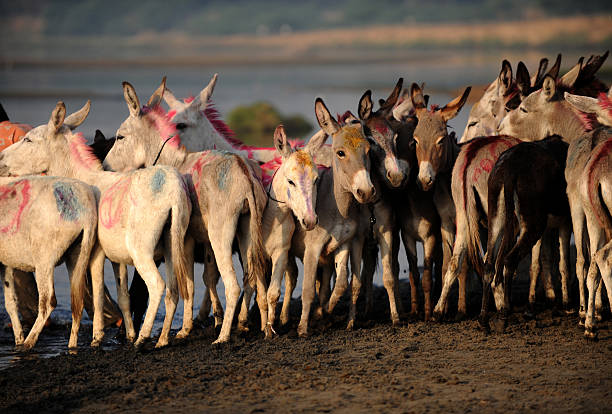
Farmers and traders from all over India bring donkeys to the fair. The animals are painted with coloured patterns and make for an attractive sight. However the buying and selling is serious business. Donkeys are closely examined to verify breed, build, fitness and health. Scrutiny of the teeth is an important part of the process. There is usually an auction to boost to competition and the prices which can range from 7,000 to 17,000 rupees or more.  

Several different breeds of donkeys make their way to this auction. Each has its own characteristics and uses. Halari donkeys from Saurashtra are white in colour and of docile temperament. They are used as pack animal during pastoralist migration, being able to walk 30-40 km a day; and also to pull carts. Kuchchhi donkeys from Kuchchh are grey, white, brown or black in colour. They are sturdy and can carry 80-100 kg and pull 200-300 kg on carts. They are used as pack animals during migration, and also for weed removal on farms. Sindhi donkeys from Barmer and Jaisalmer districts of Rajasthan are brown in colour can carry 1000-1500 kg and are used as pack animals to transport water, soil, earthenware, construction material, and fodder; as well as for pulling carts and for ploughing by small and marginal farmers. There are also donkeys from Marwad as well as other local breeds from other parts of India.

While thousands of donkeys continue to be brought and traded at this largest donkey fair, studies indicate that there is a steady decline in the donkey population in India. Increasing mechanization has replaced the need for donkeys for transporting material and as pack animals. This is also a factor for replacing donkeys in farm work. Traditional donkey-raising and herding families are moving to new occupations as demand for donkeys is going down, and the cost of maintaining the animals rises. There are also no specific government schemes or policies that promote the animal or its welfare. Donkeys are being abandoned when they are too old or feeble for hard labour. Even in Ladakh which has a tradition of donkey rearing, there is a decreasing role for donkeys in local occupations and uses. A donkey conservation park has been opened here in collaboration with communities where stray or abandoned donkeys are kept with dignity.   

In the meanwhile the donkeys still have their day at Vautha. And this year it falls on 15 November.

–Mamata

A Pre-Titanic Disaster: SS Vaitarna

112 years after the tragedy, April 15 is still marked as the day the RMS Titanic sank. This is remembered as the biggest maritime disaster of all times. The largest and most luxurious ship in the world at the time, The Titanic was also one of the most technologically advanced for its time; its 16 watertight compartments were believed to make the ship unsinkable. But just four days into its maiden voyage, the Titanic struck an iceberg near Newfoundland, Canada, damaging its watertight compartments. Only hours after the collision the ship sank, taking 1500 passengers with her.  

SS Vaitarna

Not many are aware that twenty years before this tragedy, another ship had mysteriously vanished, taking along with her, more than a thousand people. And this little known event occurred along the coast of Gujarat in India on 8 November 1888.

The ship was SS Vaitarna, one of the earliest steamships operating on the west coast of India. It was named after the Vaitarna River which flows north of Mumbai, but was built by the Grangemouth Dockyard Co. Ltd in Scotland. It took three years to build. The 170 feet long steamer had three floors and 25 cabins. Its value was estimated to be 10,000 pounds, and it was insured for 4,500 pounds. Its maiden voyage from Scotland involved sailing around Africa to Karachi its first destination.

The Vaitarna was owned by A.J. Shepherd & Co. in Bombay. The captain of the ship was Haji Cassum, a zamindar from Kuchchh who owned large tracts of land around Mumbai.

The ship started sailing in 1885 and was used mainly for carrying cargo and passengers between the Mandvi port in Kuchchh and Bombay. Vaitarna was far from the luxury liner that the Titanic would be two decades later. But it had something that was a great novelty for the time—electricity! The ship was lit with electric bulbs, long before external lighting was made mandatory for safe navigation at sea. This was such a unique feature that the local people dubbed the ship Vijli (the Gujarati word for electricity or lightning). The lighted ship attracted scores of visitors when it used to come to Mumbai; sightseers were charged two rupees for the viewing.

Vijli regularly plied between Mandvi in Kuchchh and Bombay, ferrying passengers and goods. It took 30 hours to cover the distance, and the passenger fare was eight rupees.

On 8 November 1888, the ship was anchored at Mandvi port. At noon that day it set sail for Dwarka with 520 passengers on board. About 200 more passengers are believed to have boarded at Dwarka before the ship left for Porbandar. But as the weather was turning stormy the ship did not stop at Porbandar but headed directly for Bombay. The storm gained strength and the seas were choppy. That evening the ship was seeing off the coast of Mangrol, but that was the last sighting. Vijli never reached Mumbai. The next day SS Vaitarna was declared missing with all the passengers on board. The passengers included 13 wedding parties and a number of students who were on their way to Mumbai to appear for their matriculation exams.

While it is known that there were at least 700 passengers, plus about 40 crew members, the exact number of casualties could never be ascertained. It was common practice for ships to load far beyond their normal capacity. It has been speculated that ship could have been carrying as many as 1200 passengers.

No wreck of the ship nor remains of the passengers were ever found. Unlike the Titanic, SS Vaitarna had no survivors. The first attempt to locate the remains were by the ship SS Savitri. Its captain Mahomedbhoy Dawood, had been a friend of Haji Cassum for many years; he knew Cassum to be a careful navigator.

The cause of the wreck has also remained a mystery. A Marine Court of Inquiry was set up by the Bombay Presidency to investigate. It pointed out that the ship did not have enough lifeboats, and was not adequately equipped with safety measures. Generally the ships in this region were not designed to ply on stormy seas. They would travel along the coast from port to port during the non-monsoon seasons, and would remain moored in harbour during the rainy season. But November is not the monsoon season in the Arabian Sea.  

However another report by the then government of India claimed that the ship was in good condition and all its machinery was in good order, and that it was fully equipped and sufficiently manned. It would have taken a cyclonic storm to capsize it.

Whatever the cause, the effect was the total and complete disappearance of SS Vaitarna. However this disaster led to the realization about the need for relaying early credible forecasts about storms and led to several reforms in India’s shipbuilding and navigation systems.

No compensation was given to the families of the missing passengers. After the initial attempts at searching for the wreckage, the curtains were drawn. While the sinking of the Titanic continues to evoke interest and discussion even a century later, this early, and just as tragic, shipwreck has almost been forgotten in the annals of shipping history. The Lloyd’s Register of London recorded only one word against SS Vaitarna: Missing. 

The Vaitarna tragedy however became a part of the lore of Saurashtra. Even today stories and songs commemorate Vijli and her captain Haji Cassum.

–Mamata

A MURDER OF CROWS

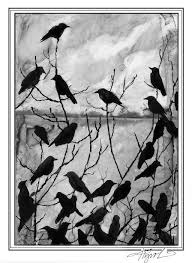
A few days ago our champa tree was the venue for an impromptu gathering of crows. They descended literally out of the blue and within flapping seconds, settled onto the branches and commenced a raucous chorus. What a “cawcaphony” I said to myself and peeped out to investigate the cause of the assembly. It turned out that there was a dead crow not far from the tree, and the incident was being marked with a suitable mourning from its clan. Quite spontaneously, I remembered that the collective noun for a group of crows is called a ‘murder’ of crows. Well here I was witness to a murder of crows in action!

Why this descriptor? The term is believed to have originated in England in the 15th century, and was linked to old folk tales and superstitions. In the Middle Ages, collective nouns were often given to animals based not only on their behaviour but also on superstitions or prevalent attitudes towards them.

One among these was the belief that crows will come together to decide the fate of another crow (a court of crows?). Another belief was that the appearance of crows was an omen of death. Yet another, based on the fact that crows are scavengers and were thought to circle over areas where animals and people were expected to die. A more scientific reason for his may be that crows are opportunistic feeders and will eat everything–carrion, small animals, insects, or crops, and thus find their way to wherever these may be available.

In fact, crows, though often considered to be pests, and generally irritating, are a highly intelligent and social species. They have the ability to create and use tools, they have been known to solve multi-step puzzles. They are extremely social birds that flock together and also have an ability to learn from each other.

Crows
Pic: Northern Woodlands Magazine

Another interesting aspect of crow communities is that they have been shown to recognize their dead and hold “funerals” for dead individuals, something that has only been observed in a few other species including elephants, dolphins and some primates. This could be an unsettling scene for observers, (probably what I witnessed) but scientists believe this is a way by which they communicate to their fellow crows about potential threats to be avoided.

Besides ‘funerals’ why do crows flock together? For many reasons. Crow are smart and adaptable, and gathering in large groups is often both a solution to a problem and a social benefit. Communal foraging strengthens social bonds and hierarchies within the crow community as well as efficiency. Communal roosting provides safety from predators and establishes social bonds, social learning and information.

The ‘cawcaphony’ also has its reasons. Loud and distinctive cawing is used to convey messages about food locations, to call others for support in defending their territory, or to alert the flock of approaching predators. There are specific caws for different types of danger. As well as caws, crows have softer calls which are used within family groups.

Yes crows are a part of our lives, generally around, but not really headline grabbers. Until recently, when crows have been in the news. And this time the news is about a literal “murder of crows”. The target of this planned execution is the Indian house crow Corvus splendens, whose population is being systematically eliminated in Kenya.

The story of the crow in Kenya goes back to the 1880s when it is believed that the first few pairs of Corvus splendens arrived on the island of Zanzibar by ship. One story goes that a breeding pair was presented to the Sultan of Zanzibar as a gift from an Indian dignitary. Another account believes that the scavenging crows were brought to the island in a bid to clean up the garbage. The introduced species soon gained a foothold not only on the island, but also spread to nearby mainland countries like Tanzania and Kenya. Showcasing all their traits of intelligence, adaptability and resourcefulness, the crow population grew rapidly and began to not just scavenge but also raid crops and poultry farms, as well as food sources in urban areas. By 1917, House crows were officially declared as ‘pests’ by the local authorities.  

The House crow reached Kenya in 1947, and since then its numbers have exploded. The growing human population, both local and tourists (tourism is the mainstay of Kenyan economy) has led to growing waste sites with mounds of garbage. The municipal authorities have not been able to efficiently manage the waste. This has led to a huge proliferation of crows who not only feed on the garbage but have also learned to mob eating places and swoop up food from diners’ plates.

Besides the pestering of humans, conservationists are concerned that the overwhelming numbers of crows are driving out many smaller indigenous species of birds, impacting biodiversity. With decline in indigenous bird species, pests and insects begin to proliferate, impacting local flora as well as crop plants. This is one more case of how invasive species can impact local ecosystems.

The Kenyan government undertook a programme to control the invasive bird species twenty years ago. While this helped reduce the crow population for some time, the resilient species bounced back with an exponential rise in numbers. In the past there this menace has been addressed with the baiting of food with Starlicide, a slow-acting poison to tackle the crow menace. This time the Kenyan government is planning to use all methods, including this, to eliminate a million crows by the end of the year. A sad, but perhaps unavoidable, murder of crows.  

And just last week was the news that the US Fish and Wildlife Service proposed to kill half a million Barred owls across the states of California, Washington and Oregon over the next ten years. This is because the population of Barred owls is crowding out its less aggressive relative the Northern spotted owl which is an endangered species. This news has sparked of several debates. While this is not a case of an invasive species, it is a case of one species becoming dominant, to the detriment of other species. There is also the moral issue of killing one species to protect another. Perhaps it will take a ‘parliament of owls’ to resolve the case!

See also:

The Camel in the Tent: Invasive Animal Species

A Parliament of Owls

–Mamata

Maze-Amaze

Last week, I was in a shopping area near my house, and got myself lost. Having no sense of direction, any set of streets can turn into a maze for me, and I can get lost hopelessly anywhere!

That is when I started thinking about real mazes. What would I ever do if I got into one? Probably panic and die!

But apparently that wouldn’t happen in a labyrinth. Because though most of us don’t really stop to think about the difference, they are very different! Labyrinths have a single continuous path which leads to the centre, and as long as you keep going forward, you will get to the centre eventually. So given enough time, it is close to impossible for anyone, even me, to get lost in a labyrinth.Mazes on the other hand, have multiple paths which branch off and will not necessarily lead to the centre or to the exit.

Mazes probably evolved from labyrinths, and over time took on elaborate forms including multiple branching paths, dead ends, etc.

The first recorded labyrinth is a 5th century BC one from Egypt. Labyrinths are found in many cultures, and generally seem to have an underlying spiritual meaning.  Some represent spiritual journeys which guide visitors towards a single path, which may be full of twists and turns, but there is no doubt of reaching the goal as long as one is walking on the right path. In some cases, entering the labyrinth signified death and exiting it signified re-birth. They were also fertility symbols. Labyrinths were also thought to represent protection or fortification. Often in temples, forts etc., one can find carvings or paintings of labyrinths on the floor or walls, to represent one of these symbolisms.

Some temples are like labyrinths themselves, and their orientation, form and geometry have symbolic as well as spatial importance. The process of moving through the pathways is supposed to unwind the Kundalini or stored energy, releasing, magnifying, and ultimately harnessing its flow. 

Chakravyuha labyrinth

Many military formations adopted in ancient Indian warfare were labyrinths. The famous Chakravyūha (wheel formation, also called Padmavyūha—lotus formation) of the Mahabharata was one such. It was a very special formation and knowledge of how to penetrate it was limited to only Abhimanyu, Arjuna, Krishna and Padyumna on the Pandavas’ side. The Kauravas strategically diverted the senior warriors to different parts of the battlefield, and then went into the Chakravyuha formation, and succeeded in decimating the Pandava warriors. 16-year old Abhimanyu was there and bravely plunged into the wheel, killing many seasoned Kaurava warriors. Alas, he did not know how to get out of the formation, and at the sixth level, was slaughtered by a horde of Kauravas.   

The Bara Imambara of Lucknow houses a famous Indian maze. Said to be the world’s largest structure that is unsupported by beams, the Imambara is considered a marvel of engineering. The fourth Nawab, Asaf-Ud-Dowhala, commissioned this building during the drought of 1784 to help people in the city earn a livelihood. He invited bids and it was won by Hafiz Kifayatullah, an architect from Shahjahanabad who was already well-known by then. Work on the building started in the 1784 and finished fourteen years later.

The Bhul Bhulaiya or Maze located on the upper floor of the Bara Imambara was Kifayatullah’s masterpiece. It is said that there are 1024 ways of getting inside the maze but only two ways of coming out! Once you enter the maze, you might end up going round and round and up and down staircases without being able to come back. It is even difficult to figure out which level you are at—you could think you have climbed down to the lower floor, but may still be on an upper one!

Interestingly, about 10 years ago, archaeologists uncovered a 2,000-year-old labyrinth that is the second-largest ever found in the country. This is in Gedimedu in Tamilnadu, along an ancient trade route on the east coast of India. It measures 56 feet by 56 feet, with passages ranging from 2.6 feet to 3.6 feet. It follows a pattern similar to Greek mazes found on clay tablets from 1200 BC. Archeologists are still studying the maze.

I am not sure I want to ever go into a maze or labyrinth. I don’t want to be loster than I am!

–Meena

.

A Tree for all Reasons: Khejri

5 June has been marked annually as World Environment Day (WED). First held in 1973, and led by the United Nations Environment Programme (UNEP), WED is the largest global platform for environmental public outreach and is celebrated by millions of people across the world. This year, 2024, the kingdom of Saudi Arabia is hosting the global celebrations.

The focus of this year’s WED is land restoration, desertification and drought resilience.

As the world is seeing rapid advances in desertification, and land degradation, propelled by climate change, it is useful to go back and see nature’s in-built mechanisms for coping with such conditions. 

Khejri tree

Plants that grow in arid areas have special ways of dealing with extreme heat or cold, and other desert conditions.  Desert plants fall into three categories according to the way they deal with the problem of surviving in arid or extremely arid conditions.

Drought evaders: Plants which remain as seeds in the sand, but are ready to spring up when it rains, to flower quickly, to produce another crop of seeds and die again. These are known as ephemerals.

Drought resisters: Plants which have evolved various ways of storing water, locating underground water or reducing their need for water by such methods as shedding their leaves. These are known as perennials. They manage to live from one rainy season to another.

Drought-endurers: Plants which have the capacity to tolerate drought for a longer period by adapting through condensed growth, small-sized leaves and very deep root system.

These natural adaptations have enabled these plants, over millennia, to grow in some of the toughest of conditions. In turn, these plants have also played an important role in supporting other life, including human life, in desert conditions. Perhaps no plant better exemplifies this than the Khejri tree.  

Khejri or Prosopis cineraria is a tree that grows in the dry and arid regions of India and West Pakistan, Afghanistan and Iran where summers are very hot, winters are harsh, and rainfall is scant. It has a variety of common names in different states of India. Khejri or sangria (Rajasthan), jand (Punjab), kandi (Sindh), sami, sumri (Gujarat). Its trade name is kandri.

A moderate-sized evergreen thorny tree, with light bluish-green foliage, its sturdy older branches, and slender tender branches have conical thorns. It sprouts freely from the base, producing a fresh growth of leaves around March. Soon after the new leaves, the small yellow, creamy white flowers appear. These, in turn, give way to pods.

This drought-resister tree has a range of adaptations that enable it to grow well in highly arid and harsh conditions, where other plants cannot survive. It grows on a variety of soils, including moderately saline soils. It has a long and well-developed root system. This serves two purposes; it provides firm anchorage and also aids in obtaining moisture supplies from deep down. Its foliage also helps to absorb moisture from the rains, as and when there is rainfall. 

The roots are a life saver not only for the tree, but are equally valuable for the environment in which the tree lives. The extensive root system helps to stabilize shifting sand dunes. The tree is useful as a windbreak shelter, and in afforestation of dry areas. It fixes nitrogen through microbial activity, and its leaf litter decomposition adds organic matter thus rejuvenating poor soils.

Often being the only kind of tree that grows in the arid conditions, the tree also provides much needed shade and shelter to local farmers, as well as livestock. Prosopis cineraria is a much valued fodder tree, which provides nutritious and highly palatable green as well as dry fodder which is readily eaten by camels, cattle, sheep and goats. Its dead leaves are fed to cattle to improve milk yield. Its dry pods are also nutritious animal feed. The pods are also eaten, in green as well as dry forms, by people who have scant access to a variety of fresh vegetables for much of the year.

The tree’s wood is suitable for construction, and is used locally for numerous purposes including making agricultural implements and tool handles, water pipes, yoke and spokes of carts. The high calorific value of the wood also makes it an efficient fuel wood. The bark of the tree is dry and acrid with a sharp taste. The bark extract is believed to have anti-inflammatory properties, and is used in traditional medicine to treat rheumatism, cough and colds, and asthma, as well as scorpion sting. The pod is also believed to have astringent properties.

A popular saying in the Thar desert encapsulates the value of the khejri. Death will not visit humans, even at the time of famine, if they have a khejri, a goat and a camel, since the three together help sustain humans even under the most trying conditions. 

Thus for millennia the people of the Thar have revered the khejri as such a critical part of their lives. And they have given up their own lives to save the trees that sustain their lives.

Nothing highlights this better than the story of Amrita Devi and the Bishnois, or Twenty-niners, a sect that lived by simple tenets: Do not cut any green tree, do not kill any animal or bird, respect every living being, it has as much right to life as we humans do.

Amrita Devi’s story dates back to 1730.  The then Maharaja of Jodhpur, Abhay Singh, wanted to build a new palace for which he required wood. He sent his soldiers to a village to cut down some khejri trees. But this was a Bishnoi village. For hundreds of years, generations of villagers had nurtured and protected their vegetation, land and wildlife. One of the villagers was churning butter when she heard the commotion. Her name was Amrita Devi. She saw the men sharpening their axes and her mind flashed back to her childhood. She remembered how, every morning, she would respectfully greet  all the khejri trees and choose a special one for that day; she would hug it and thank it for all the gifts that it gave her and her people. Every child in the village had their own special tree.

Now the trees were in danger. Amrita Devi ran and confronted the axe men. She pleaded with them: “Leave our trees. They are our brothers and sisters, our village protectors. They are the breath of life, the water we drink, and our food.”

The axe men paid her no heed. They continued with their task. Amrita Devi hugged a tree. “Chop me first” she said, “take my life and leave my tree.” The axe men tore her away, but Amrita Devi was back at her tree, clinging for dear life. She did not let go of her tree; the axe men had to chop through her body to get to the tree. No sooner did Amrita fall than hundreds of villagers, young and old, rushed to the trees. Each one hugged a khejri tree. The king’s men continued to chop through them, until 363 people lay dead at the feet of the trees they hugged to save.

When the king heard of the incident, he could not believe that people would lay down their lives for trees. He personally visited the village to meet these people. They said: “The trees can survive without us, but we cannot survive without the trees.” The king was deeply moved the faith and humility of these people. He proclaimed that from then on no Bishnoi village would be called upon to provide timber or wildlife by hunting. Almost three centuries later, the Bishnoi community is intact. The twenty-nine tenets continue to live, even as the khejri trees give life to the land and its people. Amrita’s village came to be known as Khejarli after the trees she gave her life for.

Amrita Devi’s name is synonymous with her sacrifice. In 2001, a national award (the Amrita Devi Bishnoi Wildlife Protection Award) was created in her honour, to recognize people who had contributed to environmental conservation.

This World Environment Day, as the world looks ahead to combatting desertification, it is humbling to look back and remember the story of Amrita Devi and the khejri trees.

–Mamata

The Sleeping Prince

The story of Sleeping Beauty, in one form or the other, has been around since the 1300s. The story of Rip Van Winkle was written in 1819.

But there is one famous sleeper who goes much further back—to the Ramayana in fact. That is Kumbhakarna, the brother of Ravana. Kumbhakarna’s sleep was different from that of the first two—it was intermittent sleep. He slept for six months, then woke up and ate and drank for six months to satiate his enormous appetite, and then fell back asleep.

Kumbhakarna was a good and decent man, a mighty warrior, who was, as is often the case, cursed thanks to the fears/insecurities of some gods. There are two popular stories regarding his curse, though they may be many others.

Both begin with Kumbhakarna carrying out intense austerities, praying for months to Lord Brahma.  The first variation goes that Indra knew that what Kumbhakarna would ask for was his throne, and so begged Brahma to curse him. The other goes that all the devas were worried that the asura-prince would gain too much power if Brahma decided to shower his benevolence on him. So they went to Goddess Saraswathi to beg her intervention.

After a length of time, Brahma appeared to Kumbhakarna, quite pleased with him, and said ‘Ask what boon you will.’ At that moment, Saraswathi, the Goddess of words and music and learning, put a hex on Kumbhakarna’s tongue so that he mis-spoke as he articulated his requests.

Kumbhakarna meant to ask for “Indrasaana” (the home of Lord Indra), but it came out as “Nidrasaana” (bed for sleeping) and when he asked for “Nirdevatvam” (destruction of Devas), it came out as “Nidravatvam” or sleep.

Brahma was quite a hasty God and obviously did not reflect too much on the boons he was granting and probably just said ‘Thatastu’—so be it. And in fact, the original grant was of unending sleep. Ravana had to intervene on behalf of his brother and go through loops before getting the boon modified to six months of sleep, followed by six months of waking. And so it was.

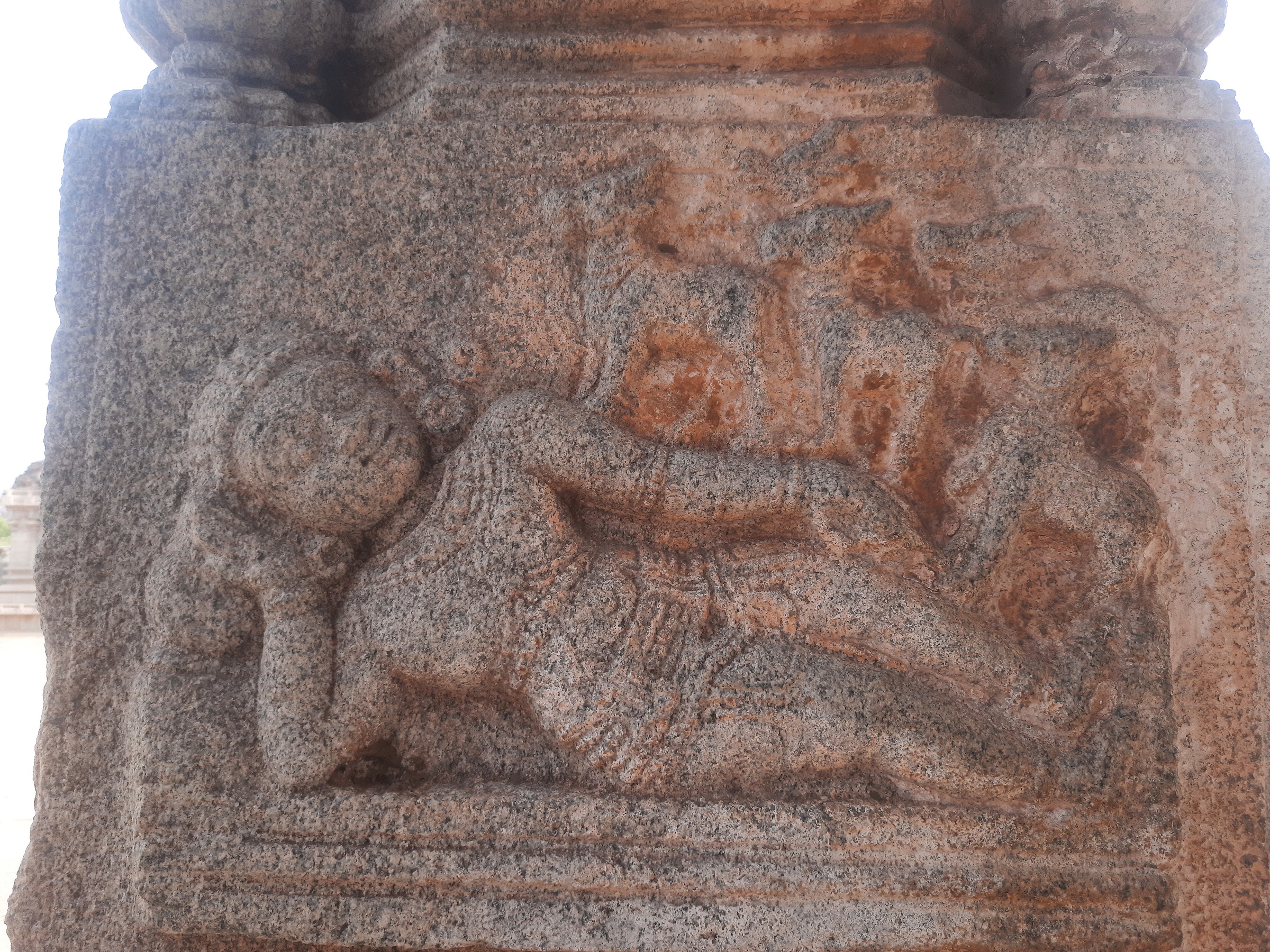
When Kumbhkarna slept, nothing could wake him—not horses and elephants walking over him, not a war or battle, nor all the musical instruments playing next to his head. And when he woke up, he would be so hungry, he would eat anything in sight.

Hampi
Horses walking over Kumbhakarna could not wake him! Sculpture atVithala Temple, Hampi.

As the war between Rama and Ravana began going against the asura king, his one hope was Kumbhakarna. Some accounts say that he ordered a 1000 elephants to walk over his brother to wake him up. When he did wake up, he counselled his brother against the war. He told him that he was not in the right, and they should give up Sita in all honour, and plead for peace. But Ravana obviously refused. Kumbhakarna, knowing they were fighting an unjust war, still threw himself into it in loyalty to his brother and kingdom. He is said to have killed 8000 monkey-warriors before Rama himself finally subdued and killed him.

Some scientists, analysing texts about Kumbhakarna suggest that he suffered from hypothalamic obesity whose symptoms include obesity, somnolence and rage (all three of which Kumbhakarna exhibited).

Well, whatever it was, his story had a sad ending. When Sleeping Beauty woke up, it was to love, a prince and a kingdom. For Kumbhakarna, it was death, defeat and loss of a kingdom.

–Meena

A Week of Celebrations

Just as the January festivities that heralded the New Year have waned, the early days of February have their own set of celebrations. From Galantines Day and Valentines Day, to Basant Panchami, to the Chinese New Year, this is a week that celebrates new beginnings.

Meena has written about the history of the first two days. The third day, Basant Panchami falls on the fifth day of the Hindu month of Magha. This year this happens to be on 14 February. This auspicious day, marks the first day of spring in the Indian seasonal almanac. This is also the day to pay homage to Saraswati, the goddess of learning, music, arts and wisdom. Homes are decorated with marigold flowers and rice flour rangoli, special food is cooked and distributed to family and neighbours after the traditional puja to invoke year-long blessings of the Goddess for knowledge and progress. Yellow is the colour that marks this celebration of spring—from wearing yellow clothes to the myriads of marigold ornamentations.

Celebrations of another spring festival in another part of the world also commenced this week with joy and fervor. This is the Chinese New Year, which like Basant Panchami, is determined by the lunar calendar. These celebrations, which last for 16 days, commenced on 10 February this year. The Chinese Spring Festival was originally a ceremonial day to pray to gods for a good planting and harvest season. As in all agrarian societies, the entire year was dependent on a good harvest. People also prayed to their ancestors, for their blessings. Even today, Chinese New Year heralds a time of renewal, prosperity, and festivity, not just in China, but for Chinese communities across the world. Celebrations symbolize fresh beginnings and a renewal of familial ties, and it is customary for family members from far and wide to travel to meet up for reunions and gatherings.

The Chinese zodiac follows a twelve-year cycle with each year assigned to an animal. The twelve animals are arranged in this order: Rat, Ox, Tiger, Rabbit, Dragon, Snake, Horse, Goat, Monkey, Rooster, Dog, and Pig. 2024 is the Year of the Dragon according to this zodiac. The dragon holds significant cultural importance in Chinese folklore. The Chinese people deeply cherish the dragon which is believed to represent strength, wisdom and good fortune. The dragon, this year’s Chinese zodiac sign represents power, magic, and the pursuit of one’s desires. Each animal in the zodiac is thought to influence the personality traits and fate of those born that year. Individuals born in the Year of the Dragon are thought to be blessed with good luck.

As in all traditional societies, there are a number of customs that mark the special days. Unlike most festivals which are preceded by a special round of ‘spring cleaning’, in the run-up to Chinese New Year’s day, traditionally bathing was not allowed on this day, as also sweeping  throwing of garbage, a few days prior to this day. This is to make sure that all the good luck is not swept or washed away! On the other hand there is a designated day before the New Year which is dedicated to cleaning so as to sweep the bad luck away and make room for the good. A delicate balance indeed! There are a few other taboos during the New Year period, once again to guard against any ‘seeping changes’. No cutting of hair or nails, no use of sharp objects, no breaking no swearing, cursing or saying unlucky words like ‘death’ or ‘sickness’.

While Indian spring festival is marked by the exuberance and cheer of yellow, it is red that marks the heralding of a new year in China. Houses are decorated with red lanterns, strings of red chilli peppers (real or fake), and red decorations on walls and doors. Red clothes are also a part of the Spring Festival wardrobe. It is believed that the colour red will help to deter evil and demons. Children traditionally receive money in red packets or pockets are they are called. These symbolize the transfer of good fortune from elders to the youngsters. The practice has its origins in folklore.

As the legend goes an evil spirit named Sui would appear on New Year’s Eve and pat the heads of sleeping children three times. This would make the children sick. One couple was playing with their child at bedtime with some coins and left the coins on red paper near the child as it slept. That night when the sprit Sui came it was frightened away by the coins glinting on the red paper. Thus began the tradition of giving children coins in red covers on New Year’s Eve, to guard against evil spirits and for their good health and fortune through the year. The tradition continues to this day.

The other tradition which is closely linked to the celebrations is the bursting of crackers, just as Diwali celebrations are marked in India. This one too has a legend attached. Another mythical beast named Nian who preyed on people and livestock, used to visit villages on New Year’s Eve, forcing people to hide in fear in their houses or escape to the mountains. There are two versions of the story. In one, a young boy burst crackers and scared away the monster. In another, a beggar took refuge in an old woman’s house and promised to save her from the monster. He pasted red papers on the doors and windows and burst crackers at midnight, both of which frightened away the monster. Thus bursting of firecrackers at midnight on New Year’s Eve and again on New Year’s morning has continued to be a tradition associated with this festival.

Ironically, due to safety reasons and air pollution concerns, the Chinese government has banned firecrackers in many cities in China. However there has been a lot of public pressure to allow people to celebrate an ages-old tradition of welcoming the New Year with the sound and light of firecrackers.

On another note, the Chinese government is hoping that the declining fertility rate and falling population numbers which has reached worrisome levels will get a boost with a flood of new babies born in the Year of the Dragon. According to the traits associated with the Chinese zodiac children born in this year will be imbued with strength, intelligence, confidence, and success. Thus it is hoped that parents will hope to conceive and deliver dragon babies in this year!

Whatever the mode of celebration, spring marks new beginnings, hope and freshness. Celebrating red and yellow every day of the year.

–Mamata

Sun, Giver of Light and Life

Makar Sankaranthi is linked to the solar calendar, and marks the beginning of the annual  transit of the Sun from the Southern Hemisphere to the Northern Hemisphere. Sankaranthi is also called ‘Uttarayan’—deriving from ‘uttar’—North, and ‘aayan’—movement.  The Sun moves from the Tropic of Cancer to the Tropic of Capricorn that day.

Makar Sankaranthi is celebrated across the country, but in different ways. In Tamilnadu, it is a harvest festival, and three days of Pongal celebrations mark worship of the sun, the rain and cattle—all fundamental to agricultural economies. It is a wonderful occasion to remind ourselves of how much we owe Nature, and that without the energy of the Sun, we can do nothing. ‘Pongal’ itself means overflowing, and the pot with rice, jaggery and milk is allowed to overflow to calls of ‘pongal-o-pongal’—welcoming abundance in the coming year.

The fundamental importance of the Sun has been recognized by many ancient cultures, and in many of them, kings ruled by the power of the sun and claimed descent from the sun.

In ancient Egypt, the sun god Re was dominant among the higher gods. The sun was not one entity– he sets out on his journey in the East as the young god Kheper; he appears at noon in the zenith as the full-grown sun, Re; and by the evening, when he is in the West he is in the shape of the old sun god, Atum.  When the Pharaoh Akhnaton (husband of the famed Queen Nefertiti) reformed Egyptian religion somewhere around 1350 BC, he took Sun worship to the next level by making it the official religion and the sun’s qualities as creator and nourisher of the Earth and its inhabitants were worshipped.

As far as Roman history is concerned, sun worship became fairly important in the later period.

Both Sumerian and Akkadian religions put sun worship at the centre of their belief system, and in Iran, sun festivals were celebrated as a heritage from pre-Islamic times.

In North America, the Plains Indians followed a solar cult with the Sun Dance as an important ritual. In South America, especially Mexico and Peru, sun worship was widely prevalent.  The ruler of Peru was believed to an incarnation of the sun god, Inti. The Aztecs worshipped Huitzilopochtli, the Sun God who was one of their most powerful and most revered gods. In fact, Aztec people considered themselves to be ‘the people of the sun’.

The sun goddess Amaterasu  played an important role in ancient Japanese mythology and was considered to be the supreme ruler of the world and the guiding deity for the imperial rulers. 

Sankaranthi
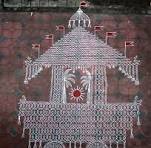
Sun Chariot Kolam

In many of these ancient traditions, the Sun God rides in a chariot drawn by horses. In Hindu mythology too, he rides chariot drawn by seven horses—which are said to stand for the seven colours of visible light or the seven days of the week. There are different versions of the names of the seven horses. In some traditions, they are named after the seven meters of Sanskrit poetry: Gayatri, Brihati, Ushnih, Jagati, Trishtubha, Anushtubha and Pankti. In others, they are called Jaya, Vijaya, Ajaya, Jitapraṇa, Jitasrama, Manojava and Jitakrodha , which are different phases of light transmission through the length of the day.

The most traditional rangoli or kolam made in Tamilnadu for Pongal is the Ratham or Sun’s chariot. While there are 5×5 dot ratham kolams for amateurs, these designs can become incredibly complex and set off a competitive spirit across streets!

So let us rejoice in the spirit of Sankaranthi, and pray for abundance, peace and prosperity in the coming year!

–Meena

PS: The beautiful kolam is from the Net. I can claim no credit!

Kuldhara: Ghosts of the Past, Vandals of the Present

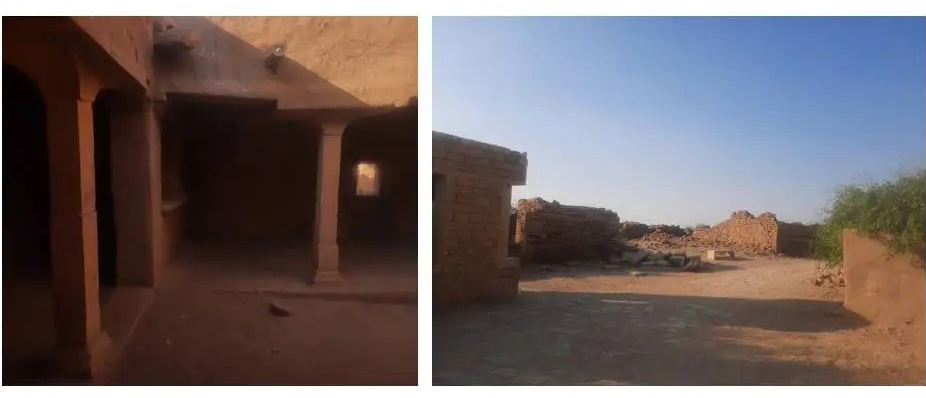
Kuldhara is on the tourist map of Jaisalmer district. On the way to Sam where the desert starts, is this ‘ghost town’ abandoned by its inhabitants about 200 years ago. The history of the town goes back to the 13th century when it was first settled by Paliwals, people from Pali district. Over the centuries, it grew into a prosperous place, with about 400 houses and over 1500 inhabitants at the peak. It had a pond, Udhansar, excavated by one of the first inhabitants, and at least one temple dedicated to Vishnu, as well as several wells and a step-well. It is actually a planned city, with proper layouts and a place for everything.

Till it was suddenly abandoned. It is not clear why the inhabitants left, but many reasons are given. Was it dwindling water supplies? Was it an earthquake? Or, more dramatically, was it the unwanted pursuit of one of the beautiful girls of the town by a local minister?

Well, whatever the reason or combination of them, it is a fact that people started leaving the place, probably not fleeing overnight as the tourist guides will tell you, but probably in trickles.

The mud-brick houses, temple and various other structures still stand in fairly good condition. Local legend of course goes that the township is haunted, and visitors are assured it is a dangerous place at night! The legend also says that the Paliwals while leaving the place, placed a curse on it, saying that anyone who tried to occupy it would meet dire consequences. All this led to its attracting tourists.

Kuldhara

The Rajasthan government decided to develop this as a tourist site around 2015. This is definitely a strategic move, given that it is just 18 kms away from Jaisalmer, and makes for a comfortable half-day trip, and it had already gained notoriety for its ghosts.

It is well-maintained by the Archeological Survey of India. There are of course guides. And importantly, fairly clean toilets. To this day, the neighbouring villages insist the gates be closed in the evening, so the Kuldhara ghosts don’t wander into their houses!

Of course, a lot more could be done—more signage, re-creation of a typical house, visualization of the town as it must have originally been, a more serious delve into the reasons for its abandonment, etc.

All of this will hopefully be done by the authorities in due course.

But an extremely disturbing incident that happened last week brings to fore the need for us as citizens and tourists to be more responsible. Newspapers report on a video that went viral. The video shows two tourists holding hands and kicking down the ancient brick wall of one the houses in Kuldhara. They were apparently doing this for putting up the video on social media.

The police are waiting for a formal complaint to be filed before taking action. Hopefully, this will be done fairly soon and action will be taken. The penalty for those who deface structures of national and historical importance has fortunately been enhanced in 2010 vide an amendment to the Ancient Monuments and Archaeological Sites and Remains Act. Now, such vandals will have to face imprisonment up to 2 years and/or a fine of up to Rs. 1 lakh.

Sadly, very few cases actually come to the stage where the punishment is given. Often, even the FIR is not registered—though in this case, the police seem to be ready to do this.

Kuldhara is just the latest example—from tourists knocking down pillars at Hampi to graffiti in Golconda, we have a long sad story of vandalism at cultural heritage sites.  If our monuments are to have a chance, punishment in these cases needs to swift, exemplary and well-publicized. Maybe there needs to be a sign outside the monument as to how someone tried to vandalize and what punishment they got!

And of course our educational institutions need to instill respect for our cultural and natural heritage, and strongly din home the need to take the greatest care of them.

The responsibility rests with each and every one of us.

­­–Meena

Ring in the New!

Welcoming the new year with the ringing of bells is an old tradition, immortalized by the lines from the familiar lines by Alfred Lord Tennyson.

‘Ring out the old, ring in the new,

Ring, happy bells, across the snow;

The year is going, let him go;

Ring out the false, ring in the true.’

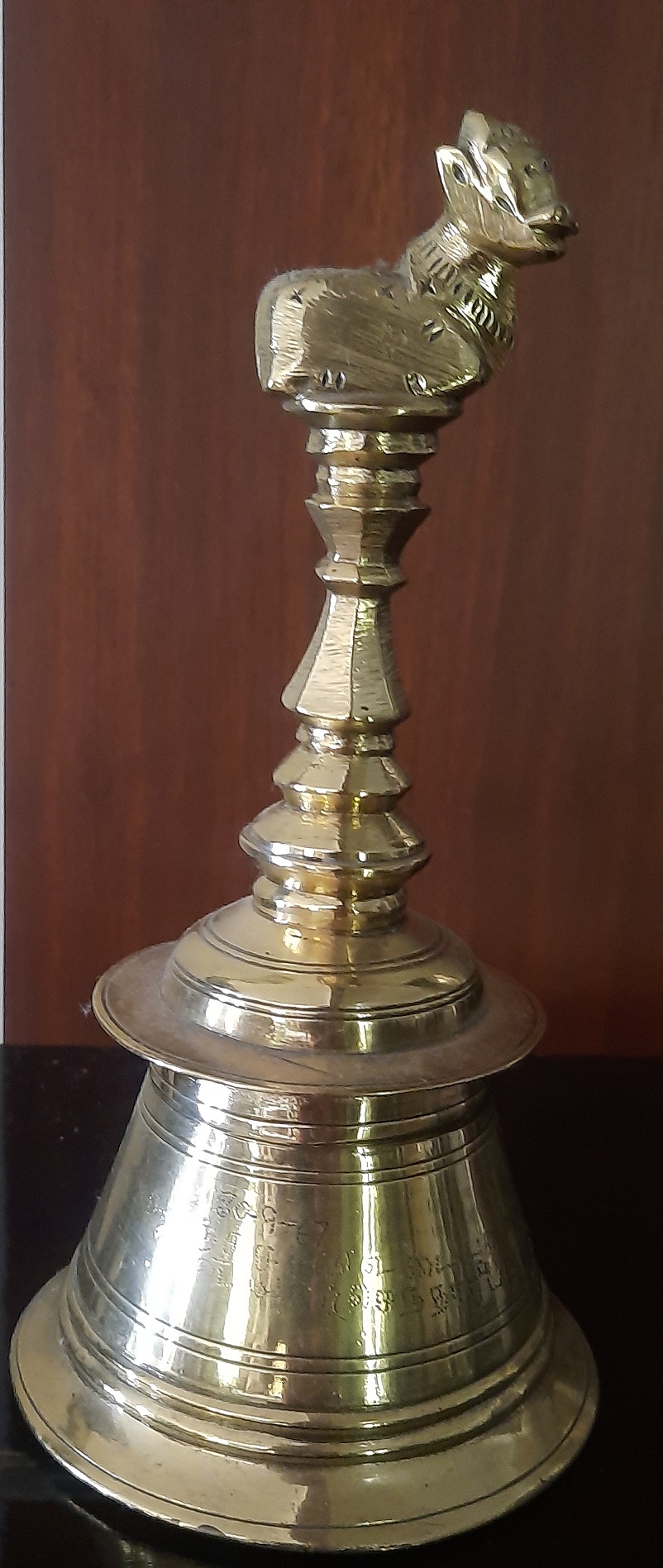
Down the ages and across the world, bells have played an important role—from summoning people to a gathering place, to a role in religious rituals, to announcing danger, to attracting attention. And importantly, to summon children to school, and provide them joyful reprieve at the end of classes! I am talking of course of traditional metal bells which are rung manually.  These traditional bells are ‘melodic percussive musical instruments usually made of metal (bronze, copper, or tin) but sometimes made of glass, wood, clay, or horn. When a bell is struck by a clapper (an interior object) or an exterior mallet or hammer, the bell, constructed of solid, resonant material, vibrates and produces a sonorous ringing sound’. Each bell is unique, depending on the material it is made of, how thick it is and its size and shape. Based on these factors, it resonates at certain harmonic frequencies and pitches. 

bell

A bell is usually suspended from a yoke– a cross piece that allows the bell to hang freely. The top of the bell is known as the crown and the middle portion is called the waist. The lower open section is known as the mouth, and the lower edge of the bell is called a lip. The part of the bell which is struck with a clapper is the thickest part of it, and is called the sound bow. Some bells are rung with clappers, a metal sphere that swings inside the bell Others are struck with a mallet or stick externally.

Gungroos represent a variation. Rather than being bell-shaped, they are orbs, with a few openings, which have small metal balls or even tiny stones enclosed within, which rattle and produce a tinkling sound.

With new technologies and means of communications, traditional bells and the traditional role of bells is diminishing. But interest in these bells and bell-ringing is alive. Many thousands of people around the world practice bell-ringing as hobby!

In fact, January 1 is observed as Bell Ringing in some countries. Many universities in the UK have bell-ringing clubs. When you join such a club, you first have to master the technique of pulling the rope attached to the clapper in a rhythmic way. Once you have mastered this, you can start “change ringing”–rhythmically ringing in a descending scale and then changing the order in which the bells ring in various different ways. Team bell-ringing is an activity which requires immense amount of coordination, and is a competitive event!

Bell Ringing Day not only sets out to encourage bell-ringers, but also to focus attention on the need to restore and maintain bells.

Our temples have beautiful bells which devotees ring as they go in. Most homes have small bells, and pujas are accompanied by the chiming of bells. Dancers wear ghungroos or rows of bells on their ankles. Cows are adorned with bells which chime as they move.

A cheery note to begin the year!

Happy New Year, and may the chiming of bells bring in good tidings!

Peace on earth, and goodwill to all.

–Meena