Riding High on the Waves: Women Pirates

This week Meena wrote about Bungaree the first Aboriginal man to circumvent the continent of Australia. His feat was amazing not only because he was the first to undertake the journey but also because he was from an indigenous tribe, in an era when sailors and adventurers were white men. Bungaree broke the mold in more ways than one, but always remained in the footnotes of the history of sailing.

There is another group that has been in a similar position in this context—women sailors. According to traditional sailing superstition, it was believed that having women on board ships could anger the Gods and lead to misfortune such as storms and shipwrecks. It was also felt that the presence of women on board would be a distraction to sailors and lead to fights and disruptions. In fact seafaring professions were officially barred to women until the 20th century. But maritime history has its own set of tales about spunky women who rode the waves over the earlier centuries, in many cases disguised as men, but also openly and boldly. The most fascinating of these are some of the women pirates who defied every established norm of the day.

Zheng Yi Sao: Queen of the South China Seas
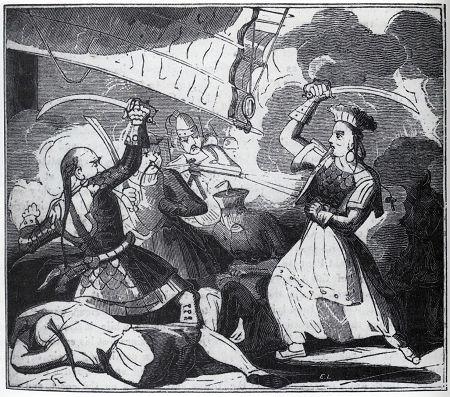
Zheng Yi Sao is described as the most successful female pirate in history. Born in 1775 into humble circumstances, she married the notorious pirate captain Zheng Yi, but on her own terms. She demanded equal partnership in his pirate fleet—an unprecedented and audacious demand. Zheng Yi was agreeable, and she took on the name Zheng Yi Sao (wife of Zheng Yi).

After her husband died when she was 32, Sao took control of his pirate fleet and transformed it into an unstoppable force in the South China Sea. She knew the coastline better than any imperial admiral, using hidden inlets and storm-lashed coves to evade capture. Sao was not just a skilled seafarer, she was a brilliant and brutal administrator. Her fleet was governed by a strict code of conduct:

Loot was divided fairly, with captains receiving a smaller share than their crew to ensure widespread loyalty. Female captives were to be treated with respect, and could only be taken as wives with mutual consent. Rape was punishable by immediate execution. All plundered goods had to be presented for group inspection, all captured goods were registered, and the punishment for disobedience was often beheading. Perhaps her most revolutionary approach was for other women within her fleet. The wives and widows of pirates were encouraged to take on leadership roles, creating an unprecedented situation where women held genuine authority in a violent, male-dominated world.

Zheng Yi Sao reigned supreme with an armada of over 300 ships and a crew of 20,000 to 40,000 pirates. Her fleet successfully defeated the navy of the ruling Qing dynasty, and even the ruling government could not destroy her power. Zheng Yi Sao’s power stemmed not just from ruthlessness and brute force, she was equally a strategic planner and shrewd negotiator. Recognizing that prolonged conflict would eventually erode her power she negotiated a surrender with the government, once again, on her own terms. She secured full amnesty for herself and almost all her crew, the right to keep her accumulated wealth; military positions for many of her top commanders.

Zheng Yi Sao eventually retired with all her loot, and continued to lead a civilian life for the next several decades. However she has gone down in the annals as the most successful pirate of all times. 

Sayyida al Hurra: Pirate Queen of the Mediterranean

Sayyida al Hurra was not just a pirate; she was a queen, a refugee, a warrior and a power broker of the 16th century Mediterranean. She was born in 1485 in a family of Andalusian nobles, but forced to flee to Morocco. While in exile there Sayyida rose to become Governor of a vital port city on the North African coast. Once in power, she decided to avenge Spain and Portugal, not through politics or war, but through piracy. She forged a strategic alliance with Barbarossa an Ottoman admiral and pirate, and together they controlled the seas, he in the east and she in the west.

Sayyida was more than a pirate commander; she was also a skilled diplomat and ruler. She negotiated directly with European monarchs, wielding influence usually denied to women of her era. She even married the Sultan of Morocco and insisted the wedding take place in her city, making her the only woman in Islamic history to have married a reigning monarch without leaving her seat of power. Thus Sayyida established rule over both land and sea, a rarity in history.

 Laskarina Bouboulina: The Pirate Admiral of Greek Independence

Laskarina Bouboulina was born defiant. Her father was a naval captain and rebel who had been imprisoned by the Ottomans. Laskarina was born in a prison cell in Constantinople in 1771, where her mother had gone to visit her imprisoned husband. After her father’s death Laskarina and her mother moved to the island of Spetses. This was no idyllic Mediterranean village, but a haven for smugglers, sailors and rebels who had fled conventional authority. The young Laskarina grew up among pirates and ship’s captains, learning about the language of the sea and sailing ships even before she could read.

By the time she was 40, Laskarina was married and widowed twice, to powerful ship owners, and inherited their fleets and fortunes. She used these resources not just for commerce but to fight the Ottoman Empire. She became a member of Filiki Eteria a secret organisation plotting to overthrow Ottoman control over Greece. Her main role was to smuggle food, weapons and ammunition into Spetses. She used her wealth to commission the construction of Agammennon, her personal warship, considered to be one of the largest and fastest Greek warships of the revolution. She commanded the rest of her fleet from this warship. Spetses was the first island to revolt against the Ottoman Empire in 1821. Laskarina then led her fleet to begin a naval blockade of the fortified city of Nafpoli, followed by the siege of other cities.  

Throughout the battle against the Ottomans, Laskarina conducted her spirited resistance with a mix of strategy, ruthless power and charisma. She was fierce, but an inspiring leader who commanded the respect of the men who willingly joined her battle. Ironically, she was killed in a family feud.

These swashbuckling buccaneers ruled the waves, broke every rule written for women, and rewrote history at sea.

–Mamata


A Moon of Many Names

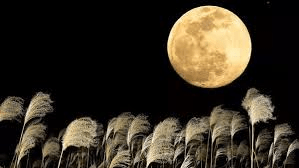
This week offered a rare celestial phenomenon which also coincided with the festival of Sharad Purnima, the full moon heralding the beginning of the winter season in India. This was the appearance of the Harvest Moon. This was one of the Supermoons that are scheduled to appear this year.

The Moon’s orbit around the Earth is not circular but elliptical, meaning that the distance between the two varies throughout the year. A Supermoon is when the moon is full at its closest point to the earth, called the perigree, or within 90% of its closest point. When it is at this point, the full moon appears noticeably larger and brighter. The term Supermoon was first coined by astrologer Richard Nolle in 1979.

The recent October full moon is known as the Harvest Moon. The Harvest Moon is the name given to the full Moon that rises closest to the Autumn equinox which is usually around 22 September, but aligning with the time between late September and November. During these weeks, the full moon tends to rise earlier than usual for several nights in a row, causing the evening sky to stay illuminated for a longer time. The name dates from the time before electricity, when farmers in the northern hemisphere depended on the Moon’s light to harvest their crops late into the night. The Moon’s bright light and extended period of illumination was particularly important during fall, when harvests are the largest in America.

Over time different cultures, have traditionally given names to full moon across the lunar calendar. The cycles of lunar phases were also a method of timekeeping. For example, in many Native American tribes, names of full moons reflected what was happening in Nature at that time. For example: January: Wolf Moon named after the howling of hungry wolves lamenting the scarcity of food in midwinter. February: Snow Moon reflecting the month’s typically cold, snowy weather. March: Worm Moon after the worm trails that would appear in the newly-thawed ground. April: Pink Moon after a species of early blooming wildflower. May: Flower Moon as thanks for the abundant blooming of spring flowers. June: Strawberry Moon to reflect the time for harvesting of strawberries. July: Buck Moon for the time when male deer, which shed their antlers every year, begin to regrow them. August: Sturgeon Moon which is when this fish species appeared. September: Full Corn Moon when crops are gathered at the end of the summer season. It is often the nearest full moon to the autumnal equinox, earning the title of ‘harvest moon’. October: Hunter’s Moon which gives hunters enough light to be able to stalk prey and hunt at night. November: Beaver Moon which refers to both the time when beavers are actively building dams, and also when hunters set beaver traps. December: Cold Moon which marks the setting in of winter.

The moon and its cycles have fascinated people from time immemorial. While the Native American tribes found a close connection of these cycles with their own life and work cycles, the mystery of the moon has also been the staple of folklore and fantasy. Several Asian cultures have tales about the moon. In China and Japan one of the zodiac animals–the rabbit—also has links with the moon.

There is a popular folktale in Japan about the Moon Rabbit which is believed to have its origins in the Buddhist origin tale. As one version of the story goes:

Many years ago, the Old Man of the Moon decided to visit the Earth. He disguised himself as a beggar and asked Fox (Kitsune), Monkey (Saru), and Rabbit (Usagi) for some food.

Monkey climbed a tree and brought him some fruit. Fox went to a stream, caught a fish, and brought it back to him. But Rabbit had nothing to offer him but some grass. So he asked the beggar to build a fire. After the beggar started the fire, Rabbit jumped into it and offered himself as a meal for the beggar to eat.

Quickly the beggar changed back into the Old Man of the Moon and pulled Rabbit from the fire. He said “You are most kind, Rabbit, but don’t do anything to harm yourself. Since you were the kindest of all to me, I’ll take you back to the moon to live with me.”

The Old Man carried Rabbit in his arms back to the moon and he is still there to this very day exactly where the Old Man left him. Just look at the moon in the night sky and the rabbit is there!

The rabbit on the moon is called Tsuki no Usagi in Japanese. People imagine when they look up at the full moon that they can see the shape of the rabbit pounding rice cakes with a pestle. At Jugo-ya the Japanese mid-autumn festival, people gather to watch the full moon, and children sing a song about Usagi the moon rabbit.

There is a similar legend in Korea where the moon rabbit is known as Daltokki, and also pounds rice cakes. In Vietnam, in a similar legend, the white rabbit is named Tho Trang. All these are celebrated at the Mid-Autumn festival.

The legend has also captured the fantasy of modern artists. A Dutch artist Florentijn Hofman created a giant moon rabbit as part of a display at the Taoyuan Land Arts Festival in Taiwan in 2014. It was made of 12,000 pieces of Tyvek, a kind of high-density polyethylene fibre, and placed in the open where it looked as if it was staring at the clouds in the sky and daydreaming, as the breeze ruffled its tyvek ‘fur’.  

India too has its share of moon legends. Whatever we may imagine we see in the shadows on the moon, the sight of a full moon is always breath-taking. This year the Harvest Moon which usually occurs in September, was on 6 and 7 October, a rare occurrence. Sadly many missed a clear viewing as many parts of the country had rain or cloud cover. But not to despair, this year will still allow us to enjoy two more Supermoons—on 5 November and 4 December.  

–Mamata

The Game of Life: Monopoly

This year is supposed to mark 90 years of one of the world’s most popular board games—Monopoly. It is estimated that the game, translated into 47 languages, has been played by one billion people worldwide. Hasbro, the company that produces the game is marking the milestone with events and publicity that retells the story of the invention of the game, and its subsequent success that made history.

According to this version, the game was originally created in 1935 by Parker Brothers. As the story goes, in 1932, a Philadelphia businessman named Charles Todd and his wife, Olive, introduced their friends Charles and Esther Darrow to a real-estate board game they had recently learned. The board game involved rolling dice to move tokens across the board while buying up properties listed on the board. The game did not have a name, and was not marketed but passed from friend to friend who all enjoyed playing it. Charles Darrow, who was at the time unemployed and in need of money, saw a potential opportunity, and asked his friend Todd for the written rules. There were none, friends made up rules as they played. It was informally known as the ‘monopoly game’.

Darrow however put together these ‘rules’ and hired an artist to design a board, and tokens and began to hand produce sets which he sold to a local department store with the name Monopoly. The game was a hit. Darrow sold this version to the toy manufacturer Parker Brothers in 1935, claiming that it was entirely his invention. He was granted a patent for this in 1935. And thus the official time line for the origin of game was pegged by Parker Brothers at 1935, and Monopoly was marketed with the story of how a struggling salesman created the game in his basement to support his family during the Great Depression.  

However, the real origin of the game goes back much further, to the beginning of the century, and its creator was a woman who was a pioneer in more fields than one. Born in Illinois in1866 to Scottish immigrant parents Elizabeth Magie moved to Washington DC in her early 20s. Lizzie, as she was known to her friends, lived as a single woman supporting herself, working as a stenographer and typist, both unusual for a woman in those times. Not only did she live on her own, she saved up and bought her own home, and went on purchase some acres of property. She also wrote poetry and short stories, and did comedic routines onstage. Lizzie had strong and radical political views. This was a time of mighty monopolies which led to huge income disparities. Lizzie became interested in the anti-monopolist policies of Henry George a politician and economist who propagated the concept of a single “land value tax”. The general idea that instead of taxing income or other sources, the government should only tax land, based on the usefulness, size, and location of the land, thus shifting the tax burden to wealthy landlords. The government should use the money from the collected taxes for its essential functions and distribute the rest to people in the lower socio-economic segment. His message resonated with many Americans in the late 1800s, when poverty and squalor were widespread in the cities.

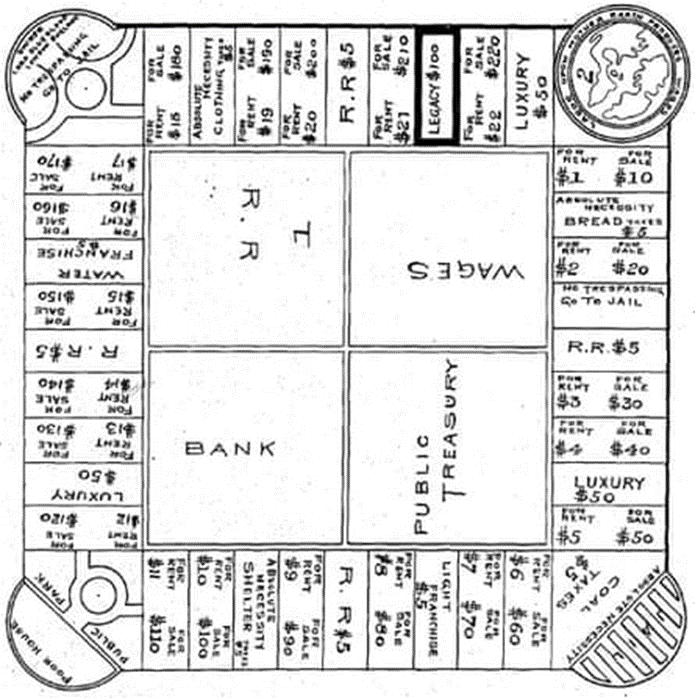
Magie’s original board design for the Landlord’s Game, which she patented in 1903. https://www.theguardian.com/lifeandstyle/2015/apr/11/secret-history-monopoly-capitalist-game-leftwing-origins

Lizzie was looking for an interactive and creative way to teach Henry George’s economic theories to friends and colleagues. The twentieth century had just dawned, and board games were becoming popular in middle-class homes. Many inventors realized their potential not just as a form of recreation, but as a means of communication. Elizabeth Magie felt that a board game could do what she visualized. After her office hours, Lizzie sat at home night after night thinking and drawing, rethinking and redrawing the grid and messages that would communicate these radical concepts.

Most of the board games at that time had a linear path design. Lizzie’s game had a grid that went round the board. The game featured play money and deeds and properties that could be bought and sold. Players borrowed money, either from the bank or from each other, and they had to pay taxes. In one corner were the Poor House and the Public Park, and across the board was the Jail. Also included on the board were three words scrawled across: GO TO JAIL.

Lizzie Magie created two sets of rules for her game: an anti-monopolist set in which all were rewarded when wealth was created, and a monopolist set in which the goal was to create monopolies and crush opponents. Her dualistic approach was a teaching tool meant to demonstrate that the first set of rules was morally superior. Ironically it was the monopolistic version of the game that caught on.

Lizzie called this game the Landlord’s Game. She described the new concept thus: “It is a practical demonstration of the present system of land-grabbing with all its usual outcomes and consequences,” she wrote in a political magazine.

She was in her thirties when she applied for a patent for her game in 1903. At that time she represented the less than 1 percent of all patent applicants who were women. And this was three decades before Parker Brothers started manufacturing Monopoly for which Darrow claimed credit as inventor, and Darrow’s story of a fluke invention by an unemployed man grew into the legend of Monopoly (and earned him millions). 

While some people noted the similarity between Monopoly and the Elizabeth Magie’s Landlord’s Game, the Darrow legend continued. A newspaper story in 1936 aroused interest when it reported on the similarity, and also that in 1935 (when Monopoly got its patent) Lizzie had sold her board game patent rights to Parker Brothers for only $500 and no royalties. Elizabeth Magie never got due credit for her invention, and she died in relative obscurity in 1948.

With its iconic design elements, the paper money, the property names, the tokens and the rush of ‘buying and selling’, ‘making deals’ and ‘undisguised competition’ Monopoly’s popularity continues even a century later. Its origins which were based in the critique of landlords have been obscured as the game has come to represent the blatant pursuit and accumulation of wealth. The words of the mother of its invention Elizabeth Magie still resonate: “It might well have been called the ‘Game of Life’, as it contains all the elements of success and failure in the real world, and the object is the same as the human race in general seem[s] to have, i.e., the accumulation of wealth.”

–Mamata

Racing with the Oars of Tradition – Kerala’s Boat Races

Come August, the air begins to buzz with anticipation in Kerala. The boat race season is here! Known locally as vallamkali (literally, boat play), the sight of dozens of snake boats slicing through the waters, powered by hundreds of synchronized oarsmen, is one of Kerala’s most spectacular traditions. Shiny black boats stretching almost 100 feet, with rowers swaying to the rhythm of a vanchipattu (boat song).

The most famous of the boat races is the Nehru Trophy Boat Race, inaugurated in 1952 when Jawaharlal Nehru, then Prime Minister, was so captivated by the spectacle that he donated a silver trophy. Today, the Nehru Trophy on the Punnamada Lake in Alappuzha attracts international attention and has been featured on tourism campaigns worldwide. But across the state, from Aranmula to Champakulam, local communities host their own races, each with its own traditions and lore.

Innovation on the Water

One of the most interesting aspects of the boat races today is how technology has crept in—not to diminish tradition, but to amplify it. While the boats themselves are still crafted the old way, using Anjili wood and painstaking carpentry handed down through generations, innovations have entered the training and organization.

Rowers now undergo scientific fitness regimes, with physiotherapists, nutritionists, and even sports psychologists guiding teams. GPS trackers and drone footage help coaches analyze synchronization and speed—things once left only to the naked eye and instinct. Live-streaming and 4K broadcasts take the drama of the races across the world, making it a truly global event. And traditional boat songs as well as new ones are now available on Spotify playlists.

Women at the Oars

But what about women? For long, the snake boat races were a male preserve, embodying sheer physicality. Yet, in recent years, there has been a quiet but important shift. Kerala has begun hosting all-women boat races—a recognition that strength and stamina are not male monopolies. In 2022, the first Vallamkali exclusively for women was held, with teams of fisherwomen taking to the waters.

Even in mixed-community celebrations, women’s teams are increasingly visible, particularly in the Kettu Vallam (smaller decorated boats) races. It is still early days, but the image of women rowing with fierce determination underlines how traditions evolve without losing their essence.

More than a Race

Preparing a snake boat involves dozens of families. Training the oarsmen requires food, lodging, and encouragement from entire villages. On race day, the banks are filled with people singing, cheering, and celebrating. Divisions of caste, class, and creed dissolve.

There is also a spiritual dimension. The Aranmula boat race, for instance, is tied to temple rituals, where the boats are offered as homage to Lord Parthasarathy. Here, winning or losing is less important than participation.

The Kerala boat races are not just about the boats—they’re about the teams, each carrying the pride of their village or community. In recent years, the competition has become so professional that many villages now run their own “boat clubs,” with dedicated squads training year-round. It’s a bit like football clubs elsewhere—loyalty runs deep, rivalries are fierce, and victories are celebrated across the community!  A few of the most celebrated teams are:United Boat Club (UBC), Kainakary, Police Boat Club, Kollam, Jawahar Boat Club (JBC), Kollam, St. Pius Boat Club, Alappuzha, Karichal Chundan (Alappuzha), Champakulam Chundan, Veppu Vallams of Aranmula.

Congratulations to the winner of this year’s 71st Nehru Boat race held last week, the boat Veeyapuram Chundan of Village Boat Club Kainakary. The winning team which was one among 75 competitors, touched the finishing line in 4.21.084 minutes.


And Happy Onam to all
!

–Meena

Pic: nehrutrophy.nic.in/

The Other Kumbh

The town of Kumbakonam in Tamilnadu has a hoary history. It is supposed to be the cradle of life of this yug, namely the Kali Yug. Each yug ends with a pralayam or flood which leads to the destruction of all living beings on the earth. When the last yug was about to end, Brahma put the seeds of all living organisms as well as the Vedas and Puranas, in a pot called the Amrita Kalasam or Kumbham (pot of nectar).

The pot was befittingly decorated with flowers, leaves, ausipicious cloth, sandalwood paste and a sacred thread. The Kumbham’s mouth was stopped with a coconut and it was placed on the top of mount Meru.

When the floods came, they destroyed all creatures on earth. The Kumbham prepared by Brahma was displaced, and floated on the flood waters for years and years. Finally, it settled at a spot considered to be present-day Kumbakonam.

But the seeds had to be released in order for life to start again on earth. Siva, in the guise of a hunter, discharged an arrow from His bow, breaking open the pot. The seeds of life and the Vedas and puranas in the pot were scattered around, and thus life on earth re-started.

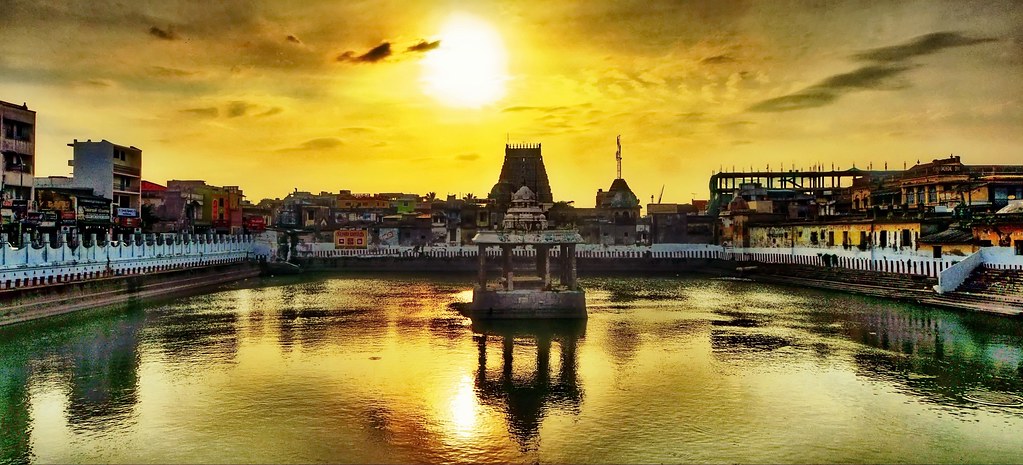
And this spot is the site of the other great Kumbh festival. The place where the pot broke and the contents flowed out–Mahamaham kulam (tank) is where the Mahamaham festival is celebrated.  

While Masimaham is an annual event that occurs and thousands of people gather for a dip during this time, it takes on special significance once in twelve years. For it is believed that every 12 years, when Jupiter passes over Leo, the waters of all of India’s holiest rivers, including the Ganges, flow into the tank, and it is at this time that the Kumbh mela of South India is celebrated at the Mahamaham tank. Since it is believed that all the rivers of India meet at the tank on this day, a bath here is considered equal to the combined dips in all the holy rivers of India! Over 10 lakh people congregate here for the event.

Kumbakonam, meaning ‘pot’s corner’ to remind us of where the pot-of-life landed, is considered a very holy place. There are any number of ancient temples in and around the town—there is a temple wherever any shard of the pot landed. In all, there are around 188 temples within the municipal limits of Kumbakonam!

The region around Kumbakonam was inhabited as early as the Sangam Age (third century BC to third century AD), and it has played its role in the history of the region.

Down the passage of time, Kumbakonam has been a major learning center. During the British times, it was referred to as the “Cambridge of the South” with several institutions of repute, the most notable of them being the Government Arts College, considered one of the oldest colleges in Tamil Nadu. The town is home to many libraries and is considered the hub of modern Tamil writing.

Kumbakonam, relative to its size, is associated with more than its share of great achievers, including:

Srinivasa Ramanujam, the world-famous mathematician was born here and studied here. After a stint in Chennai, he went to Cambridge where he shook the world of mathematics with his uncanny understanding of numbers.

MS Swaminathan, the agricultural scientist who saved India from food-crisis and laid the foundation for food-security in our country.

Indira Parthasarathy, a Padma Shri awardee and reputed Tamil novelist whose works have been translated into many world languages.

Srinivasa Sastry, dubbed the Silver Tounged Orator of the British Empire by Winston Churchill, who played a prominent role in the Independence struggle and was an educator and administrator of repute.

2028 will see the next Mahamagam in Kumbakonam. Over 20 lakh people are expected to participate. But don’t wait till then to visit this town—it has so much to offer.

-Meena

Dedicated to Malathi Athai, whose house in Kumabakonam is the site of the most cherished memories of summer vacations.

Angostura Bitters to settle the Stomach

Queasy stomachs have plagued humanity since ancient times. Many have been the remedies, each with its own followers and detractors. For instanc, in India, ginger, omam (ajwain), jeera, curd are all popular.

Somewhere in ancient times, probably in Egypt, wine infused with herbs became a popular remedy for uneasy stomachs.  The popularity of such infusions, called bitters, was high till even a hundred years ago.

Bitters are ‘liquid aromatic alcohol-based infusions of bittering botanicals and flavoring agents’. They are extracts of seeds, herbs, roots, bark, leaves, flowers, and fruit liquid from various plants.  While they started out as medicines, soon another use was found for bitters.

Today, we have two types of bitters: Digestive bitters and Cocktail bitters. Digestive bitters aid in the digestion of food and are usually sipped straight, on the rocks, after a meal and are popular in Europe. Cocktail bitters are made from a tincture of water and alcohol, containing spices and plant-based components.  They are too strong to be had neat, and are added to cocktails to elevate the taste and add a dash of sophistication.

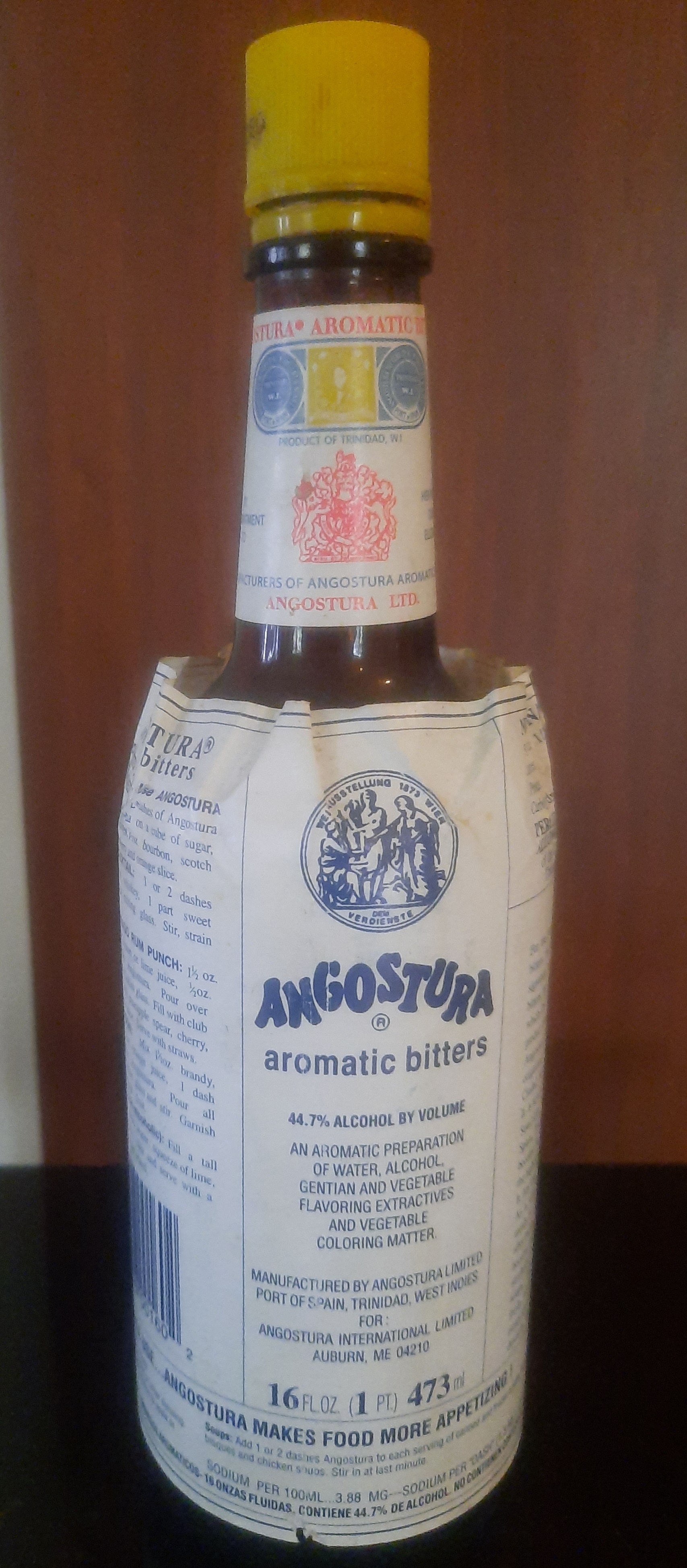
Of all the bitters, Angostura Bitters are probably the best known, and are a staple for every bartender and cocktail-mixer, and are used in classic cocktails like the Old Fashioned and Manhattan. More than that, they are in every kitchen cupboard in Trinidad and Tobago where they are made, as a home remedy for stomach problems. They are also an important ingredient in many local dishes.

Angostura is a tree native to South America, but strangely, the famous bitters are not made from the bark of this tree. Rather, they get their name from the town of Angostura in Venezuela, where they were invented. (The name of the town was changed subsequently, and it is now known as Ciduad Bolivar).

They were first concocted in 1824 as a medicine for the army of Simon Bolivar by a German army surgeon called Johann Siegert in the town of Angostura. He called it ‘Amargo Aromatico’. Dr. Siegert started exporting this to Europe, USA and the Caribbean. Apart from its use as a medicine, this product caught the fancy of bartenders at a time when cocktails were just becoming popular. Demand boomed.

The Siegert family migrated to Trinidad in the mid-19th century and started manufacturing the tincture in Port of Spain, the capital. And the company flourished.

Angostura Bitters were something one had vaguely read about. It definitely did not loom large in our lives. Till we visited family in Trinidad. Then we realized how big a thing it was!

A tour of the Bitters factory was of course on the essential itinerary. It was an overwhelming experience, especially to the nose! The pervasive smell of alcohol and herbs and tinctures almost made one dizzy.

All the processes of making the Bitters were on display. But the critical part is a secret—the mix and proportions of the herbs which go into making the product! It is apparently one of the world’s longest-held culinary mysteries, and no one has been able to replicate it exactly! Apparently only five people are privy to the secret.

Another part of the myth and legend of Angostura Bitters is the over-sized labels on the bottles. Apparently, in the late 1800s, Siegert’s sons decided to re-brand the product.   As a part of a competition, one brother designed the new bottle, while another designed the new label. But they did not discuss their designs with each till it was too late. So the labels that had been printed were too big for the bottles they made!  Though the Siegerts lost the competition, one savvy judge advised them to keep the design as it was. He said that this would help the packaging stand out among the competition. And that is exactly what has happened! The oversize labels area distinctive feature even today.

I remembered my bottle of Angostura Bitters from our trip to Port of Spain trip when I recently had a stomach upset. Whether thanks to this or some of the other home remedies I tried, I was better soon!

–Meena


Continuing Celebrations: Chinese Spring Festival

As most are surfacing after celebrations that ushered in a new calendar year 2025, it is continuing celebrations for a large population to welcome another new year. This is the Chinese New Year which begins on 29 January this year. This follows the lunar calendar which is based on the 28-day cycle of the moon. The New Year is calculated according to the second new moon after the winter solstice, and this year it fell on 29 January. The New Year day is, in fact, the start of a fifteen-day  celebration which is known as the Spring Festival in China. The festival traditionally begins on the first day of the first lunar month in the Chinese calendar and ends on the 15th day. Each day has a special significance and is marked with its set of traditional rituals, lore, and celebration which involve the whole families.

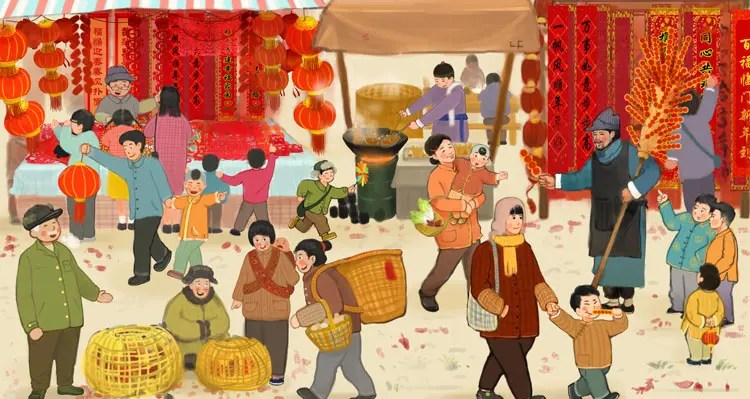
New Year shopping in a traditional Chinese market

For some families, the preparations for the longer festival begin even earlier, on the eighth day of the 12th month of the lunar calendar, with a festival called Laba. The name is derived from the Chinese words for the 12th month (La) and 8 (Ba). Traditionally the festival also marked the start of the agricultural calendar. On this day prayers are offered to ancestors and gods for fortune and a good harvest. Laba congee, a porridge containing different types of rice, beans, dried nuts, bean curd and meat is eaten.

This marks the beginning of the preparations for the lunar New Year which include cleaning the house by “sweeping away the dust”, shopping for food, new clothes, buying fireworks, preparing gifts and decorations, and prayers to the stove god.

The decorations include red lanterns, paper cuttings, and red spring couplets. The couplets are complementary poetic lines which adhere to certain rules. The spring couplets are written in black ink on red paper, one half affixed vertically on each side of a door, and usually express best wishes for the coming year. Putting up those decorations is thought to keep evil away, and a prayer for blessing, longevity, health, and peace.

Finally it is New Year’s Eve. This is considered as, if not more important than, New Year’s day. The highlight is the family reunion dinner which includes several generations, many who travel long distances to be together for this family gathering. Before they eat, the family makes offerings including food, wine, joss sticks and joss paper to their ancestors.

The dinner menu includes dishes which have symbolic meaning including whole fish, dumplings, sticky rice cake, and spring rolls. After dinner, parents usually give their children money in red envelopes. This is believed to bring good luck, and carry wishes for health, growth, and good studies in the coming year. The family stays up until midnight to usher in the New Year, a tradition called shousui (to keep watch over the year). The start of the New Year is announced with firecrackers and fireworks. It is believed that the louder the firecrackers, the better and luckier it will be for business and farming in the coming year.

Then it is officially the New Year, which marks the start of the 15-day Spring Festival. Each day has its own significance and associated traditions; some customs may vary between regions and groups.

Day 1: People put on new clothes and wish each other with the greeting ”gongxi” meaning “respectful joy.” It is a day of visits. The oldest and most senior members are visited, as well as other relatives and friends. Guests are welcomed with tea and sweet treats, such as sugared fruits which are supposed to sweeten one’s upcoming year. Sweets and fruits are served on a round or octagonal tray – the form resembling togetherness.  Most likely the amount of sweets will be arranged in eight units, as the number eight symbolises luck. The visitor also carries a small gift for the hosts–usually oranges, tangerines, or mandarins, as the fruit symbolises gold, hence wealth and good fortune.

In some traditions it is believed that abstaining from meat on this day will enhance longevity. A traditional Buddhist vegetarian dish is prepared using eighteen different ingredients, each of which has a symbolic meaning. Eighteen is believed to be a lucky number signifying wealth and prosperity.  There are also temple fairs and activities in parks such as Lion dances and Dragon dances, which are enjoyed by families.

Day 2: This is the day when married women visit their parents, accompanied by their husbands, with gifts and red envelopes for the family.

On this day, people offer sacrifices to the God of Wealth, wishing for a luckier and more prosperous year. People say that after being offered sacrifices, the God of Wealth, leaves for heaven on this day.

Day 3: This is not considered as an auspicious day as it is believed that evil spirits roam around. People avoid visiting friends and relatives and stay at home. Traditionally the house is not swept on the first two days of the New Year so as not to sweep away the good luck accrued by the litter of firecrackers, red paper, wrappers, and other evidence of celebration on the floor. This is the day when the house is swept after New Year’s Eve. There is also a legend that this is the day when rats get married, so people leave some rice in the kitchen as gifts, and sleep early so as not to disturb rats. In return the rats would not disturb the family for the whole year.

Day 4, 5 and 6: People resume visits to friends, relatives and temples. Different regions of China have some variations in the traditions associated with these days. The fourth day is one to honour the God of the Kitchen with the prayer to continue watching over the kitchen. Day five honours the God of Wealth for good fortune. People usually stay at home in case they are visited by the God on this day. It is also the day to light firecrackers to drive away the five bad lucks: of intelligence, learning ability, literacy, life, and relationships.

Day 7: According to a legend, Nuwa the goddess created the world. It is believed that she spent the first six days creating animals. Each day of the festival is also believed to be the birthday of the different animals that she is believed to have created in sequence. On the seventh day she created humans. Thus this is the birthday of humans. The day is celebrated with certain foods. The ingredients of the dishes are healthy and have a symbolic meaning.

Day 8: People normally return to work on the eighth day. As eight is the luckiest number in China, most businesses like to reopen on day 8 of the New Year.

Day 9:  This is the birthday of Jade Emperor, said to be the God of all Heavens. People go to ponds and rivers to pray to the gods with offerings of fragrant flower candles.

Day 10: God of Stone’s birthday and also the birthday of Earth Mother celebrated with sweet pastries.

Day 11: A day for fathers to treat their sons-in-law

Day 12, 13 14: These are quieter days, marking a respite from feasting on rich food, but preparing for the first full moon of the year which marks the Lantern festival.

15th day: Lantern festival or the “first night of the full moon” sees lanterns being put and lit everywhere. People often post riddles on the lanterns. Dumplings, with sweet fillings, resembling the shape of the full moon are traditionally eaten on this day. There is usually another family dinner that marks the close of the two-week celebrations, and the official start of the New Year.

According to the Chinese calendar this is the Year of the Snake and much is being written about it. May the spirit of celebrations that mark this day, continue to brighten every day of the year ahead.

–Mamata

High in the Sky, Celebrating the Sun

Today is Makar Sankaranthi. It marks the day the Sun starts moving from the South to the North, and coincides with its transition from the zodiac of Sagittarius (dhanu) to Capricorn (makara). Dedicated to the Sun, the day is observed across India in many different ways, but all signifying thanks-giving and a new beginning.

Kite-flying marks the day, especially in Gujarat. The sky is full of colour, with myriad shapes and sizes of kites, and fierce battles to bring down opponents’ kites.

Since media is full of reports of kites, kite-festivals and other sundry related topics, I thought I would mark Sankaranthi by writing about another flying object which is used to denote joy and celebration—balloons!

Definitionally, a balloon is a flexible membrane bag. It is inflated using a gas. At the most basic level, it is about filling it with as much air as our lung-power allows.  But otherwise, a range of gases is used– helium, hydrogen, nitrous oxide, oxygen etc. Balloons can also be filled with smoke, liquid water, small solids like sand, flour or rice.

Though in everyday life, we go out to buy balloons for birthdays, parties and events, the rubber balloon was invented for scientific experiments by the great scientist Michael Faraday in 1824. He came out with these for use in the lab for experiments with various gases.

Even today, apart from their use in fun and games and as decoration, more serious uses include meteorology, medical treatment, military defence, or transportation. The fact that a balloon is low cost and has a low density, makes it useful in several situations.

The use of balloons for decoration has extended into balloon modelling or balloon twisting where special balloons are twisted into various shapes, often animals, by artists called twisters, balloon benders or balloon artists. 

Balloon or Inflatable Art museums and exhibitions too dot the world. Artists who work with this medium are fascinated with the concept of how the air element can fill various shapes. They translate this fascination into installations, inflatable sculptures, interactive and digital artworks.

Prime among these is Balloon Museum– a curatorial team that designs contemporary art exhibitions with specific works in which ‘air’ is a distinctive element. Their ‘The Pop Air Tour’, with the tagline ‘Art is Inflatable’ has been travelling across Europe. It has several immersive exhibits: ‘A Quiet Strom’ in which infinite white spheres fall to the ground, as tiny soap bubbles caress the audience. ‘Aria’, a ‘digital interpretation of inflatable art in which the visitor finds himself enveloped, in a tight space, surrounded by a multitude of balloons lost in the sky, involving visitors in the journey through the metaphysical experience of suspension. This exhibit like many others has immersive sound design ‘intended to bring back in sound the sensations created around the visitors with the same intensity and depth of a breath taken miles high with the unique intention of experiencing a space without limits.’ Apart from these serious exhibits, there are also fun ones like  the independent inflatable maze, and The Goof — an entourage of inflatable Monsters that are taking over the world, but how they got here and what their motives are is unknown! 

The US has its share of Balloon Museums, including the Anderson Abruzzo International Balloon Museum Foundation with a ‘mission to uplift’!

So this Sankaranthi, let us be uplifted along with the kites (or balloons), pay homage to the Sun, and wish for a healthy, happy, prosperous year for all!

–Meena

Merry Christmas with Amigurumi

Tis the season of good cheer and brotherhood.

Of celebrations and togetherness.

Of Christmas trees and ornaments.

And this last is what we are talking about today.

Photocredit: amigurumi.com

The tradition of decorating trees with ornaments is thought to have originated in Germany in the 1800s.  An enterprising gentleman by the name Hans Greiner began making glass ornaments called baubles for hanging on trees. These were the first mass-produced Christmas ornaments and were a huge commercial success.  Woolworths was the first company to import these types of decorations into the United States in 1890, from where  the custom spread to other parts of the world.

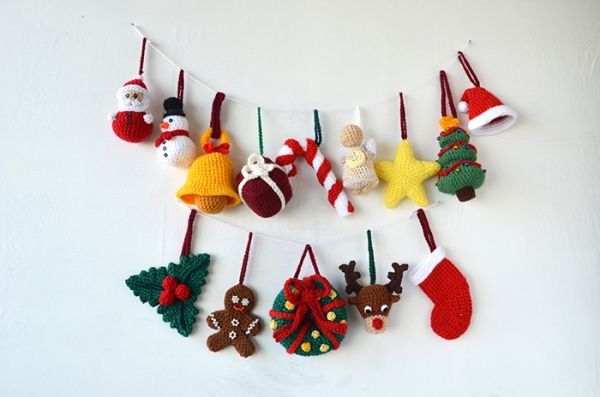
Common ornaments include globe ornaments, angels, egg ornaments, figurines, snowflakes, icicles and stars. They are made from a variety of materials, including glass, plastic, porcelain, metal, wood, and expanded polystyrene

A trend that has been popular in recent years is amigurumi Xmas ornaments. If like me, you haven’t a clue what this is, amigurumi is the art of creating crocheted or knitted stuffed creatures and objects, which has its roots in Japanese culture.

While the exact origins are not clear, it is believed to have developed from multiple influences over time. Japan has a long history of hand-made dolls and toys, such as “temari” (decorative balls made from thread) and “daruma” dolls. Amigurumi probably grew from these traditions. During the Meiji period (1868-1912), European knitting and crochet techniques were introduced to Japan and became popular. Japanese crafters combined these techniques with their traditional doll-making skills to create amigurumi,which comes from the Japanese words “ami” meaning crocheted or knitted, and “nuigurumi” meaning stuffed doll.  

Amigurumi grew more popular in Japan in the post-World War II era. As the country’s economy grew stronger, it led to increased income and leisure time, and a resurgence in crafting hobbies. It was during this time amigurumi gained recognition as a distinct art form.

A major impetus to the growth of this craft was the rise of “kawaii” culture. This Japanese aesthetic emphasizes cuteness and adorableness—think Hello Kitty.  Amigurumi lends itself to the creation of cute, whimsical, and anthropomorphic designs and hence appealed to the kawaii aesthetic.

Internet and social media brought amigurumi international attention and today, amigurumi enjoys a global following including in its use as Xmas ornaments. Amigurumi angles, cherubs, stars, elves and reindeers decorate trees across the world. Many people take pride in crocheting or knitting figures either on their own or with the help of popular amigurumi kits which include patterns, instructions, wools and needles.

A popular Xmas tree ornaments also rendered in crochet, which we are not very familiar with in India, is the Christmas Pickle. This is an American tradition. A decoration in the shape of a pickle is hidden on a Christmas tree, with the finder receiving an extra gift. It is also thought that he or she will enjoy good fortune for the next year. (While for us Indians, a pickle brings thoughts of mangoes and limes, in the West, it is often a cucumber, and that is what Christmas Pickle ornaments represent).  

The origin of the Pickle ornament is not known. Americans think it came from Germany, but Germans have no clue about this tradition. But here is one story: During the American Civil War, Bavarian-born Private John C. Lower had enlisted in the Pennsylvania Infantry. He was captured in 1864 and taken to the prison camp. On Christmas Eve he begged a guard for a pickle because he was starving. The guard provided the pickle, which Lower later credited for saving his life. After returning to his family in Bavaria, he began a tradition of hiding a pickle on their Christmas tree each year.

Even if it is not true, it is surely a story that captures the Christmas spirit!

Christmas wishes, Peace and Goodwill among all!

–Meena

Walking Stick: Symbol of Status, Symbol of Renunciation

The walking stick may be one of the most ancient tools ever invented (or should we say ‘discovered’??!!). I can imagine my ancient-ancestress in Africa, 300,000 years ago, stopping to cut a branch and smoothen it, to help her trek and clamber over hills and rocks.

Walking sticks obviously began as mobility aids, in that they help with balance and mobility issues; reduce the risk of falling; help those recovering from injuries and those who experience pain in their hips or knees. But of course, they were also used for self-defence. Having a two-in-one is always great–my ancient grandmother would have used hers to shoo away wolves or hyenas.

What began as a very functional item would soon have become a thing of beauty and pride– my ancestress-grandmother may have spent the evenings chipping at her stick and carving wonderful designs on it.

Down the ages, these sticks became a symbol of power, authority and status. Ancient images show kings, religious leaders and authority figures holding them.

But walking sticks really came into their own in the 17th and 18th centuries, when they became an essential part of the wardrobe of fashionable men in Europe. The cult is thought to have started with Louis XIV. This royal king was conscious of his height—he was 5’4”, and so used heels (red and high). And to help him balance, he used a walking stick. Heels and walking sticks became the rage in the French court, and then spread to the rest of Europe and to England. They became prized possessions  and an oft-exchanged gift between kings and courts.

And of course, befitting the importance given to these objects, they began to be made of precious material and extravagantly decorated. The knobs or handles were carved individually, made of gold, silver, ivory, tortoise shell, or painted porcelain, and studded with precious stones or inlaid with mother of pearl. Shapes ranged from lions to dogs to rams to fantastical creatures. Louis XIV had a stick whose eagle knob was set with twenty-four diamonds!

And no one who could afford it was content to have just one.   Voltaire, the French philosopher-writer owned eighty sticks, though he considered himself a man who did not follow fashion.  Count Brühl of Dresden, owned three hundred canes to match his three hundred suits, and had a snuff-box to match each cane! Queen Victoria had a room full of canes, gifted to her from across the world, though she used only one–one of great historic value which had been presented to King Charles II. The head was made of “An idol which graced the temple of an ill-fated Indian prince… an exquisitely wrought affair in ivory… The eyes and forehead are jewelled and on the tongue is the rarest of rubies.”

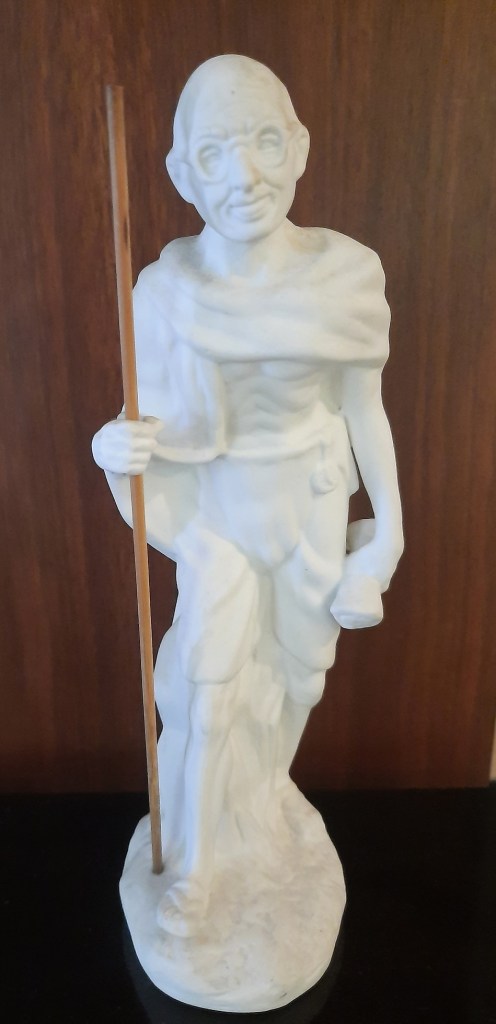
But if walking sticks were a symbol of worldly power, they were also the symbol of spirituality. They were among the few possessions of monks–Hindu, Jain and Buddhist.  A staff is part of our image of Swami Vivekananda. And of course Gandhiji! It was with the help of his lathi that Gandhi strode across the country, and walked 241 miles in 24 days to protest the British monopoly on salt in India.

There is a very interesting story about Gandhiji and his lathi. In the 1920s and 30s, Ghorghat village in Bihar made and supplied lathis all across north India, and these were essentially used by the British forces on protesting unarmed Indians. When Gandhiji visited Ghorghat in 1934, the villagers wanted to gift him a lathi. He agreed but put a condition—that they would not sell them to the British anymore. It is a symbol of those times and of Gandhiji’s influence that the villagers readily agreed to give up a means of their livelihood. Gandhi accepted their gift. Ever since, the village celebrates ‘lathi mahotsav’ to commemorate the gifting of a lathi to the Mahatma.

Walking sticks started losing their image as a fashion-accessory around the middle of the last century, but great are the advancements of walking sticks as mobility aids. So now it is about function and not art!

Well, we, especially men, may have lost a fashion accessory. But with better and more functional walking sticks on the market, senior-life is surely better!

–Meena