Shady Environment-Talk

June 5: Marked as Environment Day across the world since 1973.

The world has come a long way since the time in 1972 when such a day was mooted. Not only in terms of becoming more aware about the environment and taking action, but also in terms of the planetary boundaries being pushed to the brink through not taking enough action!

With the environment being such a widely talked-about issue, every actor—governments, businesses, civil society– have taken these issues on board.

Which is very good.

Till it is not.

The ‘till it is not’ includes corporates and other entities passing themselves off as environmentally or socially friendly when they are not. How do they do this? Here are a few terms that are used in the context of the many, many shades of these tricks:

  • Green Washing is undertaking misleading promotion of products or policies as environmentally friendly when in reality, they are not—often exaggerating the benefits while hiding the true or non-existent environmental impact. Common and insidious, such examples may range from misleading ads, to misleading recycling claims, to unverifiable carbon footprint claims, and every PR stunt in the book.
  • Blue Washing, indulged in by some of the largest corporations across the world, is the practice of businesses to sign up for the UN Global Compact and use their association with the United Nations to enhance their image and shift attention from their controversial business practices.
  • Carbon Washing is when companies make misleading or unsubstantiated claims about their carbon impacts or initiatives.
  • Social washing is similar to green washing, but in the context of being socially conscious–corporations wrongfully trying to market themselves as socially responsible.
  • Purple Washing is when a state or organization appeals to women’s rights and feminism in order to deflect attention from its doing nothing, or in fact actually harming these rights. 
  • Pink Washing is when companies try to create a false impression of being LGBTQ friendly while doing nothing to make life for their LGBTQ employees easier.
  • Rainbow Washing is similar to the above, when corporations use the rainbow symbol or colours, while being involved in activities that are damaging to LGBTQIA+ community 
  • Vegan Washing is when companies promote their products through appeals to compassion for animals, while actually causing animal suffering

Of recent times, the vocabulary of Green Washing has got even more nuanced! Here are some subtle variations:

  • Green Shifting: This is a subtle move, wherein companies highlight consumer choices, thus transferring responsibility to them, rather than highlighting their sustainability efforts.
  • Green Lighting: This trend is about corporations highlighting a particularly environmentally friendly aspect of their operations, in an effort to divert attention from less sustainable practices elsewhere in the company.
  • Green Rinsing: This involves businesses frequently changing ESG targets without genuine accomplishment, thereby making it hard for stakeholders to track their progress.

The UN warns about the seriousness of the harm that Green Washing (and allied colour-washes) can cause. In the context of climate change, the UN points out that: ‘Greenwashing presents a significant obstacle to tackling climate change. By misleading the public to believe that a company or other entity is doing more to protect the environment than it is, greenwashing promotes false solutions to the climate crisis that distract from and delay concrete and credible action.’

They identify many tactics of green washing including:

  • :‘Claiming to be on track to reduce a company’s polluting emissions when no credible plan is actually in place.
  • Being purposely vague or non-specific about a company’s operations or materials used.
  • Applying intentionally misleading labels such as “green” or “eco-friendly,” which do not have standard definitions and can be easily misinterpreted.
  • Implying that a minor improvement has a major impact or promoting a product that meets the minimum regulatory requirements as if it is significantly better than the standard.
  • Emphasizing a single environmental attribute while ignoring other impacts.
  • Claiming to avoid illegal or non-standard practices that are irrelevant to a product.
  • Communicating the sustainability attributes of a product in isolation of brand activities (and vice versa) – e.g. a garment made from recycled materials that is produced in a high-emitting factory that pollutes the air and nearby waterways.’

The UN urges us all to be more responsible by:

  • Learning more about green washing techniques so that we are more discerning
  • Make better consumer choices by buying only from companies whose green claims have been substantiated
  • Taking into account a product’s lifecycle and its environmental impact through every stage of making, use and disposal.

This Environment Day, let’s become better watch-dogs for the environment by getting more savvy about this colour palatte!

–Meena

Words Maketh Books

This week Meena wrote about World Book Day on 23 April. Not exactly coincidentally, this day is also marked as English Language Day. English Language Day is the result of a 2010 initiative by the UN’s Department of Global Communications, establishing language days for each of the Organization’s six official languages (English, French, Spanish, Chinese, Arabic, and Russian).The purpose of the UN’s language days is to celebrate multilingualism and cultural diversity, and to promote equal use of all six official languages throughout the Organization. English Language Day celebrates the English language and promotes its history, culture and achievements.

Books certainly come in all the languages of the world, but the very fact that we are, at this moment, reading and writing in English, is a testimony to the fact that English is indeed one of the languages that unites word lovers across the world. English is one of the languages of international communication; it enables people from different countries and cultures to communicate with each other in a common language, even if it is not their first language.

April 23, as English Language Day, celebrates the life and works of William Shakespeare, who not only died on this day, but is also believed to have been born on the same date in 1564. The day is a tribute to the enormous contribution that Shakespeare made to the English language.   

Shakespeare’s prodigious output of sonnets and plays was remarkable as a body of creative work. These literary works were expressed in thousands of words, many of which (1700 it is believed), he created himself! When he embarked on his literary marathon, there were no dictionaries that Shakespeare could dip into. The first such reference to meanings of words in English was A Table Alphabeticall that was published in 1604. Texts on grammar appeared only in the 1700s. Thus Shakespeare did not have ready resources which could be used to populate his vocabulary.

Scholars believe that Shakespeare’s vocabulary owed to a combination of sources. It is likely that he lent an alert ear to the commonly spoken language of the time, and drew words from there which were written into his plays and verses. Thus he can certainly be credited with the ‘first recorded uses’ of numerous words. But he was equally a master of wordplay. He coined new words himself, often by combining words (eye and ball to make eyeball) changing nouns into verbs (from ‘elbow’ to ‘elbow someone out’), adding prefixes and suffixes into preexisting words. He anglicised foreign words, such as creating ‘bandit’ from the Italian ‘banditto’, and the word ‘zanni’ which referred to characters in sixteenth-century Italian comedies who mimicked the antics of clowns and other performers, and used it as a noun–zany.

These introduced words were soon adopted into the English language, enriching it considerably.

I must admit that in my younger days, I did not take as easily to Shakespeare in the original as may have been done by the more “literary types” of my generation. Whatever Shakespeare we were exposed to was in the form of the ‘abridged and simplified’ versions that made their way into English language textbooks year after year. Yes, we knew that “a rose by any other name”, and  “all the world’s a stage” and “all’s well that ends well” was quintessentially Shakespeare, but I for one did not know that so many words that we use today, imagining them to be ‘contemporary’ language were coined and couched in William’s prose and poetry!

Here are some very ‘modern’ terms that first appeared in Shakespeare’s writing.

Addiction, assassination, auspicious, baseless, barefaced, bedroom, champion, cold-blooded, critic, elbow, fashionable, generous, gloomy, hint, hostile, lackluster, lonely, majestic, manager, obscene, overblown, puking, pious, radiance, reliance, skim milk, submerge, swagger, watchdog!

Here are some that have not travelled intact through the centuries. Today some of these are “Greek to us” (incidentally it is Shakespeare who first coined this phrase!).

Mobbled: With face muffled up, veiled.

Foison: Abundance, plenty, profusion

Ganesome: Sportive, merry, playful

Noddle: The back of the head

Fleshment: The excitement associated with a successful beginning

Gratulate: Greet, welcome, salute

Kicky-wicky: Girlfriend, wife

Bawcock: Fine fellow, good chap

Buzzer: Rumour-monger, gossiper

Gallimaufry: Complete mixture, medley, hotchpotch

Garboil: Trouble, disturbance, commotion

Miching: Sulking, lurking, sneaking

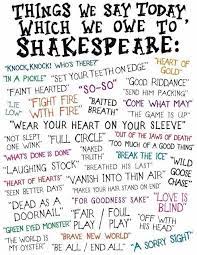
For Shakespeare “all the world was a stage” and he also coined a number of colloquial phrases that added drama to the dialogues of his many characters, from Romeo and Juliet to Othello, from the Merchant of Venice to Hamlet and Macbeth. These “as good luck would have it” continue to enrich our speech even today.

All that glisters is not gold

A sorry sight

Bated breath

Break the ice

Cold comfort

Come what may

Dead as a doornail

Devil incarnate

Eaten me out of house and home

Fair play

Green-eyed monster

Laughing stock

Naked truth

In a pickle

Seen better days

Set your teeth on edge

The world is my oyster

Too much of a good thing

Vanish into thin air

Wild-goose chase

What’s done is done

And, it is not Sherlock Holmes but Shakespeare who first said “the game is afoot!”

Shakespeare may be “as dead as a doornail” but he remains the most quoted writer in English of all time. How zany is that!

Well, words maketh a book, and Shakespeare maketh words!

–Mamata

Double Dutch

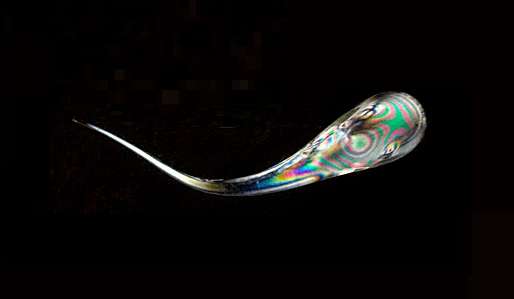
Dutch tears—that is an intriguing term I came across recently. At first I thought it was an idiom, like Dutch courage or Dutch comfort. But turns out Dutch tears are a real physical thing–toughened glass beads created by dripping molten glass into cold water! When glass is dripped into water, it solidifies into tadpole-shaped drops with thin, long tails. These were first produced in the Netherlands in the early 17th century. These tadpoles exhibit unusual characteristics—the bulbous part of the drop can withstand being hit by a hammer without breaking, but even a small pressure of the fingers to the tail-end will dramatically shatter the whole drop.

Dutch tear

These very contrary properties led to a great amount of scientific curiosity and they were the subject of much research in the 1700s and 1800s. But it was not till recently that the mystery was solved. One breakthrough came in 1994, when Prof. S. Chandrasekar of Purdue University and Prof. M. M. Chaudhri of University of Cambridge used high-speed framing photography to observe the drop-shattering process and concluded that the surface of each drop experiences highly compressive stresses, while the interior experiences high tension forces. So the drop is in a state of unstable equilibrium, which can be easily disturbed by breaking the tail. But the complete explanation came in 2017 when these scientists collaborated with Prof. Hillar Aben, of Tallinn University of Technology in Estonia and found that heads of the drops have a much higher surface compressive stress than previously thought—nearly 7,000 times atmospheric pressure. This gives the droplet-heads a very high fracture strength. (For a proper understanding of the science, please go to https://phys.org/news/2017-05-scientists-year-old-mystery-prince-rupert.html, rather than depending on my précis from there! Photocredit also to this page.)

But to get back to my original thought process: When I had tried to think of possible meanings of Dutch tears , so many idioms featuring the Dutch came to mind. We are very familiar with some:

When someone speaks very fast or unintelligibly, we say they are speaking Double Dutch–in other words, nonsense.

When one takes a shot of alcohol to boost up one’s courage before doing something one is afraid to do, it is called Dutch courage.

And of course, the Dutch treat, where each one finds they have to pay for whatever they consume.

And if you talk to someone like a Dutch uncle, you are giving them stern and serious talking-to.

And here is a small sample out of a range of many lesser-used ones:

Dutch agreement, where the parties making the agreement are drunk. And the related Dutch bargain—a bargain settled when the parties are intoxicated.

A Dutch headache is a hangover. And a Dutch concert is a very noisy situation, as would be made by a lot of drunken Dutchmen.

Dutch comfort is comfort which comes from the feeling that things could have been much worse.

Dutch reckoning is a very high bill that’s neither itemised nor detailed, and hence a bit of a con.

Dutch gold is a yellow-coloured alloy of copper and zinc from which imitation gold leaf is made.

HR persons should not go looking for Dutch talent, which is more brawn than brain. And they should be wary of employees who take Dutch leave, i.e., leave without permission.

Readers would have noticed that most of these idioms show the Dutch in a bad light. And apparently, there is good reason for this. Most of these came into being about 1665 and later, when the Netherlands and England were vying with each other both on land (England won a Dutch colony what is currently New York), and on sea for the control of trade routes. During the 17th century, the Netherlands and Britain waged three wars against each other over 20 years. The deep-seated animosity must have spilt over to language, and given the number of such idioms, the English must have vied with each other to come with nasty expressions about the enemy. (While this explanation seems logical, there don’t seem to be such expressions which feature the Spanish. And England and Spain were enemies and rivals for a good long time too. Maybe there is a Ph.D. thesis for someone here!).

Fortunately, many of these mean-idioms are falling out of use. And we have the rise of the Dutch oven—the most sought after cooking device; and of Dutch auctions–a type of open auction where the price starts high and decreases until the first bidder accepts it—which are seen as fast and efficient, as they end as soon as the first bid is made. 

Here’s to many more Dutch-positives!

–Meena

The Shape of Words: Kiki Bouba

Do words have shapes? Or, in other words, are certain words or sounds associated with certain shapes?

Well till about a century ago, linguists did not think so. It was assumed that the connection between words and the objects they are attached to was arbitrary. For example, there is no link between the English word ‘dog’, or the French word ‘chien’, or the Hindi word ‘kutta’ and an actual dog. These are just names that people choose to give objects.

But in 1929 came an experiment by Wolfgang Kohler, followed by others building on this, which changed this thinking.

In the experiment, subjects were given these two words ‘bouba’ and ‘kiki’, and shown two shapes—one rounded and blob-like and the other spiky. Participants were asked to associate each of the given words to one of the shapes.

Over time, the experiment was carried out across regions and languages and ages—900 people across 25 countries.

And invariably, across countries and languages, the majority of people associated ‘bouba’ with the blob-like shape, and ‘kiki’ with the spiky shape. On average, more than 70% of the people tested confirmed the Bouba/Kiki effect– a non-arbitrary mental association between certain speech sounds and certain visual shapes

While this surprising phenomenon has now been accepted, there is no widely-accepted explanation of why it occurs, though several hy­potheses have been put forward. One hypothesis is that the association is related to the shape of the mouth when produc­ing the sounds—the more rounded shape of the lips when saying bouba, and the more taut shape when saying kiki. Another suggestion is that ‘the association is tied to the proportion of vowels and con­sonants and the phonemic qualities of the sounds in the words. It seems that people tend to base sound–symbol associations on the acoustic cues of the sounds.’ But exactly how they do so is yet to be explained.

Some researchers have extended these experiments to other senses. Professor Charles Spence explored the phenomenon in relation to taste. He asked his subjects to associate the words ‘ bouba’ and ‘kiki’ to the following tastes:

  • Dark chocolate / milk chocolate
  • Strong cheddar cheese / brie
  • Sparkling water / still water

Prof. Spence found that kiki was associated with dark chocolate, strong cheddar cheese and sparkling water by most people— in other words, the stronger, more bitter or sour tastes (similar to the spiky shape). Bouba was associated with more rounded, sweeter tastes (similar to the rounded shape).

While researchers are still trying to figure out the science, several interesting practical implications have emerged. Since these associations of sound/shape, sound/taste etc. are real, what happens when there is a mismatch in the image conjured up by a sound, and the real object? Well, people don’t like such dissonance!

For instance, people associate round names (“Bob,” “Lou”) with round-faced (vs. angular-faced) individuals.  And they like targets with “matching” names. One study has found that senatorial candidates in an election got 10% more votes when their names fit their faces very well, versus very poorly! (Will we be seeing a rush of name-changes before elections?!?).

And obviously, these insights are very important in naming products, developing brands, etc.

There are several such kiki-bouba association tests that you can find online. Go ahead and check if your conclusions range with the majority!

–Meena

On A Musical Note: Of Earworms and Mondegreens

Who hasn’t, at some time or the other, had a song or piece of music stuck in their heads, which just won’t go away! You get up in the morning, and suddenly you find yourself humming a tune. It follows you around the house, to the office, on the drive back home. It serenades you inside your head through dinner. And sometimes it is still there when you wake up in the morning!

This is what is called an earworm. Extremely irritating, but nothing to worry about. It happens to most of us at some time in life. A recent study of American college students found that 97% had experienced an earworm in the past month. Other studies have found similar results.

And don’t worry how long an earworm troubles you. Though the typical length is 10 to 30 minutes, research shows that for about 20% folks, the earworm lasts an hour or more. And some unlucky folks have been stuck with one for a year or even longer!

The term earworm comes from the German “ohrwurm,” which  is defined as a “cognitive itch” or “the inability to dislodge a song and prevent it from repeating itself in one’s head”. Several terms have been coined for this, including stuck song syndrome, sticky music, musical imagery repetition, intrusive musical imagery etc. The semi-official term is ‘involuntary musical imagery’, or INMI.

It has been a serious area of study since 1885, and scientists hope to get insights into the functioning of the brain. Several major universities have been undertaking studies into the phenomenon.

Sufferers try various ways to get rid of an earworm– by thinking of another song, singing the earworm song all the way through to its end, or taking up other tasks that require focussed concentration. But trying to get rid of an earworm may be counter-productive. One study has found that the harder people fight to quiet an earworm, the longer it tends to harass them!

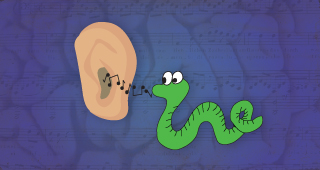
Something that is not irritating to you, but may be to others if you sing, is a mondegreen. A mondegreen is a word or phrase in a song or poem that you get wrong–the result of mishearing something recited or sung. Incorrectly heard lyrics are called mondegreens.

The origin of the word itself is from an instance of such mishearing. In a column by journalist Sylvia Wright in the 1950s, she wrote about a Scottish folksong The Bonny Earl of Morray that she had listened to. Wright misheard the lyric “Oh, they have slain the Earl o’ Morray and laid him on the green” as “Oh, they have slain the Earl o’ Morray and Lady Mondegreen.” And ever since, such mishearings have been referred to as mondegreens!

The scientific explanation goes as follows: Hearing is a two-step process. First sound waves make their way through the ear and into the auditory cortex of the brain. On receiving the signal, the brain tries to make sense of the noise.  Mondegreens occur when, somewhere between the sound and the sense-making, communication breaks down. You hear the same sound as another person, but your brain doesn’t interpret it the same way.

Sometimes we may just mishear something because it is noisy, the phone signal is weak, or there are other extraneous factors. Or it may be because the speaker is speaking in an unfamiliar accent or is mumbling.  So the sound becomes ambiguous and our brain tries its best to resolve the ambiguity—and gets it wrong.

Another common cause of mondegreens is the oronym–word strings in which the sounds can be logically divided in different ways. This is similar to what we call sandhi vichhed in Sanskrit—the process of analysing and separating compound words into their component parts. Oronyms result in a wrong parsing of sounds when context or prior knowledge is missing.

Yet another reason could be letters and letter combinations which sound alike, and without a context, we can go wrong, and one sound can be mistaken for the other. An example often given to illustrate this is, :“There’s a bathroom on the right” being heard as “there’s a bad moon on the rise”.

When we hear a sound, a number of related words are activated all at once in our heads. These words could be those that sound the same, or have component parts that are the same. Our brain then chooses the one that makes the most sense. In this choosing, we are more likely to select a word or phrase that we’re more familiar with. An oft cited example is that if you’re a member of a boat crew, you’re far more likely to select “row” instead of “roe” from an ambiguous sentence. If you’re a chef, the opposite is likely.

Some mondegreens become the word!  For instance, the word orange was such a widespread mispronunciation of “a naranj” (from Persian and Sanskrit), that it became the official name of the fruit! One can think of any number of place-names which the English mangled, for instance!

Bollywood songs of course have their share of mondegreens. Though not systematically documented, some common ones identified include:

From the song Hawa Hawai (Mr. India):Bijli girane mai hoon aayi’ being heard as ‘Bijli ki rani mai hoon aayi’; and from the song Banno (Tanu weds Mannu) ‘Banno tera swagger laage sexy’ being heard as ‘Banno tera sweater laage sexy’.

Raghu has these examples from his childhood (which he attributes to the poor sound quality of radio transmissions of those times):

Hearing ‘Yeh manzar dekh kar jaana’ (from the film Around the World) as ‘Yeh mandir dekh ke kar jaana’ (could be a jingle for a recent event!); and ‘Ahsan tera hoga mujh par’ (from the film Junglee)  as ‘Ahsan tera ho gaa mujh par’!

The only request: If you have a mondegreen, don’t sing the song aloud. You may give someone a more than usually horrible earworm!

–Meena


Oh Sh*t!

The last few weeks have been peppered with cleaning cat-poop of the lawn. A particular cat has taken to using our garden as its favoured toilet. Now we are spraying the lawn with a suspension of coffee grounds and haven’t had an episode in the last few days. Fingers crossed.

But the whole trauma got me thinking about poop in general.

And I realized how many words there were for this. In fact, the number of synonyms for faeces is proof of human fascination for the subject.

There is wide variety of terms for poop, and though some of them are interchangeable, there are also very specific ones– for certain types of animals or species or used in certain circumstances. Here are some of them so our vocabulary in this area can go beyond shit and crap!

Faeces is the most generic term, and the word comes from the Latin word faex, meaning “dregs”. Excrement, Excreta and Stool are also fairly generic and mean the solid wast released solid waste from the bowels of a person or animal. bowels of a person or animal Ordure too is similar—the solid waste solid from the bowels of people or animals.  

Here is a look at a few other terms:

Droppings: Faeces of animals.

Dung: Solid waste from animals, especially cattle and horses

Scat: Animal faeces, particularly of wild carnivores

Spraint:  This is the dung of otters.

Fras: These are the droppings/faeces of insect larvae

Manure: Manure is organic matter that is used as fertilizer in agriculture. Most manure consists of animal faeces but may also include compost and green.

Guano: This is accumulated excrement and remains of birds, bats, and seals, valued as fertilizer. 

Worm casts: These are the excrement of worms. Earthworm casts are prized as fertilizer.

Fecal Pellets: An organic excrement, mainly of invertebrates.

Fewmets: In hunting terminology, these are the droppings of deer and other quarry animals by which a hunter identifies his targets. Another term used in hunting is Spoor which can indicate a track, a trail, a scent, or droppings especially of a wild animal

Fewments: For science fiction fans, this is the term for dragon droppings!

Coprolite: Fossilised faeces of animals that lived millions of years ago.

Paleofaeces: Ancient faeces, often found as part of archaeological excavations or surveys.

Rabbits, hares and related species produce two types of fecal pellets: hard ones, which are the real poop; and soft ones or cecotropes, which are partially digested food which they eject, and eat again!

In medicine and biology, scatology or coprology is the study of faeces.

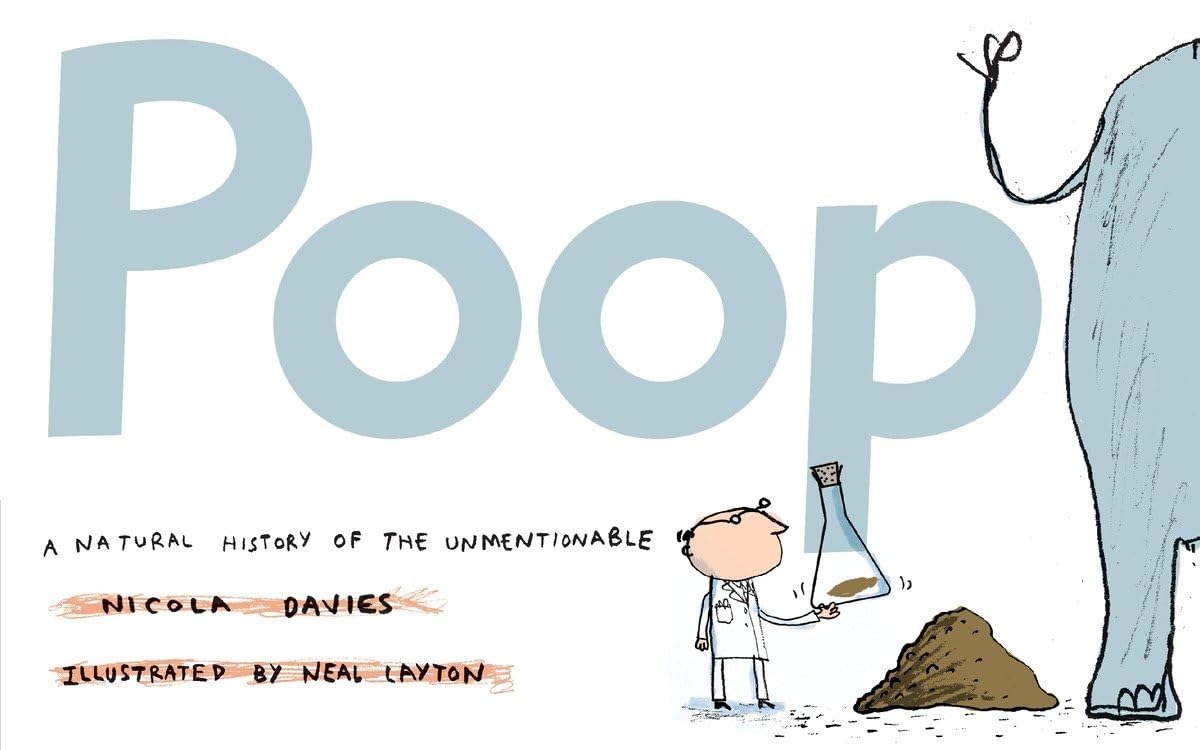
poop
Looking forward to reading this fascinating picture book for adults!

The study of such excrement is of course of use to doctors in the diagnosis of various medical conditions. It is also of great importance in obtaining an understanding of wildlife behavior, and the environment as a whole. Scat analysis can yield useful information on animal populations and their distribution across a habitat, how many males and females there are, what they are eating, their health condition and from all these, information on the health of the habitat itself can be deduced. Scat analysis is sometimes faster, easier and cheaper than many other means of studying animal populations, and it is possible to get a lot of information about animals non-invasively.  It is also possible to extract DNA from poop and this has helped identify species characteristics.

So it’s not just 4-year olds who have a fascination for this subject. Many adults make it their life’s work, and their chosen tool in getting to know more about the world!

–Meena

Words Over the Years

It is the time of the year when important dictionaries of the English language have just announced their Word of the Year 2023.

Collins Dictionary has picked AI (Artificial Intelligence) the term that describes ‘the modelling of human mental functions by computer programmes’. In other words, a computer system that has some of the qualities that the human brain has, such as the ability to produce language in a way that seems human.

The Cambridge Dictionary has chosen Hallucinate which has traditionally been defined as“To seem to see, hear, feel, or smell something that does not exist, usually because of a health condition or because you have taken a drug.” But is now expanded to include: ‘When an artificial intelligence (AI) hallucinates, it produces false intelligence’.

The Merriam-Webster dictionary’s Word of the Year is Authentic. Authentic has a number of meanings including “not false or imitation,” or “true to one’s own personality, spirit, or character”. It is a synonym of real and actual. It is perhaps an appropriate antidote in an age of Fake News.

To have been selected as Word of the Year means that a word has great resonance for the year in which it was chosen. These are terms that describe the prevailing trends, moods (including anxieties), attitudes, and cultural climate of our time.

Indeed these three words succinctly sum up the year which has been headlined by AI and its potential, including the dangers of false intelligence and fake news, and the growing need to have ‘authentic’ reliable information to draw upon in such times.

The Dictionaries follow a rigorous process leading to the choice. It includes research by hundreds of lexicographers, and now, evidence gathered from millions of new and emerging words of current English from web-based publications, as well as referring to dictionaries themselves, using sophisticated software.

Thus do dictionaries grow, adding words and usages as they emerge in response to changing times and modes of expression. We often forget that the process of creating a dictionary from scratch was, in its time, a complex and gargantuan task, which took years of painstaking manual and mental labour.

The first fully-developed representative of the monolingual dictionary in English is believed to be Robert Cawdrey’s Table Alphabeticall, first printed in 1604. Its first edition had 2543 headwords for which Cawdrey provided a brief definition. While small and unsophisticated by today’s standards, the Table was the largest dictionary of its type at the time.

As the century rolled by, there was a growing feeling that the English language “needed improvement” and that it lacked standardisation. From the mid-17th century many literary figures proposed ideas and schemes for improving the English language, but none really came to fruition. Until Samuel Johnson, an English poet, satirist, critic, lexicographer embarked upon his Plan of a Dictionary of the English Language.

Johnson had several issues with the English language as it was at the time. As he wrote, he had found the language to be ‘copious without order, and energetick without rules’. In his view, English was in desperate need of some discipline: ‘wherever I turned my view … there was perplexity to be disentangled, and confusion to be regulated’.

A group of London booksellers first commissioned Johnson’s dictionary, as they hoped that a book of this kind would help stabilise the rules governing the English language. The booksellers’ interest was purely commercial. They were aware that this kind of work would be popular with the general public, but as such a project would be long and risky, a number of booksellers formed temporary partnerships, thereby sharing the costs as well as the risks. Also the copyright belonged to the publisher, so aside from a one-time payment to the author for commissioning the work, the publishers could enjoy the massive profits from the sales.  

In 1746 Johnson entered into an agreement with the booksellers to write an English dictionary, and began work the same year with only six assistants to aid him. A year later he published a plan for the dictionary in which he outlined his reasons for undertaking the project and explained exactly how he intended to compile his work. Johnson projected that the scheme would take about three years, but he seriously underestimated the scale of the work involved. In the end it took him three times this length of time to write over 40,000 definitions and select nearly 114,000 illustrative quotations from every field of learning and literature. Each word was defined in detail, the definitions illustrated with quotations covering every branch of learning. Johnson’s was the first dictionary to use citations for the words it listed. He sourced books stretching back to the 16th century, and used quotations from Shakespeare, Spenser and other literary sources. This was with his intention to acquaint users with the classic literary greats. Johnson was the first English lexicographer to use citations in this way, a method that greatly influenced the style of future dictionaries.

In the process of compiling the dictionary, Johnson recognised that language is impossible to fix because of its constantly changing nature, and that his role was to record the language of the day, rather than to form it.

First published in two large volumes in 1755, the book’s full title was A dictionary of the English Language: in which the words are deduced from their originals, and illustrated in their different significations by examples from the best writers. To which are prefixed, a history of the language, and an English grammar. It became popularly known as Johnson’s Dictionary.

The dictionary was a huge scholarly achievement, a more extensive and complex dictionary than any of its predecessors. The closest to compare was the French Dictionnaire which had taken 55 years to compile and required the dedication of 40 scholars. Still, Johnson’s dictionary was far from comprehensive, even by mid-eighteenth-century standards. It contains 42,773 entries, but there were almost 250,000 words in the English language, even during Johnson’s time.

Even as new words are added to the number of dictionaries today, and some of these are crowned as words of the year, here is an educational, and entertaining peek at some of the entries from Johnson’s dictionary. Starting with how he defines himself!

Lexicographer: A writer of dictionaries; a harmless drudge that busies himself in tracing the original, and detailing the signification of words. A paltry, dirty, sorry wretch.

Cough: A convulsion of the lungs, vellicated by some sharp serosity.

Distiller: One who makes and sells pernicious and inflammatory spirits.

Dull: Not exhilaterating (sic); not delightful; as, to make dictionaries is dull work.

Excise: A hateful tax levied upon commodities, and adjudged not by the common judges of property, but wretches hired by those to whom excise is paid.

Far-fetch: A deep stratagem. A ludicrous word.

Jobbernowl: Loggerhead; blockhead.

Kickshaw: A dish so changed by the cookery that it can scarcely be known.

Network: Any thing reticulated or decussated, at equal distances, with interstices between the intersections. (See how he defined ‘reticulated,’ below.)

Oats: A grain, which in England is generally given to horses, but in Scotland appears to support the people.

Patron: One who countenances, supports or protects. Commonly a wretch who supports with insolence, and is paid with flattery.

Politician: 1. One versed in the arts of government; one skilled in politicks. 2. A man of artifice; one of deep contrivance.

Reticulated: Made of network; formed with interstitial vacuities.

To worm: To deprive a dog of something, nobody knows what, under his tongue, which is said to prevent him, nobody knows why, from running mad.

Samuel Johnson, was in fact much more than a lexicographer; he was a prodigious writer who published periodicals, plays, poems, biographies and a novel, as well as a celebrated humourist.

–Mamata

There’s a Word For It!

I recently read a book by Jhumpa Lahiri. She is perhaps best known for her novel The Namesake which was also made into a film. This book, titled In Other Words, is very different in that it is not fiction but rather an autobiographical work that describes the author’s determination, and process, of not just learning a new language—Italian–but writing a book directly in this acquired language. The English version is a translation (not by her) of the original in Italian.

One of the key observations and learnings from this process is the realization that every language has so many nuances that are closely linked with the culture and history of its land, that on many occasions it is almost impossible to find a satisfactory equivalent, let alone a appropriate ‘translation’ of the word. She describes her experiences of actually conversing with local people, even after having academically ‘mastered’ Italian, and the nervous jitters it caused her. It would be interesting to know if the Italians have a specific word for this feeling. Well, the Japanese do! Yoko meshi is a Japanese word that describes just this feeling! 

As someone who does some basic translation I too often find that Indian languages have such a gamut of words that so aptly describe such nuances. In the English language these are often simply clubbed into a single word; a word that is unable to capture the spontaneous response or image that the word evokes in the original language.

This is true of all languages and cultures. It is great fun and invigorating to come across such words. Here is a sample from my collection!

Honnomushi is the Japanese word for ‘bookworm’ and its literal translation is found in English as well as other languages. But what about the bookworms who accumulate books with all good intentions of reading them some day? Well the Japanese have a word for that too–Tsundoku.

Tsundoku. The word literally means ‘reading pile’. It derives from a combination of tsunde-oku (to let things pile up) and dokusho (to read books). It generally refers to the tendency to buy books and let them pile up around the house unread. It can also refer to the stacks themselves. The word carries no pejorative sense in Japanese. Rather it connotes a cheerful whimsy: wobbly towers of unread books, each containing an unknown world. I am happy that now my stash of books “saved for a rainy day” has a respectable name!

Aspaldiko. Besides the joy and comfort of books, it is friends that make life worth living. While there are some that we meet regularly, there are some who one cannot meet as often. Meeting an old friend after a long time has a special excitement and delight. Well the Basque people have a word exactly for that feeling. Aspaldiko. It refers to the joy of catching up with someone you haven’t seen in a long time. A perfect word to the next time one reconnects with an old friend!

Tartle. There is the aspaldiko of meeting up with that special friend. But another way of meeting up is the organized ‘class reunion’. Meeting with literally ‘old’ faces, decades after one last saw each other, has its moments of embarrassment. The face is sort of familiar but the name that matches the face eludes, at the precise moment when you meet face-to-face. More red faces when you don’t know how to introduce the same to your spouse or children. Well the Scots have just the word for this—Tartle! This sums up the embarrassment and panic you feel when you forget someone’s name before introducing them. The word even comes handy to excuse your apparent rudeness. All you need to say is “Sorry for my tartle!”

Shemomedjamo. Reunions are also an occasion to eat, drink and be merry. As the feasting continues, you know when you’re really full, but your meal is just so delicious, you can’t stop eating it. The Georgians have a word for this mixture of gluttony and gastronomic distress. Shemomedjamo. This word means, “I accidentally ate the whole thing.”

Pelinti. In the process of getting to the stage of Shemomedjamo, you reach out for that slice of freshly arrived pizza. The melted cheese is irresistible. You bite into the piece and that tanatalizing cheese immediately sticks to your palate causing sheer agony. You frantically move the piece in your mouth hoping for some relief. While this may render you temporarily speechless, in Ghana they have a word for just this moment. Pelinti! You can scream Pelinti as you move the hot food around in your mouth in a desperate attempt to cool it before swallowing.

Abbiocco. You have feasted to the point of overeating, and perhaps had occasion to scream “pelinti”. The belly is happy and the senses replete. Conversation slowly ebbs, and it’s time for the next scene in the play. Most of us know that this calls for a siesta! Well the Italians also have a perfect word for this–abbiocco, literally meaning to collapse with exhaustion, but more effectively used to denote the slothful feeling of the need to lie down after heavy eating and drinking.

Lagom. While many cultures celebrate the joys of indulgences and their languages have appropriate words to define these excesses, the Swedes are more restrained, with a more functional approach to living. And reflecting the same approach is a single word Lagom. The word describes a general contentment with the “enoughness” of what’s presented to you in the moment. Lagom means not too much and not too little. It asks us to create balance in our lives by taking everything in moderation, avoiding both excess and deprivation.

Well it’s each to their own formula of a good life! Provided that one can have brief moments of Gigil. This giggly-sounding word comes from the Tagalog language of the Philippines. Gigil as defined is more than joy, and not quite pure excitement, but somewhere in the middle of joy, excitement, and a giddy heart-warming feeling. It is such moments that keep us alive.

Have a good life!

–Mamata

A House for Mr. Narayan

Generations of Indians have grown up on RK Narayan’s writings. If you have not read his novels, maybe you have seen ‘Guide’, starring Dev Anand and Waheeda Rehman? Or the charming TV series ‘Malgudi Days’? Well, suggest you visit or re-visit all of the above!

RK Narayan was one of the first Indian authors to gain international recognition. His first novel, Swami and Friends, which he wrote in 1930 did not find a publisher for many years. But sometime in 1933, his friends in Oxford to whom he had sent the manuscript, showed it to the famous author Graham Greene. The senior author liked it so much that he recommended it to his publishers and the book saw the light of day in 1935. It got good reviews across the world. RKN followed this up with The English Teacher and The Dark Room, which also won appreciation. From then, it was a steady stream of novels, short stories and articles.

Narayan created the fictional town of Malgudi as the setting for his novels. So authentic was it to his readers that many even today believe it is a real place.

But why the sudden piece on RK Narayan, one might ask.

Well, it has been triggered by a visit to his house in Mysuru. Just last week, when I was there, I was lucky to get to visit this house. RKN spent many years in Mysore (as it was spelt then)—some of his growing up years, as well as his adult life when he accepted a commission in the State of Mysore.

It was in the second stint that he built a house which I visited. Set in the quiet area of Yadavagiri, it is a beautiful house typical of the 1950s, full of light and air, with red oxide floors and a beautiful balcony.

It was indeed gratifying to see the house so well preserved. Especially after we heard the story of how it was almost demolished. The author passed away in 2001. All of his family had left Mysuru by then. The house was falling to rack and ruin, when a builder wanted to pick it up and re-develop it. It was at this time that Mysuru woke up to this legacy. Led by a journalist, the people of the city protested. Finally in 2011, the city corporation bought the house and restored it.  

And we must be thankful for this! For not only is the house in good shape, it seems to have been restored fairly faithfully. There is also an exhibition of several artifacts, including his awards, personal items etc., many photographs, as well panels of text for those who have the patience to read them.

But…

And it is a very big BUT!

When one thinks of the potential that the house has for the students, literature lovers and citizens of Mysuru, not to mention the thousands of tourists the city attracts, it is a tragedy to leave it to routine care-taking and not very imaginative management.

As we reflected on our visit, we could come up with more than 10 ideas in less than 5 minutes:

  • Have a lively permanent exhibition, along with special temporary exhibitions to explore specific themes: maybe selected books; his relationship and collaboration with his brother, the famous RK Laxman, who illustrated so many of his books; maybe the process of turning his books into movies or TV (he is said to have hated the movie Guide), RK Narayan compared to comtempory Indian writers, etc., etc.
  • Sell RKN’s books (no, unbelievably, they don’t!)
  • Make it the hub for meetings of book-clubs
  • Make it a venue for book-launches
  • Host lit fests
  • Have literary events for children
  • Have screenings and discussions of movie and TV shows based on his books
  • Have an author-in-residence programme
  • Develop an archive related to his life and work
  • Create and sell souvenirs based on Malgudi
  • Start a café in the lovely little garden space around the house, and serve his favourite dishes
  • Make it a wifi café, so young people hang out
  • And charge a small fee for entrance (the Corporation has kept entry free..generous but it would be more sustainable to charge something).

Ideas are of course easy. Execution is difficult. But do this for RK Narayan’s house we must. He is a very important part of Indian writing in English.

While India does not have a great tradition of making author’s houses into educational and enjoyable experiences, there are more than enough international experiences to learn from: Shakespeare’s birthplace; Mark Twain’s house; Emily Dickenson’s House; Jane Austen’s House; Milton’s House are among the many which are successfully keeping the legacy of these authors alive.

Maybe RK Narayan House can set the example for homes of other Indian authors?

–Meena

Fruity Names

I have a guava tree which has just started fruiting this year. And with the enthusiasm of a newbie, it is overdoing the act. But I must marvel at its boldness—a thin, weak tree, it has literally 10s of fruits on each branch and is completely bowed down with the weight. Even after the birds and squirrels have done feasting on them, we are left with about 5-6 fruits every day. Which is a lot more than we can eat.

So I decided to check out some guava-based recipes. A visit to cooking sites threw up a few promising ones. But I got side-tracked. Browsing through the pages, I was reminded that guavas, apart from being called amrood, are also called peru. I was intrigued. Where did that name come from? A fairly straight forward explanation: Guava is believed to be a native of Peru in South America. Guavas came to India only around the 16th century, and probably because consignments were received from Peru, people in and around the port of Bombay started calling it that.  The fruit took well to Indian growing conditions and became popular here. Today peru or guava is the fifth-most widely grown fruit crop of India!

Guava
Guava, also called Peru

That got me thinking of the names of other fruits and vegetables which take their names from the names of places. Obviously, they are not called that in their place of origin, but when they travel, they take along the name. I doubt if anyone in the country of origin knows that the fruits are carrying the names of their countries far and wide, albeit in a strange context (how confusing it would be if people in Peru called a fruit ‘peru’!). And for sure, most people in the destination country after a passage of time, don’t link the name of the fruit to anything–a name is a name is a name and just is.

Here is a look at some more such fruit names

Peaches were called persicum—‘Persian apples’–by the Romans because they were traded by Persians. And a variation of the name stuck in English.

The name ‘currant’ is derived from the ancient Greek city of Corinth, which was known for its production of small dried grapes now known as currants.

Musk melons are sometimes called Cantaloupe. Though the fruit is not native to Italy, it was brought to the Cantus region of that country from Armenia and gained popularity there. As it slowly spread from there to other parts of the world, it carried the name of the Cantus region with it.

Oranges are indigenous to India and the origin of the name is from the Sanskrit naranaga. Most languages call oranges by some variation of this name. But in Greek, it is called portokali  because Portugese merchants traded in them.

Oranges spread far and wide, and variations developed. A type of blood orange which originated in the Mediterranean islands of Malta circled back to India and we call it the ‘Malta’. It is widely grown in Uttarakhand today. Tangerines are a variant which come from Tangier, Morocco.

Though the tamarind probably has its origins in tropical Africa, it has been cultivated in the Indian subcontinent for so long that it is universally known as Tamarind—the date of India!

Even apart from being named for the place of their origin, fruit and vegetable names are often prefixed with place names. The Devenahalli Pomelo for instance, is a special variety of the fruit which grows only in the Devenahalli area around Bangalore airport, and is tagged with Geographical Indicator (GI) status.  Another example is the Shimla Mirch. When the British brought capsicum to India, they first cultivated it in Shimla, so the name of the district is still used to refer to the now-ubiquitous vegetable.

The Nagpur orange, Lima beans, Brussels sprouts, are all named for places where they originated or where they grew abundantly. Ponni rice, so popular in the South, derives its name from the Cauvery, also called Ponni (meaning gold), since it grows in the deltas of this river.

Interestingly, the origin of the word ‘fruit’ itself can be traced back to the Latin word fructus, which comes from frui meaning ‘to enjoy’.

What could be more appropriate!

–Meena

PS: I found a few recipies for peru subzi and chutney, which shall be tried out in due course.