Of Tongues: Tied and Twisted

Many of us have student-day memories of freezing up in the middle of an elocution competition, or as adults, not being able to converse comfortably when in a large group of people. We were told that had become “tongue-tied”. The dictionary defines this state as being ‘too shy or embarrassed to speak’.

More recently I was introduced to another, more literal, form of tongue tie. This is a medical condition where a tight band of tissue connects the underside of the tongue to the floor of the mouth, keeping it from moving freely. Nowadays, paediatricians usually check for this in new born babies, and a minor surgical procedure can cut the tight tissue to allow for a free movement of the tongue. While this is not a mandatory nor critical issue, sometimes this restrictive movement of the tongue could hamper the baby from proper breast feeding, and could (though not definitely) be an impediment to speech as the child begins to speak.

This was not a condition that I was familiar with, and I suspect that many adults have grown up unaware about this. At best, these were labelled as people with speech impediments, and either lived with it through their life, or were sent to speech therapists. Perhaps one of the exercises that they were prescribed, was to recite aloud some phrases that had alliteration, rhymes, and repetition. Speech therapists believe that such exercises help to strengthen the muscles that are used when we speak. The muscles of the mouth need to move in certain positions to create individual sounds. Tongue twisters help practice and strengthen these positions and muscles in order to perfect these sounds. 

Even without being guided by a therapist, many of us have childhood memories of getting our tongues in a twist with these lines:

She sells seas shells on the seashore

The shells she sells are seashells, I’m sure

So if she sells seashells on the seashore

Then I’m sure she sells seashore shells.

No wonder such lines were described as ‘’tongue twisters”. Such phrases have been part of the oral tradition in all cultures since early times. In ancient Russia travelling performers called skomorokhi would amuse crowds by reciting fast tricky lines and challenging the audience to repeat these. Most people couldn’t and their fumbling attempts raised a laugh from the others. Folklore in all languages has examples of such nonsense rhymes that need an acrobatic tongue to master.

In fact even today, performers use tongue twisters to loosen up before they are scheduled to go on stage. These help them warm up and get their mouth and tongues ready to perform in front of an audience. Tongue twisters are also used by voice actors before they are recorded.

The term tongue twister is believed to have appeared in print in the late 19th century to describe phrases that are difficult to articulate due to their use of similar but distinct sounds. In the English language these gained attention with the publication of a book called Peter Piper’s Practical Principles of Plain and Perfect Pronunciation, which included a tongue twister for every letter of the alphabet. The book was meant to help children learn the fundamentals of speech mechanics, but it attracted a lot of attention. The title itself garnered curiosity. The author of the book was John Harris, who then was the Peter Piper? The mystery was heightened with the inclusion of the rhyme:

Peter Piper picked a peck of pickled peppers.

A peck of pickled peppers Peter Piper picked.

If Peter Piper picked a peck of pickled peppers,

Where’s the peck of pickled peppers Peter Piper picked?

It turns out that this one was based on a French horticulturist Pierre Poivre. Pierrre is the French version of Peter, and Poivre is the French word for pepper. Pierre, it is believed, was exploring the viability of growing spices in the Seychelles. Thus the peppers, and the peck which was an old measure of weight.

Tenuous connections, at best, but they do add some spice to the story!

While tongue twisters are accepted as a part of speech therapy, people enjoy these just for the fun of fumbling and stumbling over words in absurd sentences. So much so that there is even a day designated as the International Tongue Twister Day celebrated on the second Sunday in November every year. And there is an International Tongue Twister Contest held at the Logic Puzzle Museum in Burlington, Wisconsin in the USA. First held in 2008, the contest has become an annual tradition. This invites everyone between the ages of ‘6 and 106 years of age’ to test their verbal dexterity. A joyful celebration of the playful side of language!

At the same time there is also serious research being carried out on this subject. A team of researchers from the Massachusetts Institute of Technology (MIT) have deemed that the most difficult tongue twister in the world is this one:

“Pad kid poured curd pulled cod”.

If one is not quite up to the challenge of cracking this one, here are some others to twist our tongues around:

“The sixth sick sheik’s sixth sheep’s sick.”

“Imagine an imaginary menagerie manager managing an imaginary menagerie.”

“A tutor who tooted the flute tried to teach two young tooters to toot. Said the two to the tutor, ‘Is it harder to toot, or to tutor two tooters to toot?’”

Don’t let these leave you tongue-tied!

–Mamata

Remembrancers To Resurrectionists: A Stroll Through Forgotten Job Titles

Once upon a time—before HR departments and LinkedIn profiles—jobs came with titles so evocative, so oddly poetic, they sound like characters straight out of a Dickensian drama or a Ruskin Bond vignette. While today’s professions lean towards the ultra-pragmatic and descriptive, many titles of the past came with a whiff of romance. For example: the Remembrancer.

Yes, the Remembrancer. Not an app. Not a diary. A person. One whose very profession was to remember. Specifically, to remind monarchs and magistrates of important affairs—debts, legislation, ceremonies. A Remembrancer was originally an official tasked with reminding a monarch or government body about matters of state, legal affairs, or financial obligations. The title comes from the idea of “remembering” important business that required attention.

The City Remembrancer of London–a post dating back to 1571–still exists, quietly observing proceedings in Parliament, tucked behind the Speaker’s Chair. We can’t help but picture him as an elderly gentleman in an impeccably cut coat. who acts as a liaison between the City of London and Parliament. Their duties include monitoring legislation that might affect the City, representing the City at ceremonial functions, and advising on constitutional matters. The Remembrancer also attends the State Opening of Parliament and sits in a specially designated place in the House of Lords.

It is not just the UK. India too continues something that must have started in colonial times. We still have Legal Remembrancers in our legal system, primarily at the state level. They play a crucial role in advising the government on legal matters and representing the state in court proceedings. The Legal Remembrancer (or Remembrancer of Legal Affairs) is a government official who acts as the chief legal advisor to the state government. 

Even quainter are the roles that seem to exist simply to add charm to history books. The Ale Conner who tested beer for public consumption. The Knocker-Up who tapped windows with a stick to wake people up before alarm clocks were invented.

Saggar Maker’s Bottom Knocker is not a Victorian insult; it is an occupation. In pottery, a saggar is the box which holds the clay which is being fired. By placing various substances in a saggar, dramatic effects can be produced on the finished pottery. A master-craftsman called a saggar maker made the saggars. But bases of the saggars were produced mechanically and did not require much skill. They were left to young apprentices called bottom knockers, as they literally knocked them into shape.

While a Computist might bring visions of those working on advanced computer programmes, in the old days, these were people charged with calculating Easter based on lunar cycles—part astronomer, part theologian. An alternative term for jyotish?

A Lector was a person who used to read out Karl Marx or pulp fiction to cigar workers in Cuba while they rolled tobacco leaves by hand.

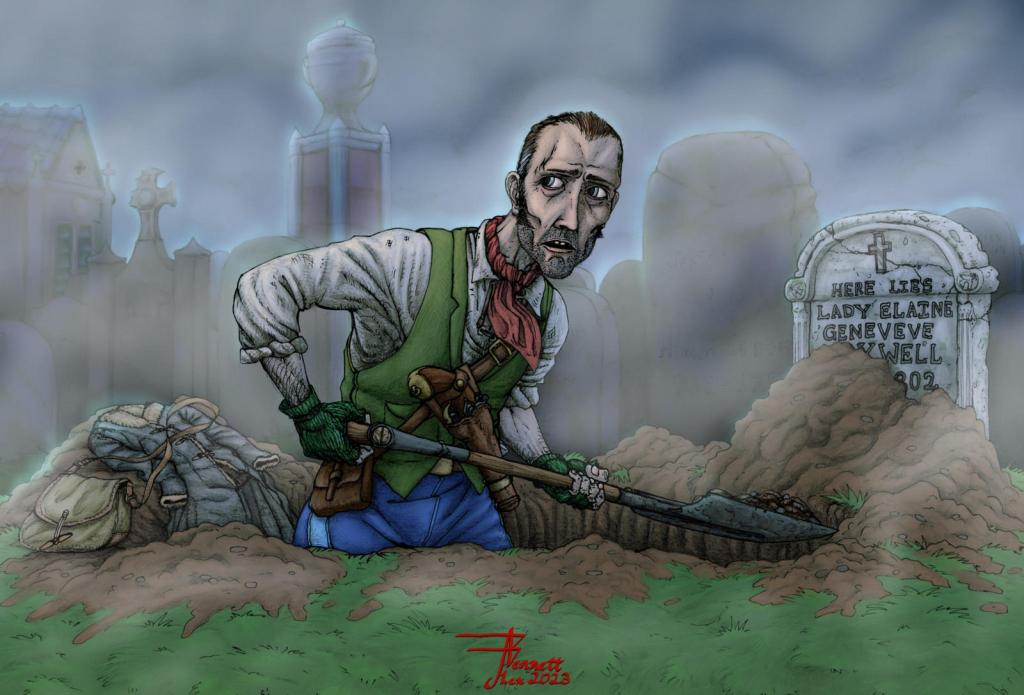
Resurrectionists or resurrection men were body-snatchers who would steal fresh corpses and sell them to medical schools for students to practice dissection. This trade flourished at the end of the 18th and beginning of the 19th centuries in Britain as a result of a lack of bodies to dissect in these schools. Organised criminal gangs would steal recently buried bodies, or acquire dead bodies before burial, and then sell them at a premium to anatomy teachers who used them to demonstrate dissection and also give students a chance to try dissecting themselves, as this was a required part of medical training. The widespread practice of body snatching led to the Anatomy Act in Britain, which legalized the use of unclaimed bodies for anatomical study.

We can’t help but wonder what future historians will make of us. “Brand Evangelist,” they might scoff. “Was that a missionary or a marketer?” “Content Creator—was that a novelist or a TikToker?”

Perhaps some titles are best left in the mists of time, to be stumbled upon in dusty libraries or trivia nights. But wouldn’t it be something to bring a few back? A ceremonial Remembrancer for family birthdays, perhaps? A Beadle to enforce silence during Zoom calls?

Till then, we’ll sip our tea like old scribes, toast to forgotten vocations, and remember to remember the Remembrancers.

My first and recent encounter with the wonderfully romantic word ‘remembrancer’ was not in a pleasant context. A Haryana committee which recommended the appointment of Vikas Barnala, an accused in a stalking case, to the position of assistant advocate general in the office of advocate general, included a Remembrancer.

–Meena

Pic credit: Our Great American Heritage

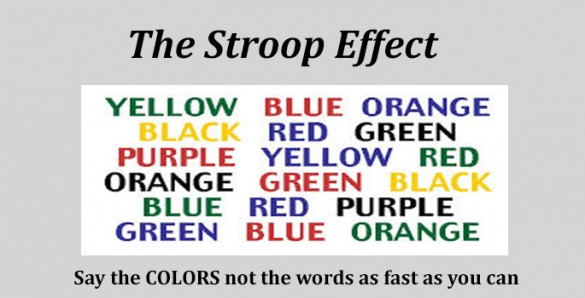
The Stroop Effect and Other Sneaky Brain Games

Having been associated for long with Vikram A. Sarabhai Community Science Centre (VASCSC), the pioneering science centre in the country, I always source STEM education materials and kits from them.

A few weeks ago, we received one such package I had ordered. The wonderful thing about VASCSC material is that they don’t let an inch of space go to waste. So the large envelope in which the kit came was also printed with any number of science games and puzzles.

The one that my 6 year old grand daughter and I really had fun with was the Stroop Effect.

It was all giggles as she held out the sheet with a bunch of words and asked me to look at them.  The word “RED” was written in bright blue ink. She asked me to say the colour, not the word..

“Red!” I said instinctively.

“No!” she giggled. “It’s blue ! You have to say the colour of the ink!”

Oh.

And just like that, we stumbled headfirst into the Stroop Effect—a clever little quirk of our brains first identified by psychologist John Ridley Stroop in 1935. Stroop, an American psychologist conducted a series of studies as part of his PhD research. He was fascinated by how automatic processes—like reading—can interfere with other tasks, such as identifying colours. In his now-famous experiment, he showed that when colour words (like “red” or “green”) were printed in mismatched ink colours, people took longer to name the ink colour. This delay, or interference, revealed something profound about how our brains handle conflicting information.

So what is the Stroop Effect?

The classic version of the Stroop test asks you to name the colour of the ink in which a different colour name is written. Like the word “Green” printed in red ink. Sounds simple, right? But our brains are wired to read words so automatically that it slows us down, or even trips us up, when the word and the ink colour don’t match.

This interference between what we read and what we see is a fascinating peek into how our minds juggle competing bits of information.

Why does it matter?

What seems like a party trick actually has deeper implications. Psychologists use the Stroop test to study attention, processing speed, and cognitive control. In clinical settings, it helps assess brain injuries, dementia, and even ADHD. The longer it takes for a person to respond correctly, the more it can reveal about how their brain is functioning.

But even beyond labs and clinics, understanding the Stroop Effect has very real applications.

Take driving, for instance. Ever noticed how highway signs use simple fonts and colours? Imagine if a stop sign said “Go” in red letters—confusing, right? Designers rely on principles like those revealed by the Stroop Effect to make sure our brains process the right cue first.

It’s not just colours and words

Once you start noticing, these mental speed bumps are everywhere. Consider this: we all know that when we try rubbing our stomach with one hand and patting our head with the other, we run into hilarious situations. It is tricky, because your brain is trying to coordinate two conflicting patterns of movement. That’s a bit like motor interference, another cousin in the Stroop family.

Or think of the McGurk Effect, where what you see affects what you hear. If a video shows someone saying “ga,” but the sound is “ba,” your brain may hear “da.” Vision wins over sound, just like reading wins over colour in the Stroop test.

And then there is change blindness—when something in a visual scene changes, and we don’t notice because our attention is elsewhere. Magicians depend a lot on this trick, as also UX designers, who try to guide user attention in websites and apps using visual cues.

A lesson in humility

For me, discovering the Stroop Effect was a gentle reminder that our brains, for all their wonder, are not infallible. They’re predictably imperfect, prone to biases and blind spots. Well, that makes life more exciting!

–Meena

Image: Venderbilt University site

Casting a Spell

The Indian-American domination of a peculiarly American phenomenon—the Spell Bee—is something that intrigues me no end. Not to say Indian-Americans don’t excel in many pursuits out there, but these kids winning the national level spelling competitions year after year after year after year is quite something.

The American tradition of spelling competitions may have started with the Puritans. By the mid-18th century, spelling competitions were common across the country. In 1750, Benjamin Franklin apparently recommended their use in a proposal for a school. Spelling challenges were quite the rage with both adults and children in the 19th century. Mark Twain apparently mentions ‘spelling fights’ in Adventures of Tom Sawyer!

The use of the term ‘bee’ for these competitions started in the mid 1870s. It is an unusual usage of the word, as ‘bee’ usually refers to a community activity with a shared goal—like quilting bees or knitting bees.

English, with words from various sources and a variety of languages, probably peculiarly lends itself to this pastime. Afterall, I don’t think there can be much confusion how 99% of words are spelt in Tamil or Kannada or Oriya– languages with phonetic writing systems do not have so much confusion in spelling. Moreover, because English has borrowed words from many languages through its history, the result is a diverse vocabulary with inconsistent spelling patterns which are carried over from the mother-languages.

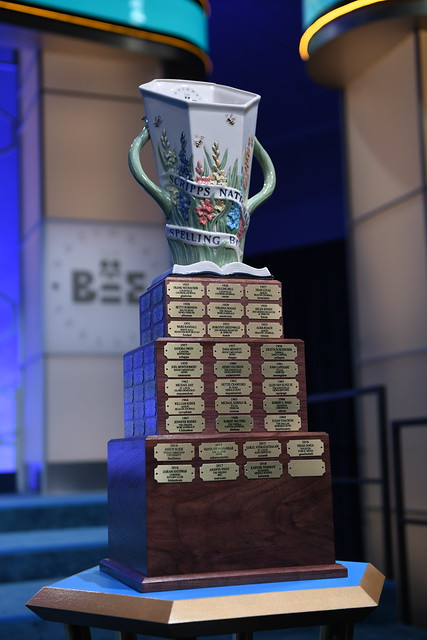
In the US, the National Spelling Bee, as we know it today, was established in 1925. The Louisville Courier-Journal was the first sponsor, who saw it as a way to foster interest in spelling and language. 

The E.W. Scripps Company acquired the rights to the National Spelling Bee in 1941. This company was started by E.W. Scripps who founded The Penny Press, a daily newspaper in Cleveland. Today, the company is involved in investigative documentaries and enterprise journalism with the purpose to ‘…advancing understanding of the world around us.’

The Spell Bee has been held annually, in late May or early June since its inception, except for a few years during World War II and in 2020 due to COVID-19.  It has evolved over time, beyond just spelling, encompassing vocabulary development and broader language knowledge. 

The first winner of the Spell Bee, in 1925, was Frank Neuhauser of Louisville, whose winning word was “gladiolus”. The next year saw a girl winning for the first time– Pauline Bell, also of Louisville, who spelt the word “cerise”. (Incidentally, girls won nine consecutive competitions from 1932 to 1940.)

Now coming to winners of Indian origin. 30 of the last 36 competitions have been won by them. Which is surely not a chance thing. Before 1999, there were only two spelling bee winners of Indian-American descent—Balu Natarajan in 1985, with the word “milieu”, and Rageshree Ramachandran in 1989 with “elegiacal”.  Nupur Lala opened the floodgates in 1999 winning with “logorrhoea,” and there has been no looking back since then! This year of course we celebrate Faizan Zaki, a 13-year-old Indian-American student from Texas, who won with the word ‘éclaircissement”

Rebecca Sealfon who won in 1997 against Prem Murthy Trivedi, has done some analysis on the subject of Spell Bee competitors, and tells us that children practice for about 500 hours in the years in which they compete; some hire ex-competitors as coaches; and they typically and unsurprisingly relax by playing word games like Scrabble or Boogle. Some try to learn every word in the dictionary. She further tells us that double ‘ll’ words are the ones which have tripped up a large number of contestants, along with the words ‘metastasize’ and ‘metonymy’.

Since I don’t know many of these words, and would certainly not be able to spell them, I can only express my wonder at these sub-14 year olds who can.

Kudos to all of you! You have cast a spell on me!

–Meena

Pic: https:spellingbee.comblogscripps-cups

MOOMINS

Way back in the ‘60s and ‘70s growing up in Delhi, the family newspaper was The Statesman. It was considered by Tamilian families to be the closest substitute for The Hindu, which in those days used to arrive in Delhi with a delay of a day or two.

So like all good Tamilian families outside Tamil Nadu, we too took The Statesman. And through this, got introduced to the Moomins, which was the only cartoon strip that the paper carried.

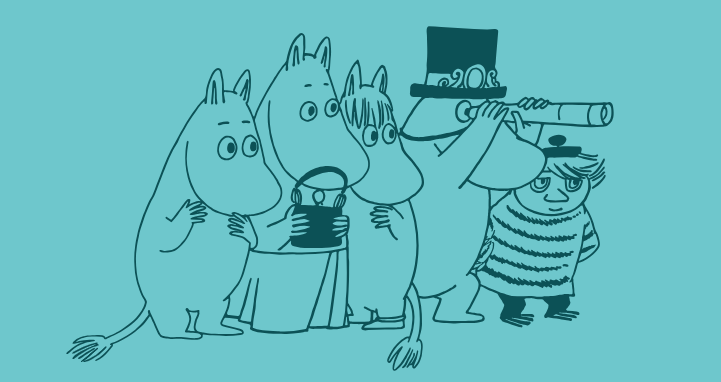
The central characters of the cartoons, which have just turned 80, are gentle-looking hippo-like creatures called the Moomins . They are white and roundish, with large snouts. The Moomin world and its characters are the creations of the Swedish-Finn illustrator and writer Tove Jansson, and the books and comic strips were originally published in Swedish in Finland.

The core family consists of the main protagonist, Moomintroll, a small and well-meaning Moomin who who is forever having adventures and often finds himself in trouble; his mother, the nurturing and loving Moominmamma; and his father, the restless Momminpappa. And besides, there are many of their friends.

The first book was written during World War II as a fairytale for Tove to comfort herself during dark times.  It is based on the situation and stories of  millions of displaced people seeking refuge. The Moomins live in a tall blue house – a joyful place where everyone is welcome, whoever they are. The motto is ‘The door is always open’. The blue-purple Moominhouse is thus a symbol of security, shelter and a sense of belonging. No wonder then that even today the Moomins represent hope for refugees, so much so that UK cities are using this as an the inspiration for a series of art installations in UK cities, in collaboration with Refugee Week. 

The Moomin stories are tales of adventure and overcoming adversities, always with a sense of inclusion and tolerance, and living together in cheer and happiness. Harmony with nature is a recurring underlying theme. The underlying message of all the Moomin stories is that it’s the simple things that are valuable in any situation, and that one’s attitude can often change a bad day into a good one.

Many in India may not be very familiar with these characters, but there are nine Moomin novels which were all successful. The cartoon strip was syndicated in 1954, to over 120 publications in 40 countries. This comic strip reached 20 million readers daily. There was a TV show too, which was originally broadcast in Poland and then sold to other countries including the UK, and aired on PBS in the US. There are even two Moomin theme parks, one in Finland and the other in Japan. Moomin stories have been adapted for the theatre, the cinema, and as an opera.

Here are some Moomin quotes, encapsulating good sense and postivity:

‘That’s most extraordinary, but I’m so used to your doing extraordinary things that nothing surprises me.’

‘Perhaps it will come – perhaps not. It’s all the same to a person who knows that everything is unnecessary.’

‘How nice to be on your own for a bit and do what you like.’

‘I like you, I don’t want to make you feel unhappy.’

‘The main thing in life is to know your own mind.’

In a conflicted world, Moomins may be the cartoon characters we need!

–Meena

Visual: From http://www.moomins.com

Wordsmithery: Animals as Verbs

I am a logophile! A lover of words in all their forms. So I was excited when I discovered that there is a day called Wordsmith Day! What is a wordsmith and what is this day all about? The term wordsmith is derived from other words like blacksmith, goldsmith, silversmith and locksmith, all of which refer to a high level of competence and expertise in a particular technique, and who work to create something using that mastery. Wordsmith thus denotes a person who possesses a mastery of words and who can mould and craft words to form thoughts and ideas.

Wordsmith Day celebrates authors, editors, poets and other writers and their ability to weave words to create masterful word pictures. 

While I am not sure if I can count myself among the club of wordsmiths, I surely appreciate and enjoy the works of master wordsmiths, in all genres. So it was a happy coincidence that I recently came across an interesting way of comparing characteristics. This initially triggered memories of grammar periods in school when we were learning Similes. As strong as an ox. As busy as a bee. As slippery as an eel. As proud as a peacock. As slow as a sloth…

A simile is an expression which describes a person or thing as being similar to someone or something else. Usually similes combine an adjective with a noun to make the comparison, drawing upon a characteristic feature of the creature.

It is interesting that similes compare unlike things, which makes them different from usual comparisons. However there is another way of comparing. Here, the animal becomes a verb rather than a noun. I thought it would be fun to mix and match, and see how both these kinds of comparisons play out.

Ape: The simile could be ‘as clumsy as an ape’. But we also use the word to mean imitate or mimic. Another member of the menagerie performing the same action would be parrot.

Bat: ‘Blind as a bat’ is an apt description of the bat in the daytime. But the other ‘bat’ (also a noun) has a place of honour in many sports. However ‘to bat’ becomes an action word when it is used to strike a ball. And there you have the batter in action.

Dog:  As ‘loyal as a dog’ is a reassuring trait. But when that loyalty is demonstrated by faithfully following the master, it becomes a verb that indicates the action of ‘following closely and persistently’. When the dog is a hound, the action becomes somewhat distressing as in “that moneylender is hounding me day and night”.

Badger: Is an animal with a tenacious bite that is difficult to loosen. One does not usually compare anyone to a badger, but when someone repeatedly asks questions or makes demands in an annoying fashion, we can rightly demand: ”Stop badgering me!”

Fish: ‘To swim like a fish’ denotes ease and grace of moving through water. But the act of ‘fishing’ is one that pulls the fish out of water by hook (or crook). And hopefully when we describe someone as feeling like ‘a fish out of water’, we assume that person is still very much alive (though probably uncomfortable!) But we also ‘fish’ for items out of our pockets or handbags, as well as ‘fish’ for compliments.  

Slug: Along with snail, this indicates slow and lazy. But the action words are far from sluggish. When you ‘slug’ someone or ‘slug it out’, it takes speed and strength to deliver that punch in the fight. Loading a gun with bullets is also called ‘slugging’, and once fired, a bullet moves with a speed that no slug can ever dream of. ‘Slugging back’ a beer equally denotes a fast gulping action.n.   

Worm: Denotes a creature of the dirt, and may be used synonymously with creep, or louse. While a worm may burrow in the soil, its action verb, ‘to worm out’ means to extract or remove what should remain within. ‘Worming out’ such information may require a range of tactics from subterfuge to manipulation to force. While it generally denotes extraction, one can also say that someone will ‘worm’ their way in. 

While worming usually involves indirect methods, information that is ‘ferreted’ out is usually obtained by searching for it in a determined and assiduous way: a close match to the ferret’s hunting instincts and natural ability to navigate burrows to search out animals.  

Leech: There was a time when ‘to leech’ meant to heal or to cure. To leech someone was to care for their wellbeing. This referred to the time when leeches were used to drain out bad blood to remove the toxins in the body. With medical advances, these references became obsolete. Now we use ‘to leech’ to refer to the act of being parasitic, sponging, or freeloading.  

Wolf and Pig: In the old fairy tale it was the hungry wolf who huffed and puffed to bring down the houses of the three little pigs, in the hope of a tasty meal. Today too, it is hunger that drives us to ‘wolf down’ food (devour ravenously). Interestingly it is probably the same hunger that leads us to sometimes ‘pig out’, that is to gorge on something or eat greedily.   

Ram: When two rams fight for dominance, they charge at each other head-on, and smash into each other locking their strong horns. The action has evolved into a verb that evokes a smashing forceful action as in ‘the car rammed into the pillar’, or ‘that really rammed home the message’.  

Bear: Some people are as grumpy as a bear in the morning. But the description does not have much in common with the verb that denotes more responsible actions—‘to carry, to bring, to endure’. People bear children, some bear arms, others bear responsibility for their actions. We bear the weight of, and some bear the brunt of, and a tree will bear fruit. Not quite relatable to the animal at all!   

Lots of play on words! A fun way to mark Wordsmith Day on 3 May!

–Mamata

Updating Anthems

In this week of Republic Day, the tune of our national anthem and other patriotic songs are all around us. Without them, the mood cannot be built. Singing the national anthem together with neighbours, community, colleagues, fellow-students—there is nothing more symbolic of our oneness.

Anthems in general are rallying cries, rousing or uplifting songs identified with a country, section, cause etc. A national anthem is a solemn patriotic song officially adopted by a country as an expression of national identity.

These songs are our identity. But just as in so much else, should they change as contexts and realities change?

Well, five countries have taken the bold step of changing their anthems in recent years.

Australia: On Jan 1, 2021, Australia’s national anthem, “Advance Australia Fair,” underwent a significant change. The phrase “For we are young and free” in the second line was changed to “For we are one and free.”  This is an effort to respect the Aboriginal and Torres Strait Islander peoples, recognizing that Australia’s history precedes European settlers tens of thousands of years. It is a symbol of Australia’s commitment to unity and reconciliation with Indigenous population.

Austria: Austria’s national anthem is “Land der Berge, Land am Strome” (Land of Mountains, Land by the River). The language was reviewed and modified to promote gender inclusivity in 2021 . The original lyrics which referred to “great sons,” was changed to “great daughters and sons.”

Canada: In 2018, Canada made a significant and widely-welcomed change to its national anthem “O Canada” in 2018. The line “in all thy sons command” was changed to “in all of us command.” was changed to “in all of us command”, again an effort for gender-inclusivity.  

South Africa: Like the nation itself, South Africa’s national anthem is unique. It combines lines from several different languages and songs, including the hymn “Nkosi Sikelel’ iAfrika” and the former anthem “Die Stem van Suid-Afrika.” In recent times, small changes have been made to the anthem with the purpose to ensure proper pronunciation and inclusion of all languages and honour the linguistic heritage of all its people.

New Zealand: In 1977, the Government announced that New Zealand would have two national anthems — the traditional anthem ‘God Save The Queen’ and the poem ‘God Defend New Zealand’. Since then, both the anthems have had equal status. Following the accession of King Charles III to the throne in 2022, the words of the first anthem changed to ‘God Save the King’.

The latest change in a national anthem is not for a change of words but of the tune. In January 2025, Saudi Arabia has asked Hans Zimmer (Oscar-winning composer of the Lion King, Dune etc.) to create a new version of its national anthem, Aash Al Malik (Long live the King)!

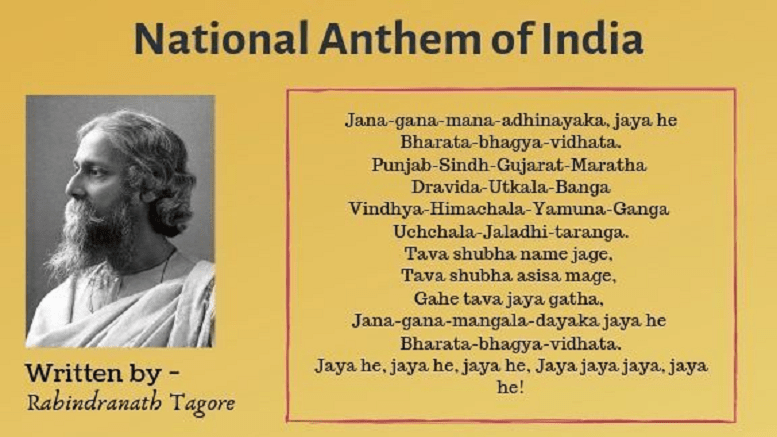
Our anthem Jana Gana Mana (‘[Ruler of] the minds of the people’) was  composed as “Bharato Bhagya Bidhata” in Bengali by  Rabindranath Tagore on 11 December 1911. The first stanza of the song  was adopted by the Constituent Assembly of India as the National Anthem on 24 January 1950, the same day as the Indian Constitution was signed. (Mamata has dwelt on this at length in post last week).

There have been a few proposals to change/add/delete words and phrases. For instance, to add the name ‘Kamrup’ to make the anthem inclusive of the Northeast; or remove the name ‘Sind’ because it is no longer in India. The word “Adhinayak” has also been controversial,  because it was used to praise King George V in 1911. In 2019, there was a bill moved in the Rajya Sabha, to modify the third line to ‘Punjab Sindh Uttarpurv Gujarat Maratha’, to bring in the Northeast. However,  the Supreme Court has struck down all of these.

While tampering with sacred traditions is always fraught, there does seem to be sense in these suggestions, and maybe we need a debate on this. After all, the essence of democracy is debate, and this seems a worthwhile one!

Happy Republic Day!

–Meena

Thanks: http://www.vanguardngr.com

Word of the Year

Come the end of the year, and we see various lists, rankings, selections ,’ Best of..’,  ‘..of the Year’, and what have you. For me, the most interesting of these is the Word of the Year, or WOTY.

Word of the Year is what is considered the most important word(s) or expression(s) in the public sphere during a specific year. It is supposed to capture the zeitgeist of the year gone by. There is no THE Word of the Year. There are several Words of the Year, assessed and declared by several bodies—dictionaries, learned societies, etc.

The tradition started in German when the first Wort des Jahres was selected in 1971. The word was aufmüpfig, meaning rebellious or insubordinate.

The first English WOTY was declared by the American Dialect Society’s in 1990, and was bushlips, meaning insincere political rhetoric (from Bush’s ‘read my lips’ comment). The American Dialect Society (ADS) is a learned society, not connected to any commercial interest, and their WOTY is picked by vote of independent linguists, though anyone can nominate a word at any time of the year. As appropirate for a seriously academic institution, ADS really gets into the issue, defining several categories apart from overall WOTY, including: Most useful/Most Likely to Succeed WOTY; Political WOTY; Digital WOTY; Informal WOTY; Acronym/Initialism of the Year; AI-related WOTY; Most Creative WOTY; and Euphemism of the Year. While all other organizations declare WOTYs at the end of the given year, ADS comes out with it’s in the beginning of the next year.

As we have seen from the newspapers, several other organizations also pick their own WOTYs, using different methodologies. Here is a look at some of the popular ones and how they are selected:

Oxford WOTY

‘The candidates for the Word of the Year are drawn from evidence gathered by our extensive language research program, including the Oxford Corpus, which gathers around 150 million words of current English from web-based publications each month. Sophisticated software allows our expert lexicographers to identify new and emerging words and examine the shifts in how more established words are being used.

Dictionary editors also flag notable words for consideration throughout the year and use other sources of data to identify contenders.

We regularly take into account the many suggestions sent to us via social media.

The final Word of the Year selection is made by the Oxford Languages team on the basis of all the information available to us.’ (https://corp.oup.com/word-of-the-year/)

Cambridge WOTY

‘The candidates for the Word of the Year are drawn from evidence gathered by our extensive language research program, including the Oxford Corpus, which gathers around 150 million words of current English from web-based publications each month. Sophisticated software allows our expert lexicographers to identify new and emerging words and examine the shifts in how more established words are being used.

Dictionary editors also flag notable words for consideration throughout the year and use other sources of data to identify contenders.

We regularly take into account the many suggestions sent to us via social media.

 The final Word of the Year selection is made by the Oxford Languages team on the basis of all the information available to us.’ (https://dictionary.cambridge.org/editorial/word-of-the-year)

Dictionary.com

‘Dictionary.com’s Word of the Year and short-listed nominees capture pivotal moments in language and culture. These words serve as a linguistic time capsule, reflecting social trends and global events that defined the year. The Word of the Year isn’t just about popular usage; it reveals the stories we tell about ourselves and how we’ve changed over the year. And for these reasons, Dictionary.com’s 2024 Word of the Year is demure.’ (https://www.dictionary.com/e/word-of-the-year)

Merriam-Webster WOTY

‘When the Word of the Year was started in 2003, Merriam-Webster determined which words would appear on the list by analyzing page hits and popular searches to its website. For example, the 2003 and 2004 lists were determined by online hits to the Merriam-Webster Online Dictionary and Online Thesaurus and to Merriam-WebsterCollegiate.com.

In 2006 and 2007, Merriam-Webster changed this practice, and the list was determined by an online poll among words that were suggested by visitors to the site. Visitors were requested to vote for one entry out of a list of twenty words and phrases. The list consisted of the words and phrases that were frequently looked up on the site and those that were submitted by many readers.

From 2008 onwards, however, user submissions have not been a deciding factor, and the list has been composed only of the words which were looked up most frequently that year. Merriam-Webster said that the reason for the change was that otherwise ordinary words were receiving so many hits that their significance could not be ignored.’ (https://www.merriam-webster.com/wordplay/word-of-the-year)

The Oxford WOTY 2024 is brain rot, which is ‘any Internet content deemed to be of low quality or value, or the supposed negative psychological and cognitive effects caused by it’.

The Cambridge WOTY for the year is manifest, meaning ‘to speak your dreams into existence. It’s also associated with the practice of visualizing goals to achieve them’.

And stop press! Merriam-Webster has just declared polarization as its WOTY. While polarization means division into two sharply contrasting group, Merriam-Webster’s editor at large clarified further that in the context of their choice. “Polarization means that we are tending toward the extremes rather than toward the center.”

If only we could ‘manifest’ ‘brain rot’ and ‘polarization’ away, wouldn’t that make for a great 2025!

–Meena

Grammarly yours…

A title itself which will be grist to the mill for the “Grammar police”, a term for people who feel compelled to correct other people’s grammar, often in public. Of course, I would rather be pulled up by the grammar police than the “Grammar nazi”—a term which originated in the 1990s to describe someone who is overly critical of others’ grammar, spelling, typos, and other writing or speech errors.  Grammar nazis are obsessed with formal grammar rules. 

The world of grammar is a contentious one, with some debate or the other making the headlines. The latest is Germany’s outrage about the increasing influence of English on their grammar. The kerfuffle is about what is called the ‘idiot’s apostrophe’ (a translation from the German Deppenapostroph).

What is this intriguing thing? Well it stems from a basic difference between the grammar of the two languages. Unlike English, German does not traditionally use apostrophes to indicate the genitive case or possession. So in German, the correct form for a shop named after its owner, say Kareena or Paul, is ‘Kareenas Kirana’ or ‘Pauls Dry-cleaning’. And this is how it has been for centuries.

However in English, as we know, the correct form is ‘Kareena’s Kirana’ or Paul’s Dry-cleaning’. And for the last several years, thanks to the influence of English, slowly the general usage in Germany has shifted from ‘Kareenas Kirana’ to ‘Kareena’s Kirana’. Which was OK with the general public.

But now the new edition of the Council for German Orthography’s style guide—the official set of rules for the use of grammar has endorsed this shift, saying ‘Kareena’s Kirana’ is perfectly acceptable. Which has set the pedants and scholars up in arms, as they see it as a dilution of the rules of their language due the pernicious influence of a foreign tongue. The controversy continues to rage there!

We in India are rather free in our misuse of apostrophes, though not quite in this way. What we often see is what is called the English greengrocer’s apostrophe, when an apostrophe before an ‘s’ is mistakenly used to form the plural of a noun (e.g., “a kilo of potato’s”). Look closely at emails you receive, menus, or local ads, and you will find plenty of examples.

It is not just the apostrophe which is at the root of grammar-controversies. The Oxford comma is a case in point. The last comma in a list of three or more things is called the Oxford comma (or the serial comma). For example, in She bought peanuts, soap, and candles, there is a comma between each item listed. The comma before and is the Oxford comma. Not everyone agrees on whether to use the Oxford comma. In this case, the comma can be deleted without changing the sense of the sentence. But there are cases when things may get confusing without it. For example, in the sentence I love my dogs, chikko, and cheese, the Oxford comma makes it clear that all three items are separate. This one could be confusing if the Oxford comma were left out: I love my dogs, chikko and cheese, might mean that the speaker’s dogs are named Chikko and Cheese. Which would also of course imply that the writer is not strong with capitalization! But there is a point there, and doing away completely with Oxford commas does not seem a good idea.

Some people have proposed that we should have Grammar Czars–benevolent dictators who would hand down rulings on ambiguous grammatical rules. The GC’s decisions would be final. All would abide by the GC’s decisions, upon penalty of death (or being banned from social media for periods ranging from a month to a year!).

In the meantime, let us enjoy the creativity of grammatical mistakes, mis-spellings and confusions arising from misunderstanding of words.  I love my neighbourhood ‘Karim Puncher Shop’. But surely an ad for a new housing society which I saw some years ago in Hyderabad, which proudly called for subscribers for ‘Mildew Apartments’,  takes the cake!

–Meena

The Moving Finger…

Last week was devoted to calligraphy, which we are assured by practitioners, is not handwriting at all. Rather, they aver, it is an art form.

Calligraphers are few and far between. But each and every one of us is a hand-writer. Children start doodling and scribbling by the age of two, and most write the alphabet before they are four. It might be one of the most universal of skills! And an essential one too, because research suggests that writing by hand enhances learning and memory. Brain patterns established during handwriting are important for memory formation and learning new information. And of course it improves fine motor skills. So hand writing practice is pretty important even for children who are digital natives and may not use the skill very much as grown-ups.

There are 12 characteristics on which quality of handwriting is evaluated: line quality, spacing, size consistency, pen lifts, connecting strokes, complete letters, cursive vs. print, pen pressure, slant, baselines, embellishments, and placements.

But it is a fact that the quality of penmanship has gone down with time. As we use the skill less, we get worse at it. In fact, there are times when I can’t decipher my own scribbled notes. Reports and records based on these notes are my only forays into fiction!

Which is why it is probably important to highlight and celebrate this skill.

In the US, they observe National Handwriting Day on January 23rd. Why this date? Well, it is the birthday of John Hancock, the first signatory of the Declaration of Independence. Among the 56 signatures on the document, his large, flamboyant signature stood out. In fact, so prominent was it that “John Hancock” is an informal synonym for signature in the US!

The Day started to be observed in 1977, when educators were already beginning to feel that the art of handwriting was getting lost. The Writing Instrument Manufacturers Association came forward to do something about this (and of course at the same time, increase sales of pens, pencils, paper and writing instruments). They initiated National Handwriting Day.

(Incidentally, though we use handwriting and penmanship interchangeably, they are not quite the same. Handwriting is the act of writing out full words or sentences by hand on paper. Words may be written either legibly or illegibly. Penmanship is the art or skill of having excellent writing, and good penmanship makes the process of reading written work much easier.)

Lately, something called the World Handwriting Contest has been initiated. Each year, the World Handwriting Contest opens for entries between January 1 and June 30. There are eight age categories, starting from Children below age 7, right through –Teens, Teens, Adults and Seniors (age 65 up). And it is open to anyone, anywhere.

There are two styles for which prizes are given:

Functional Handwriting which strives for legibility, speed, and fluency without aiming at artistic effect. For this category, the judges will further separate entries as cursive, which joins 50% or more of its letters or manuscript printing, which joins fewer than half of its letters; and
Artistic handwriting which uses a monoline or calligraphy marker, pen, or brush along with decorative strokes, flourishes, and/or combinations of shading, hairlines and/or thick and thin strokes to create an artistic effect.

NRI domination over the Spelling Bee contests is well accepted. People of Asian origin now seem to dominate among winners of the Handwriting competition too, with Indians and Indian-origin names finding frequent mention (with stiff competition from Bangladesh!). Among Indians, Salil Jha of Bhopal has won a prize (above 65 category). Roslin Richard of Bangalore is first place winner in the Adult Category; Feba Sara Saji of Kerala is a winner in the Teens category. Keep it up people! May the moving finger keep writing beautifully!

–Meena