
A few weeks ago, we looked into the renewed focus on cycling in India. From looking forward, this week we look back to the history of cycles and associated accessories.
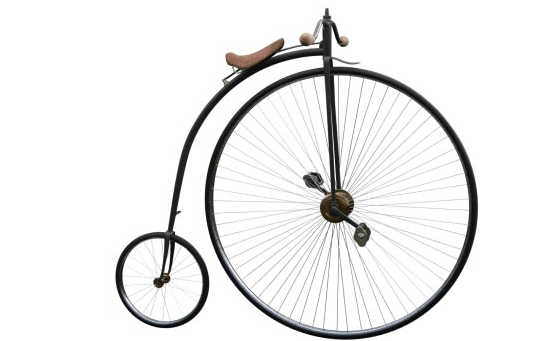
When the first velocipedes (how dinosaurish does that sound??) rattled down European streets in the mid-19th century, they were little more than mechanical curiosities. Wooden frames, iron tyres, no brakes worth the name. Riding one was only for the reckless! The penny-farthing that followed —towering front wheel and precarious balance — made cycling a performance. Only the young and fearless could mount it, and the fall was as much a part of the experience as the ride.
Everything changed with the “safety bicycle” of the 1880s: two wheels of equal size, a chain drive, pneumatic tyres. Suddenly, cycling became practical. You could ride to work, to the market, to visit a friend. No fuel, no maintenance.
And practically no special gear in those days.
But soon came the humble trouser clip did make riding more convenient for men. To modern eyes, it looks medieval: a spring-loaded strip of metal hugging the ankle, holding fabric away from a greasy chain. But for decades, it was an essential. Men could cycle to office or factory without rolling up their trousers like labourers or risking oil-stained cuffs. Infact, I remember my father had one!
In Britain and Europe, cyclists also used trouser straps made of leather, elastic bands with buckles, even improvised safety pins. In India, where bicycles quickly became tools of work — for clerks, teachers, postmen — it was a metal slip-on around the ankle.
Women faced a more complicated problem. In the West, corsets, long skirts, layers of petticoats, and in India, the sari — none were designed for pedalling. Accessories stepped in stepped in because dressing styles took their time to change. Skirt guards– mesh or wire panels fitted over the rear wheel–prevented fabric from tangling in spokes. In India, the chain guard became standard, not optional — a solid metal shield protecting sarees, dupattas, school uniforms.
Other innovations took root in India, to cater to the specific needs. Rear carriers grew wider and sturdier– for schoolbags, milk cans, whole families. Bells had loud, rings that announced presence on crowded roads.
Lighting tells another story of evolution. Early bicycles relied on oil lamps and carbide lamps — lovely if moody. Then came the dynamos. Today’s LEDs and rechargeable lamps are brighter and lighter, and fulfil the same needs — that the cyclist be seen, that night need not be a barrier. But in India, there has been a regression. From lights being quite common specially in the South, they are seldom to be seen today.
And then there is the helmet — the most contested accessory of all.
For most of cycling history, helmets did not exist in any recognisable modern form. Riders trusted balance, experience, and luck. It was only with the rise of fast motor traffic and increasingly hostile roads in the late 20th century that helmets entered everyday cycling conversations.
Countries with strong everyday cycling cultures like the Netherlands, Denmark, Germany, and the United Kingdom tend to prioritise safer infrastructure and do not have compulsory helmet laws for cyclists.
But in most countries, there is neither a mandatory helmet rule, nor an effort towards safter infra. Very few places in the world make helmets mandatory for all bicycle riders. Nations that mandate helmets for all riders often do so in environments where cycling is seen as high-risk.
Countries with universal bicycle helmet laws — applying to adults as well as children — include Australia and New Zealand, where nationwide mandates have been in place for decades. A smaller group of countries, including Argentina, Costa Rica, Namibia, Cyprus, Singapore, and parts of the United Arab Emirates, also require cyclists to wear helmets by law, though enforcement and penalties vary.
Some countries like Japan, have introduced a legal duty to wear helmets for cyclists, but without the kind of fines or policing associated with traffic offences.
Far more common are age-based helmet laws, where children or teenagers must wear helmets but adults are exempt. Yet other countries do not require helmets in cities, but helmets are compulsory for cyclists outside urban areas.
In India, there is no nationwide law that makes helmets mandatory for people riding ordinary, non-motorised bicycles. Sadly, these laws do not even exist for motorized two-wheelers, or are not uniformly enforced even where they exist. Neither is there effort towards roads, lanes and infra to make cycling safter.
Given that India stands first in the world in absolute number of traffic deaths, and that two-wheelers including bicycles account for over 50% of these deaths, is it not time to make it mandatory of cyclists and two-wheeler drives to use helmets? And for city-planners to make roads safer for cyclists?
Safety please!
–Meena



 Millennial Matriarchs