What Say You?

When I lived in Kenya, and learnt a little bit of Kiswahili, it was great fun to discover curious words or phrases. One of the best ones was to the local word for curd/yogurt. This was called Mazeevaa Lala—literally “sleeping milk!”

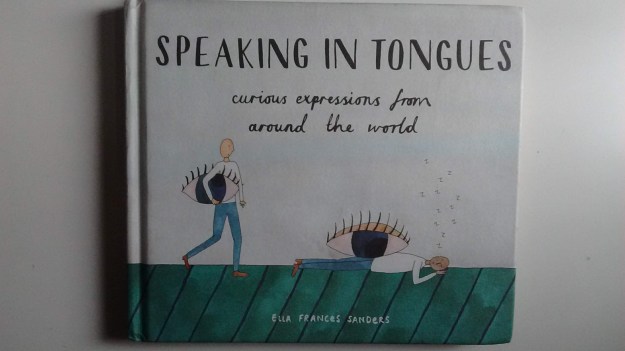
I was reminded of this recently when I chanced upon a Maltese saying My eye went with me, to mean that you have fallen asleep, as not taking your eyes with you would result in a sleepless night!

This is one of the many sayings in a delightful book titled Speaking in Tongues: curious expressions from around the world–a compilation of proverbs, idioms and sayings from different languages of the world, put together by Ella Frances Sanders. What brings the words alive are the accompanying illustrations, also by Ella who describes herself as “a writer out of necessity and an illustrator by accident.”

IMG_20180725_181146775.jpgFrom Finnish to Igbo, Armenian to Yiddish, each double spread presents delectable sayings and drawings that blend the wit and wisdom of the ages while also placing these in their cultural context.
Cannot resist sharing some:

Even the monkeys fall from trees. This well-known Japanese saying reminds that even the best and the cleverest can still make mistakes, and cautioning to keep overconfidence in check!  Perhaps the recent World Cup surprises where the superheroes fell from grace is an apt analogy!

You are my orange half. A Spanish term of endearment that means that someone is your soulmate or love of your life. Not quite sure what is so endearing about an orange, but reminded of the Amul chocolate ads that urged us to “Share it with someone you love!”

Horse horse Tiger tiger. To describe something that is so-so, or neither here nor there. This is a Mandarin expression; its origin lies in a story about a painter who painted a half tiger half horse but nobody bought it as it was neither one nor the other.

To pull someone out of their watermelons. A Romanian idiom that means to drive someone crazy! Not much light on why being in or out of watermelons can be harmful to mental health!

Stop ironing my head. An Armenian way of saying “Stop bugging me!” Popularly used when someone keeps asking irritating questions and won’t leave you alone. In many Indian languages we have our own equivalents in the form of “Don’t eat my head.”

To give a green answer to a blue question. A Tibetan reference to when the answer is completely unrelated to the question asked. Something that people in politics are adept at!

This is just a sampler of the 52 proverbs, expressions and idioms that have been passed on from one generation to another in diverse cultures. Interestingly, they reflect not just diversity, but also the sameness as it were. As I read I immediately thought of similar ones in Hindi and Gujarati, as will surely be the case in all languages. Remember how we had to memorise proverbs in our language subjects in school and what a pain it was? Maybe it is time to revisit these!

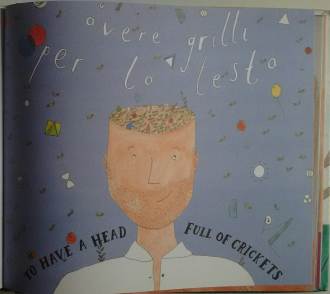
A perfect one to end with. To have a head full of crickets. 

IMG_20180725_181247.jpg

How the Spanish describe a mind buzzing with crazy, wonderful ideas, whims, and flights of fantasy…(what some would call nonsense!)

Nicely sums up how I often feel!

–Mamata

A Magical Walk

I remember it well—a mere 400 metre walk on our office campus in Ahmedabad. That day we were walking along the path that all of us took regularly; walking along with us was Professor HY Mohan Ram, a member of our Governing Council, who was there for the Council meeting. As we walked, Professor Mohan Ram talked—gently, softly, but with passion and excitement, pointing out plants that we saw every day, but, as we realised, we never really ‘looked at’.

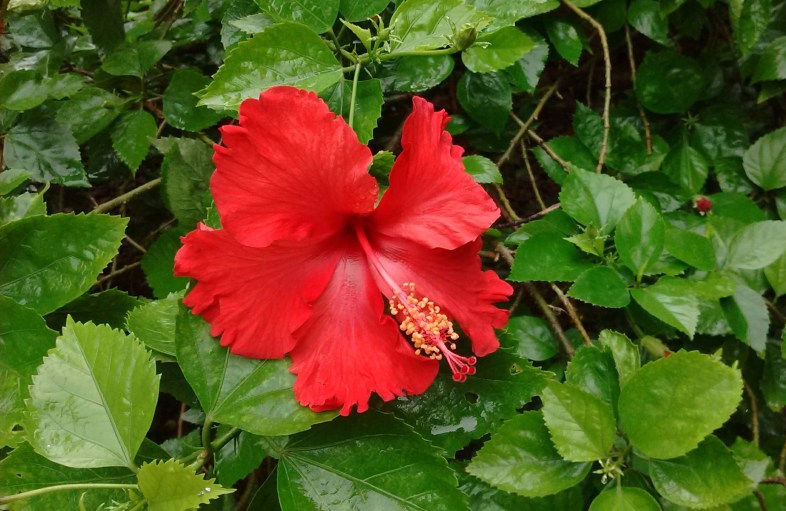
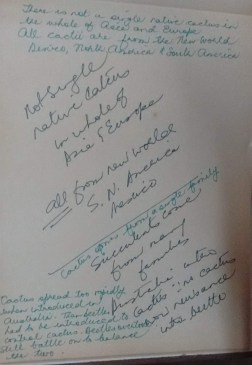
“Look at this one”, he pointed at a plant, “this is Aduso. Its botanical name is Adhatoda vasika which means ‘that which the goat will not touch’. This is what is used for making medicines for cough and cold.” Going just two steps ahead, “You know the cactus, but did you know that there is not a single native cactus in the whole of Asia and Europe? All cactii are from the New World—Mexico, North America and South America.” ”Look at this magnificent neem tree.  Its botanical name Azadirachta indica comes from the Arabic for azad meaning ‘free’ and drakhta meaning ‘tree’. This is thought to be a tree indigenous to India, but there is some doubt if it is originally Indian. It may have originated on the Burma border and come to Bangladesh from there.” “Did you know that Lutyens, when planning the landscaping of Delhi’s roads, planted only native species. Each avenue was planted with one species of fruit tree.” Three steps ahead, we come to the white flower commonly called Chandni. Professor tells us, “Have you noted carefully the arrangement of petals of flowers? Most flower petals are usually in multiples of 3 or 5 (except in the case of the mustard flower).” “Many high school students know this as the shoe flower that they got for dissection in the exams. But why the name shoe flower? Because it is used to polish shoes! Its other name is hibiscus, and is believed to have originated in China.”

IMG_20170822_090553807.jpg

Professor HYM had a fascinating story for every step that we took, drawing attention to the tiniest of flowers that we carelessly trampled underfoot, to the towering culms of bamboo. The path that took us 5-7 minutes to traverse became a magical mystery tour that took close to two hours. Through his eyes the blur of vegetation turned into a veritable treasure trove, with each plant glowing with its own special attributes.

Not long after this visit, Meena and I invited Professor HYM to contribute to a collection of tales of ‘Nature Heroes’ that we were putting together. He graciously agreed, and shared with us some of his journey, experiences and inspirations in a piece titled Reflections of a Botanist.  He writes “I have not pursued any single course. I have done what interests me and not what is in style. I have a deep interest in Indian classical music and photography.”

He concludes the piece with this, “What enlightenment have I received as a student of plant biology? I wish I could be like a tree: deep-rooted and firmly fixed, bearing a lofty bole and a broad canopy, continuously absorbing, synthesizing and renewing, unmindful of stresses and insults, resilient to changes and perpetually giving.”

In the passing away of Professor HY Mohan Ram the world has lost not only a botanist par excellence, but a much loved and respected teacher, researcher, and writer. For us, the Matriarchs, Professor Mohan Ram will always be remembered as a gentle, unassuming guide with a twinkle in his eyes, and a life-long inspiration whose visits to the Centre were like the Open Sesame to a fascinating world of flora.

A page from my notes on the Walk!  (Date 22 August 1998)

IMG_20180620_115125823.jpg


–Mamata

Sights That Make Me Smile As I Walk By

Our Indian cities don’t have much by way of street art. And what there is, looks typically municipality-commissioned.

Which is why i thought i should share a few examples of street art that ticks all the boxes of what this should be–creative, imaginative, quirky and brilliantly executed.

So I am going to let the pics speak for themselves!

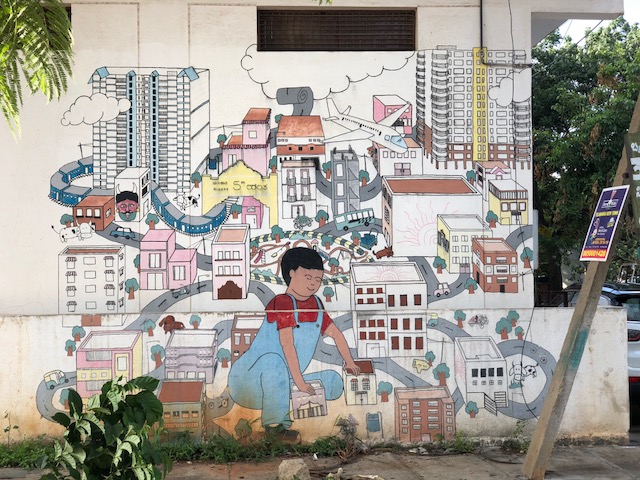
A brilliant 2-level piece, partly on the compound wall, and partly on the building wall. (Note the line across the boy’s shoulder. Below that, is the the portion on the compound wall, and above on the building wall). Yelahanka, Bangalore.

2E61621F-9F75-4954-9F46-955590FBF2F7

Compound wall of a house. Yelahanka, Bangalore.

bd744ad6-bc93-4e87-9255-21e9fbc1be89.jpeg

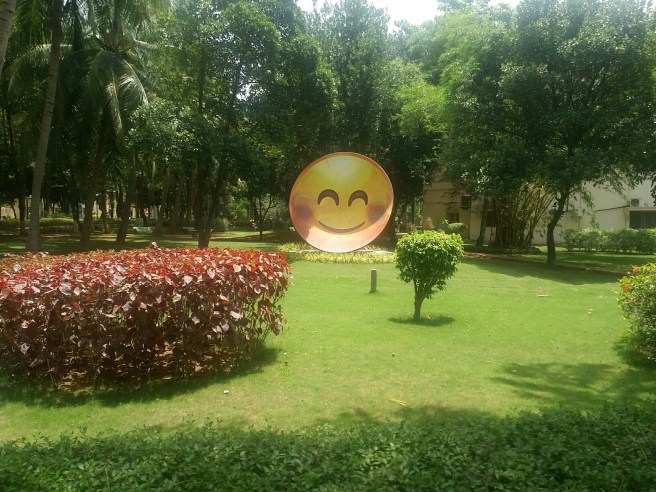
Discarded dish antenna. GMR Institute of Technology. Rajam, Andhra Pradesh.

04AD7BC1-8698-4AE9-8D94-4A94F29005E2

–Meena

Two BHIMS I am Fan Of

The first is the hero of Randamoozham, or The Second Turn, the masterly Malayalam novel by M.T. Vasudevan Nair, based on the Mahabharata. It is told from the perspective of Bhima who never got his due, though he took the brunt of every battle, was the bravest, kept every promise, and made his share of sacrifices. The novel makes one question stereotypes and assumptions. For instance, after reading the book, you will never quite respect Yudhisthra, who comes across as self-righteous and pompous, or admire Arjun, whom we now see as egoistical and pretty focussed on himself.

bhim

It was my friend Ann, knowing of my interest in such take-offs on the epics, who told me about Randamoozham, which she said was the best book she had ever read. After a huge build-up, when I asked her to get me an English translation on her next visit to Kerala, she said she thought there wasn’t one! Anyway she said, she would check –she mentioned that there was a bookseller who sold books on the train, who was very knowledgeable, and he would be the best person to ask. And faithfully, she asked him on her next train trip from Bangalore to Kerala. And oh boy! Did she get an earful! The bookseller took a break from business and lectured her for five whole minutes about the younger generation who did not care to know enough of their mother tongue to read in it; how did they expect to get the real essence of a book written in Malayalam when they read it in English; how could she insult the writing of a master like Vasudevan Nair by even dreaming of reading his masterpiece in English. etc. etc.

Subsequently, several English translations of the book have come out. But the one I love is BHIMSEN by Prem Panicker, shared with me by my friend Unni. It has none of the hiccups and awkwardness that translations from Indian languages to English often suffer.  It is surely a work of love. I am not even sure it is published formally—what I recall is that it was published chapter by chapter on Mr. Panicker’s blog. Prem Panicker, is incidentally a cricket journalist.

(You can access the book on https://prempanicker.wordpress.com/2009/10/05/bhim-complete-and-unabridged/)

The other BHIM I love is the app for money transfer. I am in general very wary of financial transactions through electronic media. And being technologically-challenged, have great difficulty operating most of them. But BHIM is one thing which works like a dream. I routinely pay salaries using BHIM. I use it in shops. Whenever my friends buy anything on my behalf, two clicks and the money is in their account.

So folks, two messages:

Download Bhim the novel, and enjoy the best read in a long time.

Download Bhim the app, and enjoy superlative convenience.

–Meena

P.S. ‘Duryodhana’ by V. Raghunathan, is the re-telling of the Mahabharata from, you guessed it, Duryodhana’s point of view.

Ministry of T

It is finding the known in the unknown, and the unknown in the known.

It is mental exhilaration and physical exhaustion.

It is anticipation and satisfaction.

It is memories of things seen and the curiosity to see new things.

8A2CDD6B-77AA-46E4-AEAA-6E2D88B21634

It is re-living old memories and storing up new ones.

It is sinking in comfort, it is roughing it out.

It is pleasant surprises and unpleasant shocks.

It is a camera lost, it is a vision captured in memory.

It is being with the family, it is getting away from the family.

It is being duped by touts, it is being helped by strangers.

It is tasting exotic food, it is finding the familiar dhabha.

It is being a bit bored, it is having a lot of fun.

It is being away from home, it is finding new homes.

It is being out of touch, it is finding new connections.

It is cockroaches in the bathroom, it is squeaky clean sheets.

It is upset stomachs, it is healthy carrot juice.

It is swearing never to travel again, it is booking tickets for the next trip.

Is this just me, or do most people think of travel like this?


–Meena


Trash Toy Story

The Matriarchs were groomed in the eighties with regard to ideologies, ideals, ideas and their chosen vocation—education and what is today called sustainable development. There were many khadi-clad people who inspired them and several of their generation. One such inspiration was Dr. Arvind Gupta, who received the Padma Shri last week.

Arvind Gupta, an alumnus of IIT Kanpur, has dedicated his life to popularizing science and making science education accessible–through demonstrating how everyday, low-cost materials can be used to teach science. His core belief is that children learn best ‘by touching, feeling, cutting, sticking — pulling things apart, putting them apart..’ and his mission is to empower educators to create simple toys and educational experiments using locally available materials—the ‘Toys from Trash’ approach.

We stand testimony to the fact that adults too find this fascinating—I can recall informal sessions at our Centre, where he would enthrall  all of us with a series demonstrations using drinking straws, balloons, ball-pen refills, match sticks, rubber bands etc., and suddenly things we had learnt years ago in our science classes, made sense at last!

In today’s world, when we increasingly think that quality education means high-tech, high-cost kits and labs and aids, the Padma Shri should in fact reinforce the message that quality education has little to do with money, and much more to do with the ingenuity, creativity and commitment of educators and teachers. A good way to encapsulate his message to educators is his motto:

‘The whole world is a garbage pit
Collect some junk and make a kit.’

Thank you Arvindji, from two people you have inspired!

Meena

PS: Do view his TED Talk: Turning Trash into Toys for learning, rated among the best education related TEDs by many.


World Meteorology Day: A Tribute to the Father of Indian Meteorology, Dr. P.R Pisharoty

He is the one of whom Sir C.V. Raman said: ‘I would include Mr. Pisharoty in a short-list of the ablest men I have ever had working with. His personal and intellectual qualities are such as to enable him successfully to undertake the highest type of scientific and administrative work.’

Dr. Pisharoty was not just the father of Indian Meteorology, he was a world authority as well. He pushed for the use of Numerical Weather Prediction in India and if today, we have the capacity to do fairly good short, medium and long term weather forecasts, it can be traced back to the foundations he laid.

Dr. Pisharoty was called the ‘Rain Man’ of india—it is he who fully understood the nature of the Indian Monsoon, and it is this understanding which should underpin our thinking on water conservation and management. He pointed out that rains in India are very different in nature to rains anywhere else. India gets 400 million hectare meters of rain annually, with a landmass of 329 million hectares—enough to submerge our land under 1.29 meters of water per year if spread evenly. But there are areas is India with rainfall as low as 200 mm per year and areas with rainfall as high as 11,400 mm per year. Moreover, the rain in India, unlike in Europe, falls within a very short time. There are parts of India where the entire quota of annual rainfall is received in just 100 hours. Hence he pointed out, the critical need for understanding the local patterns, and for proper planning for water management. With such planning and husbanding he maintained, even the lowest rainfall area of the country could have enough drinking water throughout the year.

He was given the responsibility of exploring the use of remote sensing for India, and when he succeeded in using remote sensing to detect coconut root wilt disease in the late 1960s, the foundation for remote sensing was laid in the country.

We, the Millennial Matriarchs, had the privilege of being mentored by Dr. Pisharoty, as a member of the Governing Council of our organization. He must have been over 75 years old when we first met him (he went to office every day till the age of about 85!). We used to be sent to this giant for getting ‘scientific validation’ of the educational material we developed. The enthusiasm he had for each and every project, the wisdom he imparted ever so gently, the Sanskrit slokas he would quote to bring out a point, the patience with which he put up with rooky, cocky youngsters—the memory of it still gives me goose bumps. Dr. Pisharoty was also a member of all our promotion review committees. The twinkle in his eyes would set us at ease and put life in perspective.  I think we were too young and foolish to appreciate how privileged we were.

My deepest regret: Typical of the old school, he wrote and wrote—letters, articles, notes, comments. He once wrote me a note with an alternative interpretation of my name ‘Meenalochani’ in the Dikshiter composition ‘Meenakshi  Me Mudem’. In my various house-moves, I have misplaced it.

And two quotes from Dr. Pisharoty, which I will think on today :

‘The more you write, the better will be your handwriting; and the more you think, the sharper will be your intellect.’

‘Science is our profession as well as our life’s hobby. Government is paying us for our hobby. Amount of money which we get from the Government should not worry us very much; we are being paid for our hobby.’

A Decade of Caring for Little Hearts

Tragedy comes into all our lives. And so too, it visited my friend Chitra Vishwanathan. She lost her beautiful little daughter Aishwarya who had a Congenital Heart Defect.

‘Congenital Heart Defect is a neonatal birth defect due to abnormal development of the heart that could involve the interior walls of the heart, the valves inside the heart, or the arteries and veins that carry blood to the heart or the body. Blue baby is another term used for CHD. Such babies have a blue complexion from lack of oxygen in the blood due to a congenital defect of the heart or major blood vessels.

The severity of CHD ranges from simple to complex. Simple CHDs such as a small hole between heart chambers do not require any treatment because they get corrected on its own. But complex CHDs require special medical care and multiple surgeries over a span of several years.
CHD affects approximately nine out of 1,000 new-borns and is one of the leading causes of infant mortality. Approximately 10% of infant mortality in India could be attributed to CHD alone. However, early detection and right treatment increases the chance of survival and has good long-term prognosis among new-borns. Around 90% of CHD-affected children can be treated if diagnosed early, even better if it gets detected before birth. Roughly around 1,80,000 children are born each year in India with CHD. Of these nearly 60,000 to 90,000 require early intervention.’(1)

What did Chitra do with her sense of loss and her grief? Turned it into a mission to reach as many babies with CHD as possible and try to save their lives. She set up Aishwarya Trust, which this month completes 10 years. The Trust focusses on creating awareness about CHD; undertaking massive screening camps; and free surgeries as required, in partnership with reputed doctors and hospitals. The Trust has saved 1300 young lives through surgeries in this decade–including children from Tamil Nadu, Karnataka, Puducherry, and other parts of India, along with children from 5 African nations (Rwanda, Burundi, Sudan, Nigeria, and Somalia) and Iraq. And created huge awareness about the issue through awareness and screening programs.

Thanks Chitra!

Readers, anyone you know who has turned tragedy into a mission? Do share and inspire!

–Meena

Ref (1): http://rhythmofheart.org/about-aishwarya-trust/