
6 August 2020 marks 75 years since one of the most devastating events in the history of warfare took place. On this day, in 1945, an American bomber plane called Enola Gay dropped a 4000+ kilo uranium bomb named ‘Little Boy’ on the Japanese city of Hiroshima.
It was as if the city was struck by a blinding flash; the bomb exploded, and a giant mushroom-shaped cloud rose to the sky. The blast flattened the city and killed nearly 100,000 people; tens of thousands were injured. Three days later, on 9 August, the Americans dropped another nuclear bomb on the Japanese city of Nagasaki. On 15 August 1945 World War II ended.
But for the survivors of the nuclear blasts the battles had just begun. Within a month of Little Boy hitting Hiroshima, radiation exposure is thought to have caused the deaths of at least 6,000 people who survived the blast. And the long-term effects of radiation exposure, physical and psychological, continued to reveal themselves for the next decades. There was a documented rise in cancer, especially, in leukaemia cases. In the years following the attacks, the survivors became known as the hibakusha (the explosion-affected people) and were subjected to widespread discrimination as it was believed that they were carriers of a contagious disease. And for years the ugly spectre of the after-effects kept raising itself.
Amidst all this, there were still some stories of hope and resilience. One of the classic stories that beautifully captures this is that of Sadako and the Thousand Paper Cranes by Eleanor Coerr. This is based on the life of a real little girl named Sadako who lived in Hiroshima from 1943 to 1955. Sadako Sasaki was a baby when the bomb devastated Hiroshima. Her grandmother died in the explosion. The story opens ten years later when Sadako is a lively girl who dreams of becoming a runner. One of the annual outings of Sadako and her family is on 6 August to what was called the Peace Park to commemorate those who lost their lives on that fateful day in 1945, and to pray for peace and good luck.
Sadako loves her family, her friends and her school. One day as she is practicing for a big race, she feels dizzy. Quickly, and without any obvious causes, the dizziness and weakness continue to worsen. After some tests at the Red Cross Hospital, the doctors’ worst fears are confirmed: Sadako has leukemia, the dreaded “atom bomb disease”. The cheerful little girl’s world is turned upside down.
Sadako needs to stay on in hospital. One day, Sadako’s best friend Chizuko comes to visit her in hospital. Chizuko has brought with her some golden paper, and she folds this to make a crane. She tells Sadako: Don’t you remember that old story about the crane? It’s supposed to live for a thousand years. If a sick person folds one thousand paper cranes, the gods will grant her wish and make her healthy again. She handed the crane to Sadako. “Here’s your first one”.
This gives Sadako hope and cheer. She spends the next few weeks folding as many orizuru or paper cranes as she can, even as she is getting weaker and sicker. Soon everyone becomes a part of the project.
Everyone saved paper for Sadako’s good luck cranes. Chizuko brought colored paper from the bamboo class. Father saved every scrap from the barbershop. Even Nurse Yasunaga gave Sadako the wrappings from packages of medicine. And Masahiro hung every one of the birds, as he had promised. Sometimes he strung many on one thread. The biggest cranes flew alone.
Sadako channels all her fast depleting energy into painstakingly folding paper crane after paper crane, making a wish with the completion of each one, and determined to reach the magic number of 1000 paper cranes.
She never complained about the shots and almost constant pain. A bigger pain was growing deep inside of her. It was the fear of dying. She had to fight it as well as the disease. The golden crane helped. It reminded Sadako that there was always hope.
Against all odds, Sadako manages to complete 644 cranes before she slowly sinks into a peaceful death.
She looked at her flock hanging from the ceiling. As she watched, a light autumn breeze made the birds rustle and sway. They seemed to be alive and flying out through the open window. How beautiful and free they were! Sadako sighed and closed her eyes. She never woke up.
Sadako died on October 25, 1955. Her classmates folded the remaining 356 cranes, and all 1000 paper cranes were buried with her. Her classmates also collected her letters and journal and published them in a book. The book reached young people across Japan, and they all came to know the story of the courageous Sadako and her cranes.
Sadako’s classmates resolved to honour the memory of their friend in as many ways as possible. Their efforts sparked a children’s peace movement that swept through Japan, and then the world. This transformed the origami paper crane into an international symbol of peace. Their fundraising campaign led to the establishment of the Children’s Peace Monument in the centre of Hiroshima’s Peace Memorial Park. Here stands a statue of Sadako holding aloft a golden crane.
Today millions of paper cranes, reach here from all corners of the globe, symbolizing the universal value of peace and the preciousness of life. In Japan a popular tradition is to fold 1000 cranes and string these together, usually 25 strings of 40 cranes each, which are given as gifts called senbazuru which literally means, ‘one-thousand cranes’.
On 6 August every year, people still place folded paper cranes at Sadako’s statue, and reiterate the same wish that is engraved at the base of the statue:
This is our cry,
this is our prayer;
peace in the world.
Today the long and complex history of the World War II is just that—history. But more than ever before, the unleashed peril of a nuclear explosion continues to keep the entire world on tenterhooks. Hiroshima is a reminder of the horrific legacy of nuclear warfare, but the Peace Memorial is a reminder that there can be another legacy—one of peace.
–Mamata
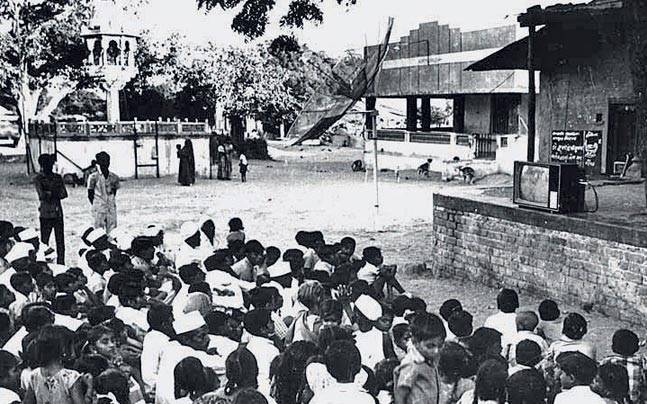 The programs were broadcast for a few hours a day, and hundreds of
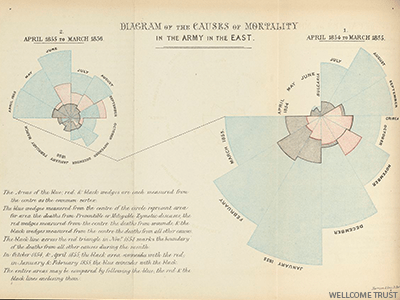 Florence was also one who shook up systems and brought in systemic changes. She battled with entrenched bureaucracies most of her working life, in order to bring about these changes. She was aware that it would be difficult to convince decision makers of the need for change, and maybe out of this requirement was born what is today counted as her major contribution to statistics—the first infographics ever made. The best-known of the infographics she invented are what are called the “coxcomb” diagrams, understandable by even the public. ‘The coxcomb is similar to a pie chart, but more intricate. In a pie chart the size of the ‘slices’ represent a proportion of data, while in a coxcomb the length which the slice extends radially from the center-point, represents the first layer of data. The specific organization of Nightingale’s chart allowed her to represent more complex information layered in a single space. In her coxcomb during the Crimean War, the chart was divided evenly into 12 slices representing months of the year, with the shaded area of each month’s slice proportional to the death rate that month. Her color-coding shading indicated the cause of death in each area of the diagram.’*
 Polio was a dreaded disease in the early 20th century. It left death in its wake, but even more, it paralysed. Till date, there is no cure for polio, and the only defence is vaccination. Jonas Salk rightly deserves the credit for the polio vaccine, but there were two women, without whose work things would not have happened as they happened, when they happened. One was Dr. Isabel Morgan of Johns Hopkins University, whose work was a turning point in understanding host immunity to polio and on use of killed-virus (vs. live-virus) as the basis of vaccines for this disease. The other was Dr. Dorothy Horstmann of Yale and her team, whose work is said to have paved the way for oral polio vaccines.
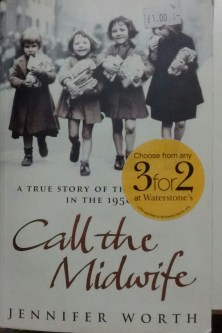 d midwife spent in the poor slums of the East End of London. 23 years old and newly qualified she lived and trained as a midwife with a dedicated group of nuns St Raymond Nonnatus.
 Millennial Matriarchs