
A Register of Opportunity

BDB307A0-742C-4A7E-B7E0-18323D154F33As botanic gardens go, the Sir Seewoosagu Ramgoolam Botanic Gardens in Mauritius are not large. 92 acres to Bangalore’s Lal Bagh of 240 acres to put it in perspective (but of course we need to factor in the size of the two countries!).  We don’t need to dwell on the variety of flora, both endemic and exotic, on display there. Nor the few but interesting animals—specifically some deer and some huge tortoises. The only endemic Mauritian mammal, a bat, the Peropus niger, may also be spotted on the trees, it is said.

But it was not all this that really fascinated me. Let me tell you what did.

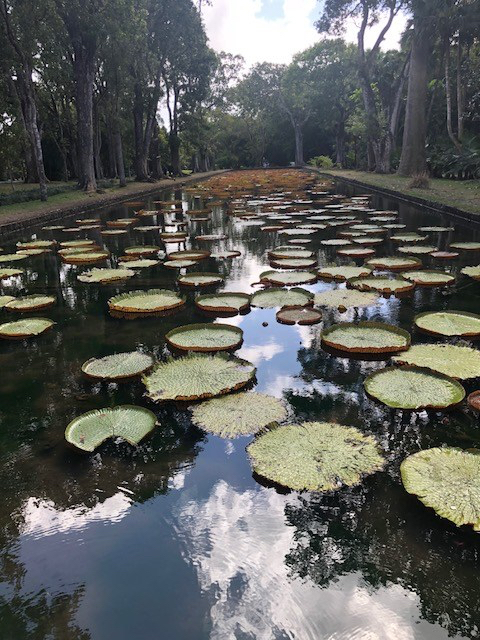
Little shelters dot the gardens. At the shelter overlooking the beautiful lily pond was2C9A861B-73C8-4075-9652-6A6A1E1591B9 a table. And on the table was a register. I sneaked a peak into the register. And this is what I saw: Several entries each day on the condition of the pond, the leaves, the flowers; the birds and insects seen. And a sketch of the pond, done at the same time every day, showing where flowers had bloomed and where there were buds. And it was not only the lily pond. There was a similar register at the lotus pond, and some other spots in the garden. As I flipped the pages, I could see that no day was missed, no entry casual

What seriousness of purpose and systematic application, to a job that may seem not to have any particular outcome. But the person behind the system and the people implementing it obviously know the importance.  After all, scientific method consists of : ‘systematic observation, measurement, and experiment, and the formulation, testing, and modification of hypotheses.

The Botanic Garden in Mauritius is definitely doing its part! It is obvious that they know the value of keeping systematic notes and data. It may seem trivial, but who knows what it may lead to? After all, research is one of the stated objectives of Botanic Gardens, Zoos, Aquaria and all such facilities do. And keeping such meticulous notes may be the single most important contribution they can make.

Are we in India at all using such opportunities? I am not sure!

An excerpt from Darwin’s Beagle Notebooks. He observed and noted down everything around him—flora, fauna, geology, weather conditions, animal behaviour. And at the end of the day, changed human understanding of the world! Without his notes, he may not have reached his conclusions!

Extraordinary numbers of Turpin —

 drinking bury head above eyes — Will drink when a person is within 2 yards of them about 10 gulps in minute.

Noise during cohabitation.

Eggs covered by sand soil from 4 to 5 in number — require a long time before they are hatched.

Eat Cacti in the dry Islands

Yellow Iguana1 intestine full of Guyavitas & some large leaves

All morning descended highest Crater — Glassy Feldspar — red glossy scoriæ:

Iguana1 — shakes head vertically;, hind legs stretched out walks very slowly — sleeps — closes eyes — Eats much Cactus:

run walking from two other carrying it in mouth — Eats very deliberately, without chewing — Small Finc[h] picking from same piece after alights on back —

In the Tent generally 85-80˚ —

Trade wind & sun 77˚ or 78 —

On Rock out of wind 108˚ — —

http://darwin-online.org.uk/content/frameset?

The Dodo and The Myna

The Dodo is the textbook example of man’s role in driving other species to extinction. This defenceless bird was hunted and harried to disappearance through the appearance of humans on the uninhabited island of what is now called Mauritius. Sailors on the high seas—the Arabs, the Portuguese and then the Dutch, discovered and re-discovered the pristine isle. For dodos, the beginning of the end was in 1598 when the Dutch discovered them on the island. Dodos were flightless birds, and also fearless because they had never encountered predators. So when humans appeared with their guns and weapons, they had no clue how to protect themselves. Moreover, humans brought along dogs, cats, pigs, rats—all which hunted the birds and raided their nests. Till there were none left.

8887BB0D-6F92-4CD0-AE58-EDF689F6A0AA

But if this is a story of man’s role in the loss of a species, what follows is an equally sorry tale of havoc cause by man’s deliberate introduction of a species into an alien eco-system. And on the very same island of Mauritius!

Sugarcane did and continues to play a key role in the economy of Mauritius. The sugarcane crop in Mauritius was beset by grasshoppers, which ate the leaves. In the 1780s, the French deliberately introduced mynas to the island to help control these. To a certain extent they did, but soon enough the mynas figured out the local lizards were easier to catch than the grasshoppers, and so made the lizards the mainstay of their diet. One consequence of this was that the insects that the lizards fed on multiplied, as they now had no predators! And even more seriously perhaps, the mynas themselves became pests to native species. Mynas are by nature aggressive and raid nests for eggs and newly hatched chicks. They compete with native birds for nesting sites. In Mauritius, they have been known to compete with an endemic species, the endangered Echo Parakeet, for nesting spaces.

Island ecosystems are very special. Human interventions can have disastrous results. To quote the IUCN Island Ecosystem Specialist Group:

‘Earth is home to over 100,000 islands, which support 20% of global biodiversity. The characteristics of size, shape and degree of isolation make many of these islands ecologically and culturally unique.

However, these same characteristics also make islands fragile and vulnerable ecosystems. Islands have the highest proportion of recorded species extinctions. Eighty percent of known species extinctions have occurred on islands and currently 45 percent of IUCN Red List endangered species occur on islands.’

Mauritius and all islands are beautiful and special! Let’s hope that we humans can preserve what makes them special, and leave the generations to follow this precious legacy.

An interesting aside:  A Mughal-time painting found in St. Petersburg  shows a dodo along with several Indian birds. The painting is believed to be from the 17th century and is attributed to the artist Ustad Mansur. The bird depicted probably lived in Emperor Jahangir’s zoo in Surat!

–Meena

Snakes Alive!

This is the month when many parts of India celebrate Nag Panchami or festival of snakes, by worshipping the Snake God for protection. The many rituals and myths associated with this perpetuate many false perceptions about snakes. This takes me back to my own snake story.IMG_20180830_100525311.jpg

When I started my career as an environmental educator, one of my first close encounters of the wild kind was when we were asked to touch a snake! This was in Sundarvan, a small snake park. The snake was a Red Sand Boa—a non-venomous snake. For someone who was, at that time, far from being a passionate wild-lifer, this was indeed an experience that served to dispel the many myths that one had grown up with. One of these were that snakes were “slimy”, and to be avoided at all costs. The skin of the sand boa felt dry and smooth, and we learnt that most snakes are in fact non-venomous.

And there began my long and fascinating journey in the natural world. A journey along which I had the most wonderful encounters with some of India’s best known naturalists and educators.

One of these was the Snakeman of India Romulus Whitaker.

Not so long after my induction by snakes, Romulus himself came to CEE and fascinated us with snake tales and the importance of breaking the myths that associated snakes with all things creepy and vile, and communicating the vital role of snakes in the ecosystem, especially as friends of farmers because they eat the rats that destroy crops.

A little later, Romulus graciously accepted to write a piece for a book that Meena and I were editing. In this he recounted how he first came to India from New York city when he was 8 years old, and returned a few years later  to make India his home, and herpetology his career. He recalled how “the snake charmers at Juhu Beach in Bombay were my first tutors but it wasn’t long before I outgrew their mixture of magic and nonsense.”

Romulus’s passion for setting the record straight about reptiles has manifested itself in a long and close association with the Irulas, an indigenous tribe of snake catchers of Tamil Nadu who became his friends and mentors; setting up of India’s first Snake Park in 1970 and the Madras Crocodile Bank in 1975 and, in 2005 the Agumbe Rainforest Research Station in Karnataka. These Parks continue to attract and educate millions of visitors every year, and they have also become the base of conservation research projects in many parts of India including the Andaman islands.

His never-ending impulse to show and tell people about reptiles led Romulus to start making documentary films, many of which have won international awards. One of his first films Snakebite tells about how to avoid and treat snakebite. While studying incidents of snakebites in India, Whitaker discovered that numerous lives were lost due to inadequate production and distribution of anti-venom serum. That is when he mobilised the Irula community to form a snake catchers’ cooperative, who under licenses from the Wildlife Department, extract and freeze-dry venom from snakes and sell it to anti-venom producing laboratories before releasing the snakes back into the wild.

In 2018 Romulus was awarded the Padma Shri for nature conservation. In one of the interviews following the award Romulus said “I believe that touching a snake opens people’s minds and changes it forever.” I can totally vouch for that!

Thank you Rom for helping to open a new world, and for being a continuing inspiration!

–Mamata

Crotchety Me!

Knitting. Not my area of natural comfort. The only time I did knit was when I was forced to, back in school. And were those booties and bonnets and ponchos disastrous! My needlework teacher ‘frogged’ them regularly (to fully understand the term, continue reading!).

Then why do a piece on knitting-related terms?

Because a dear friend just gifted me a beautiful crocheted shawl. I have been looking at it all week and appreciating the beauty of the piece, the patience that has gone in, and the centuries of tradition behind it. So here is to my friend Mahashwetha and knitters and crotcheters across the world who bring beauty and warmth (pun intended) to our lives.

CB8E4CC3-FB0E-4E77-8EBB-D9EBB791C477

Since the gift is crocheted, not knitted, we will begin with ‘crotchety’ terms.

Crochet: ‘Crotchet’ is from a very old French word for ‘small hook,’ and the verb means ‘sewing with a hooked needle’. ‘Crotchet’ has been in use in this sense since the 15th century.

Crotchety: By late 16th century, ‘crotchet’ was also being used to mean ‘an odd whim or peculiar notion.’ The logic of this seems to be that strange ideas or unusual behavior are mental ‘twists’! A person with odd ideas and habits came to be described as ‘full of crotchets’ or simply ‘crotchety,’ a term which first appeared around 1847. “Crotchety” is now also used in place of “grouchy”.

Knitting commemorates people!

Cardigan: Knitted jackets or sweaters open down the front have been around for several centuries, but the term cardigan came into use in 1862. The cardigan was named after the seventh earl of Cardigan (a county in Wales) who sported such jackets during the Crimean War.

Raglan: The word raglan also came into use during the Crimean War. It is named after Cardigan’s commanding officer, the first Baron Raglan. During the war, Raglan wore a loose-fitting overcoat with sleeves that extended all the way to the neckline instead of stopping at the shoulder. Originally raglan referred to the overcoat; it now can also refer to the style of sleeve.
And animals too!
Frog: What happens when a knitting project doesn’t go well? Well, a knitter frogs it. Frog is knitting slang for “ripping out” knitting: taking the piece off the needles, and unraveling it quickly. It’s not unique to knitting: crocheters frog their work, and needleworkers also frog stitches that aren’t right.

As well as places…

English knitting: Also called right-handed knitting, this is the method of knitting in which the working yarn in is held in the right hand.

Continental knitting: This is a method of knitting in which the working yarn is held in the left hand.

Knitting terms confuse…

Ravel: The verb ravel can mean “to knit together.” It can also mean “to unspool, unknit, or unravel.” Ravel is a contronym (or Janus word), a word with meanings that contradict each other.
End note

If you thought only music had its own notation, turns out knitting does too! Just to start you off….

BO: bind off (cast off)

CC: contrasting color

cn: cable needle

CO: cast on

dec:: decrease

dpn(s): double-pointed needle(s)

inc: increase

kfb: knit into the front and back of the stitch (an increase)

knitwise: as if to knit

And so on…
–Meena
References:

http://en.wiktionary.org/wiki/crotchety
http://en.wiktionary.org/wiki/crotchet#E…
https://www.dummies.com/crafts/knitting/designs-patterns/terms-and-abbreviations-used-in-knitting-patterns/
• Terms and abbreviations used in Knitting Patterns. Kristi Porter.

Magnificence—Endangered

Not just endangered, critically endangered. We are talking of the Great Indian Bustard (GIB). There are only about 200 birds left in the wild in India, mainly in Rajasthan and Gujarat. There are a few birds still in Maharashtra, Andhra Pradesh, Gujarat, Karnataka and Madhya Pradesh. But they have completely disappeared from Punjab, Haryana, Uttar Pradesh, Orissa and Tamil Nadu.

GIB has been listed as Critically Endangered in 2011 on the IUCN Red List, which means that it faces an extremely high risk of extinction in the wild. When we say that a species is extinct it means that there is not be a single living member left of that species.

The Great Indian Bustard is a magnificent bird, standing about 1 metre tall. Its wingspan is more than 2 metres. It is mostly brown, with a light-coloured head and neck. The distinguishing feature is the black crown on the head. Interestingly although they look closer to ostriches or cranes, most recent research shows that the Bustard family is more closely related to the cuckoo family!

At about 15 kg, it is the heaviest flier in India, but not in the world. The world record is held by a relative, if we may call it that, the Kori Bustard which is found in Africa. The Kori often weighs upwards of 18 kg.

These birds live in wide open landscapes which have sparse grasses and shrubs. They spend most of their time on the ground. Their long legs and front-facing toes help them to run fast. Although they are usually seen striding or running, they also have strong wings and can fly well.

Their diet varies depending on what is available during a particular season. These birds feed on grass seeds, agricultural crops such as groundnuts, millets and legumes, as well as insects like grasshoppers and beetles, and rodents and lizards

They usually breed in the monsoon season which is when food is most easily available. The female scrapes the soil in a secluded place to lay her egg. Generally, she lays only one egg. She incubates the egg for 25 days before the chick is hatched. The exposed egg is always in danger from predators. The mother has to be alert to keep the egg and the new chick safe. The male does not play any part in making the nest, incubation or raising of the chick. It is the Mother GIB who does this alone!

What are the threats? Plenty! GIB can be found in some parts Pakistan also, and there, it is still hunted. There is also some amount of poaching occurring in India. Apart from that, the natural home of these birds is reducing in size. A major cause for this is expansion of agricultural fields and increase in mechanized farming in the areas where the GIB live. This also means that human settlements get closer. Then there other very mundane reasons. Dogs are a major threat to GIBs. As I told you, GIBs lay their eggs on the ground. With the villages so close, dogs often eat the eggs. Also, there has been a huge increase in high tension electric wires in the habitat area. GIBs often dash against these and get electrocuted. They may also get hit by fast-moving vehicles.

Only urgent mission-mode action can save the GIB. Can we let this magnificent bird got the way of the Dodo?

–Meena and Mamata