The Upside-Down Tree

A Tree-Tale on the occasion of World Environment Day

I first saw a Baobab tree in Tsavo National Park, on safari in Kenya. With a huge bulging trunk and branches that looked like roots spreading in a wide canopy, it was unlike any tree I had seen. I was intrigued. As I read more about Africa I found that this tree, which was native to Africa, Madagascar, and Australia, played a significant role not only in the ecology, but equally the folklore of these regions.

Across Africa, there seem to be many stories passed on from generation to generation, that explain why the Baboab looks the way it does. One of the most popular, and my favourite one, goes like this.

The first Baobab grew near a small lake, along with many other trees. One day it saw its reflection in the water, and it was shocked. It saw a huge fat trunk covered in bark that looked like the wrinkled hide of an old elephant; small leaves and pale flowers.

Now this Baobob was a complainer. “Why did you make me so ugly?” it asked the Creator. “Why did you make me so big and fat? Why can’t I be tall and slender like the Palm tree?” “Why is my bark so rough and tough? Why can’t I have a smooth trunk like the Mahogany tree?” “And such insignificant flowers, why not bright ones like those of the Tulip tree?”

And the Baobab went on whining and complaining, comparing itself to every other tree, and feeling short-changed in every aspect. Until finally the Creator had enough! In a fit of exasperation, he came down and yanked the Baobab up from its roots, and replanted it upside down! No longer could the Baobab see its reflection, and no longer could it compare and contrast!

But the Creator could not be heartless. The vain whiner had to be taught a lesson, but after all this too was one of his own creations! So the Creator gave the Baobab some special features that would make it one of the most valued of trees for countless other living beings, including humans.

This Tree of Life, as it is called by some tribes in Africa, creates its own ecosystem, as it supports the life of countless creatures, from the giant elephants to the thousands of tiny creatures scurrying in and out of its crevices. Weaver birds nest in its branches and owls and Hornbills roost in its hollows; baboons and warthogs devour the seedpods and the fruit; bush babies and fruit bats drink the nectar and pollinate the flowers. The tree can store hundreds of litres of water in its trunk, an adaptation to the harsh drought conditions of its environment. This water is tapped in dry periods by elephants and Bushmen.

P1130244.JPGEvery part of the tree is valuable for the local communities; its lumber is used for storage, its bark is pounded to make rope, fishnets, mats, baskets, paper and cloth. More recently, its fruit has joined the ranks of international Superfoods–it is known to contain six times as much vitamin C as oranges, twice as much calcium as milk, and plenty of B vitamins, magnesium, iron, phosphorous, and antioxidants.

Baobabs can reach up to 75 feet in height, and the trunk can grow more than 60 feet wide. Humans have used the hollowed trunks for a variety of purposes—from a post office, to a jail, and even a pub!

Baobabs are some of the longest living of trees, believed to live for more than 2000 years!  When they do die, they simply rot from the inside and suddenly collapse, leaving a heap of fibres, and so the local belief is that they do not die at all, but simply disappear!  No wonder the Bushmen call it the Magic tree!

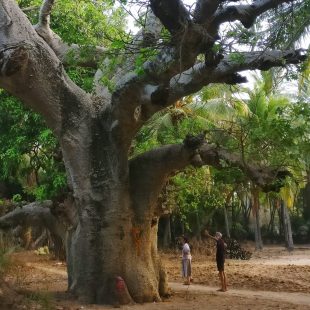
Some years after I returned from Kenya, we visited Diu, an island just off the coast of Gujarat. As we walked around, we were astonished to come across a Baobab tree! Solidly ensconced in majestic, solitary splendour among the Hoka palms and green fields, it brought back memories of our Safari days!  No one seemed to know when and how it came to be there. Thereafter, on our annual Diu trip with the children, we all eagerly looked forward to spending a morning exploring the Baobab. Over the years, as the children grew, it remained a reassuring and comforting presence. This year, the Baobab was introduced by my now-grown daughter to her husband, as an old friend!
IMG-20180519-WA0003.jpg

Happy World Environment Day!

–Mamata

Average is Normal

It is that time of the year again. It is the season of Superlatives. Exam results with Beyond Belief percentages, pictures of the Highest Scorers in the papers, magazines listing the Best Colleges, coaching classes advertising Record-breaking Achievers. So many wonder-kids? Are there no ‘average’ children anymore?

Even several years ago, I remember meeting my children’s classmates’ mothers when we were summoned to meet the teachers after the exam results were given. I heard exchanges about the achievements of the respective prodigy—prizes for painting, dancing, skating, swimming and more. Class toppers, school leaders all. I wondered, if every child is so brilliant, are there any simply ordinary children in the class?

I began to have doubts about my own parenting responsibilities and skills. Well, I did try to get the children to go for swimming coaching, largely because their cousins were going too (50% success—my daughter picked it up, and my son did not), dance lessons (my daughter did last a couple of years, but never made it till an arangetram!), and karate (my daughter made it till the first camp, my son till the white-one belt!).  Neither they, nor I, seemed to have the endurance run the gauntlet and emerge a Winner every time!

As parents who followed a relatively laissez-faire style of parenting, our considerations were mainly that the children were given the space to simply be, and blossom as they will. But as they grew, it became increasingly difficult to cope with the expectations of a competitive system. Still we thought that we were managing ok within the larger environment. We got a jolt one fine morning, when our son was denied readmission into Class 11 in the same school he had studied in for 10 years, because he missed the “cut off” by a couple of marks. Imagine the devastation for a fifteen year old. The experience that followed is a story in itself. One of the outcomes was that we decided that we did not wish our daughter (who was even less equipped to cope with a mindlessly competitive system) to go through this. Despite being told that “this is the system, your children and you will need to learn to swim with the tide, or sink”, we actively explored alternatives….and found them.

The children made it through! Today they are in the ‘system’ as it were, without being sucked into its vortex. They may not meet the generally accepted norms of Mainstream Success. (“Settled” so to speak, with six-figure earnings, car and apartment, designation, the skills to compete ruthlessly …and burn out at 35). They are following somewhat unconventional paths; they continue to explore, and discover new passions, new horizons, and new accomplishments. They are rich in experience, life skills, and relationships. They have the confidence to be themselves, and “not just another brick in the wall”.

Perhaps the greatest freedom we can offer our children is to allow them to think differently, and more importantly, to act differently.  Gunter Pauli

peanuts flaws

From Peanuts by Charles Schulz

Two BHIMS I am Fan Of

The first is the hero of Randamoozham, or The Second Turn, the masterly Malayalam novel by M.T. Vasudevan Nair, based on the Mahabharata. It is told from the perspective of Bhima who never got his due, though he took the brunt of every battle, was the bravest, kept every promise, and made his share of sacrifices. The novel makes one question stereotypes and assumptions. For instance, after reading the book, you will never quite respect Yudhisthra, who comes across as self-righteous and pompous, or admire Arjun, whom we now see as egoistical and pretty focussed on himself.

bhim

It was my friend Ann, knowing of my interest in such take-offs on the epics, who told me about Randamoozham, which she said was the best book she had ever read. After a huge build-up, when I asked her to get me an English translation on her next visit to Kerala, she said she thought there wasn’t one! Anyway she said, she would check –she mentioned that there was a bookseller who sold books on the train, who was very knowledgeable, and he would be the best person to ask. And faithfully, she asked him on her next train trip from Bangalore to Kerala. And oh boy! Did she get an earful! The bookseller took a break from business and lectured her for five whole minutes about the younger generation who did not care to know enough of their mother tongue to read in it; how did they expect to get the real essence of a book written in Malayalam when they read it in English; how could she insult the writing of a master like Vasudevan Nair by even dreaming of reading his masterpiece in English. etc. etc.

Subsequently, several English translations of the book have come out. But the one I love is BHIMSEN by Prem Panicker, shared with me by my friend Unni. It has none of the hiccups and awkwardness that translations from Indian languages to English often suffer.  It is surely a work of love. I am not even sure it is published formally—what I recall is that it was published chapter by chapter on Mr. Panicker’s blog. Prem Panicker, is incidentally a cricket journalist.

(You can access the book on https://prempanicker.wordpress.com/2009/10/05/bhim-complete-and-unabridged/)

The other BHIM I love is the app for money transfer. I am in general very wary of financial transactions through electronic media. And being technologically-challenged, have great difficulty operating most of them. But BHIM is one thing which works like a dream. I routinely pay salaries using BHIM. I use it in shops. Whenever my friends buy anything on my behalf, two clicks and the money is in their account.

So folks, two messages:

Download Bhim the novel, and enjoy the best read in a long time.

Download Bhim the app, and enjoy superlative convenience.

–Meena

P.S. ‘Duryodhana’ by V. Raghunathan, is the re-telling of the Mahabharata from, you guessed it, Duryodhana’s point of view.

Rain, rain…

The Monsoon is scheduled to hit Kerala today, 29th May. Traditionally, in agriculture-based societies like ours, rain is a welcome phenomenon. Down the ages, music, art, dance, poetry in every part of India have celebrated the rains and the monsoon. There is a raga to bring rain. Lovers long for the rains. Literature celebrates the monsoons.

Even young urbanities, thanks to movies like ‘Lagaan’ will appreciate that rains are the lifeline for agriculture. And let us not forget that is not only the farmers who depend on the rains. The looming food crisis and rising prices of vegetables, fruit and produce has brought home very sharply that ultimately for everyone, it all goes back the land, to those who till the land, and to the rains.
In spite of all this, we urbanites have to admit that we are not happy to see the rains, except for the fact that it brings down temperatures. That could be attributed to two major reasons—(a) lack of preparedness of civic authorities to cope with the rains, and (b) our own increasing inability to put up with even minor inconveniences.
If the rains bring flooding to my street because the storm water drains are not kept in functional order; if manholes left open become death traps for people who are wading through knee deep water; if the roads are potholed and pitted after the rains and never mended; if improperly planned road dividers and badly leveled roads lead to stagnation and chaos—no wonder then that the normal city dweller fears the rainy season. If rains mean uncleared, rotting garbage all over; if rains mean frequent electricity cuts; if rains mean the threat of minor epidemics due to unsanitary conditions—no wonder then that we dislike the rains.
Is there anything unexpected about the rains? They come every year, on a fairly predictable date. The volume of rain is also forecasted—if not accurately, at least better than election results! Then why can our cities not prepare better? Should not every city and town worth its name have a regular plan of action to prepare for the rains? Civic authorities may say they have such plans, but isn’t the proof of the pudding in the eating?
Apart from civic authorities, we as individuals also love our comfort so much, that we cannot stand clothes drying inside the house; we cannot put up with rains disturbing our plans for an open air party; we don’t want the driver or maid to come in half-an-hour late because of the rain.
Rains bring joy; rains bring life to the land; rains are what make the world go round. Let’s bring back the joy of monsoon to our lives.
–Meena

Simple Joys of Summer

Come May, and it was time to begin the summer excursion from Delhi to “home town” Bhavnagar, in Gujarat. This entailed a long hot dusty meter-gauge train trip to Baroda or Ahmedabad, complete with bedrolls, surahis of water and much food carried, and bought from the stations. Some years later when the first Deluxe train with AC sitting coaches was introduced, it was the very height of luxury! One’s best outfits were to be worn en route, and there was much anticipation about choosing comics and magazines from the AH Wheeler stall on the platform. That was only Part 1. Part 2 involved an equally long and hot and dusty onward bus on the state transport or ‘ST’ bus. And then, we were there!

Bhavnagar had the double bonus in that both my paternal and maternal family homes were in the same town…and within a stone’s throw of each other! Two houses, two sets of aunts and uncles, and two sets of cousins! Where was the question of feeling bored, or not knowing what to do next? Most of the morning was spent in doing nothing much, while waiting for one’s turn to have a bath. As the hours rolled from breakfast to lunch, one of the assigned duties was to go up to where the home-grown mangoes were laid out to ripen, and pick the ones for lunch. Another one was digging ice cubes out of the dinosaur-age fridge and making a bucketful of cold water to drink. As one grew older, the duties graduated to squeezing the pulp out of the dozens of mangoes, and learning how to roll chapatis! Replete with mango ras and an array of newly-made pickles it was time for a long siesta, with the gaggle of old and young, lying down from wall to wall in the central room, with the vetiver or khus ‘chicks’ keeping out the glare and keeping us cool. (Another assigned duty was sprinkling water on the chicks).

Post-siesta special outings involved a ghoda gaadi (tonga) ride into the ‘bajaar’ accompanied by an aunt. Walking through the crowded market with halts to buy thread for embroidery, or fabric for summer clothes was indeed an adventure. And then, the delicious process of ‘designing’ one’s own clothes…to be executed by the family tailor who sat at his machine, day after day, in the verandah, whirring out baby-doll pyjamas, ruffled frocks, and basic petticoats and bloomers! (The person whose clothes were being tailored on the day was assigned to ensure that the tailor was kept well supplied with food and water). Talk about bespoke wardrobes!

As soon as the peak heat of the day abated, it was time to walk across to the other house. More cousins, more food and more fun and games….learning to ride the bicycle; pretending to swim in the 6 by 6 feet water tank; trying to get on to the roof with clay tiles (and being scolded by granny); climbing trees, and huffing and puffing up the  hill to the temple…After sunset, when the grand-aunts came by, it was time to sit on the steps and the jhoola, and listen in on the family gossip!

Dinner in the open chowk, all seated in a circle on the wooden paatlas, with much noise and merriment. (Later this evolved into several tables of varying heights put together to form a long dining line). Bedtime involved tying of mosquito nets and making of beds–in the front courtyard or on the flat terrace, depending on which house we were spending the night at. And, falling into a blissful slumber, under the starry sky, after a day well-spent.

And so the summer passed…until it was time to start the trek back. No helicopter parents, no scheduling, no planning, no personality development classes, no activity clubs, no life-coaching, no play dates! We drifted along languorously, and yet every day was packed. A good time it was indeed, to be young!

Last week I visited the home town. Much has changed. Only one of the beloved homes still stands, empty now; but housefuls of memories remain, as fresh as if it were yesterday.

IMG-20180517-WA0001.jpg

–Mamata

Ministry of T

It is finding the known in the unknown, and the unknown in the known.

It is mental exhilaration and physical exhaustion.

It is anticipation and satisfaction.

It is memories of things seen and the curiosity to see new things.

8A2CDD6B-77AA-46E4-AEAA-6E2D88B21634

It is re-living old memories and storing up new ones.

It is sinking in comfort, it is roughing it out.

It is pleasant surprises and unpleasant shocks.

It is a camera lost, it is a vision captured in memory.

It is being with the family, it is getting away from the family.

It is being duped by touts, it is being helped by strangers.

It is tasting exotic food, it is finding the familiar dhabha.

It is being a bit bored, it is having a lot of fun.

It is being away from home, it is finding new homes.

It is being out of touch, it is finding new connections.

It is cockroaches in the bathroom, it is squeaky clean sheets.

It is upset stomachs, it is healthy carrot juice.

It is swearing never to travel again, it is booking tickets for the next trip.

Is this just me, or do most people think of travel like this?


–Meena


Ode to Libraries

As is probably, by now, evident, the Millennial Matriarchs are bookworms. We grew up with books, and we need books just as much, or more, as we grow older.

The enervating summer afternoons bring back so many memories of the joy of discovering, devouring, savouring, hoarding, exchanging, borrowing, and drowning in books, and more books. And, libraries were the dream destination of summer holidays.

Sharing some eloquent words that describe the power (and perils!) of libraries.

 Don’t Go Into The Library

The library is dangerous–

Don’t go in. If you do

You know what will happen.

It’s like a pet store or a bakery—

Every single time you will come out of there

Holding something in your arms.

Those novels with their big eyes.

And those no-nonsense, all muscle

Greyhounds and Dobermans,

All non-fiction and business,

Cuddly when they are young,

But then the first page is turned.

The doughnut scent of it all, knowledge,

The aroma of coffee being made

In all those books, something for everyone,

The deli offering of civilisation itself.

The library is the book of books,

Its concrete and glass and wood covers

Keeping within them the very big,

Very long story of everything.

The library is dangerous, full

Of answers, if you go inside,

You may not come out

The same person who went in.

Alberto Rios       Contemporary American Chicano poet

–Mamata


Of Libraries and Books

We lived in a government colony in Delhi. A library van used to visit every week. Come Friday, without a doubt, the van would be at the end of our street. We would queue up, return our book, get into the van, choose another book, have it stamped and come out. A lot of strategic planning was involved. Like ‘You take this book, I’ll take that one. You finish by Tuesday and we will exchange.’ Or hiding a book you wanted (next-most after the book you took) behind a pile of other books in an obscure stack, in the hope that it would remain hidden till the next week when the van returned.

These vans were run by the Delhi Public Library system. I marvel today at this amazing service. I am not aware of any such today, that too run by any government system.

A second mainstay of our reading was our school library. We had a library period every week, and it was compulsory to borrow a book. Occasional book report requirements were put in to ensure we did read them, though for at least half the class, this wasn’t necessary.  As I recall, the borrowable collection was mainly fiction. (For some reason, our school was paranoid about our bringing ‘non-authorized’ books into the premises. There would be random surprise checks and any such book would be confiscated! Considering how innocent we were and how little access we had to unsavoury reading material, this seems rather excessively zealous. But those were different times!)

And last but not the least, the neighbourhood ‘lending library’. This we were allowed to visit only during the long breaks (summer and winter holidays). And were given a limited budget, which usually stretched to one book and one comic a day. Going to the library also involved a daily outing and a walk of 20 minutes either way. But while this was good exercise for the body, regrettably, it was not great exercise for the mind, as we raced through upwards of 50 M&Bs and 50 Archie comics during a typical summer break—with an occasional Alistair Maclean, Nevil Shute or latest bestseller thrown in. But well, it helped improved our reading speed (because we used to try to finish a book overnight and swap, and try to finish another one a friend had borrowed before it was time to walk to the library).

As we grew older and more independently mobile, it was of course the BCL and the USIS. These were usually fortnightly outings in small groups from college.

How many children or adults are members of libraries today? I know a lot of people read. But it seems everyone just buys each and every book they want to read. But the excitement of reading is also partly in looking for and stumbling upon books in a library; it is yearning to lay your hands on a book, and conniving and strategizing—from reserving it in a library to striking complex deals with friends.

20180518_135152_resized

I don’t want to buy every book I want to read. I have no space. I don’t want to spend that much. And I do want to stumble upon books. Not in a bookshop setting, where books are not arranged as I like them, but in a library-like situation.

As of the last few years, ‘Just Books’ has been my library. I have to admit, since I am a ‘deliver to’ member, I don’t have the pleasure of browsing. But I do browse through their huge online catalogue and put books on the waitlist. There is a little thrill in not knowing which two books will land up at my door in a particular week, out of the 50-60 on the waitlist. It is a low-risk option—I put likely looking books on the list, and if I don’t like it, I just abandon it after the first 30-40 pages. And my shelves are not heaving with the addition of more and more books.

If you don’t know about Just Books, do check it outback (www.justbooks.in). It is a network of about 700 neigbourhood libraries, with a holding over about a million books, in English and most Indian languages. And it has an option of home delivery of books.

Happy reading!

–Meena

Living Together in Peace

In 1900 the poet Rabindranath Tagore dreamt of a world that has “not been broken up into fragments by narrow domestic walls…a world where the mind is without fear and the head is held high.” Several generations of students (including yours truly) recited the stirring lines with passion.

In 1971 John Lennon imagined a world where “There’s no countries…Nothing to kill or die for, And no religion too. Imagine all the people living life in peace.” A whole generation of young people (including yours truly) joined the chorus in a spirit of optimism and hope.

Sadly the world seems to have gone in the completely opposite direction. Today people seem to exist in a state of war…not just a war between nations but an insidious war between every kind of difference imaginable—colour and creed, race and religion, gender and age…what you wear and what you eat… Anything to kill or die for.

What a sad era when it is easier to smash an atom than a prejudice.”  Albert Einstein

Imagine—the United Nations has to dedicate a special day (16 May) as the International Day of Living Together in Peace. And to remind us that living together in peace is all about accepting differences and having the ability to listen to, recognize, respect and appreciate others, as well as living in a peaceful and united way.

Peace Poem

If there is to be peace in the world

There must be peace in the nations.

If there is to be peace in the nations

There must be peace in the cities.

If there is to be peace in the cities

There must be peace between neighbours.

If there is to be peace between neighbours

There must be peace at home.

If there is to be peace at home

There must be peace in the heart.

Author Unknown


If only…..


–Mamata

Lemon Tree Very Pretty, or The Recalcitrant Citrus

Those who grew up in the ‘70s would remember this song. It went something like this:

‘Lemon tree very pretty
And the lemon flowers are sweet
But the fruit of the lemon
Is impossible to eat.’

I grew up in Delhi, and in my youth had not seen a lemon tree. So I took the first few lines of the song to be true. But I always wondered about the last two lines. Sure, we didn’t eat the lemon, but we couldn’t get by a day with it! The rasam, the dal, the nimbu paani, the lemon rice, the zing needed to cover up any insipid dish. The lemon was irreplaceable.

A few years ago, we moved to Bangalore. And for some reason, the price of lemons soared that year. Considering we use about 10 a week, my veggie budget soured. Having a small plot at the back of the house, I decided to grow my own lemons.
The next day, I marched off to the nearest nursery. The nursery-wallah sold me a lemon tree (over the years, the feeling has grown that he actually sold me a lemon, but more on that!). He assured me it was a hybrid and would start flowering the very year. ‘Pluck out all the flowers this year’, he said. “Then next year, you will get a good crop.’

I looked out of the window every morning to check on the flowering so as to quickly pluck them out, lest they jeopardize the long-term fruiting. After several months, there was one bud. I plucked it out.

Along came the next year. Oh, the anticipation! I waited and waited for my tree to flower. Every time I picked up lemons from the vendor or the super market, it was with a sense of ‘Listen, I am paying your price now. But you are not going to take me for a ride for too long. Just wait till my tree starts fruiting.’
It was a case of the milkmaid and her castles in the air!

My tree did not flower that year.
Or the next.
I shared my sob story with anyone and everyone who would listen.
Then a friend told me to beat the tree with a broom, in the night! She said that it was a well-known remedy for such recalcitrant lemon trees! I got home and googled it, and sure, there were lots of people talking about this. Quite a prevalent urban myth! Many posts suggested that it was the beating with the broom that was at the core of it. The beating at night, they said, was so that the neighbours didn’t think the perpetrator was mad!
Nothing to lose, I thought, and did the needful for a week, in the dead of night. Though I have to admit, I couldn’t bring myself to beat it very hard!
A month or so after that, I went to a Krishi Mela. Lots of agri-related people and enterprises had stalls. I picked a couple of likely looking ones and shared my woes. The first listened, asked me a few questions, and declared that there was no hope. I just needed to pull out the tree and plant another one. The next stall guy told me the problem was completely solvable, and sold me a few soil tonics and leaf sprays, which he assured me would fix it.
I followed the instructions. And also beat the tree once in a while for good measure.
And lo and behold! The tree flowered. Rather generously. At last, I thought! Whether the beating or the tonics, one or both seem to have worked. I didn’t care which!
The flowers turned to fruit. But my days of waiting are not over. The fruits haven’t grown bigger than a large marble, in two months. My neighbour’s tree in the meanwhile is full of large, yellow fruit.

Believe me, the lemons look much bigger in the pic than on the tree!

66099837-DC6B-4FD7-B4EA-5C32F9AF7F64
I look out of the window every morning and think: ‘The lemon tree is not a particularly pretty tree. Nice enough but nothing spectacular. The flowers are nice too—small and white. But again, the anar next to it has prettier flowers. But the fruit of the lemon is what I want, but will I get it?’
Will I be  a sour loser this year too? Well, at least I will try not to be a sore one!
–Meena