Inside Outside

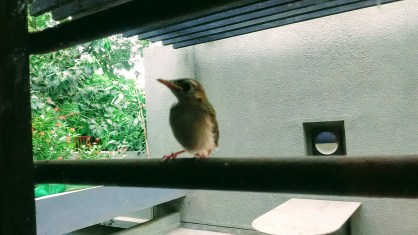
Through the glass, curiously

IMG_20180805_120336063.jpg

Little bird looking in

What do you see?

Strange giants pacing within.

Trapped in a cage of steel, stone and wood

In an existence that your kind has not understood.

Harried human looking out

What do I see?

A fledgeling just sprouting wings

To soar wide and free with a song to sing

Of the air and light, the trees and the sky.

Grow strong little one, spread your wings and fly

And I will wait for you to sometime come by.

–Mamata

Crossed Digits

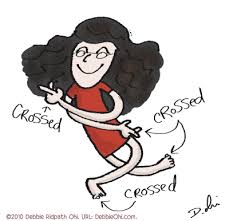
“Digits crossed!” is an expression that my friends and I use when we are hoping for things to turn out well—with double the power of “fingers crossed!” Yes, we hope to ensure this by metaphorically crossing not just the fingers, but also the toes.

In today’s ‘digital age’ where the digit-related terms  are so commonly used—digitization, digital camera, digital natives, digital divide, digital detox….we relate the word only to numbers. We seem to have forgotten that the word’s anatomical meaning. The word digit has its roots in the Latin root word digitus which means “finger or toe,” and English borrowed from this to mean “number.”

In fact, the practice of calling numbers digits comes from the digits on the hands — specifically, the habit of counting to ten on one’s fingers.

The digit in this sense was also a unit of measurement, long ago when  people used their hands and arms for measuring things. The width of a first finger was called a digit. This was used to measure things. The width of a palm was called a hand breadth. The width of an outstretched hand was called a span. The distance between an elbow and the tip of the longest finger was called a cubit.

The Egyptians had a standard length from the elbow to the middle fingertip, a distance of about 45-50 cm which they called a cubit. The width of the hand or four fingers was called a palm or hand and was about 9-10 cm. Hands is still used for measuring horses.

The ancient fathom was the distance between the outstretched arms about 1.8 metres. It is still used for measuring depth at sea.

The foot may have come from an ancient Babylonian brick measurement but in fact it works out to the approximate length of a man’s foot about 30 cm. The finger became an inch, which the Roman’s made one-twelfth of a foot.

In this digital age, if you want to sound smart, you can refer to your finger, thumb, or toe as a digit!

If you want to sound smarter still, go digital in Latin!

Here’s what they are called:

Thumb Pollex

Index finger  (pointer finger, fore finger) Digitus Secundus Manus

Middle finger Digitus Medius Manus

Ring finger Digitus Annularis Manus

Pinky ( little finger) Digitus Minimus Manus

And keep your digits crossed!

–Mamata

digits
source: Google

Crotchety Me!

Knitting. Not my area of natural comfort. The only time I did knit was when I was forced to, back in school. And were those booties and bonnets and ponchos disastrous! My needlework teacher ‘frogged’ them regularly (to fully understand the term, continue reading!).

Then why do a piece on knitting-related terms?

Because a dear friend just gifted me a beautiful crocheted shawl. I have been looking at it all week and appreciating the beauty of the piece, the patience that has gone in, and the centuries of tradition behind it. So here is to my friend Mahashwetha and knitters and crotcheters across the world who bring beauty and warmth (pun intended) to our lives.

CB8E4CC3-FB0E-4E77-8EBB-D9EBB791C477

Since the gift is crocheted, not knitted, we will begin with ‘crotchety’ terms.

Crochet: ‘Crotchet’ is from a very old French word for ‘small hook,’ and the verb means ‘sewing with a hooked needle’. ‘Crotchet’ has been in use in this sense since the 15th century.

Crotchety: By late 16th century, ‘crotchet’ was also being used to mean ‘an odd whim or peculiar notion.’ The logic of this seems to be that strange ideas or unusual behavior are mental ‘twists’! A person with odd ideas and habits came to be described as ‘full of crotchets’ or simply ‘crotchety,’ a term which first appeared around 1847. “Crotchety” is now also used in place of “grouchy”.

Knitting commemorates people!

Cardigan: Knitted jackets or sweaters open down the front have been around for several centuries, but the term cardigan came into use in 1862. The cardigan was named after the seventh earl of Cardigan (a county in Wales) who sported such jackets during the Crimean War.

Raglan: The word raglan also came into use during the Crimean War. It is named after Cardigan’s commanding officer, the first Baron Raglan. During the war, Raglan wore a loose-fitting overcoat with sleeves that extended all the way to the neckline instead of stopping at the shoulder. Originally raglan referred to the overcoat; it now can also refer to the style of sleeve.
And animals too!
Frog: What happens when a knitting project doesn’t go well? Well, a knitter frogs it. Frog is knitting slang for “ripping out” knitting: taking the piece off the needles, and unraveling it quickly. It’s not unique to knitting: crocheters frog their work, and needleworkers also frog stitches that aren’t right.

As well as places…

English knitting: Also called right-handed knitting, this is the method of knitting in which the working yarn in is held in the right hand.

Continental knitting: This is a method of knitting in which the working yarn is held in the left hand.

Knitting terms confuse…

Ravel: The verb ravel can mean “to knit together.” It can also mean “to unspool, unknit, or unravel.” Ravel is a contronym (or Janus word), a word with meanings that contradict each other.
End note

If you thought only music had its own notation, turns out knitting does too! Just to start you off….

BO: bind off (cast off)

CC: contrasting color

cn: cable needle

CO: cast on

dec:: decrease

dpn(s): double-pointed needle(s)

inc: increase

kfb: knit into the front and back of the stitch (an increase)

knitwise: as if to knit

And so on…
–Meena
References:

http://en.wiktionary.org/wiki/crotchety
http://en.wiktionary.org/wiki/crotchet#E…
https://www.dummies.com/crafts/knitting/designs-patterns/terms-and-abbreviations-used-in-knitting-patterns/
• Terms and abbreviations used in Knitting Patterns. Kristi Porter.

In Fashion

“Fashion sometimes ignores convenience, sometimes even causes inconvenience. All fashions may not have great thinking behind them, and sometimes thinking people fall prey to fashion.

Children of fashion-conscious parents have also to swim with the tides of the times. Children are often made to exhibit what parents find fashionable or what is ‘in style’ at the moment.

Take an example of girls’ dresses. Most of these have buttons at the back. No one knows who thought of this style, but children wear it, parents demand it and tailors stitch accordingly. So far, so good.

But what happens when a child wears a dress with buttons at the back. “Mother do my buttons.””Papa please fasten my hooks.” The parents are hassled with other tasks. The mother calls for the older sister. “Help her with her buttons”, or she calls for the servant,”Why don’t you close the buttons for her?”

The child with her own two hands is helpless. She is dependent on someone else to complete dressing. She cannot go out unless someone is there to button her up. She has to request, or plead, or shout for this. She is dependent all for the sake of being dressed in the fashion, a dress with buttons at the back!

That is just for dressing. What about undressing?

If the dress gets wet the child cannot take it off. If she is feeling hot, she can’t take it off. And, heaven forbid, if her dress catches fire, she can’t take it off.

But still the child wears such dresses. She likes them because her parents do. They like them because they want their child to be ‘well dressed.’

But fashion is really a series of fads. Started somewhere by someone who wants to be different, it sometimes catches on, and then everyone wants to follow blindly.

Sometimes the glamour of being different, or being in style blinds people to the basic tenets of simplicity, comfort, and practicality in the way they dress.

We might, as adults, indulge in this. But when it comes to our children we must first think of their comfort and convenience with respect to what they wear. Even infants often show distinct preferences for what they like, or do not like, to wear.

At our Balmandir we have a ‘front button’ attendance. Children whose clothes have buttons at the back take home a note requesting parents to get them clothes with buttons in the front. And parents do make an attempt to do so.

Sometimes they have not even thought about the difference it would make: that changing the orientation of a few buttons is indeed rendering a great service to their child.”

This is not taken from, nor meant for, a magazine on New-age Parenting. These words were written in the early 1930s–nearly 90 years ago, by my grandfather. The author Gijubhai Badheka is well known not only as the creator of some of the best loved and popular children’s literature in Gujarat, but equally for his writings for parents and teachers. He was also one of the pioneers of the Montessori system of education in India. Gijubhai observed children and adults and recorded his thoughts; he described dilemmas faced by both, and explored how these could be handled. Many of these were complied in a series of books in Gujarati called It Is Not Easy Being Parents.

This is one of the many pieces translated from the original Gujarati by me.

–Mamata

Magnificence—Endangered

Not just endangered, critically endangered. We are talking of the Great Indian Bustard (GIB). There are only about 200 birds left in the wild in India, mainly in Rajasthan and Gujarat. There are a few birds still in Maharashtra, Andhra Pradesh, Gujarat, Karnataka and Madhya Pradesh. But they have completely disappeared from Punjab, Haryana, Uttar Pradesh, Orissa and Tamil Nadu.

GIB has been listed as Critically Endangered in 2011 on the IUCN Red List, which means that it faces an extremely high risk of extinction in the wild. When we say that a species is extinct it means that there is not be a single living member left of that species.

The Great Indian Bustard is a magnificent bird, standing about 1 metre tall. Its wingspan is more than 2 metres. It is mostly brown, with a light-coloured head and neck. The distinguishing feature is the black crown on the head. Interestingly although they look closer to ostriches or cranes, most recent research shows that the Bustard family is more closely related to the cuckoo family!

At about 15 kg, it is the heaviest flier in India, but not in the world. The world record is held by a relative, if we may call it that, the Kori Bustard which is found in Africa. The Kori often weighs upwards of 18 kg.

These birds live in wide open landscapes which have sparse grasses and shrubs. They spend most of their time on the ground. Their long legs and front-facing toes help them to run fast. Although they are usually seen striding or running, they also have strong wings and can fly well.

Their diet varies depending on what is available during a particular season. These birds feed on grass seeds, agricultural crops such as groundnuts, millets and legumes, as well as insects like grasshoppers and beetles, and rodents and lizards

They usually breed in the monsoon season which is when food is most easily available. The female scrapes the soil in a secluded place to lay her egg. Generally, she lays only one egg. She incubates the egg for 25 days before the chick is hatched. The exposed egg is always in danger from predators. The mother has to be alert to keep the egg and the new chick safe. The male does not play any part in making the nest, incubation or raising of the chick. It is the Mother GIB who does this alone!

What are the threats? Plenty! GIB can be found in some parts Pakistan also, and there, it is still hunted. There is also some amount of poaching occurring in India. Apart from that, the natural home of these birds is reducing in size. A major cause for this is expansion of agricultural fields and increase in mechanized farming in the areas where the GIB live. This also means that human settlements get closer. Then there other very mundane reasons. Dogs are a major threat to GIBs. As I told you, GIBs lay their eggs on the ground. With the villages so close, dogs often eat the eggs. Also, there has been a huge increase in high tension electric wires in the habitat area. GIBs often dash against these and get electrocuted. They may also get hit by fast-moving vehicles.

Only urgent mission-mode action can save the GIB. Can we let this magnificent bird got the way of the Dodo?

–Meena and Mamata

What’s in a Moth?

When is a butterfly not a butterfly? When it is a moth!

20180725_163659_resized.jpg

Butterflies have always hogged the limelight with their beauty and colour. Moths have always been the Cinderella, perceived as drab and uninteresting, and usually overlooked. Yet, moths greatly outnumber butterflies by a ratio of 10:1 and there are more than 12,000 species of moths.

There’s a lot in a moth for Dr Shubhalakshmi Vaylure, the first woman in India to study moths! “Why moths?” she was often asked when she started her research over 15 years ago. In fact, as she related in an interview, once she was asked why she chose to spend the nights studying moths (not quite suited to being a girl!) when she could study butterflies during the day, she replied “Well, someone’s gotta do this unpleasant night shift.”

It is that approach – Passion, Persistence and Push that sums up India’s Moth Lady!

Shubhalakshmi started by studying zoology and entomology in college, which is also when she signed up with Bombay Natural History Society (BNHS) as a student member to use the library, and volunteering, joining nature walks and trails. After graduation she joined the Conservation Education Centre of the BNHS as an administrative assistant. At the time BNHS was the only institution in Mumbai which was offering a master’s degree through research, and she signed up for this.  Isaac Kehimkar, an eminent butterfly expert, suggested she study moths as they had not  been much studied in India. And that is where it all began. On completing her master’s degree, she became an Education Officer at the CEC, and went on to head the Centre.

As fellow environmental educators and Fulbright scholars, Shubha and I have met several times, and her energy and enthusiasm have been inspiring and infectious. Over the years I have been following Shubha’s journey and have seen how capably she has combined her passion for nature with smart use of technology and successful entrepreneurship.

Shubha is one of the pioneers of Citizen Science in India which empowers and enables ordinary citizens to be part of wildlife and environmental research by observing, collecting and sharing local data.

In 2014 she started a social enterprise Ladybird Environmental Consulting. The first project that Ladybird undertook was the development of three mobile-based applications iButterflies, iTrees, iNaturewatch birds under iNaturewatch Urban Challenge, a citizen science programme that worked with schools in Mumbai, New Delhi, Kolkata and Hyderabad to collect data on their city’s flora and fauna. Following this she set up iNaturewatch Foundation, to continue such urban biodiversity citizen projects.

For those who are inspired to become citizen scientists, and follow in the steps of the Moth Lady, a great start will be Shubhalakshmi’s book Field Guide to Indian Moths. The culmination of 15 years of research, this reader-friendly field guide features descriptions of 733 species of moths, supported by over 1000 colour photographs. Shubha also coined for the first time, common names for several of the species. Way to go Shubha!

What better way to mark this week which is designated as National Moth Week.

–Mamata

What Say You?

When I lived in Kenya, and learnt a little bit of Kiswahili, it was great fun to discover curious words or phrases. One of the best ones was to the local word for curd/yogurt. This was called Mazeevaa Lala—literally “sleeping milk!”

I was reminded of this recently when I chanced upon a Maltese saying My eye went with me, to mean that you have fallen asleep, as not taking your eyes with you would result in a sleepless night!

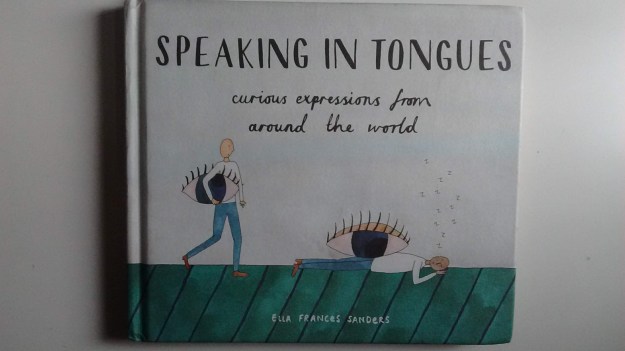
This is one of the many sayings in a delightful book titled Speaking in Tongues: curious expressions from around the world–a compilation of proverbs, idioms and sayings from different languages of the world, put together by Ella Frances Sanders. What brings the words alive are the accompanying illustrations, also by Ella who describes herself as “a writer out of necessity and an illustrator by accident.”

IMG_20180725_181146775.jpgFrom Finnish to Igbo, Armenian to Yiddish, each double spread presents delectable sayings and drawings that blend the wit and wisdom of the ages while also placing these in their cultural context.
Cannot resist sharing some:

Even the monkeys fall from trees. This well-known Japanese saying reminds that even the best and the cleverest can still make mistakes, and cautioning to keep overconfidence in check!  Perhaps the recent World Cup surprises where the superheroes fell from grace is an apt analogy!

You are my orange half. A Spanish term of endearment that means that someone is your soulmate or love of your life. Not quite sure what is so endearing about an orange, but reminded of the Amul chocolate ads that urged us to “Share it with someone you love!”

Horse horse Tiger tiger. To describe something that is so-so, or neither here nor there. This is a Mandarin expression; its origin lies in a story about a painter who painted a half tiger half horse but nobody bought it as it was neither one nor the other.

To pull someone out of their watermelons. A Romanian idiom that means to drive someone crazy! Not much light on why being in or out of watermelons can be harmful to mental health!

Stop ironing my head. An Armenian way of saying “Stop bugging me!” Popularly used when someone keeps asking irritating questions and won’t leave you alone. In many Indian languages we have our own equivalents in the form of “Don’t eat my head.”

To give a green answer to a blue question. A Tibetan reference to when the answer is completely unrelated to the question asked. Something that people in politics are adept at!

This is just a sampler of the 52 proverbs, expressions and idioms that have been passed on from one generation to another in diverse cultures. Interestingly, they reflect not just diversity, but also the sameness as it were. As I read I immediately thought of similar ones in Hindi and Gujarati, as will surely be the case in all languages. Remember how we had to memorise proverbs in our language subjects in school and what a pain it was? Maybe it is time to revisit these!

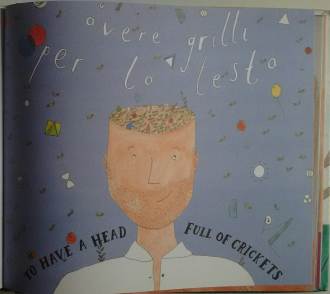
A perfect one to end with. To have a head full of crickets. 

IMG_20180725_181247.jpg

How the Spanish describe a mind buzzing with crazy, wonderful ideas, whims, and flights of fantasy…(what some would call nonsense!)

Nicely sums up how I often feel!

–Mamata

Reading Word Pictures

I am re-reading Markus Zusak’s ‘The Book Thief’, set in Nazi Germany in World War II. It is about a girl who steals books and is fascinated by them, but cannot read too well.

Which got me thinking of the ASER (Annual State of Education Report) test results, which year after year show children in India are simply not reading at the required level. Reading is the most important pathway to learning, and if our children don’t read, they can’t learn.
Which then brought me to techniques for teaching reading more effectively.
Research avers that reading and learning improve if children visualize what they are reading. They not only are able to understand better, they are also able to relate better to the text. But it is not something all children will do automatically. Sometimes, they need to be encouraged and supported in doing this.

Continue reading “Reading Word Pictures”

Otherness and Sameness

When we were in school one of the most assigned topics for essay was Unity in Diversity. We prepared hard for this by finding out many examples from India to demonstrate this. We were proud of living in a country where people of such diversity could co-exist, and celebrated this diversity. We also sang with fervour a school song in Hindi that proclaimed that all people of Hind were one, even though there were many colours and features, attires and languages. Hind desh ke nivasi, sabhi jan ek hai, Rang, roop, vesh-bhasha chahe anek hai.

 My heart breaks today, day after day, to read about a country and a world where it is this very diversity that is broken into identity fragments that divide rather than unite; a world that is increasingly emphasising the ‘otherness’ to create chasms, rather than the ‘sameness’ that builds bridges.

This sentiment is beautifully expressed by Maria Popova:

“Where Walt Whitman once invited us to celebrate the glorious multitudes we each contain and to welcome the wonder that comes from discovering one another’s multitudes afresh, we now cling to our identity-fragments, using them as badges and badgering artillery in confronting the templated identity-fragments of others.”

And then, this past month there was a ray of hope in the World Cup with the multi-ethnic compositions of many of the teams, and much was written about how the not-so-long ago ‘outsiders’ had become integral parts of National teams. This was best demonstrated by the multicultural French team that lifted the Cup…where the Otherness was transcended by the Sameness.

“You gave me blue and I gave you yellow

Together we are simple green. You gave me

What you did not have, and I gave you

What I had to give—together, we made

Something greater than the difference.” (Alberto Rios)

Yes it can happen, and yes there is hope, even in these strange and uncertain times, as Barack Obama said in his centennial memorial lecture to Nelson Mandela, and reminding us of his words: “No one is born hating another person because of the color of his skin, or his background, or his religion. People must learn to hate, and if they can learn to hate, they can be taught to love, for love comes more naturally to the human heart.”

–Mamata


Well Spun!

Ponduru, a village in Srikakulam, Andhra Pradesh, arguably produces the best khadi in India. Well, at least Gandhiji thought so. He was highly impressed with the fineness of the khadi produced here and preferred it to other khadis. The best dressed (khadi-mode) contemporary politicians even today get their saris, dhotis and shirt material from here.

Ponduru khadi is hand-carded, hand spun and hand woven—truly khadi in letter and spirit.

What makes it special? Well, more than one factor, it seems. For one, the raw material itself is of a special quality—it is made from special varieties of hill cotton and red cotton which are grown in Vizianagaram and Srikakulam districts. For another, Ponduru khadi is very smooth, especially the higher count variety. This is because the jawbone of the Valunga fish found in Srikalkulam is used to comb the cotton  fibers to separate them from the seeds, and the process lends a soft sheen  to the cotton.

21637405-76C9-4CD8-B597-D2A608CB60E3

There was a time when every home in this village had a loom. But like in most of India, the number of khadi workers in Ponduru is falling. The low remuneration is of course a major reason. Those involved in the sector do not want their children to follow them—they would much rather they got a ‘professional’ degree and got a ‘secure’ job.

Fortunately, there are some efforts to improve the situation, including dedicated NGOs working in the sector. Chitrika is one such which has been working closely with the Ponduru khadi sector for over a decade now. They are helping the workers organize themselves into Producer Cooperatives, find newer markets, and improve their capacities. New and innovative designs are being brought in. All this is enhancing the incomes of the weavers, almost doubling them in the last decade.

But without a pull from the market, no government subsidies or NGO efforts are going to lead to sustainable results. An eminent Gandhian once mentioned that if every Indian bought one khadi garment a year, the sector would thrive and all our khadi workers would be able to earn decent incomes.

A small thing to ask! And this is in our hands.

So this piece today is a call to action. We are about a month away from Independence Day. Go out and buy some khadi! It is a practical and easy ‘good deed’ for 15 August!

Buy khadi, and specially buy Ponduru khadi, best of all khadis!

–Meena