Wash ‘Em Clean

One of our favourite childhood books was a delightfully illustrated Russian book called Wash ‘Em Clean. It was a funny poem about a little boy who would not wash and bathe, and how he was converted to cleanliness.

Instilling the habit of proper hand hygiene has been one of the great challenges through the ages.

On 15 October, in 2008, over 120 million children in more than 70 countries around the world washed their hands with soap. This marked the first Global Handwashing Day, founded by the Global Handwashing Partnership as a way to raise awareness about the importance of washing hands. Since then, this day is celebrated annually to reiterate the simplicity and value of clean hands. The theme for this year is Hand Hygiene For All.

Ironically, in just over a decade since then, a single Handwashing Day is not enough. Handwashing is making daily headlines across the world as, possibly, the most effective protection from Covid 19.

Interestingly this was the very message that was sought to be promoted as far back as 1847 by Dr. Ignaz Semmelweis, a German-Hungarian physician and scientist. Armed with a doctorate from the University of Vienna and a Master’s degree in midwifery, Semmelweis joined as Director of the maternity clinic at the Vienna General Hospital in Austria.  At that time a mysterious infection known as ‘childbed fever’ was leading to high mortality rates in new mothers in maternity wards across Europe. Semmelweis was determined to understand what caused this rampant infection, and he began to closely observe the practices of the doctors on duty.

Until the late 1800s surgeons did not scrub up before and after surgery, or even wash their hands between patients; causing infections to be transferred from one patient to another. In fact, even after dissecting corpses, doctors and medical students went straight to the maternity wards to examine women who had recently delivered, without first washing their hands. Semmelwies deduced that it was the doctors who were transmitting infections to the patients. In maternity wards these infections led to the new mothers dying from puerperal fever or ‘childbed’ fever as it was called.

This was in the era before antibiotics (and before the recognition that germs are the agents of infectious disease).

Dr Semmelweis immediately instituted a strict regimen wherein all medical staff had to wash their hands between patient examinations. This seemingly simple step was the most difficult to implement. His peers were very sceptical, some were openly hostile; how could he dare to claim that the doctors were killing their patients? His own staff rose against him. He was labelled a madman because of his fanatic insistence on hand washing.

But the results of his ‘lunacy’ spoke for themselves–before hand washing was instituted in May 1847, his clinic’s mortality rate was 18.3%. By July, the rate had dropped to 1.2%, and it was zero the next year. But despite the clear link between cause and effect, most doctors did not change their practices.

Instead, in the face of opposition from a large part of the medical fraternity, the doctor  was dismissed from his post, and he moved to Budapest. At the age of 47 he was committed to a mental asylum, and died there only 14 days later.

Semmelweis never published an explanation of the logic behind his theory.  His experiments with hygienic practices were only validated some years later when Louis Pasteur expanded on the germ theory of disease. This was taken further by Joseph Lister a British surgeon. Based on his observations as a surgeon, Lister also deduced that a high number of post-operative deaths, which were attributed to ‘ward fever,’ were caused not by the surgery but by infections spread by germs from unwashed bed linen and surgical instruments, as well as lack of hand hygiene among doctors. Lister saw this as the cause, as well as the solution, to the problem. He started using carbolic acid to wash hands and to sterilize instruments, as well as to dress wounds. He experimented successfully with these techniques, and, unlike Semmelweis, went on to publish everything he discovered in a medical journal The Lancet in 1867. He became known as the father of antiseptic surgery.

That was a hundred and fifty years ago; but how much have things changed even now?

Here are some shocking facts.

Most patients and their families believe that a hospital is the safest place in terms of hygiene. But the Centers for Disease Control (CDCs) in America estimate that 1 in 25 patients pick up an infection while hospitalized. In 2011 there were more than 700,000 health care-related infections at intensive-care hospitals, and about 10 per cent of the infected patients died during their hospitalization. One of the major contributors to the spread was low hand-washing compliance among the attending doctors and nurses.

The well-known author and surgeon Dr Atul Gawande wrote an eye-opening essay in 2004. Titled On Washing Hands the essay endorsed that hand washing non-compliance was a major factor in spread of infection. But it also explained why this seemingly simple measure is, in practice, very complicated due to the sheer volume of interactions between a medical caregiver and a patient. For example, in a regular 12 hour shift a nurse would have up to 100 occasions on which hand washing is required. Given the tremendous pressure of time and patients, he accepts that the kind of hand washing that would be effective would mean that one-third of the medical staff’s time would be spent on washing.  While this is not realistic, he urges that even a small increase in compliance would mean saving at least a few more lives that are lost to infection.  

From Semmelweis to Gawande, the crusaders for hand washing have been spreading the message for almost 200 years. In this year of the Corona, never before has hand washing been more critical and more imperative. Handwashing is not just for doctors. Every one of us can save lives—especially our own, by becoming fanatical about hand washing.

Let’s put our hands together to applaud the super power of soap and water.

–Mamata

Beach Lore

The good news that newspapers brought us yesterday was that eight Indian beaches had qualified for the Blue Flag tag—an achievement indeed! This Certification is awarded by Foundation for Environmental Education (FEE), an NGO, and is a respected one, with stringent requirements. There are 33 criteria spanning environmental, educational, access and safety related parameters. Beaches tagged as Blue Flag provide clean and hygienic bathing water, along with basic infrastructure for tourists.

It is not impossible to spruce up for an inspection and get a certification or award. The challenge is make the improvement sustainable, and an inclusive shared vision with all stakeholders. Let us hope these eight beaches are able to do this and stay on the list, even as more join them in the years to come.

At any rate, it provides an opportunity to revise some beachy information:

A beach is a narrow, gently sloping strip of land that lies along the edge of an ocean, lake, or river (yes, technically, even the land around a lake or along a river is a beach!).

Beaches are made of materials such as sand, pebbles, rocks, and seashell fragments. Over the decades and centuries, forces of nature—water, wind, erosion, weathering—act on the cliffs, rocks and landforms at the edge of the waters, and break them down.  As tides come in, they deposit sediment which may have sand, shells, seaweed, and even marine organisms like crabs or sea anemones. When they go out, they take some sediment back with them.

Beaches are constantly changing. Tides and weather can alter beaches every day, bringing new materials and taking away others. There are seasonal variations too. In the winter, storm winds throw sand into the air. This can sometimes erode beaches and create sandbars. In the summer, waves retrieve sand from sandbars and build the beach back up again. These seasonal changes cause beaches to be wider and have a gentle slope in the summer, and be narrower and steeper in the winter.

At 7500 kms, India has the world’s seventh-longest coastline, with nine states and two union territories having coasts.

Apart from aesthetics, beaches are habitats for many, many species. The Olive Ridley coming to nest in the Gahirmatha beach of Orissa is a phenomenon that naturalists come from around the world to witness. In all, about 2,50,000 to 3,00,000 turtles nest here every year, in the space of about two weeks. Thousands of female turtles arrive each night to lay eggs. They make nest holes, lay 100-300 eggs, smooth the nests over, sometimes covering them with vegetation, and go back. Fifty days later, the eggs hatch, and millions of little turtles, each the size of a brooch, make their way into the ocean to start their lives.  

Our coasts and beaches are also witness to a hoary past: The rockcut temples of Elephanta date back to the 6th century AD. The temples of Mahabalipuram are almost as old—going back to the 7th century. The Konarak temple dates back to the 13th century, at which point it stood directly on the sea, though today the sea has moved about 3 km away. Dwarka is believed to have been the Krishna’s capital, and is said to stand on the site of five earlier cities. Fort Aguada, Goa, built in the 17th century has a unique lighthouse. Rameshwaram has the largest temple in India.

And of course, on April 5, 1930, Gandhiji and 78 satyagrahis reached the beach at Dandi on the coast of Gujarat to make salt and history.

So let’s protect our beaches! Let’s Blue Flag them all!

–Meena

Looking and Seeing

A couple of months after the lockdown started there was a spurt of pieces and pictures about different aspects of the natural world that people had started noticing around them—the variety of birds and insects; the hues of the sunsets and sunrises; the vegetation with its changing cycles; the diverse sounds of nature, and much more. True that these became more evident as the relentless activity and cacophony of urban life became more muted. But perhaps, more likely, it was the fact that we humans have had more time to ‘stop and stare’ as it were.  

If we were to stop a moment and think about it, we are always ‘looking’ at things but how often are we really ‘seeing’ something? We use our eyes, but our gaze is glancing, merely considering the objects, people and scenes that pass before our eyes. Things appear as they are at first glance, and we move on, not stopping to take in the image in all its dimensions and depths.

The dictionary says that to look means to direct your eyes in a particular direction, while in order to see, you must notice or become aware of someone or something. Seeing is not only noticing that something is, but understanding it, attending to it, and looking past the obvious to enjoy its more subtle nuances. It means noticing not only the details but also how those details are part of a whole.

Thus seeing is not just a function of the eyes but rather a combined effort of the eyes and the brain, which work together to sort out visual input and arrange it into meaningful images, within a context, and with significance to detail.

How do an artist and a scientist ‘look at’ and ‘see’ the same thing? Two beautiful passages bring these together on the same canvas.

Georgia O’Keeffe a 20th-century American painter and pioneer of American modernism best known for her canvases depicting enlarged flowers explained why she did this: A flower is relatively small. Everyone has many associations with a flower–the idea of flowers. You put out your hand to touch the flower–lean forward to smell it–maybe touch it with your lips almost without thinking–or give it to someone to please them. Still–in a way–nobody sees a flower—really–it is so small–we haven’t time– and to see takes time, like to have a friend takes time. If I could paint the flower exactly as I see it no one would see what I see because I would paint it small like the flower is small. So I said to myself–I’ll paint what I see–what the flower is to me but I’ll paint it big and they will be surprised into taking time to look at it–I will make even busy New-Yorkers take time to see what I see of flowers.

Nobel-winning physicist Richard Feynman sees more than the aesthetic. As he said: I have a friend who’s an artist and has sometimes taken a view which I don’t agree with very well. He’ll hold up a flower and say “look how beautiful it is,” and I’ll agree. Then he says “I as an artist can see how beautiful this is but you as a scientist take this all apart and it becomes a dull thing,” and I think that he’s kind of nutty. First of all, the beauty that he sees is available to other people and to me too, I believe…

I can appreciate the beauty of a flower. At the same time, I see much more about the flower than he sees. I could imagine the cells in there, the complicated actions inside, which also have a beauty. I mean it’s not just beauty at this dimension, at one centimeter; there’s also beauty at smaller dimensions, the inner structure, also the processes. The fact that the colors in the flower evolved in order to attract insects to pollinate it is interesting; it means that insects can see the color. It adds a question: does this aesthetic sense also exist in the lower forms? Why is it aesthetic? All kinds of interesting questions which the science knowledge only adds to the excitement, the mystery and the awe of a flower. It only adds. I don’t understand how it subtracts.

As the great French novelist, playwright, essayist, and filmmaker Marguerite Duras said “The art of seeing has to be learned”. This takes time, patience, and attention. And having learnt it, a skill that continually needs to be honed.

Today we are inundated with fast moving visual images that grab our eyeballs as they flash across our screens. But our attention spans are continually decreasing, as is our attention to detail. We do spend most of our times with our eyes wide open, but how much of that time do we spend in seeing? What better time than now, to start practicing the art of seeing?

Look! Can you see what I did?

As I look at my little garden blooming after the rains, aflutter with multi coloured butterflies, and vibrant with the hum of the bees, I rejoice in ‘seeing’ it with new eyes each day.

–Mamata

Monumental Tragedy

Thanks to COVID and the search for not-too-popular sights, we ended up visiting the Chikkajala Fort last weekend. On the way to Bangalore Airport and not too far from my home, we have been meaning to go for a long time.

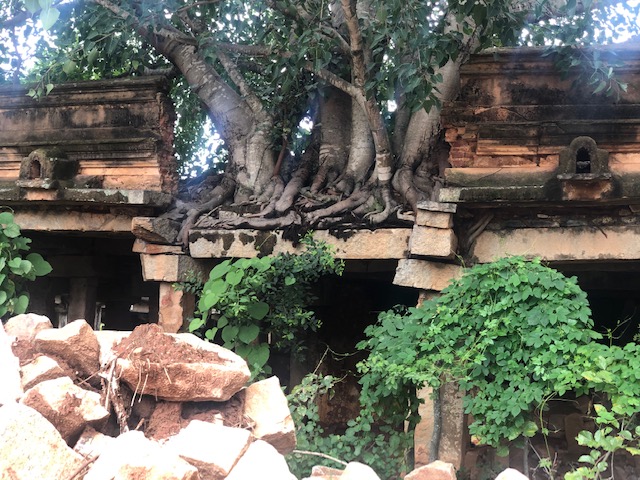
‘Fort’ is a misnomer today—what stands is a temple with what once must have been a beautiful, deep temple-tank in front of it, and a few long corridor-like stone structures. The site of Chikkajala is a prehistoric one apparently. It is likely there was a ‘vassal fort’ but it no longer stands. The estimates of the age of the temple and extant structures range from 300 to 950 years!

Apart from the general ravages of time and the overall neglect, apparently some parts of the structures were demolished for road widening after the new airport came up.

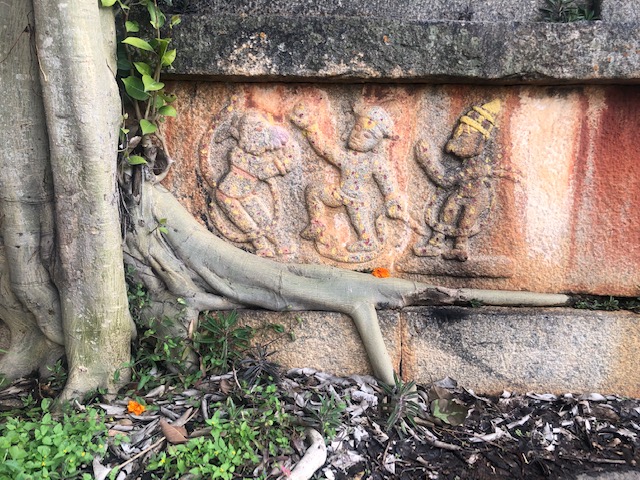
Whatever the reasons, it was sad!  To see a construction which must have a thing of beauty, lying in rack and ruin. The structure just falling down as it stands. Carvings defaced. Trees growing on and through the buildings. Cows grazing and leaving behind generous piles of cow dung. The temple tank completely overgrown with vegetation.  Plastic water bottles and discarded chips packets.

It was particularly poignant because only last week, Karnataka announced its Tourism Policy for 2020-25. The State aims to be among the top two tourist destinations in the country. I confess I have not read the 104-page document completely, but what I have read leaves me completely confused! While it talks at length of developing tourism infrastructure, ‘products and services’, I am amazed that it says nothing about the core of tourism—the sights that tourists go to see. What is to be done to preserve and enhance the condition of the cultural artefacts and natural heritage. Agreed, this is in the purview of other departments, but does a tourism policy not have to be in sync with these other departments, and should the synergies not be laid out as a part of the Policy?

The strategic intervention as mentioned by the Policy, and which seem to me to sadly lack so many, many critical elements, are:

  • Position Karnataka as a preferred tourism destination at state ,national and international levels
  • Facilitate improvement of Infrastructure, Tourism Products and Services
  • Streamline processes for obtaining approvals and clearances
  • Prioritise Human Resources Development & Capacity Enhancement
  • Promote ICT based initiatives for providing timely and reliable information services to tourists
  • Create institutional structures for effective implementation of the Policy
  • Provide attractive concessions and investment subsidies for various tourism

Admittedly I know nothing about Tourism or Tourism policy. But I do know when an ancient monument next to my house is falling to bits. I do see that a monument right on the main road to the airport can attract a lot of footfalls. I can gauge that it is about some money, but  much more about caring.

A small piece of heritage in a country which has so much that we can’t be bothered about any of it? A tiny blip in a list of monumental tragedies?

–Meena

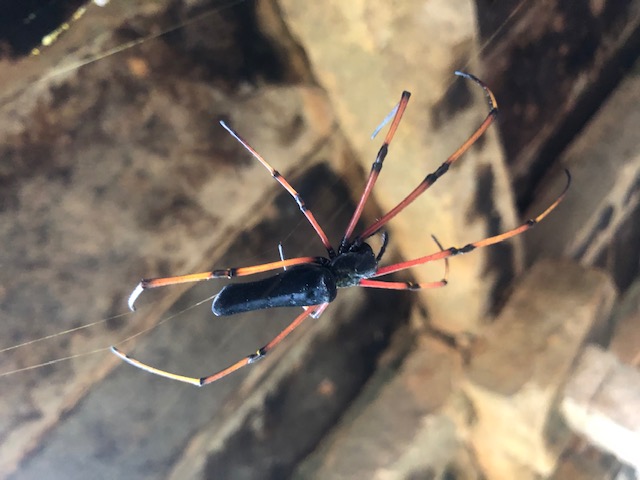
PS: A lovely spider sighted in the ruins. About 5 inches across, it had spun a web which was about 4 ft across. Maybe Nephila pylipis, but I am not quite sure.

Photo credits: V. Raghunathan

Gandhi the Vegetarian

In September 1888 a young Gujarati man named Mohandas Karamchand Gandhi set sail for England where he would pursue studies in law. Before he left he made a vow to his mother that while he was abroad he would not touch wine, women and meat. Easier said than done!

The challenge began as soon as he boarded the ship–managing to find something to eat, which both his religious belief and palate could support. A fellow passenger, an Englishman, assured him that it was so cold in England that one could not possibly survive without eating meat. The young man managed to subsist on what he could, until he reached England. It did not get any easier when he tried a couple of different lodgings. The English landladies were kind, but at a loss about what to feed their boarder. He ate oatmeal for breakfast, but barely subsisted on bland spinach, a few slices of bread and jam for lunch and dinner. The young man was almost always hungry, but was adamant to keep his vow.

As time passed, he began to find his feet in his new environs. He began to walk around the neighbourhood. He also began to look for vegetarian restaurants; walking sometimes ten or twelve miles in his search. Then one day, as he described in his autobiography: During these wanderings I once hit on a vegetarian restaurant in Farringdon Street. The sight of it filled me with the same joy that a child feels on getting a thing after his own heart. Before I entered I noticed books for sale exhibited under a glass window near the door. I saw among them Salt’s ‘A Plea for Vegetarianism’. This I purchased for a shilling and went straight to the dining room. This was my first hearty meal since my arrival in England. God had come to my aid.

Henry Salt’s book opened up a new perspective for Gandhi, and it whetted his appetite for dietetic studies. As he recalled over 40 years later when he shared the dais with Henry Salt at a meeting organised by the London Vegetarian Society on 20 November 1931: I received the invitation to be present at this meeting, I need not tell you how pleased I was because it revived old memories and recollections of pleasant friendships formed with vegetarians. I feel especially honoured to find on my right, Mr. Henry Salt. It was Mr. Salt’s book ‘ A Plea for Vegetarianism’, which showed me why apart from a hereditary habit, and apart from my adherence to a vow administered to me by my mother, it was right to be a vegetarian.

Till then Gandhi was a vegetarian by religion and tradition, but from the moment he read Salt he became ‘a vegetarian by choice’ and the spread of vegetarianism became his mission. He read whatever he could find on the subject. He found that there was a Vegetarian Society in London; he subscribed to its weekly journal, and then began to attend its meetings. In his new zeal, he even formed a branch of the Society in the locality where he then lived. Through the meetings he made friends with like-minded people. One of these friends was a man named Josiah Oldfield who was an active member of the London Vegetarian Society and editor of its journal. Sometime later, the two friends also shared accommodation, and dietetic experiments. In September 1890 Gandhi was elected to the Executive Committee of the Vegetarian Society as Secretary.

Badge of the Vegetarian Society as designed by Gandhi

Interestingly the start of Gandhi’s life-long prolific writing was a series of six essays that he wrote for the Society’s journal The Vegetarian. These were published from February to June 1891 under the heading Indian Vegetarians. In one of the essays Gandhi explained how Asian vegetarianism differed from its European counterpart. Unlike the English, the Indians do not take each dish separately, but they mix many things together. …Each dish is elaborately prepared. In fact, they don’t believe in plain boiled vegetables, but must have them flavoured with plenty of condiments, e.g., pepper, salt, cloves, turmeric, mustard seed, and various other things for which it would be difficult to find English names unless they be those used in medicine.’ He explained how the Indian diet was richer and more varied, except in one respect—the fruit, yes, the all-important fruit, is sadly conspicuous by its absence in the above-mentioned specimen dishes.

Gandhi’s essays took apart some common myths and misconceptions. They also  helped him to articulate his early thoughts on what was to remain a life-long passion and preoccupation. His experiments in dietetics continued during his time in South Africa, and throughout out his life in India. As he experimented, Gandhi also continued to write about diet and health. In 1906 while in South Africa, he wrote some articles under the heading Guide to Health. He further consolidated and expanded his ideas while he was confined to the Aga Khan Palace in Poona in 1942. These were published under the title Key to Health. This booklet concisely but comprehensively covers a wide spectrum of topics related to all aspects of health.

Today, across the world there is a proliferation of gyan on healthy foods and lifestyle. Movements like veganism are trending; as are the paeans to fruit, nuts and seeds; eliminating refined sugar and salt, and adopting non-dairy milks such as almond and soya milk. Whole grains and raw food, and even fasting are being promoted as the newly-discovered pillars of healthy life.  

1 October is celebrated as World Vegetarian Day, and 2 October marks the birth anniversary of Mohandas Karamchand Gandhi. An appropriate time to remind ourselves that well over a hundred years ago, MKG had already “been there, done that.”

–Mamata

Waiting for the Mahatma

This slim 1955 novel by R.K. Narayan is the best Gandhi Jayanti gift I could have given myself. It transported me to the days of the Independence struggle. The story itself is not really the crux of it, though it is a novel and there is a love story interwoven with the freedom movement.

So much time has passed since the time of the Mahatma that we cannot really fathom what it must have been to live in his time, to be inspired by him and be, even in the remotest way, a part of the freedom movement. And that is just what the book brought to me. That the most uneducated person in the remotest village in any corner of the country was somehow moved and fired by this figure called Gandhi. Whether the person fully understood what Gandhi stood for or what he wanted of them, still they were ready to believe in him, to dedicate themselves to his mission. In the tens of thousands they stood for hours in the sun for a glimpse of the Great Soul. In the thousands, they were ready to give up everything in life and go to jail for him. The book gives us a glimpse of the person behind the myth.

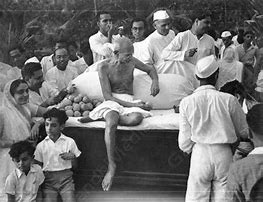
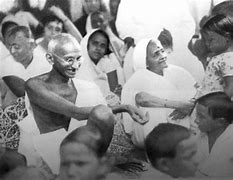
The incidents in the book obviously draw from many, many real happenings of those times. When I found the photograph of the Mahatma, children and fruits, it told me how authentic was the experience from which the book came. The book describes an incident when Gandhiji is taken to the house of the richest man in a town he is visiting, and all the elite are there, waiting for him to speak and to catch his attention. There are trays and trays piled with fruit. Not one of which he touches. Instead, he calls the children in the audience and distributes the fruit to them. While the adults are not thrilled, they still tolerate it. But they definitely are not happy when the Mahatma spots a little urchin in completely tattered clothes in the crowd, calls him up to the dais, seats him beside himself, plies him with fruit and has a full-fledged conversation.  And then decides to go and stay in the home of the urchin, who lives in the Cleaners’ Colony– the poorest, filthiest and unhealthiest part of town. In spite of the exhortations of all the bigwigs to stay in the house of the town’s wealthiest man where arrangements have been made, gently but uncompromisingly, Gandhi insists on going to the boy’s house, throwing the local elite and officials into a complete tizzy.

His uncompromising insistence on truth and ahimsa. His never sacrificing the means for the end. His belief in people, and at the same time, his being able to understand why they slip from the path. His interest in the minutest details of the lives of those around him. His prodigious correspondence—responding to each one of the letters he got. His sense of humour and unshakeable resolve. His sticking to his point without aggression. With this, he inspired a sub-continent and fought the mightiest empire of the time. With this he got us our freedom.

But we still make the Mahatma wait for us. Wait for us to live up to his ideals. Wait for us to be the nation he dreamt we would be.

How long will he have to wait?

–Meena

Gandhiji’s Wisdom on Education

As we approach Gandhi Jayanti with the New Education Policy (NEP) now a reality, it is an appropriate time to re-visit Gandhiji’s philosophy of education as encapsulated in his Nai Talim (New Education)—Basic Education for All.

The fundamental premise of Nai Talim is that basic education is a holistic process, where all aspects of the individual—intellectual, physical, social, and spiritual—are given opportunity for development.  The curriculum seeks to impart learning through hands-on skill-based work that prepares young people for the real world, rather than creating islands where education has nothing to do with the surrounding community. The centrality of skills aims to reinforce the dignity of labor, the value of self-sufficiency, and strengthen local culture. In this approach to education, craft-skill serves as the center of the holistic development of the student. Other skills such as literacy and mathematics are learned in the context of their craft, and subjects are taught in an interdisciplinary way and never separated from their practical application in the world.

Some other perspectives that under-pinned Gandhiji’s thinking on education were:

  • That education should include a “reverent study of all religions.”
  • Education meant lifelong learning
  • And a re-definition of the role of the teacher, which is summed up by him as : “A teacher who establishes rapport with the taught, becomes one with them, learns more from them than he teaches them. He who learns nothing from his disciples is, in my opinion, worthless. ..In this way, a true teacher regards himself as a student of his students.”

A national education conference held at Wardha on 22–23 October 1937 wherein Gandhiji shared his vision of education led to the setting up of two model schools at Wardha and nearby Segaon.  A few years ago, I was in Wardha and sadly, it did not seem that the school was doing too well, or that it was at the forefront of educational innovation. It would seem that it is not easy to implement the philosophy of Nai Talim in a way that is relevant to today’s world.

They say the NEP has some influences from Nai Talim. How far these elements are implementable or how seriously they will be implemented is yet to be seen. My feeling is that it will take very creative re-interpretation of the philosophy of Nai Talim, if we want the spirit of it to infuse our education system. And as of now, I am not aware of any exciting experiments in this direction.  

I often find myself returning to these two quotes from Gandhiji after discussions and debates on education. To me, they are the touchstone by which any educational initiative must be evaluated:

“By education I mean an all-round drawing out of the best in child and man–body, mind and spirit. Literacy is not the end of education nor even the beginning. It is only one of the means by which man and woman can be educated. Literacy in itself is no education.’

“The real difficulty is that people have no idea of what education truly is. We assess the value of education in the same manner as we assess the value of land or of shares in the stock-exchange market. We want to provide only such education as would enable the student to earn more. We hardly give any thought to the improvement of the character of the educated.’


–Meena

A Preposterous and Perplexing Beast

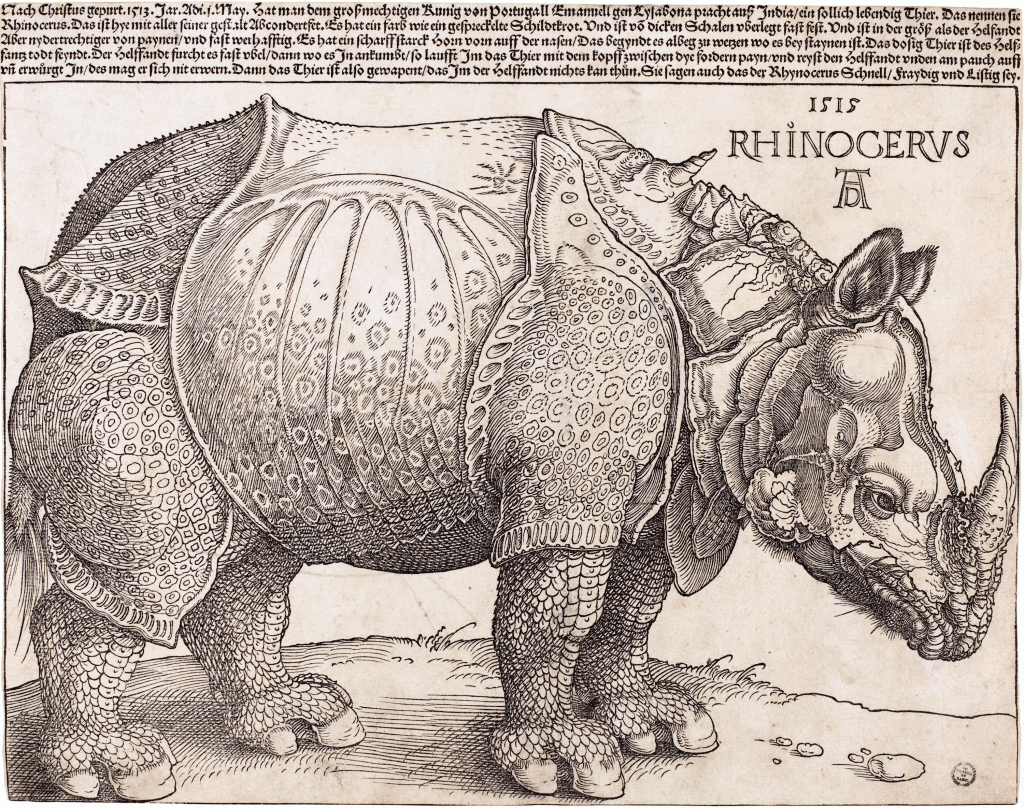
Dürer’s 1515 RHINOCERVS Source:https://en.wikipedia.org

In the sixteenth century, trade and merchant ships used to carry plants, spices and exotic animals from the colonial outposts of the ruling powers to Europe. In 1515, among the ship load of gifts despatched by the governor of Portugese India, Alfonso d’Albuquerque, to King Manuel I in Portugal, was a curious animal known by its Gujarati name of genda, and its Indian keeper, named Ocem. This rhino was the first to arrive in Europe since the days of the Roman Empire, and it caused quite a sensation. The animal was examined by scholars and the curious, and letters describing the fantastic creature were sent throughout Europe.

Albrecht Dürer, an artist, mathematician, engraver and painter living in Nuremberg read about this strange animal and based on the description, he began a pen sketch which became a woodcut. Dürer’s 1515 RHINOCERVS became famous. Dürer himself had never seen a rhino and hence his rendering was more fanciful than accurate.

In many ways a rhinoceros is an odd-looking creature. Even its name, literally meaning a creature with a horn on its nose, belies its unusual appearance. Much before Dürer, even for those who had seen a real rhino, its strange form and peculiar characteristics spawned a variety of tales. Tribes in Africa and Asia where the rhinoceros is found in the wild, have their folk tales that imagine how this creature came to be what it is. Here are some abridged versions.

A folk tale of the Tharu people of the Terai grasslands at the foothills of the Himalaya describes how the beast was created by the Hindu god Vishwakarma. He picked the best parts of many animals on earth and stitched them together. His creation had the skin of an elephant, the hooves of a horse, the ears of a hare, the eyes of a crocodile, the brains of a bear, the heart of a lion, and horns like Nandi, Shiva’s bull. Viswakarma creatively twisted, moulded and further modified these parts, even fusing two horns into one. The result was beyond his expectation, a masterpiece of the art of imperfection.

The naturalist and wildlife writer Edward Pritchard Gee recounted an ancient Indian myth that explains the ‘armour plating’ of the rhino. It is said that, once, Lord Krishna decided to use rhinos in place of elephants in battle. However, when the creature, all covered in armour for battle, was brought in, it was found to be too stupid to obey commands. Therefore, it was sent back to the forest. Unfortunately, they forgot to take off its armour—and so it remains until this day.

One African tale tells of how the rhino got its skin. Long long ago, when all the animals were without a skin, God gave each one a needle and told them to sew a skin for themselves. The animals got to work, each creating for themselves beautifully patterned and fitting skins. But Kifam, the first black rhino, was clumsy and short sighted. As he started on his skin, he dropped his needle; so he charged back and forth looking for it, but being short sighted, he could not find it. In frustration, he snatched up a thorn and started stitching, trying to put something together. When he put on his hastily assembled patchwork coat, it hung in wrinkles and folds. The other animals all laughed at him; this made him very cross; he was sure that they had hidden his needle. Since then the rhino charges at everything that crosses his path.   

Another African folktale explains the rhino’s habit of scattering its dung. As the story goes: In days long ago when animals could talk, Elephant always used to tease rhino about his near-sightedness and bad temper. One day Rhino really lost his temper. He challenged Elephant to a contest. The contest was to see who could produce the largest dung heap. Imagine two very large animals and the vast quantities of vegetation they eat, and you can imagine the lot of dung that they both make! But in the contest, Rhino made the larger pile of dung. The elephant was enraged. He attacked the poor rhino with his trunk and tusk and beat him till he cried for mercy. Finally the Elephant stopped the beating but made Rhino promise that he would never again challenge Him—the mighty Lord of the Beasts. Rhino never forgot that dreadful beating, and he is afraid to ever offend Elephant again. And that is why he always kicks at his dung heap, scattering it until it is quite flat, so that it always looks smaller than that of the Elephant.

While Rhino’s looks may be perplexing, it is the Rhino’s survival in the wild which is a   pressing issue for wildlife conservationists. Rhinos also have the unfortunate distinction of being one of the most endangered animals on earth.

Of the world’s five species of rhino, two are found in Africa–the Black Rhino and the White Rhino. The other three species are found in Asia. These are the Greater One-Horned (Indian) Rhino, the Sumatran Rhino and the Javan Rhino. While each of these species faces a different level of threat, some of the common threats that all of them face include poaching for their horn, habitat loss, and extreme climate events like floods and tsunamis.

Around 2010 less than 30,000 rhinos were alive in the wild. The plight of the Rhinoceros was not widely known around the world, and most people didn’t know just how close to total extinction majestic species was. So WWF-South Africa announced World Rhino Day in an effort raise awareness about this beast in peril, in an effort to save the world’s remaining rhinos.

Today this has become an international event. How this came about is another, modern-day, story of two determined and dedicated women.

In mid-2011, Lisa Jane Campbell of Chishakwe Ranch in Zimbabwe was preparing for World Rhino Day. She searched online for ideas and potential collaborators, and found a blog by Rhishja Cota-Larson from Saving Rhinos in the USA. Lisa Jane sent Rhishja an email, and the two found they shared a common goal of protecting rhinos. In the months that followed, they worked together to make World Rhino Day 2011 an international day of celebration of all five species of rhinos, and awareness of the threats that they face. The two continued to work together to promote this day every year.

22 September–World Rhino Day has since grown to become a global phenomenon, uniting NGOs, cause-related organisations, businesses, and concerned members of the public from nearly every corner of the world!

This is my small celebration of this quirky creature with a horn on its nose!

–Mamata

Between the Headlines

This image has an empty alt attribute; its file name is newspaper-reading-lady.jpg

I am a newspaper person. My day does not begin until I have perused my three morning papers. Even during the first Covid Lockdown when newspaper vendors stopped home-delivering newspapers, and after a week of serious withdrawal symptoms, my husband and I found an enterprising footpath vendor who braved the police to provide newspapers to addicts like us.  

In the last couple of weeks a lovely poem by Gulzar is doing the rounds, which beautifully captures this addiction. Called Newspaper Mornings, it opens with the line Bina akhbar ke, chai subah ki adhoori lagti hai (the morning tea feels incomplete without the newspaper).

 An article related to this succinctly sums up the charm of the printed newspaper vis-à-vis the blizzard of 24/7 TV channels and Social Media that relentlessly batters our senses and our lives. The newspaper does not try to recruit you to its agenda, it puts you in control. …The important thing is that you get to choose. You comment on a headline, smile at a cartoon, match wits with the crossword, eyeball a celebrity, pore over the sports statistics. …And then there is the pleasure of serendipity. You discover what you didn’t know before, you learn new things at random.

Exactly how I relate to newspapers! I often miss the headlines, but I very much enjoy reading the little items tucked away among the big news. From the mundane to the bizarre, these tidbits add the spice to my chai!

Here is a random taste from the last one month’s newspapers.

Uplifting News: People attending a kite festival in Taiwan were left looking on in horror after a three-year-old girl was lifted high into the air by powerful winds after she got entangled in the strings of a gigantic kite. The child hovered above throngs of spectators and was zipped around by strong winds for a heart-stopping 30 seconds amid inflatable pandas and astronauts as screams erupted from spectators. The girl, who was identified only by her last name Lin, landed mostly unscathed, except for abrasions around her neck and face. 

Lip-smacking News: Waking up to a town coated in chocolate powder sounds like a childhood fantasy, but for some residents in Olten, Switzerland, it was a reality on Friday morning, when it started snowing particles of cocoa powder. Popular chocolate company Lindt & Sprüngli has confirmed local reports that there was a defect in the cooling ventilation for a line of roasted cocoa nibs in its factory; as a result of which the fine chocolate dust escaped. Combined with strong winds the powder spread across the town, leaving a fine cocoa dusting on everything.

Missing News: At least 513 animals have been reported as having gone “missing” from Marghazar Zoo in Islamabad, a report said on Sunday. In July 2019 there were a total of out of 917 animals in the zoo. But by July 2020 the number came down to 404. The animals are suspected to have been stolen.

Chilling News: Austrian athlete Josef Koeberl broke the world record for longest time spent submerged in ice. He lasted more than two hours in the box, wearing nothing but a swimsuit. Koeberl took on the challenge in front of Vienna’s main train station, fully submerged up to his shoulders in a clear box filled with ice cubes. Over the course of the two hours, his temperature was monitored, and afterward, his health was checked by medical officials in an on-site ambulance. Josef Koeberl beat the previous record for full-body contact, which he set himself last year, by over 25 minutes.

Searing News: A couple’s plan to reveal the gender of their baby-to-be-born went up not in blue or pink smoke but in flames when the device that they used sparked a wildfire that burned thousands of acres and forced people to leave from a city east of Los Angeles in California. The couple went into a field and fired a device which was to let out the coloured smoke, but an errant spark quickly ignited the tall grass there, leading to the disaster. This was as part of a trend where confetti, coloured smoke, and balloons are used to announce the coming baby’s gender.

Educational News: Surat, Gujarat’s Diamond City is creating a new benchmark in green learning with its innovative approach to promote cycling among young children. To pedal up its efforts the local civic body has designed a course ‘Cyclology’. The subject will be a ten-hour course for which books have already been printed. Students will be taught history of bicycle, traffic rules, along with environmental, health, social and financial benefits in the course.  “If we teach them early kids will develop a habit for life.”

(NB No mention of whether kids will actually have to learn cycling!)

DIY for Dummies News: Whether you have hundreds of gigabytes or boxes of decades-old albums here are some simple ways to catalogue and organise your images. Cathi Nelson founder of a global community of photo organisers uses a prioritisation system she calls ABCS. Album (photos worthy of a physical or online album), Box or Backup (photos you want to keep in some form but don’t need access to), Can (as in trash can) and Stories (photos that conjure up a great memory and are thus worth holding on to). She further advises “Don’t get too lost—you only want to look at each photo for two or three seconds, max.”

Vocal for Local News: The red-purple dragon fruit that has helped Kutchi farmers make a killing may soon get a new name—kamalam (lotus). Officials and farmers say that the shape and external appearance of the fruit has a striking resemblance to a lotus. Kutch farmers have already started branding the fruit as ‘kamalam’ in the local markets.  

Breaking News: In a daring loot near Surat, burglars stole an entire ATM weighing at least 500 kg, and took it to an isolated spot in a farm about 150 feet away. They used cutters to break open the cash tray, and took away nearly Rs 8 lakh from it, in the early hours of Wednesday. They escaped leaving the damaged machine behind.

News That You Can Use: All of the above. I just did!

–Mamata

Look Around for the Butterflies!

September is observed as Butterfly Month in India. We have about 1400 species of butterflies–from the 190 mm wingspan Southern Birdwing, to the tiny Grass Jewel with a 15 mm wingspan. And we are yet to discover all the species there are—in the last few years, 77 species have been discovered in just the Matheran Hills near Mumbai.

Citizen-scientists who sight, record and report their findings are critical in any exercise of species monitoring. So here is a list of some popular guides to Indian butterflies which can get you started on your butterfly journey. Who knows, you may discover a new one, or help to expand the understanding of range or behavior! Good luck!

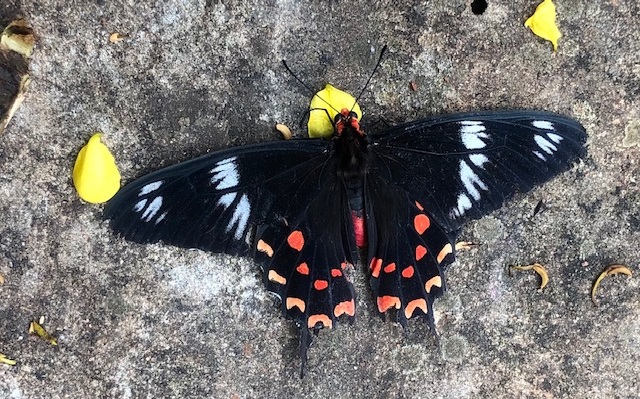
Common Rose Butterfly. Bangalore. August 2020. Photo credit V. Raghunathan
  1. Butterflies of India. Thomas Gay, Isaac Khemikar and JC Puneetha. WWF/Oxford University Press.
  2. A Naturalist’s Guide to the Butterflies of India, Pakistan, Nepal, Bhutan,  Bangladesh and Sri Lanka. Peter Smetacek.
  3. Identification of Indian Butterflies. J.H. Evans. BNHS.
  4. Butterflies of the Indian Region. MA Wynter-Blyth. BNHS.
  5. Butterflies of India. Arun Pratap Singh. Om Books International.

There are several excellent region-specific guides too, including:

  1. Butterflies of the Western Ghats. H. Gaonkar.
  2. Butterflies of Peninsular India. K. Kunthe, G. Madhav.
  3. Butterflies of Sikkim. Meena Haribal. Nature Conservation Foundation.
  4. Butterflies of Delhi. Peter Smetack. Kalpavriksh.

(Unapologetically non-conforming to  APA or any other referencing  style!)

And a few tips to help butterflies along:

  1. Butterfly gardening is a great way to provide a hospitable environment. Butterflies need different plants for different stages of their life-cycles. So planting a garden with many different types of flowering plants (or having pots with different kinds of plants) is a good first step. On the whole, plants like hibiscus, shankpushpi, sunflower, chrysanthemum, marigold, mint etc. are among those preferred by butterflies.
  2. Wherever you live, see if you can have some small areas which are left wild, with local species of wild plants. This will help butterflies, as these are probably their preferred vegetation.
  3. Stop use of chemical pesticides in your garden. These can cause serious harm to the butterfly  at the various stages of its development.

–Meena