Rahul Bajaj was a doyen of Indian industry, and a rare brave man who spoke his mind under all circumstances. His passing away is the end of an era in which he played a major role–from operating in the licence-permit raj, to competing in the liberalized regime, to establishing India’s position as an industrial force to be reckoned with.
What made him ‘him’ was surely shaped by his family influences—especially his grandfather, Jamnalal Bajaj. And that is whom we talk about today.
Jamnalal Bajaj was considered Gandhiji’s fifth son, and adopted all his values—from Ahimsa, to his dedication to the poor, to his commitment to locally made goods, to his patriotic spirit. Shri Bajaj was an active member of the Congress Party, and gave up the Rai Bahadur title conferred on him by the British Government and joined the non-cooperation movement. He fought for the admission of Harijans into temples, and in the face of strong objections, opened up his own family temple in Wardha—the first temple in the country to do this.
Wardha, Maharastra was where Jamnalal’s family was settled, and that is how it came to play such an important part in the Freedom Struggle. When Gandhiji left the Sabarmati Ashram at Ahmedabad for the Dandi March, he vowed not to go back till freedom was achieved.
Jamnalal had earlier spent time at Sabarmati Ashram with his family, and had been deeply moved by the experience. He invited Gandhiji to come to Wardha and set up an Ashram there after the Dandi March. And thus did the Sewargram Ashram come up there, and Wardha become the centre of the Freedom Movement.
A few years ago I was privileged, during a visit to Wardha, to visit Bajajwadi, where critical meetings with regard to the freedom struggle were held, marked by the presence of not only Gandhiji but also Jawaharlal Nehru, Dr. Rajendra Prasad, Maulana Azad, Sarojini Naidu, Sardar Patel, Netaji Subhas Chandra Bose, Dr. Pattibhi Sitaramayya among many others. All of them stayed there when they came for meetings and discussions. The historical resolution calling for the Quit India movement was signed at Bajajwadi.
Room in Bajajwadi where Quit India movement was discussed
Wardha was also the site where the Gandhiji’s idea of Nai Talim or New Education was developed, discussed at a National Education Conference in 1937, and put into practice at a model school.
The basic tenets of Nai Talim were:
That education should include a “reverent study of all religions.”
Education meant lifelong learning
And a re-definition of the role of the teacher, which is summed up by him as : “A teacher who establishes rapport with the taught, becomes one with them, learns more from them than he teaches them. He who learns nothing from his disciples is, in my opinion, worthless. ..In this way, a true teacher regards himself as a student of his students.”
Another important initiative rooted close to Wardha was Maharogi Seva Samiti, the first indigenous leprosy care centre in India. Manohar Diwan, one of Gandhi’s followers became the first non-missionary Indian to work on leprosy, and set up the centre under the guidance of Vinoba Bhave and Gandhiji in 1937.
Jamnalal Bajaj was deeply involved in the freedom movement and every one of these political and social reform movements. Apart of course to his involvement in business and the founding of the Bajaj Group.
They are an intrinsic part of every Indian’s meal. They are eaten as a staple or as a snack; they are part of something sweet and something savoury; they come in many forms, colours and flavours. They are pulses–the most sustainable, affordable, and versatile food items since time immemorial.
While we do not consciously think about them, we are making decisions regarding their use every day, for every meal—soak or saute, grind or roast, pressure cook or slow simmer, what spices go best with each one, and what accompaniments will make it a perfect meal?
Every Indian kitchen has a variety of pulses that go under the umbrella term of “dal”. Technically, pulses, also known as legumes, are the edible seeds of leguminous plants cultivated for food. Dried beans, lentils and peas are the most commonly known and consumed types of pulses.
Interestingly pulses do not include crops that are harvested green (e.g. green peas, green beans)—these are classified as vegetable crops. Also excluded are those crops used mainly for oil extraction (e.g. soybean and groundnuts), and leguminous crops that are used exclusively for sowing purposes (e.g. seeds of clover and alfalfa).
Pulses have formed an essential part of diets in many parts of the world for thousands of years and thus humans have cultivated this ancient food crop for centuries. Scientific studies of archaeological remains have suggested that people from modern-day Turkey grew chickpeas and lentils in 7000-8000 B.C. Evidence of lentil production has also been discovered from Egyptian pyramids, and dry peas were found in a Swiss village—dating back to the Stone Age. Experts have hypothesized that chickpeas production started to spread from the ancient Mediterranean region between Morocco in the west and the Himalayas in the east before 3000 BC. There are even mentions of certain pulses in the Vedas, which are widely believed to be at least 4000 years old.
From the Yajurveda onwards, Sanskrit literature has mention of the three Ms—mudga (green gram or mung), masura (pink gram or masoor) and masha (black gram or urad). The Buddha is said to have endorsed all three Ms for regular use. The three pulses continue to be widely used in all parts of India in different dishes and forms. It is believed that when Iranian scholar Abu Rayhan al-Biruni came to India 1,000 years ago, he discovered the daily meal of the average Indian, the porridge-like khichdi, a mixture of rice and lentils. Traditionally, the definition of a balanced meal in most parts of India always consisted of pulses, along with cereals, vegetables, fruits, and milk products.
Pulses are indeed what we call “superfoods”. The tiny seeds are loaded with nutrients, fibre, vitamins, and minerals. They are gluten-free and have high protein content, making them an ideal source of protein particularly in regions where meat and dairy are not culturally or economically accessible. Pulses are low in fat and rich in soluble fibre, which can lower cholesterol and help in the control of blood sugar. They are a great source of vitamins and minerals such as iron, zinc and magnesium.
Pulses are a rich source of fermentable fibre, which feeds intestinal bacteria and promotes the assimilation of nutrients, thus facilitating proper immune system functioning. Because of these qualities they are recommended by health organizations for the management of non-communicable diseases like diabetes and heart conditions. Pulses have also been shown to help combat obesity.
Pulses are important not just for human consumption, but also for the farmers who cultivate these. They are an important crop because they can both sell them and consume them, which helps farming families maintain food security. They provide economic stability as compared with perishable crops as they can be dried and stored for a long time.
Pulses are farmer-friendly as well as friends of the environment. The nitrogen-fixing properties of pulses improve soil fertility, which increases and extends the productivity of the farmland. Using pulses for intercropping and cover crops can promote field biodiversity and improve soil microbiome, while keeping harmful pests and diseases at bay.
Pulses are highly drought and frost-resistant, which makes them suitable for a wide range of climatic conditions and environments. Pulses are also known to be climate-smart, which means they can easily adapt themselves to weather fluctuations. They have a low water footprint. As compared to others, pulses only require one-tenth of the amount of water to grow and therefore can be easily grown in semi-arid conditions.
Pulse crops have a lower carbon footprint than most foods because they require a small amount of fertilizer to grow, and they help to naturally introduce nitrogen in the soil. One of the advantages of biological nitrogen fixation is that it provides a natural slow-release form of crop nitrogen supply that matches crop needs. By reducing dependence on synthetic fertilizers which release greenhouse gases during both their manufacture and use, pulses contribute to climate change mitigation.
While pulses have always been integral to our daily diets, they are usually not seen from these other perspectives. Recognising their multi-dimensional value the United Nations proclaimed 2016 as the International Year of Pulses (IYP). The celebration of the year, led by the Food and Agriculture Organization of the United Nations (FAO), was aimed to increase the public awareness of the nutritional and environmental benefits of pulses as part of sustainable food production.
In December 2018, the United Nations General Assembly designated February 10th to be marked as World Pulses Day every year, to recognise, and remind of, the important link of pulses to the United Nations’ 2030 Agenda for Sustainable Development.
Today, as the world celebrates World Pulses Day, let’s take a look at our own meals and list the numerous forms of pulses on our menu for the day. And as we relish our dal baati-churma, sambar-idli, rajma-chaaval, cholar dal-luchi, or even the simple khichdi, let’s put our hands together for the pulses!
Basant Panchami, celebrated on the fifth day of the Magha month, heralds the end of winter and the coming of spring. It precedes Holi which marks the beginning of summer by about 40 days.
Yellow is the colour of this festival. With good reason—of the myriad flowers that bloom in the spring, many are yellow. Mainly the mustard flowers, which turn North India’s landscapes golden in these months. Yellow is also the colour of Goddess Saraswati, to whom this festival is dedicated in some parts of the country.
Apart from marking a major seasonal change, there are many stories and myths associated with the festival.
My favourite one is to do with Poet Kalidasa. The story goes thus, for those who need a refresher: The Princess of one of the kingdoms in the North (not at all clear which one!) was very intelligent. She laid down the condition that she would marry only the man who beat her in a contest of wits. Many a suitor came and was rejected, including the son of the CM of the country. Male egos were as fragile then (approximately 5th century CE) as now, and the CM and maybe some of the rejected suitors decided to give her her comeuppance. Imagine a girl proving that she was more intelligent than men! Anyway, they decided to hunt out the dumbest guy in the country in a kind of reverse intelligence test. They were thrilled when they located a shepherd who they felt was the epitome of dumbness—it is said that they spotted him when he was sitting on the tip of branch high up on a tree, and sawing away at the branch—which would of course have resulted in his falling down along with the branch. Through a series of ruses, they managed to trick the Princess into thinking he was very intelligent. The Princess married him, and obviously the secret came out pretty soon. The Princess threw the husband out. He was in despair and on the verge of suicide. At this point, Goddess Sarwaswati is said to have appeared in front of him, and asked him to take a dip in the river. And then the miracle happened! When he emerged shivering from the river, it was with a hymn to the Goddess on his lips—the Shyamala Dandakam! A miracle had happened–he had gained poetry, wisdom, language and knowledge! That was Kalidasa—the man who gave us works such as Abhijñānaśākuntalam, Kumārasambhava, Ritusamhara, Meghadhoota, etc. The episode of the Goddess giving him darshan and his gaining wisdom is said to have happened on the fifth day of Magha, which therefore we now celebrate as Saraswati Puja, and pray that the Goddess may bestow similar gifts on us. . (It has always intrigued me as to what happened with the marriage. Did Kalidasa and the Princess get back together? I don’t remember that the story ever referred to that.).Some people also mark this as Saraswati’s birthday.
The other story involves Shiva and Parvati and is a bit gory for my liking. Shiva’s beloved wife Sati had died, and he went into total depression (following a huge show of rage). He started meditating and was oblivious to the world and his duties. But the world needed him to keep the cycle of life going—an immediate requirement being that a son be born to him to destroy the demon of the moment. As per the larger plan, Sati had already taken her birth as Parvati, the daughter of the King of the Himalayas where Shiva sat in meditation. But nothing she did could even get him to open his eyes. That is when the gods sent Kamadeva, the god of love, who shot an arrow at Shiva and got him to open his eyes. So furious was Shiva that he opened his third eye and burnt Kama before anyone knew what was happening. But the purpose was achieved–he also saw Parvati and fell in love with her. Kama’s sorrowful wife Rati underwent rigourous penances for 40 days till Shiva relented and agreed to let Kama, the collateral damage, resume his physical form for one day a year. The day this happened was Basant Panchami.
East and North India seem to celebrate this festival much more than the South—at least, I don’t remember this as one the special days in our Tamil calendar. So for me Basant Panchami is memories of amazing bhogs at the houses of dear Bengali friends. And an opportunity to wear yellow, a colour too bright for my usual palate.
Grateful for the diversity of stories, traditions, celebrations. Surely makes our lives more colourful and interesting!
February 1 was the Chinese New Year that marked the end of the Year of the Ox and the start of the Year of the Tiger. While based on the Chinese lunar calendar, this day is also celebrated as the New Year in Korea, Singapore, Mongolia, Tibet, Vietnam and in Asian communities worldwide. More than just the beginning of a new calendar year, the Lunar New Year is seen as a time of reunion and rebirth, marking the end of winter and the start of spring. Thus it is also celebrated as the Spring Festival in China. This is traditionally a time to honour ancestors and deities, with family reunions, parades and fireworks to drive off evil spirits. These customs relate to a legend according to which a monster called Nian (Chinese for year) would emerge from under the earth at the start of every year and eat villagers. It was believed that the monster was afraid of bright lights and loud noises, and the colour red. Hence the fireworks, and the tradition of wearing something red on this day.
The Chinese calendar is on a 12-year cycle, with each year linked to one of a dozen animals — the rat, ox, tiger, rabbit, dragon, snake, horse, goat, monkey, rooster, dog and pig. There is a popular legend about a race as a consequence of which these animals came to be in this order. The tiger is the third animal in the Chinese zodiac. Among the other legends that tell how the animals were selected for the Chinese zodiac, there is one about the tiger found its place here.
Once upon a time the lion was the king of animals. The lion was very cruel but the supreme gods could not take away its status on the zodiac because they did not know of another animal strong enough to control the other animals. Meanwhile, down on earth the tiger was an insignificant animal, but a clever one. It learned fighting skills from the cat, and then honed these to such an extent that it could defeat any animal in battle. Over time tiger became famous for its ferocity and bravery. The supreme gods heard about this and summoned the tiger to heaven where it was challenged to prove its prowess; and it did so, defeating even the supreme god’s warriors. The supreme gods designated the tiger as one of their warriors.
Back on earth, with no one to fear, the other animals started attacking humans who called upon the supreme gods to help them. The gods sent tiger back to earth for this mission. The tiger took on all the other animals in three major battles, defeating them all, until they fled to the forest, and no longer emerged. The humans were saved from their attacks, and were very grateful to the tiger.
The tiger went back to heaven, the gods were pleased with his winning the three big battles. As a permanent mark of reward, the supreme god marked three black horizontal lines on its forehead. Sometime later there was a huge flood on earth, caused by a turtle. Once more the tiger was sent to the rescue. It defeated the turtle in battle and saved the earth. This time the supreme god rewarded it with a vertical line in the centre of the horizontal lines, creating thereby the Chinese character ‘wang’ 王 which means ‘king’. The tiger was thus anointed the King of the Animals and replaced the lion in the zodiac.
During the year of the Tiger, children have the character Wang painted on their foreheads in wine and mercury to promote vigour and health.
The tiger is much more than a zodiac sign in Chinese culture and tradition, and has played a significant role in Chinese mythology, history, art and craft for over 7000 years. The earliest tiger statue ever discovered was dated to the Neolithic period in China, around 5000 BC. Throughout Chinese history, the tiger has evoked a sense of both awe and admiration for its prowess, its ferocity, its beauty, and the harmony of the opposites. It was especially revered in southern and north eastern China, believed to be its original habitat, as a creature with many symbolic attributes.
According to Chinese myths, five types of tigers balance the energy in the cosmos, preventing universe from chaos: Black tiger, governs the water element and rules during winter season; Blue tiger, governs the earth element and rules during spring; Red tiger, governs the fire element and rules during the summer; White tiger governs the metal element and rules during autumn; and yellow tiger, rules all other tigers and symbolizes the sun.
According to another belief, each direction of the compass is traditionally believed to be ruled by a mythical creature and the ruler of the West direction is the White tiger.
Tigers figure largely in Chinese classical literature and performance art. They are also the main protagonists of many folk tales and proverbs. In Chinese folklore tigers are believed to be such powerful creatures that they are endowed with the ability to ward off the three main household disasters; fire, thieves and evil spirits. A painting of a tiger is often hung on a wall inside a building facing the entrance to ensure that demons would be too afraid to enter. Tiger charms are used to keep away disease and evil, and babies are given colourfully embroidered tiger shoes for protection. Tiger images frequently decorate children’s clothing and caps. The “Tiger Claw” (hu chao) amulet is believed to ward off sudden fright and give the wearer the courage of the tiger. Along with the tiger, the dragon, phoenix, and tortoise are considered to be the four ‘super intelligent’ creatures, and thus are held in high esteem. They are popular design motifs in Chinese arts and crafts.
After the 12-year cycle, the year of the tiger is here again in 2022. 1926, 1938, 1950, 1962, 1974, 1986, 1998 and 2010 were all Tiger years. People born in the Year of the Tiger are said to be born leaders, who walk and talk assertively and inspire respect. They are courageous and energetic, love a challenge or competition and are prepared to take risks. They are hungry for excitement and crave attention. They can also be rebellious, short-tempered and outspoken, preferring to give orders rather than take them, which often leads to conflict. Tiger people may appear calm but there is often a hidden aggressiveness, but they can also be sensitive, humorous and capable of great generosity and love.
Last week, we paid our tribute to Prof. MK Prasad—one of the key people behind saving Silent Valley. This week, I thought I would re-visit some details about Silent Valley and the campaign.
The Silent Valley deep in the Western Ghats of Kerala is a very special forest. In fact, it is one of the oldest stretches of rainforest in the world, ‘the last authentic sizeable evergreen forests left’, in the words of MK Krishnan, the eminent naturalist.
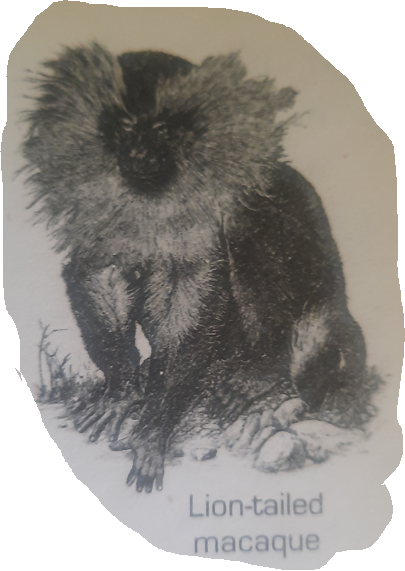
Lion-tailed Macaque. Illustration: CEE
It is home to about a 1000 species of flowering plants, 107 species of orchids, 100 ferns, 200 liverworts, 75 lichens and about 200 algae, many of them endemic to the area. It counts 34 species of mammals, 292 species of birds, 31 species of reptiles, 22 species of amphibians, 13 of fishes, 500 of butterflies and moths, besides a multitude of other orders of animal life (keralatravels.com). And these are only the species documented! The valley’s flagship species is the lion-tailed macaque, a species endemic to the Western Ghats.
Many are the myths and legends associated with this forest. It is said that the Pandavas, during their peregrinations after they lost their kingdom to the Kauravas, happened to come to this forest. So enchanted were they that they decided to make it their temporary home. The river that runs through the forest is called Kuntipuzha, in memory of their mother, and the forest itself was called Sairandhari, this being another name for Draupadi.
In 1847, the Englishman Robert Wright came upon the thick forest. He or his colleagues named it Silent Valley. There are several theories about why this name was given. It could of course be an Anglicization of Sairandhari, the traditional name. Or it could be because there are no cicadas in this forest. The constant hum in most forests is due to cicadas, and the absence of this noise can be quite stark. Cicadas do not thrive in wet climate, and that is why they are not common here. Yet another theory is that the British gave it this name due to the presence of the rare lion-tailed macaque whose Latin name is Macaca silenus. But in spite of its name, the Silent Valley resounds to the cadences of the river, bird-calls, monkey-whoops, and insect chirrups.
Silent Valley burst into the national consciousness in the 1970s, when the Kerala Government proposed to construct a dam on River Kuntiphuzha, to generate electricity for the State’s growing needs. When scientists and environmentalists came to know about this, they were very concerned, as it would mean that the Silent Valley would be flooded, and that would be the end of that very special habitat and the unique flora and fauna there.
Kerala Sastra Sahitya Parshat (KSSP), a people’s science movement, took up the cause. On the one hand they did techno-economic and socio-political studies to show the impact of the project, and its pros and cons. On the other hand, they mobilized public opinion, and garnered the support of eminent scientists and people. They also came up with alternatives to building the dam e.g., building a series of small dams, rather than one large one.
It was a long and hard battle. It became a bitter war between the State which wanted the project, and the people who did not. The Centre through the course of the controversy saw many changes, and some of the PMs were for and others against the project. Each set up Committees of scientists. Media was also ranged on the two sides, beginning with local media predominantly in favour of the project, and then slowly veering against it. For a long time, national media paid little attention to the issue, but later weighed in favour of the environment. International environmental organizations also came into the fray. The matter went to court to—with the High Court at some stage giving the go-ahead.
It was when Mrs. Indira Gandhi came back as PM that it began to look as if the conservation movement would win. In 1981, she declared Silent Valley a protected area. But it was found that the hydroelectric dam was not covered in the area under protection. Protests began anew, till finally the project was scrapped in 1983. In 1984, Mrs. Gandhi declared it a National Park—the highest level of protection that can be given. And Silent Valley was saved!
Kerala government has recently decided to declare the buffer zone of Silent Valley National Park as a wildlife sanctuary—the Bhavani Wildlife Sanctuary spread across 148 square km. So hopefully, Silent Valley continues to remain safe!
Hats off to the scientists, environmentalists, poets, artists, students, NGOs , media, politicians and the common people who fought the long and hard battle to preserve our common heritage.
There are other such success stories, but sadly not very many. And even more sadly, hardly any in recent times.
This week several of my friends shared their fond remembrances of Prof MK Prasad. For us at CEE, MKP was the mentor with the twinkle in his eye and a gentle rebuke or prodding, even as he solicitously asked about our families, and encouraged us in our work as environmental educators.
Professor MK Prasad was a rare combination of utmost humility and simplicity with the mind of a brilliant academic, a fighter’s spirit, a scientist’s rigour, a leader’s passion, a prolific writer, and a relentless campaigner for the environment. As one newspaper article mentioned ‘activism and writing are not always identical. The activist has to be amidst people organising and motivating them while garnering available scientific facts. A writer has to confine himself to his study for long hours to research, read, think and write.’ Prof MK Prasad, like some of his other fellow members of the Kerala Sasthra Sahithya Parishad (KSSP) beautifully combined activism and writing. This was also a unique characteristic of the Save the Silent Valley Movement that Meena described—the coming together of poets, writers, activists and citizens for an environmental issue.
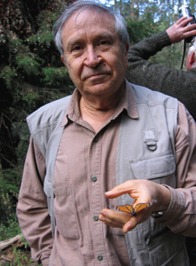
There is perhaps one other similar story that echoes this movement. The story of Homero Aridjis, a Mexican poet, novelist, activist, and diplomat, and founder of the Group of 100 a group of intellectuals and artists who united to tackle and environmental issues in Mexico, and raise awareness of environmental issues internationally.
Homero Aridjis was born in 1940, and grew up in the Mexican state of Michoacán near the area where Monarch butterflies gather for the winter. He recalled how as a child he saw Monarch butterflies flying across his village every winter. There was also his annual school excursion to the sanctuaries in the nearby mountains to see the butterflies. On these excursions he also saw that the mountains were being deforested with the connivance of politicians, loggers and local farmers who were cutting down the oyamel fir trees where the Monarchs roosted. Since then the young Homero became concerned that this would mean the loss also of the Monarch butterflies as the forests were their habitat. The Monarch butterfly, a fragile insect that flew thousands of miles from Canada to Mexico every winter sparked the poet in him, and he wrote many poems about butterflies. The butterfly also became, to him, a symbol of the environment. As he explained: I love poetry and the environment for me is the poetry of life. I can’t be living now in a world without poetry or be a member of humanity without feeling the poetry of human beings.
As he grew older, and embarked upon a career in the Diplomatic Service, being posted as his country’s envoy to several European countries, Homero’s passion for the environment was also growing. One day in 1985 he read a letter sent by a philosopher friend to a local newspaper. He felt that a single small voice of dissent would not make a difference, but he thought that if the writers and artists of Mexico joined together to make a strong statement, they would perhaps stand a chance of being heard. A few weeks later, on 1 March 1985, a fierce critique of the environmental havoc amidst which we live was signed by 100 leading personalities in the arts, literature, culture and science in Mexico.
The statement was published in the national and international media. Thus was born The Grupo de los Cien — the Group of 100 which took up the cause to reverse ecological damage and environmental degradation in Mexico, raising awareness about the threats to many species and habitats and campaigning to ensure the continuance of Mexico’s rich biological diversity.
Due to public pressure the President of Mexico in 1986, declared the habitat of the Monarch butterfly and five other sanctuaries as ‘protected’. But illegal logging and other destructive activities continued in the forests. Homero took up his pen as a weapon and wrote many articles in the newspapers and many petitions to draw attention to this. His diplomatic posting as an ambassador to UNESCO helped him to take the battle to an international stage. Before he left UNESCO, the committee of the natural heritage approved the monarch butterfly sanctuaries as protected Natural Heritage of Humanity.
The Group of 100 continued to take up critical issues that that threatened the delicate balance between environment and development. They campaigned to seek protection for the beaches where sea turtles laid their eggs, and that resulted in ending the commercial killing of sea turtles in Mexico. In 1995 they launched a fierce fight against a planned industrial salt plant that would have had catastrophic impacts on the lagoons where gray whales came to give birth as well as the surrounding environment and local communities. It took five years of battles before the plant was cancelled. Homero bore the brunt of the hostility from vested interests and even received death threats. The Group of 100 remains active to this day, fighting the same battles, with the same undiminished spirit.
As Homero Aridjis put it: You have to have a commitment and a conviction to defend the environment even if you know that the forces of destruction are very big. You have governments, you have corporations, you have individuals, you have criminals, you have many people against nature. That is very difficult but you as a human being and a person with an environmental conscience you have to do everything you can, always in peaceful ways and in legal ways, to defend the environment. You have to defend the things you love.
MK Prasad and Homero Aridjis two warriors who fought with pen as well as sword.
For those of us who started working on environment-related issues in the ‘80s, ‘Silent Valley’ was one of the success stories which was held up to us as an example of how arguments based on good science, people’s power, and unrelenting campaigning could save the world. Or some part of it.
For those who have forgotten what this was about, hydroelectric dams were proposed on the River Kunthipuzha, which would have involved the submergence of the forests of Silent Valley, a biodiversity rich habitat, home to many, many unique species of flora and fauna, including the rare and unique lion-tailed macaque which is endemic to the Western Ghats.
Kerala Sasthra Sahithya Parishad (KSSP), a people’s science movement, led the campaign against the project under the leadership of Prof. MK Prasad. They published well researched techno-economic and socio-political assessment reports of the proposed project. The campaign by KSSP evoked a huge response from citizens at large, as well as eminent scientists and environmentalists like Romulus Whitaker of the Madras Snake Park, Dr. Salim Ali (who was probably the first to flag the issue), Dr. MS Swaminathan etc. The renowned poet Sugathakumari was at the forefront of the movement, and her poem “Marathinu Stuthi” (“Ode to a Tree”), was a rallying call for the people.
In an early and unique victory for the environmental movement in India, the then-PM, Mrs. Indira Gandhi finally weighed in, and the project was halted. Subsequently, the area was declared a National Park.
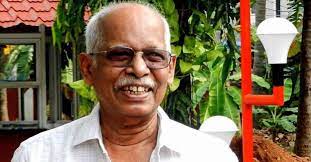
Prof MK Prasad
The story is one of the amazing dedication and hard work of a large number of people. But Prof. MK Prasad’s was a symbol of the movement. Prof MKP as he was fondly referred to, was a botanist who spent his life in academics. He taught botany, was Principal of Maharaja’s College, Eranakulam, and Pro-Vice Chancellor, Calicut University.
But he was not confined to classrooms, and believed passionately in taking science to the people. He was an environmental and science activist all his life, and a founding member of KSSP. His distinction as a scientist supported his environmental activism, which no one could dismiss as woolly-headed.
He was a member of the Governing Council of Centre for Environment Education for many decades and we at CEE were fortunate to have him as a teacher, guide, and mentor. Never for him the exalted distance of a Board Member. He was always interested in the minutest details of our projects and lives, and was happy to spend any length of time chatting with us. Prof Prasad passed away last week due to COVID. Here are a few poignant memories which bring him to life.
Prof Prasad, my mentor and a dear friend. It seems a little presumptuous to call this stalwart my friend, but as unassuming as he was, he truly was that. I’d scold him when he sat next to me during the Governing Board meetings, when lesser mortals like us were let in, because he would chatter away irreverently while serious matters were being discussed. He guided me through the challenge of trying to break into the ivory towers of higher education, and when things didn’t work, he’d say our efforts were “before their time”. That, always accompanied by his naughty smile, had become his code word. He also treated me as his unofficial research assistant, which I enjoyed. He would call to ask me to find out about things that often I knew nothing about, and it was always great learning. Will miss you, Sir!
Kiran Chhokar.
When I think of Prof Prasad, I can see him walking down the corridors of ASCI where we held our Steering Committee meetings in Hyderabad. As always, he is dressed in a half-sleeved shirt, has no smile on his face – but his kind, sharp eyes are twinkling! I am immensely grateful for all his advice and guidance to the school environmental education project. But more importantly, I feel blessed to have spent some time with such a stalwart. His greatness and his humble demeanour co-existed so well!
Something I found remarkable in him and so distinct from my generation is that he always gave a considered, detailed response to every request for advice. He never rushed to give an immediate response. Sometimes, he would respond the next day – probably after mulling over the issue.
On one of his first visits to ASCI, I told him that there was a National Park (the KBR National Park) close by and he could probably take a stroll there in the evening. When I met him the next morning, he gave me a gentle, but proper scolding about my recommendation. I learnt my lesson – one does not present KBR as a ‘National Park’ to the person who saved the Silent Valley National Park!
Kalyani Kandula
While I was working at the Centre for Environment Education (CEE), Ahmedabad, I had the good fortune of knowing Professor Prasad. I have known him for many years now. At Governing Council meetings held at CEE often I would sit next to him and would be very inspired by his valuable suggestions, critical comments and review of many projects CEE was handling. He would not mince his words. A gentle soul, very down to earth and a great inspiration to many. Professor Prasad in fact attended my sister’s wedding in Kerala. My father Dr.S.M.Nair and Professor Prasad shared a great professional and personal bond.
Meena Nair
Some weeks after CEE’s office in Pune was started, Prof MKP dropped by. He was in Pune for some other work. Though it was a single person office and I a relatively junior staff member, Prof MKP was interested to see how I was settling in and getting on. When I told him that Amma (my mother in law) would have been happy to meet him, considering his association with KSSP, he just said that he would be happy to come over for coffee. So we did that, and Amma (and I) was very touched by the gesture. Later Prof Prasad and I went to meet Prof Pisharoty and I just felt blessed to listen to their conversation.
Sanskriti Menon
For me, he was the quintessential story teller. We would invite him to come and speak in various training programmes we organized—those for Forest Officers, for Environmental Educators from around South and Southeast Asia, for NGOs, for school and college teachers. Of course his sessions had to be around the Silent Valley Campaign. I must have sat through his sessions a dozen times if not more. But the passion, involvement and detail with which he told the story of the campaign inspired not only every new batch of trainees who had never heard it before, but equally, us the organizers who had heard it and read about it and discussed it ad-infinite. Such was the power of his passionate storytelling! And not just the Silent Valley–he had done so many interesting things, met so many interesting people, been so many interesting places–he could keep an audience engaged for hours!
Thank you Sir, for inspiring us. We are comforted by the knowledge that you are looking down at us with a twinkle in your eye!
Last week was Sankranti and all eyes were turned to the skies as the colourful kites soared and dipped, drifted and sailed with the breeze. Also in the sky were the avian kites, riding the thermals. From time immemorial, humans have gazed up and dreamed of soaring the skies too. The same week there was a news item about a young Belgian-British teenager who flew her single-seater Shark ultralight plane around the world in 150 days. 19 year old Zara Rutherford thus became the youngest woman to circumnavigate the world solo. One of the objectives of her mission, she says was to infuse young women and girls worldwide with the spirit of aviation.
In the day and age when women are soaring high in all spheres, it is interesting that she feels that more women need to take to the skies. And even more interesting that India has a fair share of women, who have made their dreams of flying come true, not only today, but almost hundred years ago.
Google Doodle honouring Sarla Thukral on her 107th birthday on 8 August 2021
Sarla Thukral was the first Indian woman to fly an aircraft. Born in 1914 in Delhi, she later moved to Lahore, in what was then British India. At the age of 16 she married an airmail pilot PD Sharma who came from a family of fliers. The young bride was also smitten by the aviation bug, and encouraged by her husband, she started flying lessons. Having completed 1000 hours of flying time she earned her flying license, and did her first solo flight in a Gypsy Moth, a small, double winged plane at the age of 21, dressed in a sari. She was preparing to become a commercial pilot but the Second World War broke out, and civil aviation training was suspended. Tragically, around the same time she also lost her husband in an air crash. Sarla was grounded, but not her creativity. She took up with equal passion her love for the arts. She started studying fine arts and painting at Lahore’s Mayo School of Arts. She returned to Delhi after Partition, where she continued to paint. She married RP Thakral in 1948. She also started designing jewellery and clothes and set up a successful business which she ran till she passed away in 2008.
Sarla—high flier, in the sky and on the ground! And an inspiration for many young girls in India who have over the years taken to the skies.
One of the concerns expressed by young Zara is that there is still a big gender gap in the field of aviation in many western countries. Globally, according to the International Society of Women Airline Pilots, around 5 percent of pilots are women. In India, the share of women pilots is significantly higher – at over 15 percent, more than twice as high as in most Western countries, including the United States and Australia. According to one report India has a total of 17,726 registered pilots out of which the number of women pilots is 2,764.
We have, in the last few years, always experienced a surge of pride when we hear a woman’s voice introducing herself as the pilot on a commercial flight. Even more uplifting is the increasing number of women who are flying shoulder-to-shoulder with men in the armed forces.
Women pilots have been flying transport aircraft and helicopters in the three Forces for a long time. As far back as 1994, when many people had reservations about allowing women pilots in the Indian Air Force, Gunjan Saxena, along with Srividya Rajan, defied convention, and took up the challenge; they were two of the 25 young women to form the first batch of women IAF trainee pilots. The Kargil War of 1999 was a real test of the true grit of these women. They fearlessly flew helicopters in the combat zone, and into hostile territory to drop supplies, evacuate injured soldiers and spy on enemy positions. Gunjan and Srividya’s contribution in this critical war effort was highly commended, and an inspiration for many young women who dreamed of a career in uniform.
In October 2015, the Indian Air Force opened the fighter pilot stream to women. The first three female pilots to be inducted in the fighter squadron in June 2016 were Avani Chaturvedi, Bhawana Kanth and Mohana Singh. These young women, were fuelled by the sense of adventure as well as the spark of contributing to the defence of our country.
Today the Indian Air Force has 111 women pilots who fly transport planes and choppers, and 10 women fighter pilots.
As Bhawana Kanth said “It is not the right time for it now, it has always been the right time for women to become fighter pilots.”
Last year Flight Lieutenant Bhawana Kanth on 26 January 2021, became the first woman fighter pilot to be take part in the Indian Air Force’s (IAF’s) tableau at the Republic Day parade at Delhi’s Rajpath.
This year, as we mark the many strides forward that our Republic has made, and salute with pride the accomplishments of its citizens, let us put our hands together for all the young women who dare to dream, and who make their dreams come true. Soar high, sisters and daughters, and may even the skies not be your limit.
The Thyagaraja Aradhana held at Thiruvayaru, Tamilnadu, must be one of the most unique, participatory and joyous ways to celebrate the life and music of a great composer. The aradhana is held every year on the anniversary of the passing away of Saint Thyagaraja, and falls on 22nd January this year.
Saint Thyagaraja (1767-1847), one of the Trinity of Carnatic Music, is thought to have composed about 25,000 songs, apart from two musical dramas, the Prahalada Bhakti Vijayam and the Nauka Charitam. However, since the Saint hardly kept any record of his compositions, it is not clear how many songs he did actually compose. Only about 700 are known to us today—thanks not only to the lack of record keeping, but also vagaries of time, natural disasters, etc., which obviously were not kind to the palm leaf notes that his disciples kept.
Thyagaraja was completely immersed in bhakti, in his worship of Lord Rama. It is said that the King of Thanjavur, having heard of Thyagaraja’s musical genius, sent him an invitation to attend his court. The Saint not only rejected the invitation, but composed the song Nidhi Chala Sukhama (Does wealth bring happiness?) in response!
Coming back to the fascinating history of the Aradhana. Thyagaraja died in 1847 after renouncing the world and taking sanyas. His mortal remains were buried on the banks of the Kaveri. A small monument was built there, but soon felt into neglect. In 1903, two of his disciplines Umayalpuram Krishna Bhagavatar and Sundara Bhagavata, now eminent musicians, made a nostalgia trip to Thirivayaru. They were appalled at the neglect of the memorial, and decided to commemorate the death anniversary of their Guru at the site, so that he could be remembered appropriately, and the Samadhi maintained.
The next year 1904, was when the Aradhana started. In 1905, it became a lavish affair with days of worship, dozens of performances by top-notch artistes, and feeding of the poor etc. While Krishna Bhagavatar and Sundara Bhagavatar were the moving spirits behind the festival, they obviously needed practical men with money and organizing power to see the event through. The brothers Tillaisthanam Narasimha Bhagavatar and Tillaisthanam Panju Bhagavatar stepped in to play these roles. However, the moneyed brothers soon developed disagreements, and by 1906 had formed rival factions which each conducted its own Aradhana! In time, a compromise was reached under which the group following the younger brother began its festival five days before the day of the Aradhana and culminated its celebrations on the day of the Aradhana, while the other group started on the Aradhana day, and went on for four days after.
The factions did dissolve their differences at some point and unite. Whether as two groups or united, one thing brought them together. Their opposition to women to perform at the Aradhana. At that time, most women who performed in public were devadasis, and the keepers of morality decided they could not have them perform at such a venerable occasion.
Bangalore Nagarathnamma was one of the pre-eminent musicians of the time. She had earned name and fame as a highly gifted artiste. She was a great devotee of Thyagaraja, and felt she owed everything to him—after all, it was renditions of his songs that predominated her concerts and had brought her so much. However, as a woman, she was barred from participating in the Aradhana.
In 1921, Naratahnamma decided that she would dedicate her large wealth to preserving the Saint’s legacy. She bought land around the Samadhi and built up a temple over it. She had an idol of Thygaraja made and installed in front. The temple was consecrated in 1926.
The organizing group of the Aradhana was happy to let her do all this at her own expense. But when it came to performing at the Aradhana, they would not let her. The redoubtable Nagaratnamma decided to start her own Aradhana, which took place at the rear of the temple.This edition featured many women artists and became increasingly popular. She also went to court against the original organizing groups, saying they could not enter the temple because it was hers. While she lost the case, the court designated specific hours of the Aradhana day to her group, and the two other groups.
This was when a bureaucrat stepped in, and for once solved a problem! SY Krishnaswami, ICS, convinced the groups to unite, and in 1941 three rival events merged into one. And an important victory was won—women became part of the festival.
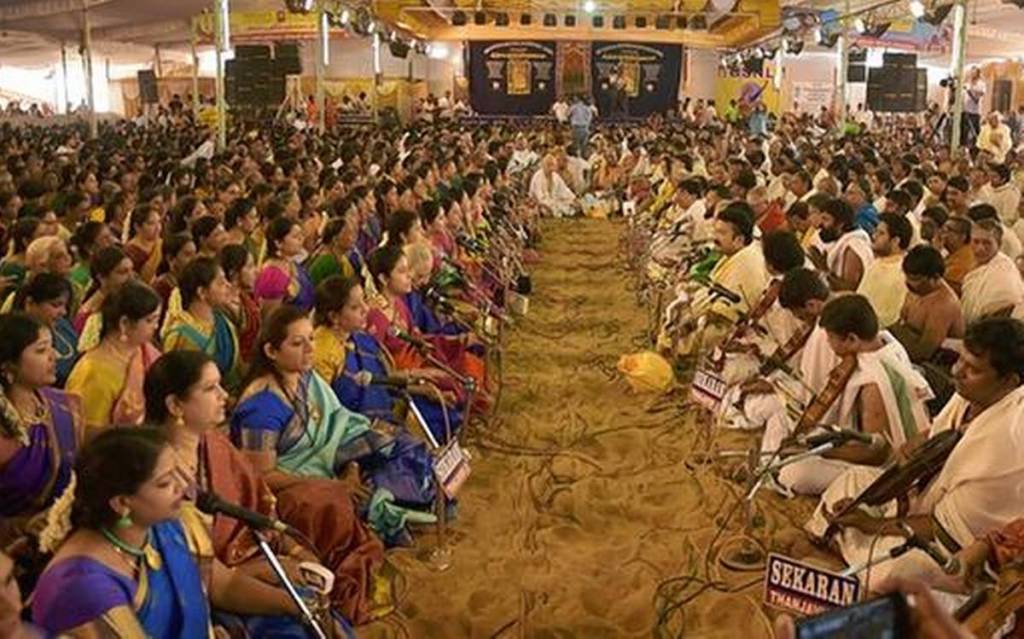
It was also in this year that the practice of singing the five pancharatnas of Thyagaraja as a group-rendering began. This is now the unique feature of the celebration. Five of the Saint’s compositions that were best suited to group singing were selected, so that all artistes could pay their homage to the Saint, unitedly. A goose-bumping raising experience to see hundreds of people singing together, without any visible coordination.
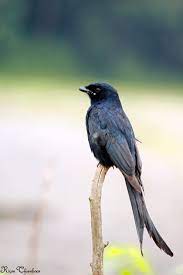
Erect and majestic, against the clear blue January sky, sits the bird. It is imperious in its mien, the king of all that it surveys, from its perch on the branch of the drumstick tree. Its glossy black feathers lengthen into a long forked tail, like the regalia of a king. No wonder it carries the moniker of King Crow. But it is not related to the crow family.
Drongo
This is the Black Drongo. It belongs to a distinct family the Dicrurus. Its scientificname is Dicrurus macrocercus. Dicrurus is derived from the Greek words dikros meaning forked, and ouros meaning tailed; macrosersus is from the Greek makrokerkos, where makros means long and kerkos means tail. It is this forked tail that is the distinctive feature of this bird. The body of the drongo is small (bulbul sized) while the tail is relatively long, giving it a graceful and regal appearance, not only when it is perched, but also when it flies with an undulating wave-like movement, alternating the flapping of wings, and gliding smoothly with wings held still.
The Black Drongo can be seen in open areas—farmlands, grasslands, fields and even urban pockets, usually perched on poles and wires, or tree branches. These are favoured as they are good look outs for spotting prey. The Drongo is primarily an insect eater, on the alert for bees, butterflies, dragonflies, grasshoppers, cicadas, termites, moths and ants. The insects are snatched from the air with daring aerial displays—shooting up like an arrow, zooming down like a rocket, veering sharply to change direction—which are a delight to watch. Once caught, the prey is carried off by the Drongo, who with deft manoeuvres, clamps its catch under foot, and tears it to pieces before swallowing it.
Drongos are also smart enough to avail of more easily available meals by being around when fields are being ploughed, or stubble is being burned, so as to feast on all the insects that are disturbed by this. They also hitch a ride on the back of grazing cattle, with the same purpose of feasting on the insects that fly up in the wake of the walking cattle. Thus Drongos help to control many agricultural pests, making them important biological pest-control agents, earning them the name ‘farmers’ friends’.
The Drongo is not just agile in its movements, it has a versatile repertoire of calls—from harsh scolding calls to a range of sweet whistles. It is also a clever mimic, imitating the calls of other birds, so as to use this to its advantage in different ways. It can imitate sounds that make a flock of diverse birds believe that they are from the same flock; it will raise an alarm call that will cause others to abandon their food and flee, leaving the rest for the Drongo. It is said that the Drongo perfectly mimics the call of a shikra which scares birds like mynas who fly away in panic, leaving the takings for the Drongo.
Despite its small size this bird is fearless, and can be aggressive, taking on larger species that may venture into its nesting territory. It is especially vigilant about keeping out crows who may poach their eggs. Thus being given the appropriate name of Kotwal or sentry in Hindi. The smaller birds take advantage of this vigil by also nesting safely in the ‘sphere of influence’ of this gutsy gatekeeper.
The battle for supremacy between the freeloading crow and the feisty bird was vividly described by British civil servant and naturalist Edward Hamilton Aitken in his book The Common Birds of Bombay published in 1900.
“Its (Drongo’s) aim is true and its beak is sharp and its target is the back of the lawbreaker. The Crow is big enough to carry off its puny enemy and pick its bones, if it could catch it, but who can fight against a ‘bolt from the blue’? The first onset may, perhaps, be dodged, but the nimble bird wheels and rises and plunges again with derisive screams, again and again piling pain and humiliation on the abject fugitive till it has gone far beyond the forbidden limits. Then the King sails slowly back to its tree and resumes its undisputed reign.”
Little wonder then, that this bird, though no relative of the Common Crow, has earned the sobriquet King Crow.
This agile and spunky little bird is equally celebrated for its cleverness. It displays these traits in a number of folk tales from different cultures and geographies—from South Africa to Australia to North East India.
Here is one from the Shangani tribe of Zimbabwe.
A long time ago, the birds decided to choose a leader. A call was sent to all birds to attend a meeting to determine the same. When he heard this, Pau the Ostrich was confident that being the largest bird, he would get this title. Gama the Eagle was equally sure that he was entitled to this, being the bird that could fly highest. The little birds also decided to compete. Thus birds of every shape, size and colour arrived at the meeting. The elders had a long and argumentative discussion to fix the criteria for selection. Finally they agreed that the bird who could stay in the air the longest would be designated as leader.
Pau the ostrich, who could not even fly, stalked out in protest at this criterion. Many smaller birds who knew the limits of their ability and endurance dropped out, knowing that they could not match the powerful fliers. But Matengwane, the fork-tailed drongo, did not throw in the towel immediately, and quietly planned his strategy. The next morning when the big birds set off flying on their course, drongo lightly settled on the back of Gama the high flying eagle, and hid amongst its feathers. As the race went on, more and more birds began to drop out from exhaustion, until finally it was only Gama soaring in the sky. The confident eagle descended, and landed to cheers. Just as the elders were about to crown Gama as the leader, they noticed that there was still one bird flying in the sky— Matengwane the drongo! The clever hitchhiker had detached himself from his ride, just as Gama was landing, and remained the sole winged creature in the sky. And thus was the Drongo declared the leader of the birds!





 Millennial Matriarchs