Some memories come back vividly when there is a trigger. Sadly, the trigger for this memory was a newspaper item reporting an accident involving a Sepak Takraw team.
But the memory itself is joyful. A trip to Burma, about fifteen years ago. It was a warm afternoon in Yangon. The tea stalls were buzzing, the pagodas gleamed in the sun, and somewhere between wandering and people-watching, I found myself drawn to a small patch of open ground near a quiet lane.
A group of young boys were playing a game I had never seen before. A boy leapt into the air, spun like a dancer mid-flight, and kicked a small rattan ball clean. I stood completely still, mesmerized. It was my first encounter with Sepak Takraw. We stood and watched for quite a while—the grace, the athleticism, the sheer joy of the players—was something amazing to watch. Fortunately on the way out, I found a Sepak Takraw at the airport and bought it.
All these years later, that moment still shines brightly in memory. Because Sepak Takraw is not a sport you easily forget.
For many of us in our generation, our playground sports were familiar—gully cricket, kho-kho, maybe a weekly volleyball session if your school had both a net and enough motivation to set it up. But Sepak Takraw feels like someone took volleyball, infused it with martial arts, added the grace of classical dance, and sprinkled it with sheer joy.
In the lanes of Myanmar, Malaysia, Thailand, and Indonesia, this sport has lived for centuries. Its early form, sepak raga, simply meant “kick the rattan ball.” Communities played in circles, keeping the woven ball aloft with feet, knees, heads—much like our own childhood attempts to keep a rubber ball bouncing on our legs, but infinitely more skillful.
Over time, the game evolved. Nets were added, rules refined, teams formed. What remained unchanged was the heart of the sport—rhythm, teamwork, and an almost balletic coordination.
What struck me in that first encounter in Burma was the joy. There was no crowd, no scoreboard, just a group of boys pushing the limits of their bodies, laughing, teasing, showing off impossible kicks.
Since then, as videos of Sepak Takraw swirl across the internet, the world has begun to share in that delight. Watching professionals play is like watching physics bend slightly. The killer kick—a full somersault that sends the ball crashing down at an angle—feels like something from a choreographed stage performance. The teamwork is intuitive, almost telepathic.
Interestingly, Sepak Takraw has been creeping into India’s sporting landscape too, especially in the Northeast. Manipur in particular has embraced it with enthusiasm, with players who train tirelessly and compete internationally. Perhaps some Indian traveller today will see a game in Imphal or Aizawl and feel the same quiet awe I felt in Yangon all those years ago.
Today the game is played at international level, and has entered the AsianGames. Efforts are on to get it into the Olympic list.
But for me, it is the memory of that afternoon in Burma—the dusty field, the laughter of boys, the swift arc of a rattan ball against the sky. It is a reminder of how sport, in its purest form, connects us across borders and time.
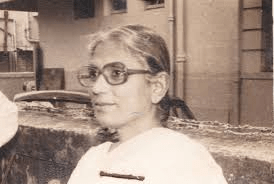
12 November marks the birthday of Salim Ali the Birdman of India. Much has been written and published by, and about, Salim Ali. However very little is known about a young woman who was recognized as the first Bird Woman of India by Salim Ali himself. This was Jamal Ara, a path breaker in more ways than one.
Jamal Ara was born in 1923 in Barh, Bihar, in a conservative Muslim family. She could study only until class ten before she was married off at a young age, much against her wishes. She moved to Calcutta with her husband where a daughter, Madhuca, was born. Sadly her marriage broke down, leaving her in dire straits. Fortunately a cousin who was in the Forest Service in Bihar, came to her aid and Jamal and her daughter moved to Ranchi. As a forest officer, her cousin was posted to different forest divisions of Bihar, and Jamal often accompanied him on his trips. This sparked in her a great love for wildlife, and Jamal would spend hours observing the flora and fauna in her surroundings. The English wife of a senior forest officer encouraged her to keep notes of her observations, and helped her to hone her writing skills. As her proficiency grew, they also encouraged her to turn her notes into articles and send them for publication.
Jamal Ara spent many years doing extensive field work in what is now Jharkhand, and her study of birds in the Chota Nagpur plateau was comprehensive and detailed. She meticulously documented her observations, and wrote prolifically from 1949 to 1988. She contributed over 60 papers and articles to the journals of the Bombay Natural History Society and Bengal Natural History Society. She could communicate equally well with a lay audience. She wrote for The Newsletter for Birdwatchers, which was popular with amateur as well as seasoned birdwatchers, and also a book for children, Watching Birds which was published by National Book Trust, and translated into many Indian languages. I remember this book as being one of my own early introductions to nature study.
Jamal Ara was a multi-faceted writer. She wrote fiction, translated stories, and worked as a journalist for a short time. She also did programmes for All India Radio. Jamal Ara was also much more than a birdwatcher. She saw birds as an integral part of a healthy ecosystem, and advocated for a balanced conservation approach, something that was not common in an age when shikar was also a popular pastime.
After such an intense involvement in ornithology, and a prolific contribution to the field, in 1988, Jamal Ara suddenly vanished from the Indian ornithology scene. Her contributions stopped, and she herself disappeared. It is believed that a series of personal losses and setbacks affected her badly. She stopped writing, and after a few years also burnt her notes and photographs. She died in 1995.
Gradually Jamal Ara’s name and contributions sunk into oblivion. She would have been lost to the history of Indian conservation if not for a young researcher Raza Kazmi, who stumbled upon a story by Madhuca Singh, a celebrated basketball coach of Ranchi who mentioned Jamal Ara, her mother, who was a great bird lover. Raza Kazmi was intrigued by this mysterious bird lover, and embarked on a search for this woman and her work. After chasing numerous leads, he finally connected with Madhuca who shared her mother’s story.
It is thanks to Raza Kazmi’s single-minded pursuit, and the publication of Jamal Ara’s story in the book Women in the Wild edited by Anita Mani published in 2023, that we can join in celebrating this enigmatic, but brilliant bird woman of India.
It is also heartening that whatever had remained of Jamal Ara’s original work has been collected and digitized as part of the Archives at NCBS, a public centre for the history of science in contemporary India. The Jamal Ara Collection has archival papers relating to her life and work from 1940s to 1980s, including correspondence, unpublished manuscripts, field diaries and notebooks, and drafts of articles.
This week, as we celebrate Salim Ali, as well as Jamal Ara, both passionate bird watchers, here are a few words from them that remind us of the simple joys of bird watching.
”A bird’s song is a sound that touches the soul; it reminds us of the beauty of nature that we must protect. For me, birds have always been the greatest source of joy and inspiration.” Salim Ali
“Even if you are not a birdwatcher and are not even faintly interested in them you cannot barricade yourself successfully against fugitive but striking impressions that the sight of a bird invariably leaves. The impression is not altogether fleeting although the sight may have been. It persists in memory. Colour, song, manner of flight, the build or some aspect of physiognomy may have thrust itself into your consciousness and nestles there pleasantly. That is why there is no person entirely uninterested in birds. Most persons are unattentive but a few helps to their stored memories and they start taking an interest in birds. They become attentive and surprise themselves by evolving into birdwatchers.” Jamal Ara
Have you ever sat through a meeting where someone confidently proclaimed an idea that made you wonder if you were the only one who found it… well, questionable? Or listened to a neighbour explaining, with great authority, how to “fix the economy” or “end corruption,” in the time it takes for the traffic light to change?
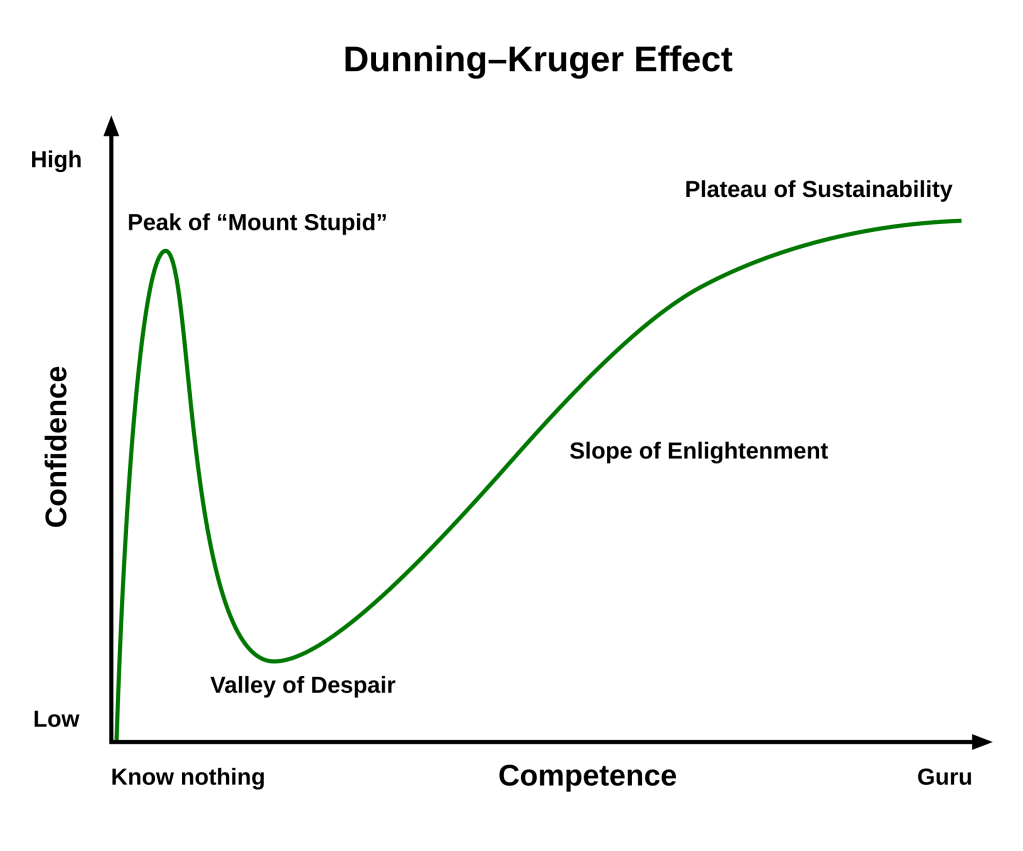
Chances are, you’ve witnessed the Dunning–Kruger Effect in action — that quirk of human psychology where people with limited knowledge or skill in an area tend to overestimate their competence. Ironically, the more ignorant we are about something, the more certain we can feel about our opinions.
The term comes from two psychologists, David Dunning and Justin Kruger, who in 1999 published a study with the rather unexciting title “Unskilled and Unaware of It.” They were intrigued by a bizarre news story about a man who robbed banks after rubbing lemon juice on his face, believing it would make him invisible to security cameras. The man wasn’t joking — he genuinely thought he had found a clever loophole. Dunning and Kruger wondered how someone could be so wrong and yet so sure.
Their research showed that people who perform poorly on tests of logic, grammar, or humour not only make more mistakes — they also lack the skill to recognise those mistakes. In contrast, the truly competent often underestimate themselves, assuming that if something is easy for them, it must be easy for everyone.
So we end up with a world divided between the confidently incompetent and the competently cautious.
If this sounds like a comment on social media, well……. Platforms like X (formerly Twitter) and Instagram stories are veritable festivals of the Dunning–Kruger Effect — where the loudest voices are often the least informed. Whether it’s miracle diets, “instant wealth” advice, or armchair experts diagnosing global issues, confidence is never in short supply. Accuracy, on the other hand, might need a search party.
But before we roll our eyes at others, it’s worth pausing. The uncomfortable truth is that we’ve all been there. Remember that time you confidently assembled a piece of IKEA furniture without reading the instructions — and then found one mysterious screw left over? Or when you tried to give a five-minute explanation of blockchain to someone who actually works in finance? Yes, that too is Dunning–Kruger territory.
What makes this effect particularly sneaky is that it feeds on self-assurance. It feels good to be certain. Admitting “I don’t know” can feel like weakness. Yet, as Socrates famously said, “The only true wisdom is in knowing you know nothing.” In other words, humility is intelligence in disguise.
The flip side of the effect is equally interesting. Those who genuinely know their stuff often hesitate to speak up. They second-guess themselves, feel like impostors, and worry that they might be wrong. This is where the Impostor Syndrome meets the Dunning–Kruger Effect — a perfect psychological storm that ensures the least qualified sometimes take charge, while the best-qualified stay silent.
So how do we guard against it? A few simple habits can help:
Ask questions. Even if you think you know. Especially if you think you know.
Seek feedback. It’s not always pleasant, but it’s the antidote to self-deception.
Stay curious. The more you learn, the more you realise how much there is to learn.
Listen before leaping. Sometimes the quietest voices in the room hold the deepest insight.
The Dunning–Kruger Effect may make for amusing anecdotes, but it also reminds us to pair confidence with curiosity. As we navigate workplaces, communities, and conversations — maybe even family and friends WhatsApp groups— it helps to remember that certainty is not the same as wisdom.
In the end, perhaps the best safeguard against foolish confidence is a dose of humble awareness — and a willingness to laugh at ourselves when we realise, as we often do, that we didn’t know as much as we thought.
This week Meena wrote about Bungaree the first Aboriginal man to circumvent the continent of Australia. His feat was amazing not only because he was the first to undertake the journey but also because he was from an indigenous tribe, in an era when sailors and adventurers were white men. Bungaree broke the mold in more ways than one, but always remained in the footnotes of the history of sailing.
There is another group that has been in a similar position in this context—women sailors. According to traditional sailing superstition, it was believed that having women on board ships could anger the Gods and lead to misfortune such as storms and shipwrecks. It was also felt that the presence of women on board would be a distraction to sailors and lead to fights and disruptions. In fact seafaring professions were officially barred to women until the 20th century. But maritime history has its own set of tales about spunky women who rode the waves over the earlier centuries, in many cases disguised as men, but also openly and boldly. The most fascinating of these are some of the women pirates who defied every established norm of the day.
Zheng Yi Sao: Queen of the South China Seas
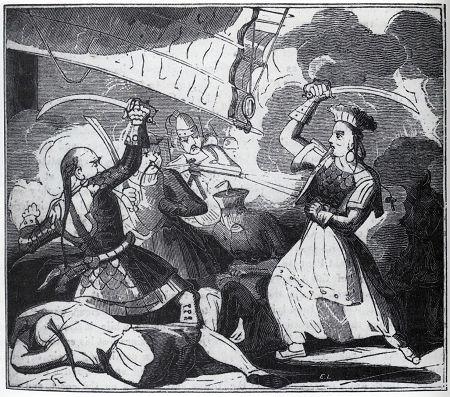
Zheng Yi Sao is described as the most successful female pirate in history. Born in 1775 into humble circumstances, she married the notorious pirate captain Zheng Yi, but on her own terms. She demanded equal partnership in his pirate fleet—an unprecedented and audacious demand. Zheng Yi was agreeable, and she took on the name Zheng Yi Sao (wife of Zheng Yi).
After her husband died when she was 32, Sao took control of his pirate fleet and transformed it into an unstoppable force in the South China Sea. She knew the coastline better than any imperial admiral, using hidden inlets and storm-lashed coves to evade capture. Sao was not just a skilled seafarer, she was a brilliant and brutal administrator. Her fleet was governed by a strict code of conduct:
Loot was divided fairly, with captains receiving a smaller share than their crew to ensure widespread loyalty. Female captives were to be treated with respect, and could only be taken as wives with mutual consent. Rape was punishable by immediate execution. All plundered goods had to be presented for group inspection, all captured goods were registered, and the punishment for disobedience was often beheading. Perhaps her most revolutionary approach was for other women within her fleet. The wives and widows of pirates were encouraged to take on leadership roles, creating an unprecedented situation where women held genuine authority in a violent, male-dominated world.
Zheng Yi Sao reigned supreme with an armada of over 300 ships and a crew of 20,000 to 40,000 pirates. Her fleet successfully defeated the navy of the ruling Qing dynasty, and even the ruling government could not destroy her power. Zheng Yi Sao’s power stemmed not just from ruthlessness and brute force, she was equally a strategic planner and shrewd negotiator. Recognizing that prolonged conflict would eventually erode her power she negotiated a surrender with the government, once again, on her own terms. She secured full amnesty for herself and almost all her crew, the right to keep her accumulated wealth; military positions for many of her top commanders.
Zheng Yi Sao eventually retired with all her loot, and continued to lead a civilian life for the next several decades. However she has gone down in the annals as the most successful pirate of all times.
Sayyida al Hurra: Pirate Queen of the Mediterranean
Sayyida al Hurra was not just a pirate; she was a queen, a refugee, a warrior and a power broker of the 16th century Mediterranean. She was born in 1485 in a family of Andalusian nobles, but forced to flee to Morocco. While in exile there Sayyida rose to become Governor of a vital port city on the North African coast. Once in power, she decided to avenge Spain and Portugal, not through politics or war, but through piracy. She forged a strategic alliance with Barbarossa an Ottoman admiral and pirate, and together they controlled the seas, he in the east and she in the west.
Sayyida was more than a pirate commander; she was also a skilled diplomat and ruler. She negotiated directly with European monarchs, wielding influence usually denied to women of her era. She even married the Sultan of Morocco and insisted the wedding take place in her city, making her the only woman in Islamic history to have married a reigning monarch without leaving her seat of power. Thus Sayyida established rule over both land and sea, a rarity in history.
Laskarina Bouboulina: The Pirate Admiral of Greek Independence
Laskarina Bouboulina was born defiant. Her father was a naval captain and rebel who had been imprisoned by the Ottomans. Laskarina was born in a prison cell in Constantinople in 1771, where her mother had gone to visit her imprisoned husband. After her father’s death Laskarina and her mother moved to the island of Spetses. This was no idyllic Mediterranean village, but a haven for smugglers, sailors and rebels who had fled conventional authority. The young Laskarina grew up among pirates and ship’s captains, learning about the language of the sea and sailing ships even before she could read.
By the time she was 40, Laskarina was married and widowed twice, to powerful ship owners, and inherited their fleets and fortunes. She used these resources not just for commerce but to fight the Ottoman Empire. She became a member of Filiki Eteria a secret organisation plotting to overthrow Ottoman control over Greece. Her main role was to smuggle food, weapons and ammunition into Spetses. She used her wealth to commission the construction of Agammennon, her personal warship, considered to be one of the largest and fastest Greek warships of the revolution. She commanded the rest of her fleet from this warship. Spetses was the first island to revolt against the Ottoman Empire in 1821. Laskarina then led her fleet to begin a naval blockade of the fortified city of Nafpoli, followed by the siege of other cities.
Throughout the battle against the Ottomans, Laskarina conducted her spirited resistance with a mix of strategy, ruthless power and charisma. She was fierce, but an inspiring leader who commanded the respect of the men who willingly joined her battle. Ironically, she was killed in a family feud.
These swashbuckling buccaneers ruled the waves, broke every rule written for women, and rewrote history at sea.
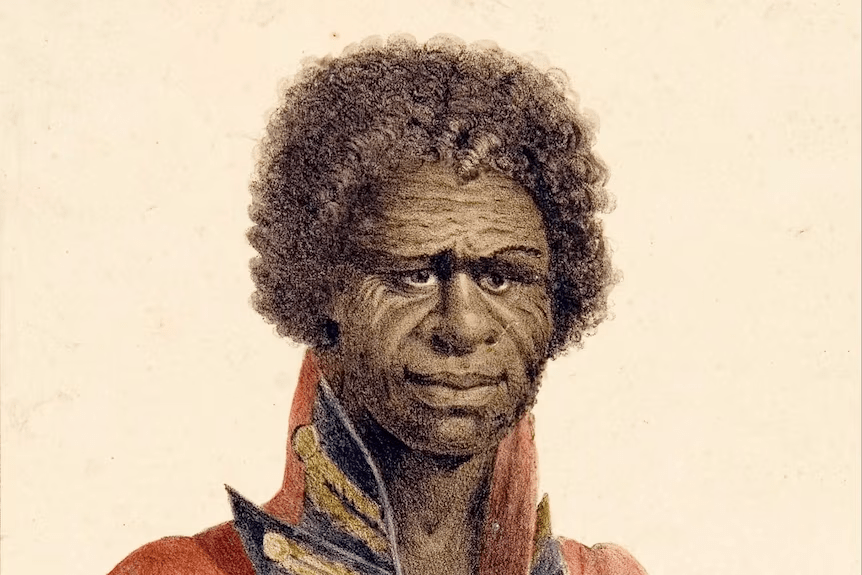
When we think of great explorers, we picture men in naval uniforms, compasses in hand, charting “new worlds.” But tucked away in the annals of Australia’s history is a story that breaks that mould. It’s the story of Bungaree—the first Aboriginal man, and indeed the first Australian, to sail right around a continent.
His name is little known today, but his contribution to one of history’s most extraordinary voyages, in an exploration led by Captain Matthew Flinders, an English navigator was extraordinary.
From Broken Bay to the World
Bungaree was a man of the sea. Born around 1775 among the Kuringgai people near Broken Bay, north of Sydney, he grew up at a time when everything around him was changing. European ships had begun to appear on the horizon; new settlements were springing up on ancient lands. While many Aboriginal communities resisted the newcomers, Bungaree was curious. Quick-witted and charismatic, he learned to move between two worlds—his own and that of the British colonists.
By the time Flinders was preparing to embark on his grand voyage of exploration, Bungaree had already earned a reputation as a skilled sailor and interpreter. Flinders, who understood the need for a knowledgeable local person on his mission, invited Bungaree to join the expedition aboard HMS Investigator in 1801.
The Journey Around a Continent
The Investigator’s mission was to chart the entire coastline of the vast southern landmass known then as New Holland. Flinders hoped to prove it was a single continent—what we now call Australia. For this, he needed not just navigational skill, but also understanding—someone who could help bridge worlds. Bungaree became that person.
Throughout the voyage –from December 1801 to June 1803–Bungaree played a vital role as peacemaker and emissary. When the Investigator anchored near Indigenous communities, it was often Bungaree who stepped ashore first—speaking to local groups in shared gestures, explaining the strangers’ peaceful intent, and easing tensions that could have turned deadly. His presence gave the expedition a human connection that maps and compasses could not.
Flinders, for his part, admired Bungaree’s warmth and humour. In his journals, he wrote that Bungaree “was always of service wherever we went,” and that his “good disposition and open, manly conduct” won respect from both shipmates and the people they met. It was a rare acknowledgment of partnership in an age otherwise defined by hierarchy and conquest.
The Man Beyond the Maps
The voyage was gruelling. The Investigator battled storms, leaks, and disease. Food was scarce; scurvy stalked the crew. Yet through months at sea and thousands of kilometres of unknown coast, Bungaree remained cheerful and steadfast—a figure of resilience and adaptability. When they finally completed the first circumnavigation of the continent in 1803, Bungaree had travelled more of Australia’s coastline than any person before him.
And yet, history gave him only a passing mention. While Flinders returned to England (and was later imprisoned by the French), Bungaree returned to Sydney. There he became something of a local character—always dignified, dressed in military uniforms, wearing his medals proudly. He was lovingly referred to as “King Bungaree,”.
An Amazing Feat
So this was the veryfirst successful circumnavigation of an entire continent in recorded history–the first time anyone had completely circumnavigated a single, continuous continental landmass on Earth.
Other earlier famous circumnavigations (like Magellan’s) went around the globe or around islands (for example, Tasmania, which Flinders himself had circumnavigated earlier with George Bass in 1798). But going around a continent — that is, a vast mainland connected by continuous coastline — was unique. (Incidentally, while one can circumnavigate Africa, the Americas through the Panama Canal, and Antarctica when the ice permits, it is not possible to circle Asia and Europe).
Remembering Bungaree
Bungaree died in 1830 and was buried at Rose Bay. His resting place, like so much of his story, is unmarked. But in recent years, there has been a growing recognition of his contribution—not just as a companion to Flinders, but as a symbol of the spirit of adventure, resilience, and bringing two worlds together.
The First International Thrift Congress was held in Milan, Italy from 26 to 31 October 1924. It was attended by over 300 delegates from 27 countries, who shared a vision: to promote savings as a key to financial security and independence. This was a period following the First World War which was marked by financial instability, and loss of confidence in banks. Banks were adopting a variety of measures and incentives to encourage people to deposit savings in banks in order to secure some stability for future uncertainties. In fact the word savings itself originates from the early 14th century, symbolizing ‘salvat’ a way to protect oneself from life’s uncertainties.
On the last day of the conference one of the organizers Professor Filippo Ravizza proposed that there should be an annual International Savings Day or Thrift Day, as a reminder of the importance of saving, and to foster the habit of saving. It was unanimously agreed that this should be marked on 31 October. The informal symbol chosen to represent World Savings Day was the piggy bank.
Over a hundred years later, World Thrift Day continues to remind about the value of saving. Taken in a broader context, the word ‘thrift’ implies more than just accumulating coins in a piggy bank, or money accrued in savings accounts and deposits in banks. It refers to the prudent management of one’s resources. It is the opposite of extravagance and waste. It encompasses the philosophy and practice of moderation, conserving, and economizing.
Perhaps there is no better example of a life led by these principles than Mahatma Gandhi. For Gandhiji thrift was not just a habit of saving money; it was an ethical and philosophical principle which guided every aspect of his life. For him, the most direct application of this was in the frugal use of resources in one’s daily life. While his own lifestyle reflected this in every moment of his daily routine, he also expected that the people who lived in his ashram do the same.
There are several anecdotes recalled by his colleagues and ashram inmates that illustrate this.
Kishorelal Mashruwala started working with Gandhiji from the time that Gandhiji returned to India from South Africa, and continued to be closely associated with him for the rest of his life. He recounted some incidents.
‘One of my young nephews lived with me at Sabarmati. He once tore his clothing during play and then went straight to Bapu’s room. Bapu saw the torn condition of the cloth, and when he saw my wife later he showed his displeasure at it. He said: “One need not be ashamed of clothes repaired with sewing or patches. Poverty in itself is not a matter for shame. But there is no excuse for a person to put on unmended or dirty clothes. A cloth must be repaired as soon as it is torn, and washed if it has become dirty”.
It is well known that Gandhiji never threw away a used envelope or telegraph form that was blank on the reverse. He would collect these and convert them into scribbling pads, to be used on the day of his silence, or to write drafts of his articles and important letters, or, sometimes, to write notes to be left for others, or sent to them. Mashruwala recalled this: ‘I may also mention a habit which I developed under his influence. It is that of preserving and using bits of paper written on one side, wrappers on book-post packets etc., and used envelopes. Perhaps the instinct of thrift was inherent in me, and it got encouragement by his example.’
Kamlaben Patel came to stay in Sabarmati Ashram with her father when she was a young girl. Every inmate was expected to participate in all tasks from cleaning, washing, cooking, and spinning; and every resource was to be used with respect and frugality. She recalled one incident.
‘One day Bapu was passing by the store when the goods were being unloaded. He stopped and enquired how much soap had come. The soap that we all used was round and white but hard as stone, and the cheapest one that was available. The next day after the women’s prayer Bapu enquired about how much soap was used by each family. From their replies it was calculated that the cost of soap for each person was from 75 paise to one rupee. Bapu proposed that the use of soap be reduced. The women frankly told Bapu that any reduction in use was not possible as the soap was used to wash thick white khadi clothes, sheets, pillow covers, and mattress covers. Bapu said that “you all know that the Ashram runs on the donations of people. We claim to be servants of the people. Three hundred people live in the Ashram, and if each one used one rupee worth of soap, what will our donors feel about 300 rupees being spent on soap every month? Even in the days when there was no soap, our clothes were clean were they not? You must consider reduction in soap use.” After a lot of discussion the women agreed to use 50 paise worth of soap each month. Bapu proposed 37 paise. The women said they would respond after more thought. The prayer meeting dispersed. The women reconvened and after considering all options, unanimously decided to inform Bapu that it was not possible to do with less than 50 paise worth of soap per person, and remain firm on this decision. After the prayer Bapu jokingly said that the women’s ultimatum was like the Viceroy’s ultimatum. He would go to Bardoli to provide an answer to the latter, but he bowed to the women’s ultimatum, and accepted their 50 paise demand.’
These insistencies may seem as if Gandhiji was bothering over trifles, but for him such thrift was not simply a habit of saving money, but a practice of core principles connected to self-sufficiency, non-violence and social justice.
He believed that self-sufficiency through Swadeshi was not just an economic protest against foreign goods but a practical lesson in self-reliance and dignity of labour. He emphasized the respect for resources (material and human) that went into creating any product. He believed that wasting or careless use of any product was to disrespect the person who made it.
These were some of the pillars of Gandhiji’s concept of ‘trusteeship’, a principle that suggested that rich individuals should not see their wealth as their own to squander but as a trust held for the benefit of society, especially the poor. He believed that wealth beyond one’s basic needs should be used for the public good.
Gandhiji believed that genuine happiness lay in contentment, not in endless satisfaction of demands. He encouraged individuals to voluntarily reduce their wants, arguing that this would lead to a more satisfying life and a more peaceful society.
These ideas are best summed up in Gandhihji’s maxim that ‘The world has enough for everyone’s need, but not for everyone’s greed’. He believed that the world naturally produces enough to satisfy the needs of every person, but insatiable wants lead to exploitation and environmental ruin.
World Thrift Day is a thus not simply a reminder of saving for a rainy day, but a promotion of a way of life that values and respects all resources and their wise use.
An uncommon name. But two people of this name, had a profound impact on India.
The first was Abel Joshua Higginbotham, who established the famous Higginbothams Bookshop in 1844–an institution which stands even today. The other was Samuel Evans Higginbottom who founded the Allahabad Agricultural Institute in 1904.
Abel Higginbotham was certainly an interesting character. He boarded a ship from England in the mid-1800s without a ticket or papers. The captain of the ship threw him out at Chennai when he was discovered. The stowaway was a trained librarian, and so could land a job at the city’s Wesleyan Book Shop run by Protestant missionaries. But the store suffered heavy losses and the missionaries who ran the business had to sell their shop at a low price. The enterprising Higginbotham bought the business, set up his own store in the year 1844 and called it “Higginbothams”—making it India’s first general bookstore. It gained a reputation for quality. The Guidebook to the Presidencies of Madras and Bombay by John Murray, which came out in 1859, describes Higginbothams as the “premier bookshop of Madras”. Higginbotham’s were appointed as the “official bookseller to His Royal Highness, the Prince of Wales” during the royal visit to India in 1875. The shop started stocking stationery too, and subsequently started printing its own books.
The second Higginbothams store came up in Bangalore in 1905 on MG Road making it the oldest bookstore in the city. In the 19th century, this was the largest chain of bookstores in the county. Even today, there are over 40 stores across the country.
To add to his achievements, during 1888 and 1889, Higginbotham served as the Sheriff of Madras!
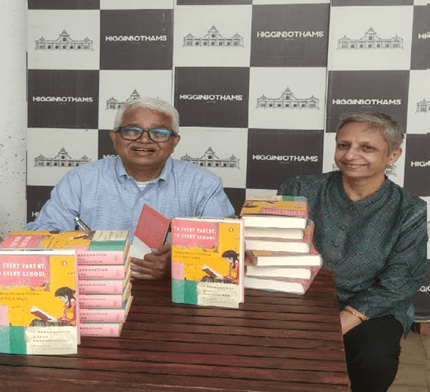
Our book-signing at Higginbothams, Bangalore
The other gentleman, Samuel Higginbottom was a missionary and agricultural reformer who arrived in India as part of the North India Mission of the Presbyterian Church, and landed up in Allahabad. He started as a teacher of economics but was deeply disturbed by the deep poverty of the farmers in the villages and districts around. The land here was not of the best, and agriculture was of very low productivity. He realized that modernization of agriculture was critical for the prosperity of the region, and returned to the United States and studied agriculture at Ohio State University for three years. He came back to Allahabad, to teach scientific methods of farming. But he was convinced that he had to take these efforts to the next level, and set about raising funds for an institution. His educational programs grew into the founding of Allahabad Agricultural Institute in 1919. Higginbotham developed close friendships with Mahatma Gandhi and Jawaharlal Nehru during the course of his work.The institute has done pioneering work for the advancement of agriculture, including introducing pest-resistant high yielding-seeds, improved farm implements and extension programs for farmers. In 2009, this was rechristened as Sam Higginbottom University of Agriculture, Technology and Sciences (SHUATS) in honour of the founder. He left India in 1945.
Sam Higginbottom wrote two books: a book about his work published in 1921 and an autobiography published in 1949.
As the sharp reader would have noticed, the name is spelt differently in the two cases. The two gentlemen were not related. Abel Higginbotham was Irish-born British, while Sam Higginbottam was American. The similarity in names is purely coincidental — different families, different geographies, different spellings, different national origins.
But we owe thanks in equal measure to both of them for their pioneering services!
As an environmental educator there was a popular story that we used to illustrate how everything is connected, and how one step can sometimes have a chain of unanticipated consequences that disturb the delicate balance of nature. The story goes thus:
In the early 1950s, there was a severe outbreak of malaria amongst the Dayak people in Borneo. The World Health Organization tried to solve the problem. They sprayed large amounts of a chemical called DDT to kill the mosquitoes that carried the malaria. The mosquitoes died and there was less malaria. That was good. However, there were side effects. One of the first effects was that the roofs of people’s houses began to fall down on their heads. It turned out that the DDT was also killing a parasitic wasp that ate thatch-eating caterpillars. Without the wasps to eat them, there were more and more thatch-eating caterpillars. Worse than that, the insects that died from being poisoned by DDT were eaten by gecko lizards, which were then eaten by cats. The cats started to die, the rats flourished, and the people were threatened by outbreaks of two new serious diseases carried by the rats, sylvatic plague and typhus. To cope with these problems, which it had itself created, the World Health Organization had to parachute live cats into Borneo. Operation Cat Drop as it was called, air dropped a number of cats (numbers range from 20 to 1400!) into the region. This step was visualized as the initiation of a reverse cycle that could restore the chain of predator-prey, wherein the cats would feed on the rats which were posing the public health challenge. The story did not continue to describe the new consequences of this step.
I remembered this story when I read a recent report where the problem and not the solution has started with cats!
This is on the small island nation of Cyprus in the eastern corner of the Mediterranean where currently cats outnumber the local human population!
Cyprus has a long history associated with cats. It is believed that cats were first domesticated in Ancient Egypt. But archaeological discoveries of cat remains close to human burial sites in sites in Cyprus dating back around 9500 years ago indicate that the interactions between humans and cats may have started here much earlier. It is speculated that cats must have been introduced to the island from the mainland, and there are several stories about this. One legend states that in AD 328 Saint Helena, a Roman Empress began construction on a monastery on the island. At that time a terrible drought afflicted the area, people fled and snakes proliferated. Helena got boatloads of cats shipped over from Egypt and established them in the area to destroy the snakes. The monastery was built, but also destroyed later and subsequently rebuilt several times. But the cats remained and thrived, and established themselves as an unofficial sub-breed known as the Cyprus Cat.
There is still a monastery, St. Nicholas of the Cats, that is believed to have been founded by St. Helena and where there are some cats which are purported to be the descendants of the original cats! The monastery has a tradition of taking in any stray cat brought to them in honour of the centuries of service of the felines. Cyprus itself is an island of cat nurturers where cat food dispensaries and other cat services are a common sight. This has also added to its tourist attractions (albeit for cat lovers!).
Cyprus Cats are part of the island’s identity; they are an example of how ecology, cultural history and animal love intersect. But they are also an example of how too much of a good thing can be counterproductive.
With the passage of time, no outside interference, and favourable conditions, the cat population on the island continued to grow. Unchecked breeding, especially in urban areas has now turned into an explosion of feral cats. The cats now outnumber humans. And that is a matter of concern for the civic authorities. Given cats’ predatory nature, a larger than sustainable population has the potential to wreak havoc with the island’s ecosystem. The feral cats threaten local wildlife, they become urban traffic hazards as they scavenge for food in the populated areas, and they themselves carry threat of diseases which could spread rapidly if there is an outbreak. Without sustainable measures the situation can reach an irreversible point. And ecologists are concerned that this point is close.
In recent years there have been programmes to control the cat population through sterilization, but the numbers have now exceeded manageable limits. The civic authorities feel the effective control and management of the issue needs huge funding, as well as a concerted effort which includes the active participation of NGOs, national as well as international animal welfare organisations, volunteers, the general public, as well as the tourists.
While the parachuted cats of the Borneo story became the saviours of the moment, it would be interesting to go back and review whether the cats, in turn, impacted the ecosystem. Meanwhile the Cyprus Cats continue to challenge the fragile balance.
We are in the midst of the Diwali celebrations—honouring and worshipping the Goddess Laxmi. In this time of wishing everyone prosperity, it is contrarily also a moment to think of poverty.
It is also timely because Oct 17 is marked as International Day for the Eradication of Poverty.
Poverty is a state of lacking sufficient money or material possessions to meet a minimum standard of living. It is “pronounced deprivation in well-being”. It is not just a lack of income but also a lack of access to basic necessities like food, clean water, shelter, healthcare, and education. It is a complex and multifaceted issue involving social, economic, and political elements.
The World Bank measures poverty primarily through an international poverty line. In June 2025, this line was updated to $3.00 per day (using 2021 purchasing power parity or PPP), replacing the previous $2.15 per day. A person is considered to be in extreme poverty if their income or consumption falls below this threshold. In India, this is approximately ₹62 per day.
Measurement of poverty is a complicated and often contentious affair. Poverty can be an absolute amount of money. It can also be tied to a specific type of consumption; for example, people could be house-poor or food-poor or health-poor. These dimensions of poverty often can be measured directly, for instance, by measuring malnutrition or literacy.
But the broadest approach to well-being (and poverty) focuses on the capability of the individual to function in society. Poverty is when people lack key capabilities; they may have inadequate income or education, or be in poor health, or feel powerless, or lack political empowerment.
In India, NITI Aayog has developed the National Multidimensional Poverty(MPI) Index, based on the global MPI framework. A person is identified as multidimensionally poor if they are deprived in at least one-third of the weighted indicators of which there are 12. These indicators are categorized into three dimensions which carry equal weights: health, education, and standard of living. Deprivation in any household member’s nutrition or the death of a child indicates health deprivation. Educational deprivation is measured by the lack of schooling years for those aged 10 and above or school non-attendance for school-aged children. Standard of living deprivations include using rudimentary cooking fuel, having inadequate sanitation or drinking water access, living in poorly constructed housing, lacking electricity, not owning essential assets, or not having a bank account.
Linked to poverty is inequality. Economic inequality is the unequal distribution of income and opportunity between different groups in society. It encompasses differences in income (pay) and wealth (total assets like property and stocks), and is measured using metrics like the Gini coefficient. Economic inequality includes Income Inequality, Wealth Inequality and Inequality of Opportunity.
Diwali is about caring and sharing. And it is about family. This year’s theme for the Poverty Eradication Day emphasizes ‘ensuring respect and effective support for families’. There could not be a happier coming together of intent, pointing the way for a truly Happy Diwali!
I recently, and reluctantly, bought a new pressure cooker, in place of my old one which has been my trusty companion over several decades and continents. The old one was an original English Prestige cooker, although over the years of replacement of its various parts (especially handles and gasket ring) with local add-ons made it a war veteran, scarred but not retired. Coincidentally, this week brought the news of the demise of TT Jagannathan who made TTK and Prestige a well-known and trusted Indian brand. In fact the Prestige pressure cooker is such a ubiquitous presence in every home, that we take complete ownership of its being uniquely Indian.
Digester: Precursor to Pressure Cooker
In fact the origin of a utensil that could cook food at high temperature can be traced back to the 17th century in England. Its earliest form was called a Digester. It was devised by Denis Papin, a French physicist, mathematician and inventor, who had moved to England. The Digester was a large cylindrical airtight container, heated over coals to produce internal steam pressure to increase the boiling temperature to above 100 degrees centigrade. A small tube in the lid closed with a flap was held in place by a weighted rod allowing the steam to escape when the pressure became too high. This was an early version of the first safety valve, one that helped prevent the contraption from exploding. In 1679, Papin presented his invention to the Royal Society which included top scientists of the day. They were so impressed that they commissioned Papin to write a book. The book published in 1681 titled A New Digester or Engine for Softening Bones detailed his successful experiments in cooking a variety of meats and was described as a construction guide, an experiment log, and a cookbook. In 1682, Papin used his Digester to cook a full meal for the Royal Society dinner which received rave reviews. However the Digester as a cooking equipment did not really take off in England till much later. Papin moved on to Germany and continued his experiments leading to other inventions based on a similar application of the pressure of steam.
The early Digester was expensive to build and could be rather dangerous as there was the threat of explosion from too much steam pressure. It wasn’t until the addition of safety valves that effectively stopped the pressure from getting too high, and safety locks preventing the lid from flying off if opened too soon, would such a utensil become more common. Papin died in obscurity, not knowing that his Digester would one day transform into the domestic pressure cooker.
But the technology triggered other experimenters to work on similar devices. In 1919, José Alix Martínez was granted the first patent in Spain for his olla exprés (express cooking pot), which used the pressure cooker technology invented by Papin. However, the term “pressure cooker” featured in the Oxford English Dictionary in 1910. In simple terms, a pressure cooker is a sealed chamber that traps the steam generated when its contents are heated. As the steam builds up, pressure increases and drives the boiling point of water beyond 100°C. Pressure cooking reduces cooking time up to 70per cent, preserves more nutrients and vitamins, uses less energy and water, and can be used to cook a wide range of foods
Around the same time, a new invention appeared in India which used steam, though not steam pressure, to cook food. This was the creation of a Calcutta gentleman Indhumadhab Mallik. In this, raw ingredients including meat and fish as well as vegetables dal and rice were placed in containers which were stacked in an inner container. The outer container had water, and the entire contraption was sealed and placed over a charcoal fire. The food cooked in the steam that was generated. The steam cooker was called ICMIC cooker (combining the words hygienic and economic.) The cooker became popular in Bengal and was also sold in other states under different names.
By the 1930s, the pressure cooker was making its presence felt across the world, even as high up as Mount Everest. Higher altitudes with lower atmospheric pressure meant longer cooking time and a pressure cooker helped ease the problem, making it a great help in mountaineering expeditions.
World War II led to a dip in the production of pressure cookers due to the need for aluminium for the war effort in the US and Europe. Pressure cooker companies were enlisted to create canned goods (the cans were made of aluminium) for the troops. However, there was continuing demand for pressure cookers, and some companies started making cheaper cookers with substandard materials, which caused the cookers to explode. This raised safety concerns leading to the fall in popularity of pressure cookers in Europe.
Pressure cookers arrived in India in the late-1950s. They were introduced by two companies—Hawkins and TTK Private Ltd. (which became known as TTK Prestige). But the safety issue remained a concern as there were frequent explosions. Simultaneously companies were working on innovations to prevent such mishaps.
A significant contribution in this field came from TT Jagannathan (TTJ) who joined the family business when he was in his early 20s, and took charge of TTK Prestige at a time when the company was struggling. The reports of faulty pressure cookers had severely damaged the company’s reputation. Jagannathan, an engineer from IIT Madras and a PhD in Operations Research from Cornell began experimenting with ways to increase safety in pressure cookers.
As he recounted in his book Disrupt and Conquer: How TTK Prestige Became A Billion-Dollar Company, Mr Jagannathan saw a godown full of unsold pressure cookers on a visit to Lucknow. The dealer explained that there were increasing cases of TTK pressure cookers bursting, and that the TTK name had lost credibility. TTJ was disturbed and launched a probe into the reason for this. A pressure cooker comes with a weight valve that is meant to rise up and release the steam that is built up by the pressure inside the cooker. The valve then settles back in place. The safety plug is a back-up safety mechanism and regulates the pressure built up in the cooker if the weight valve fails. He discovered that users were unknowingly purchasing fake safety plugs to replace the original ones. These plugs were cheaper but also made of substandard material which allowed too much steam build-up, leading to exploding cookers. He realized that there needed to be a device which, even when poor materials were used, could prevent this from happening. He immediately contacted his company’s head engineer and asked him to make certain preparations. TTJ returned to Bangalore and spent a month in the lab and used his engineering knowledge to create just such a device. This was the Gasket Release System or GRS. GRS is a secondary safety feature that releases excess steam if the primary pressure valve fails, preventing a dangerous pressure build up. It works by providing a weak point in the lid where a section of the rubber gasket will be pushed out through a slot if the main pressure vent becomes blocked or fails, allowing steam to escape down and away from the user.
This safety feature set new standards across the industry, and was also adopted by other manufacturers of pressure cookers in India. Its inventor TTJ never patented it. As he said “I did it for the industry. If any pressure cooker burst, it would mean a loss for the category. The category wouldn’t grow if people had fears around safety. I didn’t want only Prestige to be safe, but all pressure cookers in the country to be safe.”
The invention, along with Prestige’s close and continuous outreach and contact with its customers has ensured that the brand is associated with quality, durability and reliability. Today the Prestige brand has introduced a wide range of kitchen appliances catering to a new generation and befitting the ‘smart kitchens’. However the name’s first association is so much with Pressure cookers that Prestige is synonymous with Pressure cooker.






 Millennial Matriarchs