Another World Youth Skills Day…

In 2018, the proportion of India’s working-age population started growing larger than its dependant population (children below 14 and above 65 years of age). This bulge in the working-age population, called the demographic dividend is going to last till 2055—a total of 37 years.

World Youth Skills Day

But such a large population of young people is productive only if they are educated and skilled so that they realize their potential and contribute to the nation’s growth.

The harsh reality is that only about one in five Indians in the labour force is “skilled” as per the Human Development Report (HDR) Report 2020. India is 129th among 162 countries for which this data is available.

If the absolute numbers are a matter of concern, for me, the less-obvious ‘quality of skills’ is even more of concern.

Let’s look at a few indicators of how effective skill training programmes in India may be. With regard to many skills, a school dropout can be certified at Level 3 or 4 through a 3-month training programme. In the formal skill structure, which is the ITI and Polytechnic systems, the length of programmes is more respectable, but the courses and curricula are outdated by about five decades—some of these institutions still offer programmes in Stenography! The faculty may never have set foot in an industry, and the equipment, even if it is functional and not rusting, has not been in use in the real-world for at least 20 years. And the youth themselves, during their time in these institutions may never work on an industry shop-floor, or even visit a factory.

If skill is ‘the ability to do something well’ how do we expect youth passing out of such systems to do anything useful, least of all ‘well’?

Contrast this to Germany, which is one of the leaders in skill training. They base their skill training on the dual system which works because of the cooperation between Medium and Small Scale Enterprises, and vocational training institutes. Trainees in the dual system typically spend part of each week at a vocational school and the other part at a company. Dual training usually lasts two to three-and-a-half years. It is basically a combination of theory and training implanted in a real work setting. It is an integral part of the education system and is driven by industry and trade unions, who constantly upgrade and modify training modules and job roles. These occupations are certified by either a chamber of commerce or crafts or trades. About 70% of German youth go through this skilling system.

Whether is the length of the training, the rigour, the exposure and hands-on work in industry, or the up-datedness of the curriculum based on industry needs, where is the comparison between skilling in such a system and skilling in India? We can talk about the importance we place on skilling, tout the numbers (the National Skill Development Corporation website says 1,10,34,285 candidates have been certified through the flagship short-term training programmes), and the institutional structure and industry-involvement mechanisms we have put in place.

But to quote a 2019 ILO report on India,

‘Since 2013 … despite ongoing reforms promoting skills development, VET has not kept pace with general education, and its share of upper secondary education fell to 2.7 per cent in 2016. Moreover, VET does not respond to the training needs of young women. Only 17 per cent of VET students were girls in 2016, down from 20 per cent in 2000 (UIS, 2018). Non-formal and informal VET programmes do not reach a large proportion of India’s young people. Survey data collected in 2017 indicate that only 5 per cent of young people aged 14–18 were taking any type of vocational training, whether formal or not. And 59 per cent of those receiving training were taking courses shorter than six months.’

This should not be news to any of us. Each of us has experienced how difficult it is to find a plumber, electrician, carpenter or welder, leave alone one who knows their job, can problem-solve; one who turns up on time; one who works cleanly and cleans up their mess.

We are five years into our demographic window. And still have not put in place a critical building block, viz skilling. How can we hope to fulfil our dreams, aspirations and ambitions if we don’t bring about DRASTIC changes and SOON? We need to take an honest look at where we stand, admit we are not on the right track, and go back to the drawing board.  

July 15 is marked as World Youth Skills Day.  We in India too marked this last week. But Skill Days will come and go. When will our youth be able to access high quality skills?

–Meena

Living Your Dreams: Calvin and Hobbes

I am an unapologetic follower of comic strips. This is the section of the newspaper I save up to savour after reading all the gloom and doom news. One of my all-time favourites is Calvin and Hobbes.  

The creator of these iconic characters–six-year-old Calvin named after the Protestant reformer John Calvin, and his imaginary stuffed tiger friend Hobbes named after the philosopher Thomas Hobbes, is Bill Watterson.

Watterson graduated from Kenyon College, a liberal arts college in Ohio, with a degree in Political Science in 1980. He started working as a political cartoonist for a local newspaper soon after he graduated, but was fired after three months. He then worked for a company creating ads to sell products, something that he hated. All the while he continued drawing, with the idea of creating a syndicated comic strip. It was five years before his dream could be realized.

The first Calvin and Hobbes strip appeared in a newspaper in November 1985. The characters and their adventures and ruminations were much deeper than just “comical”. They reflected the universal quest to accept the impossible and to embrace the irrationality of the moment. As Watterson once described it “My strip is about private realities, the magic of imagination, and the specialness of certain friendships”. Watterson’s daily strip became an icon for all these elements and was syndicated to over 2,000 newspapers. Bill’s new ‘job’ was to come up with 365 ideas a year. For this he said he had to create a kind of mental playfulness. He sustained this for ten years. The last Calvin and Hobbes strip was published on 31 December 1995.

Despite the huge success of the characters, and in the face of intense pressure to allow related merchandise, Watterson never succumbed to what would have been a billion dollar industry. He believed that by doing so “Creativity would become work for pay. Art would turn into commerce. Selling out is usually more a matter of buying in. Sell out, and you’re really buying into someone else’s system of values, rules and rewards. I’m not interested in removing all the subtlety from my work to condense it for a product…Note pads and coffee mugs just aren’t appropriate vehicles for what I’m trying to do here.”

In 1990 Bill Watterson was invited back to Kenyon College to give a commencement address to the graduating students. His deeply personal and candid talk urges young people to follow their dreams even in the face of numerous challenges.

This month, as thousands of graduates across many parts of the world step out of the security of academic institutions and enter, with excitement and some apprehension, the vast, hitherto unknown world of work, Bill Watterson’s words offer encouragement, support and inspiration.

Sharing some excerpts.

At school, new ideas are thrust at you every day. Out in the world, you’ll have to find the inner motivation to search for new ideas on your own. With any luck at all, you’ll never need to take an idea and squeeze a punchline out of it, but as bright, creative people, you’ll be called upon to generate ideas and solutions all your lives. Letting your mind play is the best way to solve problems

You may be surprised to find how quickly daily routine and the demands of “just getting by” absorb your waking hours. You may be surprised to find how quickly you start to see your life in terms of other people’s expectations rather than issues. You may be surprised to find out how quickly reading a good book sounds like a luxury.

We’re not really taught how to recreate constructively. We need to do more than find diversions; we need to restore and expand ourselves. Our idea of relaxing is all too often to plop down in front of the television set and let its pandering idiocy liquefy our brains. Shutting off the thought process is not rejuvenating; the mind is like a car battery–it recharges by running.

A playful mind is inquisitive, and learning is fun. If you indulge your natural curiosity and retain a sense of fun in new experience, I think you’ll find it functions as a sort of shock absorber for the bumpy road ahead.

For years I got nothing but rejection letters, and I was forced to accept a real job. A REAL job is a job you hate. I designed car ads and grocery ads in the windowless basement of a convenience store, and I hated every single minute of the 4-1/2 million minutes I worked there. My fellow prisoners at work were basically concerned about how to punch the time clock at the perfect second where they would earn another 20 cents without doing any work for it.

I tell you all this because it’s worth recognizing that there is no such thing as an overnight success. You will do well to cultivate the resources in yourself that bring you happiness outside of success or failure. The truth is, most of us discover where we are headed when we arrive. At that time, we turn around and say, yes, this is obviously where I was going all along. It’s a good idea to try to enjoy the

To endure five years of rejection to get a job requires either a faith in oneself that borders on delusion, or a love of the work. I loved the work. Drawing comic strips for five years without pay drove home the point that the fun of cartooning wasn’t in the money; it was in the work. This turned out to be an important realization when my break finally came.

You will find your own ethical dilemmas in all parts of your lives, both personal and professional. We all have different desires and needs, but if we don’t discover what we want from ourselves and what we stand for, we will live passively and unfulfilled. Sooner or later, we are all asked to compromise ourselves and the things we care about. We define ourselves by our actions. With each decision, we tell ourselves and the world who we are. Think about what you want out of this life, and recognize that there are many kinds of success.
But having an enviable career is one thing, and being a happy person is another.

Creating a life that reflects your values and satisfies your soul is a rare achievement. In a culture that relentlessly promotes avarice and excess as the good life, a person happy doing his own work is usually considered an eccentric, if not a subversive. Ambition is only understood if it’s to rise to the top of some imaginary ladder of success. Someone who takes an undemanding job because it affords him the time to pursue other interests and activities is considered a flake. A person who abandons a career in order to stay home and raise children is considered not to be living up to his potential-as if a job title and salary are the sole measure of human worth.

Cultivate that interest, and you may find a deeper meaning in your life that feeds your soul and spirit. Your preparation for the real world is not in the answers you’ve learned, but in the questions you’ve learned how to ask yourself.

–Mamata

Homes for Hippos

Hippos hit the news every now and then. And in the past weeks, they have been a topic of some discussion in India, thanks to a request from the Colombian Government for us to provide a home to some of the ‘cocaine hippos’ that have become feral there. Actually, it is quite unfair to call them ‘cocaine hippos’—it is not like they snort cocaine. Their ‘fault’ is that they (or their parents/grand-parents) were owned by the infamous cocaine smuggler Pablo Escobar.

Pablo Escobar was a Colombian druglord, who was called the ‘King of Cocaine’, due to his monopoly of the cocaine trade into the US. He was the founder of the Medellin Cartel, and the wealthiest criminal ever, with his wealth being estimated at $ 30 billion in 1993, when he was killed at the age of 44, by the Colombian National Police.

Every aspect of Escobar’s life was larger-than-life. Like the emperors of old, he set up a menagerie at Hacienda Napoles, his huge ranch east of Medellin, and kept giraffes, elephants, ostriches, and other exotic species there. Four hippos—three males and one female–were part of this menagerie.

When he was killed, authorities did not quite know what to do with these animals, and just left them in the estate—where not unexpectedly, they multiplied. In about 25 years, there were close to a 100 individuals (the number may stand at over 150 today). A single hippo can eat over 35 kg of grass and other green plant material in a day, posing a threat to local biodiversity. Being large and heavy animals, they stomp the ground and compact it as they move over the same area day after day. They defecate in the water, and end up polluting rivers and water bodies.

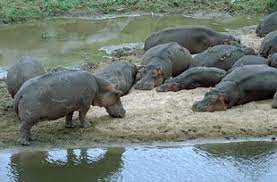
Hippos
Pic: Encyclopedia Britannica

Efforts to curb the population explosion have not met with success. About 15 years ago, the local government tried culling the animals, but this led to protests across Colombia and was thankfully stopped. A sterilization programme is in place, but the hippos breed faster than local experts can find, catch and castrate them (We can’t even manage it with stray dogs, what to talk of hippos!).

Hence the plan to ship the hippos to various countries which are ready to receive them. Mexico has agreed to take 10 of them. Colombia has approached India to house 60 of the animals at the ‘Greens Zoological Rescue and Rehabilitation Kingdom (GZRRC)’, being created by Reliance Industries in Jamnagar, Gujarat. The plan has not met with enthusiasm by any wildlife expert. Housing them in zoos is an expensive proposition.  Hippos are native to Sub-Saharan Africa, not India, and definitely cannot be released into the wild. (However, based on a small fragmented tooth unearthed in Madhya Pradesh, researchers claim that India was home to hippopotami nearly 5.9 million to 9,000 years ago. The hypothesis is that they entered Eurasia from Africa, and then diversified in South Asia before going extinct. But even if they ever were native here, they haven’t been for many millennia.)

There is no doubt Colombia has a problem. Apart from destroying vegetation and biodiversity, hippos are also a threat to humans. They are known to be very aggressive, and can chase people on land, as well as capsize boats in the water. They sometimes raid fields and come into conflict with humans.

And it is also true that a safe home must be found for the hippos—they are only living their life as they were meant to. How can they help it if someone uprooted them from their home and brought them to a new continent?

But bringing them to India definitely does not sound like a good idea. The recent import of cheetahs should serve as a cautionary tale. We need to protect our biodiversity and trying to introduce non-native (at least in human memory) species is not going to help either our diversity or the introduced species.

–Meena

Gracious, graceful, generous: Shobita Punja

Those are my memories of Shobita Punja, who passed away last week. She joined the Governing Council of Centre for Environment Education (CEE) when I was a rookie-professional there. And from then on, for the decades that followed, we would have the privilege of meeting with her twice a year when she came for the meetings, and then again at workshops and seminars. And over the years, she went from advisor to friend.

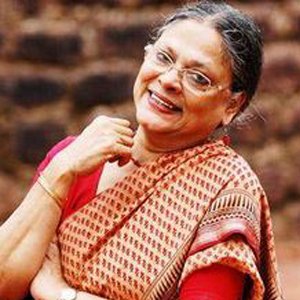
Shobita Punja
Shobita Punja. Photo: Jaipur Virasat Foundation.

And in every interaction, she was indeed gracious and generous—taking the time to talk to each one of us, enquiring about our projects, and giving her inputs gently and generously. Most conversations gave us a new perspective to the way we were looking at things.

And of course she was graceful. Her lovely cotton saries; her low, loose bun; her warm smile.

We all wished we could be half as erudite and elegant as her. Or even a quarter would do!

When we first met, she was heading the Centre for Cultural Resources and Training (CCRT), and they were bringing out innovative teaching materials to ignite the love of our history and culture in school kids, and supporting that with teacher training to ensure that the material was used in the right way in the schools. There was much to learn and share, for she was doing for the cultural environment what we at CEE were doing mainly for the natural environment. Both CEE and CCRT were pioneers in introducing experiential learning pedagogies, in getting children to look up from textbooks at the real world, and in trying to question and contextualize their experiences; analyze and synthesize their learnings. And these were revolutionary thoughts for the ‘80s! (Today, the ideas are not new, but how effectively they are put into practice in their real spirit is still a question mark).

 She was truly a pioneer! She did her BA in Art History when it was definitely not seen as a subject with any great career openings, at least not in our part of the world.  This was followed by a Master’s in Ancient History from JNU and another Master’s in Art Education from Stanford. She was awarded a Ph.D. for her contribution to Art Education.

From CCRT, Shobita moved to INTACH, and established a Heritage Education and Communication Service there. She was the moving force behind the restoration of the Chowmohalla Palace and Museum at Hyderabad. As an erstwhile resident of that historical city, I can aver to how authentically it was done and how proudly we used to be to show it off to our visitors. The restoration won the coveted UNESCO Asia-Pacific Heritage Award, apart from many other accolades. Chowmohallah after its restoration was the site for many beautiful music and dance performances, made even more beautiful by the settings. Shobita was also behind the restoration of the Jai Vilas Palace Museum, Jaipur and Reis Magos Fort, Goa.

She was a prolific writer, with over 20 books to her credit, ranging from one as recent as the 2023 co-authored ‘A New History of India: From Its Origins to the Twenty First Century’, through scholarly books on Khajuraho and Banaras, to children’s books including ‘Listen to the Animals’ A Fabulous Collection Of Takes For Children,Illustrated by Mario Miranda.

But maybe her most seminal work was her first book, ‘Illustrated Guide to Museums of India’. Nothing like this had been done before for our heritage collections, and it set a benchmark. What is wonderful is that it is available to all free online, thanks to the UNESCO archives. All you have to do is click on: https://archive.org/details/in.gov.ignca.84193/page/n17/mode/2up.

Shobita, you have left us, but your contributions and the memories of your grace and presence will live on!

May your soul Rest in Peace.

–Meena

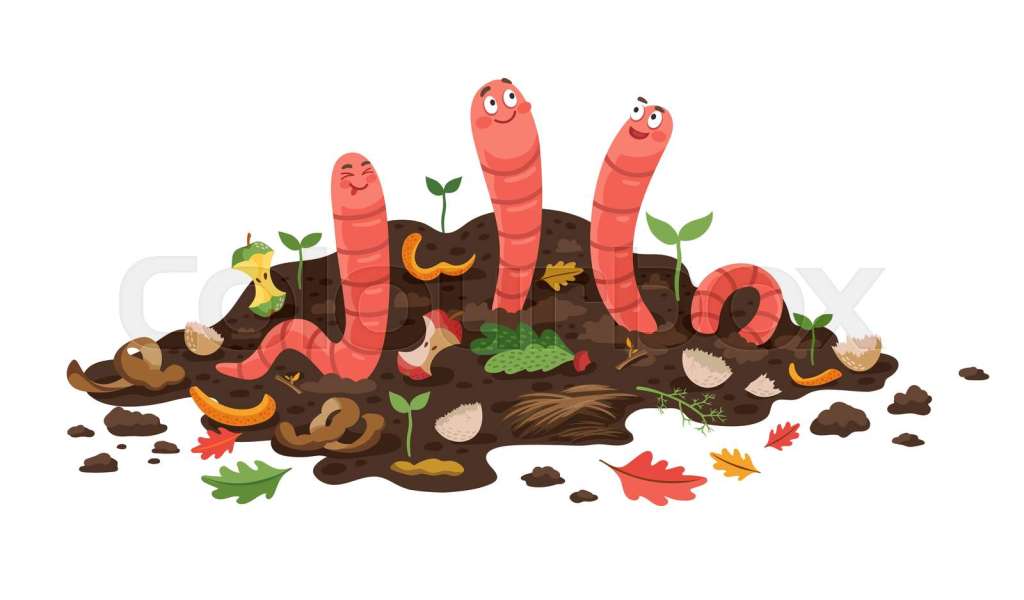
Charming Worms

Aristotle called them the ‘intestines of the earth’. Cleopatra declared them to be sacred and forbade Egyptian farmers from removing them from the land. Japanese religious lore has a story about them. Certain of the Shinto gods decided to create the world’s creatures from living clay; formulating, in turn, animals, birds, fish and insects. At each stage their creations asked: ‘What shall we eat?’ When they created Man, he was told to eat everything. Then, the gods noticed some small clay scraps that had been dropped and decided to create worms, which they instructed to live underground and eat soil – although they could come to the surface from time to time in search of anything they found edible.

These creatures are what we call earthworms. Archaeological evidence suggests that worms have been around for 600 million years. These underground creatures hardly made news or were subjects of serious scientific research. It was Charles Darwin who studied earthworms for 39 years, who reaffirmed the value of these lowly creatures when he said, “It may be doubted whether there are many other animals in the world which have played so important a part in the history of the world than the earthworm. Worms are more powerful than the African Elephant and are more important to the economy than the cow.”

Darwin’s observations, investigations, conclusions and pronouncements were published in 1881, six months before his death under the title The Formation of Vegetable Mould through the Action of Worms. Darwin estimated that an acre of mid-19th-century arable land, the result of centuries of gentle pummelling and fertilisation by farm animals and traditional toil by countrymen, contained 53,000 earthworms. He further calculated that, over the course of a year, the worms moved 15 tons of soil to the surface – a process known to agrology as bioturbation.

Many years later, in more recent times, when much of the soil surface has been degraded from the onslaught of chemicals and industrial agricultural processes, scientists have once again recognized that the presence and activities of earthworms have a dramatic effect on the soil habitat.

While eating the soil, the earthworm absorbs the nutrients it needs and casts off the rest. Under ideal conditions, earthworms are believed to eat and digest their entire weight in castings in a mere 24 hours. The nutrient content of the castings, which have gone through the earthworm’s digestive system, was found to have 5 times more soluble nitrogen, 7 times the soluble phosphorus, 11 times the soluble potassium, and 3 times the soluble magnesium plus a smaller amount of calcium. Most earthworms also mix the plant litter and organic matter into the soil, increasing the speed at which they decay and release nutrients into the soil. In these ways, earthworms recycle nutrients from dead plants and other soil organisms so that they can be used again.

Earthworms are also incomparable builders of soils. Their means of travel thorough the soil — pushing, tunnelling and eating their way through all kinds of organic matter. soil opens it up for the benefit of aeration and water seepage. The underground burrowing systems that they create increase the amount of water and air that reaches the plant roots and other soil organisms, helping their growth. Soil that has a good population of earthworms is always easier to work and plants seem to thrive in it. Thus earthworms have been given new sobriquets such as “farmers’ friends’ and ‘ecosystem engineers’.

Earthworms are getting their due. One of the quirky celebrations of these usually hidden-from-sight creatures is a festival held in some parts of England–the Festival of Worm Charming. While we know of snake charming and snake charmers, this one is certainly not part of a regular vocabulary.

Traditionally worm charming, worm grunting and worm fiddling refer to methods of attracting earthworms from the ground, mainly through creating vibrations on the ground.

Darwin was perhaps the first to study earthworm sensitivity or otherwise to light, warmth and sound. His experiments included placing lamps, candles and hot pokers close to them, blowing tobacco smoke over them, sounding a tin whistle and playing a piano close by and having his son play a bassoon loudly. He observed that it was only vibrations that caused them to become active.

Scientific experiments apart, using vibrations to bring worms to the surface has been traditionally used by fishermen to collect worms as bait. In recent years, this activity has taken the form of a competitive sport.

An International Worm Charming festival is held every year June in Devon in England. As with all competitions, this one has its rules and etiquette. 

The aim of the competition is to “charm” the earthworms to come to the surface of the soil by creating vibrations on the ground. Traditionally this was done by sticking a rod called a ‘stob’ (like a pitchfork) in the dirt and smacking it with a simple rod known as a ‘rooping iron’. This competition allows different ways of creating the vibrations—tapping the soil with feet, “twanging” the ground with a fork in the soil, but strictly no digging.

The wormers are given a 3×3 meter square of land to fiddle, grunt, and charm their way to championship glory by collecting more worms than anyone else.

Each teams comprises 3 members: a Charmerer, a Pickerer and a Counterer.

Once all teams have found their plot everyone is allowed to begin “Worming Up”. This is doing whatever you need to do to get the worms out of the ground without digging, forking or pouring harmful liquids onto plots.

“Worming Up” lasts for 5 minutes after which the competition really gets underway.

 15 minutes are allotted to all teams to get as many worms charmed out of the ground.

Any team or competitor caught cheating will be publicly humiliated and almost certainly disqualified.

The International Judges’ decision is final.

All worms must be returned unharmed to the ground after the competition.

The Worm Master presides over the Festival. The Official Cheat tempts entrants by offering them worms so that they can cheat. Old Father Worm Charming offers advice and guidance to would be worm charmers. Finally, there’s the International Judge who is the rule of law in all things to do with arbitration in worm charming disputes.

What a way to spend a sunny summer’s day! While India is known as the ‘land of snake charmers’, this festival may well lead England to be known as the ‘land of worm charmers’!

–Mamata

Desperately Seeking Women-Power

The Global Gender Gap Report 2023 is out, and the news is not good for us in India. Well, if you are an untiring optimist who insists on seeing a glass with some drops of water in it as half-full, you will stop me and scold me. For after all, India’s ranking in the list of 146 countries which have been studied, has gone up 8 places, so that we stand at 127th, up from 135th last year.  

But for me, as I go through the report, I don’t know see how we can take any comfort from this. Even if we are to view ourselves in a comparative light, we need to pause and consider that Nicaragua and Namibia rank at 7th and 8th, compared to our 127!

The report measures gender gap on four major dimensions:  Economic Opportunities, Education, Health, and Political Leadership.

The first bucket, to quote the report ‘contains three concepts: the (labour) participation gap, the remuneration gap and the advancement gap’. The second bucket of Educational Attainment ‘captures the gap between women’s and men’s current access to education through the enrolment ratios of women to men in primary-, secondary- and tertiary-level education’. The Health and Survival sub-index provides an overview of the differences between women’s and men’s health by looking at sex ratio at birth, and the gap between women’s and men’s healthy life expectancy. The last bucket of Political Empowerment measures the gap between men and women at the highest level of political decision-making through the ratio of women to men in ministerial positions, and the ratio of women to men in parliamentary positions.

Courtsey UN Women Insta

If we look at India in terms of these dimensions, less than 30 per cent of women participate in the labour market. Women make up 89 per cent of workers in informal sector, which means they are probably underpaid, do not have job security or any other benefits, and work in unsafe, unhealthy and unregulated conditions. Less than 2 per cent firms in India have female majority ownership, and less than 9 per cent have females in top management positions.

Close to 30 per cent women report having faced gender violence in their lives.

We rank 117th in terms of percentage of women in Parliament and 132nd in terms of women in ministerial positions.

That is underwhelming in terms of performance and overwhelming in terms of the task ahead. A practical way to start may be by looking at the factors that are measured to arrive at the rankings. This can probably help a government, an organization and a community and a family work out specific plans and targets.

To get into the details of the employment and economic opportunities segment, the factors include:  labour-force participation (including unemployment and working conditions); workforce participation across industries; representation of women in senior leadership; gender gaps in labour markets of the future (including STEM and AI related occupations); gender gaps in skill of the future.

What might that mean for a government? Well, maybe setting targets or incentives/disincentives for public and private sector for employment of women? Importantly government must ensure workplaces, public spaces and transport safe, so that women are able to travel and work without fear. To a large extent, government does walk the talk on gender positions? Many of our Ministries and Departments are headed by women-bureaucrats; the largest public sector bank has been headed by a woman; we have women heading government research labs and scientific institutions, playing a part in our space and nuclear programmes, now full-fledged in the armed forces, etc. But doing this even more aggressively will set an example to the private sector.

What might that mean for a corporation? That they move forward from celebrating Women’s Day to taking a hard look at their policies, systems and culture to see how they can become truly inclusive employers.

What might it mean for educational and training institutions: That they don’t, by action or inaction, deny girls opportunities; that they counsel and encourage them to take up STEM courses and careers.

What does it mean for communities? That they examine their conscious and sub-conscious biases, and understand how these affect their actions; that they make the community safe for girls and women.

And most importantly, what does it mean for a family? That they don’t discriminate against girl-children; that they provide them opportunities; that they don’t belittle their aspirations and abilities; that they don’t deny them their rights; that they help them fight their battles and give them a winner’s mindset.

It’s a long, hard journey. If we aspire to be at least in the top half rather than the bottom half of the ranking,the journey has to begin with every individual—in our hearts, minds and actions, today.

–Meena

https://www.weforum.org/reports/global-gender-gap-report-2023

Celebrating the Sun

We have just crossed the Summer Solstice on 21 June. This is a major celestial event which results in the longest day and shortest night of the year in the Northern hemisphere. The word solstice is a combination of the Latin words ‘sol’ meaning sun and ‘stice’ meaning standstill. As the days lengthen, the sun rises higher and higher, till the movement of the Sun’s path north or south appears to stop in the sky before changing direction.

The summer solstice occurs when the tilt of Earth’s axis is most inclined towards the sun and is directly above the Tropic of Cancer. It officially marks the beginning of astronomical summer, which lasts until the autumn equinox falls on 23 September, when day and night will be of almost equal length.

In most parts of the Northern hemisphere winter is long, dark, cold, and harsh. Nature seems to slow down; the ground id frozen and often snow-covered for months, and many plants and animals go into hibernation mode. The spring season marks a slow awakening, with life starting to stir again. It is only around the middle of June that “summer” really sets in. In the days of yore, when people’s lives, especially agriculture, were closely linked with the cycles of nature, this ‘return of the sun’ was a time to celebrate the passing of the months of suffering and hardship, and the appreciation for the sun that would bring harvests.

Summer Solstice is one of the most ancient of human festivals. For the early societies the longest day had both practical and religious significance. It was a fixed point around which the planting and harvesting of crops could be planned, but also marked the spiritual side of the shifting of the seasons.

Many traditions are linked to this celebration, especially in different parts of Europe. In Ireland celebrations date back over 5000 years. In ancient times, people all over the northern hemisphere would celebrate this time with games, stories and feasting, and lighting of bonfires. Since time began, fire has been regarded as a symbol of the sun and so large fires were lit on this occasion

In ancient Greece, the summer solstice festival of Kronia to honour the god Cronius, the patron of agriculture. It was a day when class distinctions were abandoned and masters and slaves celebrated side-by-side. A tradition still followed by some is to trek up to the peak of Mt Olympus on this day.

In ancient Rome, the festival of Vestalia celebrated Vesta the goddess of hearth and home and family on this day. During the week of Vestalia, only women were permitted to enter the Vestal temple, and a cake was baked using consecrated waters from a spring considered sacred. Even today Italians celebrate the solstice as a time of new beginnings. La Festa di San Giovanni is a festival observed with similar rites of water and fire as the ones performed in ancient times.

Many Native American tribes celebrated the longest day of the year with a Sun Dance, while the Mayas and Aztecs used the day as a marker by which to build many of their central structures, so that the buildings would align perfectly with the shadows of the two solstices, summer and winter.

In Mexico’s Yucatan Peninsula, the main pyramid at Chichén Itzá, known as the Temple of Kukulcan, is constructed in such a way that during the Summer Solstice the sun casts perfect shadows on the south and west sides so that it looks to be split in two.

Better known are the Neolithic structures at Stonehenge in England. There is still a mystery about who constructed these and for what purpose. One theory is that it was built to worship deities of the Earth and the sun. Stonehenge was ingeniously designed built to align with the sun on the solstices. On the summer solstice, as the sun rises behind the heel stone, the ancient entrance to the stone circle, the ascending rays of sunlight align perfectly with a circle carved in stone in the centre of the monument. Even today thousands throng Stonehenge on summer solstice to witness this breath-taking sight and join in the celebrations that include dance and music.

While June signals the start of summer in many parts of the Northern hemisphere, in a country like India, this is the peak of summer. In a large part of the subcontinent, the sun blazes and the earth is parched; in some parts it heralds the onset of the monsoon rains that will gradually move northwards, quenching the thirst of the soil and its inhabitants. While we celebrate the change of seasons with many different festivals, we do not traditionally celebrate summer solstice as a festival

However, in the last few years India had taken the lead in adding a new day of celebration on 21 June. This is International Day of Yoga Day to coincide with the summer solstice. The day was proclaimed by the United Nations General Assembly in 2014, in recognition of the universal appeal of Yoga, owing to its demonstrated benefits towards immunity building and stress relief.

While yoga is a philosophy and science in itself, one aspect that struck me in the context of the summer solstice and the celebration of the sun, is the importance of Surya Namaskar or Sun Salutation in yoga. This is a set of a sequence of 12 yoga poses which provide a complete workout which has a positive impact on the body and the mind.

There are 12 mantras that accompany the surya namaskar postures, which praise the different qualities of the Sun God or Surya. These are:

Praise to the One:

Who is the friend of all

Who shines brightly and is filled with radiance

Who eliminated darkness and brings in light

Who is filled with brilliance and lustre

Who traverses the entire sky and is all-pervasive

Who provides nourishment and fulfils desires

The one with a golden-hued lustre

The one who shines with the light of innumerable rays

The one who is the son of the divine cosmic mother Aditi

The one who gives life

The one who is worthy of all glory

The one who is wise and illuminates the heavenly world.

While it is marked in different ways, and has different cultural contexts, Summer solstice is a reminder of the how vital the sun is for all life.

–Mamata

Sky-gazing

A few weeks ago, when we were in the Western Ghats, the resort manager kindly set up a telescope in the evening. It was for the kids who were our co-guests, but ultimately it was the adults who hogged the eyepiece! It was amazing to see the craters on the moon; Mars and Venus; and sundry stars. And we were reminded once again of the fascination that the sky has always held for humans.

The conversation obviously took a turn towards raking up memories about telescopes. Techy-types among the group reminded us that the magnification power of a telescope essentially indicated the size of an object observed inside the eyepiece relative to the size of that object when observed with the naked eye. For example, when looking at Mars at 50x magnification, the red planet will appear 50 times larger than if one looked at it with one’s eyes.  Factors like light pollution, atmospheric turbulence, temperature, wind, and much more affect the viewing experience. When viewing conditions are bad, the view will be blurry, fuzzy, shaky and unstable.  That is generally why telescopes are set up in high altitudes: the atmosphere is thinner at higher levels, and makes for better viewing. Air quality is important for good observations because any particles in the air will reflect light–so higher altitudes work better in this aspect too. Also, telescopes need to be located as high above the clouds as possible. And of course remote areas have less pollution.

Humans have been gazing through telescopes since the 17th century. The earliest existing record of such an instrument is a 1608 patent submitted to the Dutch government by a spectacle-maker called Hans Lipperhey. While the actual inventor of the refracting telescope is not known, Lipperhey was the one to file the patent. Scientists all over Europe were fascinated by the invention and many started their own attempts to come up with one. Galileo built his own version a few years afterwards, and started making his telescopic observations of celestial objects. The word telescope itself was coined in 1611 by the Greek mathematician Giovanni Demisiani for one of Galileo Galilee’s instruments, and translates roughly into ‘far-seeing.’

To most of us, the word ‘telescope’ probably brings to mind the Hubble, launched by NASA in April 1990 and still in operation today.  What we refer to as the Hubble Telescope is in fact a large, space-based observatory. It has been in operation for over 31 years, and in fact, its observation abilities have grown with time because new, cutting-edge scientific instruments have been added to the telescope over the course of the years through five astronaut servicing missions. It has made over 1.5 million observations over the course of its lifetime including seeing the collision of a comet with Jupiter, and has discovered moons around Pluto. It is truly one of the instruments which is shaping our understanding of the world.

Indians of course have always been fascinated with the skies, and down history have built different kinds of instruments to study the stars and other celestial objects. The observatories built by Maharaja Sawai Jai Singh of Jaipur between 1724 and 1734–the Jantar Mantars in Jaipur, Delhi, Ujjain, Varanasi, and Mathura being among the recent ones. 

India’s focus on space observations has continued into the modern era, with ISRO launching our first dedicated Space Astronomy Observatory—Astrosat–in September 2015. India’s biggest telescope currently is the 3.6m Devasthal Optical Telescope, a custom-built instrument of great complexity. Built in collaboration with Belgium and Canada, this telescope has the distinction of being largest telescope in India for the study of celestial objects at optical wavelengths. Devasthal is a district of Nainital, at a height of about 2,450 mt.

Women have had their share in these explorations. The ancient scholar Gargi (somewhere between 800-500 BC), engaged in questions about astronomy. In a dialogue with Yajnavalkya, she asks ‘what is that which pervades above the heavens, below the earth and in between the two (heaven and earth)’.

In the present day too, we have our share of astronomical stars (pun intended).  G. C. Anupama, the former Dean and Senior Professor (retired), Indian Institute of Astrophysics (IIA) is a world renowned astronomer. She has served as president of the Astronomical Society of India (ASI), the first woman to head this association of professional astronomers.  She is a member of the Indian core team which is part of the international effort to establish the thirty meter telescope (TMT) in Hawaii, USA, as also the principal investigator of the project which led to the establishment of the 0.7m wide field telescope at Hanle near Leh in Ladakh, the world’s ninth highest site for optical, infrared and gamma-ray telescopes in the world.

Exploring the skies is fundamental to the human quest for understanding ourselves. And it can set children on a course to study the world around us scientifically. If you don’t want to invest in a telescope which may cost in the tens of thousands, if not in the lakhs, do check out DIY telescope kits, available for as little as Rs. 1000 (one such option available at https://scienceshop.vascsc.org/). Who knows, you could be starting some kid out to a journey to ISRO or NASA—if not the stars!

–Meena

A Millets Tale

Once upon a time, in a forest far away there lived a young girl. The girl had lost her parents when she was just a baby, and she had no other family that she knew of. She continued to stay by herself, and grow up in the forest, the place that she knew as home.  But she had many friends in the forest. She knew all the trees and plants, and they gave her their fruit, seeds, and flowers, different ones in different seasons. She knew all the birds and animals that lived there, and could recognize them by their calls and pugmarks. She knew the springs where cool fresh water flowed, where she could wash, and bathe and drink from. And she also knew that by planting some seeds in the earth, before the rains, would lead to a small crop of plants that she could eat, some for their leaves, some for their roots, and some for the seeds as they ripened. The seeds were of many kinds, some tiny, some larger, and of many colours—pearly white, greenish grey, reddish brown, and many shades of yellow.

The girl in the forest grew up to be strong and healthy young woman. She also grew into a beautiful and graceful maiden. One day as she was walking through the forest, humming a tune, she heard an unusual sound. It was the sound of hoof beats. Most animals in the forest walked and ran on nimble feet, making hardly a sound as their feet touched the ground. This clip clop sound was not one that she had heard before. As the sound grew closer, the girl hid herself behind a tree and peeped cautiously and curiously. From the thicket there emerged a horse, and on the horse rode a handsome young man. The girl had never seen such a sight before. She could not resist stepping away from her hiding place to get a better look.

The rider was a young prince on his way back to his kingdom. He too had never seen such a beautiful maiden before. It was love at first sight! The prince got off from his horse and stood before the lovely lady who was looking at him with undisguised curiosity. She was so different from all the ladies that he met, ladies who acted coy, who dressed in expensive silks and velvets, and were adorned from head to foot in shining jewels. After all he was a prince, the king-to-be, and every maiden in the kingdom dreamed that she would capture his heart and, someday, become the queen.  

This young woman was clad in the simplest of garments, but her skin and hair shone like silk, her face exuded a glow that came from within, and her limbs were lithe and strong. She stood erect and fearless before the young man, innocent but self-assured.

The prince was sure that this was the woman who would be his wife. He spoke gently to the maiden, but put forth his proposal. The young girl was also taken with the young man. She had no idea about kingdoms and kings and princes, and no dream or desire to live in a palace and be a queen. She liked the young man for what he was. And she was of an age when she felt that she was ready for adventure. She said yes!

The prince and the maiden returned to the palace, and were wed. With time the bride settled into her new life and role. She learned to wear the finery, and the manners of royalty. But she could not easily relish the meals that were served. Every meal was like a feast. There were many kinds of bread made from the finest refined flours, numerous dishes rich with oil, butter and spices, and the widest array of sweetmeats laden with sugar and ghee. These were prepared by the finest chefs in the land. The new bride had never, in her simple life in the forest eaten such heavy food. Her body could not digest the extravagance of seasonings and ingredients.

After some time the young woman found that she her body was changing. She felt lethargic; without the energy that she once had to walk long distances, climb trees, work with the soil—digging, planting, tending, harvesting. Her once sinewy limbs were no longer as strong as they once were, and she was becoming plump like the doves that cooed in the courtyard. Her taste buds were satiated; they no longer relished the overpowering deluge of flavours.

One day the young royal sneaked out of the palace in disguise. She went to the local market. As she walked around she saw the heaps of fresh vegetables and fruits and pictured these as she had once seen them, hanging from the branches, and growing from the soil. She came to a grain merchant’s shop and there she spotted the familiar seeds and grains that had sustained her in her days of living in the forest. She realized that these were what her body had been craving. She got these different seeds packed and returned, still incognito, to the palace.

Back in her luxurious surroundings, the queen-to-be got some of these seeds roasted and started having them for breakfast. The kitchen staff was taken aback. These were what poor people ate. How can a rich and royal personage want to eat such humble cereals? But their duty was to do as they were instructed.

 One day her husband found her eating her breakfast of multi-coloured seeds and wanted to know what they were, and why she was eating them. She said that for her these were as precious as pearls, because these are what had sustained her in her childhood and youth. It is these staples that had given her the nutrients and energy that she needed to stay healthy and active. She requested that henceforth, these seeds should become a part of the royal menus. As a royal prerogative she gave these “poor man’s” seeds their names.

The ‘pearls’ were called Bajra, Jowar and Cheena. The ones that were in different shades of yellow, green-grey, red-brown, that reminded her of the colours of the forest were named Kangani and Kakun, Kodo and Proso, Ragi and Kutki, Kuttu and Rajgira.

And so it came about that these poor man’s seeds became a part of the royal kitchen and diet. The queen-in-making devised new recipes and dishes where these could be tastily used, and the chefs added their own touches to these. The ‘pearls’ proved their value. The palace residents began to feel lighter, healthier and stronger.

Time passed. The young bride became the queen, and in time, she and the king also passed on. As with the cycle of change, there were later generations that went back to the rich cuisines that once signified wealth and status. With that came also the effects on people’s health and well-being.

 Until one day a newly-married princess discovered, among the dusty tomes in the palace library, a book of recipes of the ‘pearl seeds’.

We have come full circle again.

Celebrating Millets!

–Mamata

A Windy Day

Is it windy outside? Not really! Then why this piece? Well, it is in anticipation of Global Wind Day, a worldwide event that is marked annually on 15 June. It is ‘ a day for discovering wind energy, its power and the possibilities it holds to reshape our energy systems, decarbonise our economies and boost jobs and growth.’

Fair enough!  Today, winds are gaining huge importance because of their potential to add to the basket of energy sources—a clean energy source that will help mitigate climate change challenges. It is because of this promise that wind power has grown rapidly since 2000, Global installed wind generation capacity has increased by a factor of about 100 in the past two decades. In 2021, the total wind generation capacity globally was 830 Giga Watts. India is proudly at Number 4 position in the world, with an installed capacity of 40+ GW. And there is still a long way to go, with estimated potential for wind in India being 200 GW.

Just to double back, what is wind? Put simply, it is the the movement of air relative to the surface of the Earth. Winds play a significant role in determining and controlling climate and weather.

And how is electricity produced from winds? Basically, it is by converting the kinetic energy of air in motion into electricity. Wind rotates rotor blades of a turbine, which converts kinetic energy into rotational energy. This rotational energy is transferred by a shaft to the generator, thereby producing electrical energy.

Windmills
Domestic windmills are not common but I saw this somewhere near Mandya, Karnataka

So yes, wind is a harbinger of hope for the future.  Though maybe not without its own issues. Wind energy can obviously be produced only where the winds are strong and fairly sustained through the year—and there are not too many places like that in the world. Through the day and through the year, wind intensity changes, so that wind energy is not generated throughout—it is an intermittent source.  And of course, winds can be unpredictable, so the generation cannot be assured.  Wind turbines are noisy and also change the landscape drastically. Wind energy potential is highest in remote places, which makes investment in transmission lines and related equipment essential. They also have impacts on local biodiversity and even migratory birds. While the cost of producing wind energy has come down in the last few years, and it is a competitive source, technology and R&D have to progress further so that costs may be brought down.

India has committed to producing 140 GW of wind energy as part of its climate ambitions.

But for us in India, winds are not important just for their energy potential.  Lives and livelihoods here have always centered around the monsoon winds—which bring or don’t bring us our rains. The monsoon–a periodic wind in the Indian Ocean and southern Asia—is our lifeline. The summer monsoon usually happens between April and September and bring us our heavy rains. The winter monsoon, which lasts from October to April don’t bring much rain as far as India is concerned. The English word monsoon comes from the Portuguese monção, but ultimately from the Arabic  (mawsim, “season”). 

So all the more reason to understand the role of winds in our lives, and mark Global Wind Day!

And a fun fact to end with:

Ramakkalmedu, also called God’s Own Hill-station, in Idukki district, Kerala, is the windiest place in India and one of the windiest places in Asia. Throughout the year the wind speed here is around 35 km/hr. Located at a height of about 3500 feet, the place is home to–what else–a wind energy farm with a capacity of 12.5 MW!

–Meena