
There are artists who work with oil, watercolour, or clay—and then there is John Knuth, who collaborates with flies. Yes, flies. The kind most of us spend our lives trying to keep out of our homes are, in Knuth’s studio, co-creators in a process that is as fascinating as it is more than a little yuck.
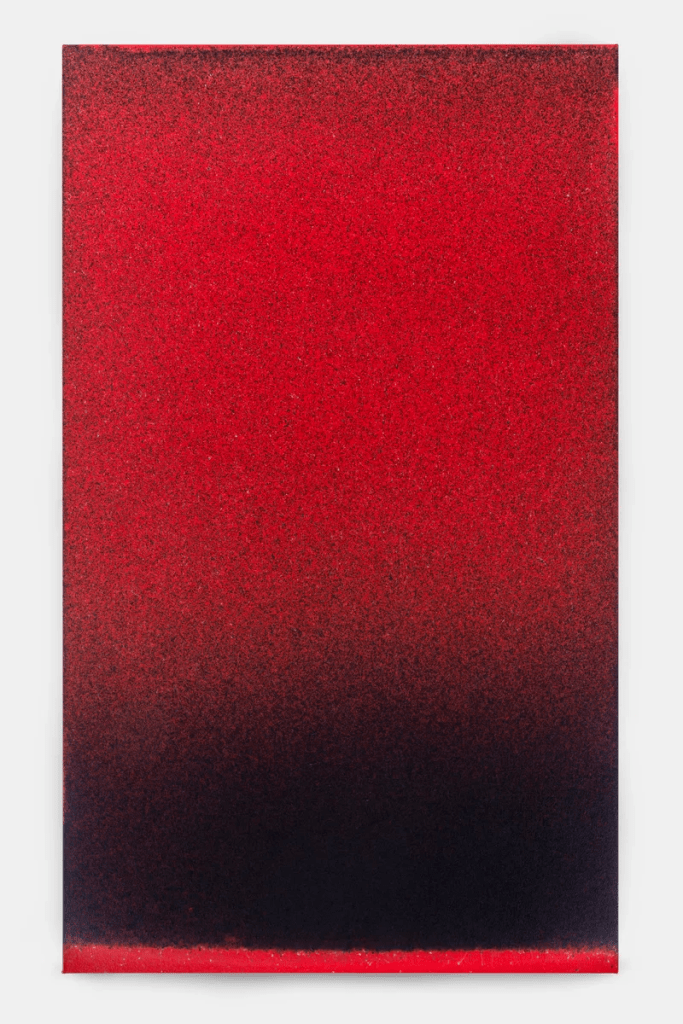
Knuth’s technique is as unusual as it sounds. He feeds houseflies a mixture of sugar and watercolour pigment, then lets them loose over canvases. What follows is a kind of chaotic choreography: the flies land, wander, and of course regurgitate. These tiny deposits of coloured liquid accumulate into intricate patterns. From a distance, the works can resemble abstract constellations or delicate nebulae. Up close, however, the viewer is reminded of their origin—and that is where the discomfort, and perhaps the brilliance, lies.
At first glance, the idea feels deliberately provocative. Why flies? Why regurgitation? Why something that many would consider “yucky”? But Knuth’s work sits within a much larger artistic tradition—one that embraces the visceral, the biological, and the taboo to challenge our assumptions about art itself.
Consider Damien Hirst, whose work has long grappled with life and death. His installations featuring animals preserved in formaldehyde are iconic, but he has also worked with live flies—allowing them to hatch, feed, and die within gallery spaces. The lifecycle becomes the artwork. Similarly, Anicka Yi works with bacteria and scent, creating installations that grow, evolve, and even smell, drawing attention to the invisible microbial worlds that surround us.
Marc Quinn went inward, creating a self-portrait sculpture from his own frozen blood, while Chris Ofili incorporated elephant dung into his richly layered paintings.
Performance artists have pushed the boundaries of the body itself. Marina Abramović has repeatedly tested endurance and vulnerability, placing her body at the mercy of audience interaction. Stelarc has taken a more techno-biological route, suspending himself with hooks and even growing an ear on his arm through tissue engineering. Meanwhile, ORLAN has used surgical procedures as a medium, turning her own body into a site of artistic transformation.
Other artists have embraced decay and impermanence. Dieter Roth used perishable materials like cheese and chocolate, allowing them to rot and transform over time. Sam Taylor-Johnson captured the slow decomposition of a bowl of fruit in a time-lapse video, turning decay into a strangely mesmerizing visual experience.
Even animals—living or dead—have been incorporated in ways that unsettle viewers. Hermann Nitsch, associated with the Vienna Actionists, used animal blood and carcasses in ritualistic performances, while Eduardo Kac explored bio-art by creating genetically modified organisms, including a fluorescent rabbit.
Seen in this broader context, Knuth’s fly paintings feel like part of an ongoing conversation. What ties these diverse practices together is not merely their ability to shock, but their trying to expand the vocabulary of art. They challenge placing ink and paint above organic matter, permanence above decay, and control above chance.
Admirers say there is something quietly philosophical in Knuth’s process. By relinquishing control to flies—creatures we associate with randomness and disorder—he disrupts the notion of the artist as a creator who works with intent. The flies do not “intend” to make art; they simply follow instinct. And yet, the outcome is aesthetic. So is art defined by intention, or by perception? If something moves us visually, does it matter how it was made?
At the same time, Knuth’s work carries an undercurrent of commentary on consumption and excess. The flies, drawn repeatedly to sugar, mirror human appetites, of craving and consumption, overconsumption and waste.
Of course, not everyone is convinced. Critics often argue that such works lean too heavily on shock value, that the concept overshadows the craft. And it is a fair question: would these works hold the same appeal if we did not know how they were made? Perhaps not. But then again, conceptual art has always relied as much on context as on craft.
For viewers, encountering these practices can be an exercise in expanding one’s comfort zone. They ask us to look beyond initial reactions—whether fascination or revulsion—and to consider deeper questions about beauty, authorship, and the natural world. They remind us that art does not always have to be clean, controlled, or even pleasant.
Yucky? Perhaps. But also, undeniably, thought-provoking. And maybe that is precisely the point.
–Meena
Pic: Redhook Blackout by John Knuth. https://www.hollistaggart.com/

 Millennial Matriarchs