When Letters Took Flight: The First Air Mail

As a member of the generation before email and ‘texting,’ and one who has always been an avid letter writer, there are many memories of trips to the local Post Office to buy stamps and personally drop the letter in the friendly red post box. The process was more complicated when mailing a letter to someone who was not in India. This meant taking a decision on whether the post should be sent by surface mail or air mail. Air mail was more expensive, albeit faster. There were two options for the air mail—the standard pre-stamped aerogramme, and the challenge to squeeze in as much text as possible in the available space, and an envelope which could accommodate more sheets and hence more matter. But then there was the issue of weight. The envelope would be weighed and the postage decided depending on the weight! Hence an earlier exercise involved acquiring the lightest, thinnest writing paper. (There was an ‘onion skin’ paper as I recall which was in itself more expensive!) Ah, the sweet travails of written communication then!

One always associated the entire concept of ‘air mail’ as having its origin in the West. Many decades later, I discovered that the very first air mail delivery happened in India!

The story goes back over a century ago. India was still under British rule but Indian festivals and fairs went on. One of the biggest of these was the Kumbh Mela held at Allahabad. It was to coincide with the Kumbh Mela of 1910-1911 that the then Lieutenant Governor of the United Provinces Sir John Prescott Hewett organized a national exhibition in Allahabad. It was a huge show housed in buildings with elaborate architecture. The twelve sections included exhibits for engineering as well as agricultural sciences, textiles, forestry, and display of handicrafts from around the world. There were cultural programmes featuring prominent singers and dancers of the day. The exhibition ran from December 1910 to February 1911.

As part of the many attractions, Captain Walter George Windham, one of the influential pioneers of aviation was invited to bring some flying machines from England to Allahabad and organize demonstration flights. These would be the first planes to fly in India. Captain Windham brought two aircraft to Allahabad and organized aerial demonstrations by the two pilots that accompanied the aircraft. One of these was a 23- year-old French pilot Henri Pequet.

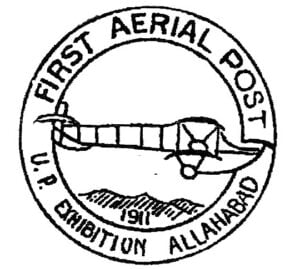
When Captain Windham was in Allahabad, the Rev. Holland, warden of a hostel for Indian students in Allahabad asked him if he could help raise some funds for repair of the hostel and construction of a new one. Windham had the idea that sending post by air would attract a lot of attention, and hopefully raise funds. He obtained permission from the India Post Office. To send through this, at the time novel means, people were asked to send mail to Rev. Holland, addressed and stamped, at the regular rate, but requested to donate a nominal sum of 6 annas for every letter or card which would be sent on the flight, as a donation for the new buildings. This mail would be part of the airborne postal service. A special postmark was authorised for this batch; it was designed by Captain Windham and the die for this was cast at the postal workshop in Allahabad. It was four cm in diameter and magenta in colour. All postal arrangements were handled by the Exhibition Camp Post Office.

On 18 February 1911, a Humber-Sommers bi-plane, piloted by Henri Pequet was loaded with 6,500 postal articles with the special postmark. The flight took off from the Allahabad polo field, witnessed by thousands of spectators. It landed near Naini railway station where there were no crowds, but a lone postal official who took the mail bags. From there, the post would continue to its destinations by the regular route, and with the regular charges.  The distance covered was approximately 11 km and the flight time was 13 minutes! Having delivered the first officially sanctioned airborne postal consignment in the world, Peqeut got back into the plane and returned to Allahabad. 

The use of a plane for delivering letters received world-wide attention once the letters with the special post mark reached England. 

Before this, some transport of post by ‘air’ was not entirely unknown. During the 1800s balloons and gliders carried some mail. The first sustained powered flight by the Wright brothers on 17 December 1903 did not carry any mail, but in the decade that followed, pioneering pilots would carry ‘unofficial’ mail on their short flights. This did not have official postal authorization. The Allahabad to Naini flight carried the first ‘official’ air mail. Following this, the world’s first scheduled airmail post service took place in the UK between the London suburb of Hendon and the Postmaster General’s office in Berkshire on 9 September 1911, as part of celebrations for King George V’s coronation.  

Subsequently, while the rest of the world saw rapid developments in postal air services, there was not so much happening in India. The first regular air service between India and UK was opened in 1929. Soon after that the first domestic route was opened between Karachi and Delhi. The Indian State Air Service as it was designated, ran for just two years during which it completed 197 scheduled flights, and carried 6,300 kg of mails. After its closure, the Delhi Flying Club was given permission to operate an exclusive mail service between Delhi and Karachi. Its one light aircraft carried over 7000 kg of mail during its operational period of 18 months. The big leap came in October 1932 when JRD Tata flew a Puss Moth airplane from Karachi to Bombay. The inaugural flight of India’s first air service was to become Tata Sons Ltd, and later grow into Air India, carried a load of mail. Karachi was chosen as the starting point because Imperial Airways terminated there with the mail from England, and the mail route chosen by Tatas was Karachi-Bombay-Madras (via Ahmedabad and Bellary). At the beginning the airplanes used were so small that the service was restricted to mail, but a single passenger was occasionally allowed to sit on top of the mail bags — usually with his heels higher than his head! Meanwhile the mail load had increased from about 10,500 kg in 1933 to about 30,000 kg in 1935. Larger aircraft were introduced only in 1936. While the government refused to subsidize the service, it could be sustained by a ten-year mail contact with the Government for transport of mails.

After Independence there was need for delivery of mail that was faster than through road and rail services. Daytime flights could carry only passengers. In 1949, Night Air Mail was introduced in which mail from Delhi, Calcutta, Bombay and Madras was collected at designated points in each city, delivered straight to the airport and flown to Nagpur, where it was sorted and flown back to the respective cities the same night, and delivered the next day. In the sixties there were as many as ten flights carrying mail to Nagpur in a single night. The service was discontinued in 1973. Subsequently the Indian Postal Service introduced many services including Speed Post. Today couriers and electronic exchange of information have overshadowed the work of the postal service. The postman, once eagerly awaited, and letters, eagerly opened and read and reread, have almost faded from memory. But it is important not to forget the pioneering efforts that brought us here. 

–Mamata

Complexifying the Simple

If there is a monument to human overthinking, it has to be the Rube Goldberg machine.

Named after the American cartoonist Rube Goldberg, these contraptions perform the simplest of tasks—turning on a light, pouring a glass of water, popping a balloon—in the most complicated way possible. A marble rolls down a ramp, tips a spoon, flicks a switch, releases a toy car, which hits a domino, which startles a rubber duck… and several improbable steps later, the job is done. Eventually.

At first glance, Rube Goldberg machines seem like elaborate jokes. In fact, they began as precisely that. In the early 20th century, Goldberg drew cartoons of absurdly complex inventions that parodied America’s growing obsession with technology and efficiency. His most famous series, “Inventions,” featured machines with labels like “Self-Operating Napkin” or “Simple Way to Take Your Own Picture.” The humour lay in contrast: why build a 20-step mechanical circus to do what your hand can accomplish in two seconds?

Yet over time, the joke evolved into a genre.

At their heart, these machines are celebrations of cause and effect.

Each step must trigger the next with precise timing. A falling object transfers energy. A lever multiplies force. A pulley redirects motion. Though they look chaotic, good Rube Goldberg machines are carefully engineered systems. Behind the apparent madness lies an understanding of physics—gravity, friction, momentum, torque.

That’s why they are so beloved in STEM education. Today, Rube Goldberg machines are built in classrooms, engineering labs, art studios, and living rooms. There are national competitions in the United States run by the Rube Goldberg Institute, where students design multi-step chain-reaction machines to complete assigned tasks. The goal is not efficiency but creativity, reliability, and storytelling through mechanics. Building one requires planning, testing, recalibrating, and accepting failure—lots of it. If step 17 misfires, the entire sequence collapses. Students learn quickly that systems thinking matters. Every action has consequences, and tiny misalignments compound.

(From V. Raghunathan’s series ‘How Administrations Work!’ featured in the Financial Express. A satire on administration, based on Goldberg machines).

And yet, beyond physics, Rube Goldberg machines are deeply artistic.

Watching one in motion feels like choreography. There is suspense as the marble pauses on a narrow ledge. There is surprise when a balloon bursts. There is delight when the final flag pops up to declare success.

Modern technology hides complexity behind smooth interfaces. Tap a screen and food appears. Click a button and money transfers. Rube Goldberg machines do the opposite—they expose process. They revel in visible mechanisms, in levers and ramps and strings that refuse to disappear into abstraction.

Perhaps that is why they continue to fascinate adults as much as children.

Unlike automated factories or digital code, these machines often fail in spectacular fashion. A domino tilts the wrong way. A ramp shifts. A candle burns too slowly. The collapse is not embarrassing—it is part of the show. Viewers laugh, builders reset, and the experiment continues.

In this way, Rube Goldberg machines mirror creative life itself. Progress rarely moves in straight lines. We improvise. We overcomplicate. We learn through misfires.

As a STEM tool perhaps most importantly, it fosters curiosity.

Why does the marble move faster on a steeper incline? What surface reduces friction? How much force is needed to tip the spoon? Questions arise naturally when objects misbehave. The machine becomes a laboratory disguised as a toy.

More than a century after Rube Goldberg first skewered modern gadgetry, his name has become synonymous not with satire but with ingenuity. What began as mockery of unnecessary complexity has turned into a celebration of imaginative problem-solving.

Today, there are national competitions in the United States run by the Rube Goldberg Institute, where teams design multi-step chain-reaction machines to complete assigned tasks. The goal is not efficiency but creativity, reliability, and storytelling through mechanics.

Beyond competitions, the aesthetic has spilled into popular culture and design.

In 2003, Honda released its now-iconic “Cog” commercial featuring parts of a Honda Accord arranged in a flawless chain reaction. Gears tipped into springs, springs released bearings, bearings rolled into levers—culminating in the car moving forward. No computer graphics. Just painstaking mechanical precision.

Similarly, the band OK Go transformed chain reactions into performance art in their video “This Too Shall Pass,” filling a warehouse with cascading objects, swinging pendulums, and erupting paint cannons. The machine became choreography. Cause and effect became spectacle.

Kinetic artist Joseph Herscher constructs domestic Rube Goldberg devices that wake him up, butter his toast, or serve tea through absurd sequences of ramps and levers.

And then there are works that stretch the idea into art philosophy. Dutch sculptor Theo Jansen builds wind-powered walking structures known as Strandbeest—intricate skeletal forms that move across beaches through elaborate mechanical linkages.

More than a century after Goldberg first thought these up, his name has become synonymous not just with unnecessary complexity, but with imaginative possibility. What began as satire is now a tribute—to curiosity, to process, and to the delicate chain reactions that connect one moment to the next.

–Meena


A Whiff of Royalty: Mysore Sandal Soap

A recent advertisement for an old soap in a new packing brought back many memories. Any visit to South India, or to the erstwhile Mysore Emporium in Delhi always included picking up several cakes of Mysore Sandal Soap. These were good gifts for friends, and  a special treat for us to use. The rich fragrance of sandalwood was very different from the light flowery fragrances like rose and jasmine that Lux, Cinthol and Rexona, the other popular soap brands of those days had, nor the medicinal smell and feel of ‘healthy’ soaps like Margo, Hamam and Lifebuoy. While Pears soap was a high-end soap that had a very English look and feel, Sandal Soap was regally Indian; sandalwood signalled luxury, and bathing with such soap made one feel like a princess!

It is only recently that I also learned about the fascinating history of this soap.

The saga goes back to the First World War.

But going back further, the kingdom of Mysore was the largest producer of sandalwood in the world. In the 1700s the largest buyer of sandalwood from Mysore was China, where the wood was used to make furniture for the affluent and also used in traditional medicine. In the early 1800s Germany became one of the main buyers of sandalwood for its oil. The Germans already had the know-how for distilling the oil from the wood. At that time Mysore was under British administration; sandalwood was a state monopoly. By the end of the 1800s the demand for sandalwood had risen considerably and it became an important source of public revenue. The demand continued to grow when the British restored the state of Mysore to the ruling Wadiyar dynasty. Sandalwood auctions were held which were attended by representatives of leading international perfumery houses. The process of sandalwood distillation to manufacture oil had, by then, been mastered by German chemists.

The outbreak of World War I in 1914 caused huge disruptions in international trade. Sandalwood exports to Germany were suspended, local auctions of the wood were stopped. With large stocks of sandalwood piling up, and no buyers, the revenue of Mysore State was adversely impacted. The Maharaja of Mysore realized that if the oil from the wood could be distilled to meet international standards, the extract could be exported. This it would be easier than transporting wood, and more lucrative. This was smart thinking!

For the execution of the idea the Maharaja selected Alfred Chatterton who had been principal of the college of engineering in Madras, and appointed him as the Director of Industries in Mysore state. Chatterton teamed up with two English chemistry professors from the Indian Institute of Science in Bangalore to experiment with distilling sandal oil in a lab. After extensive experiments and trials, the team finally discovered the right process to extract sandal oil. They continued to refine the process until they created a  product that would meet international standards. Now it was time to move from the lab to a larger scale of production.

A factory, headed by Chatterton, was opened in Mysore. It was called the Mysore Sandalwood Oil Factory. Production began, and by 1916, high-quality sandalwood oil  was being produced and exported to London. A second factory was opened in Bangalore, adding new equipment and machinery, and soon a third larger factory opened, also in Mysore. Chatterton remained Director for six years during which time he established what was then the largest sandal oil distillery in the world.

Mysore retained a near monopoly in the sandal oil market until about 1930, when it was challenged by Australian sandalwood oil.  

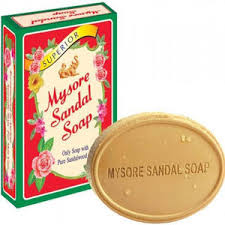
Until then the oil was used primarily in perfume making. But a foreign guest presented the Maharaja of Mysore Krishnaraja Wadiyar IV with a pack of soaps made by using sandalwood oil. Ironically the oil used for the soap had been produced in Mysore! The Maharaja saw an opportunity and discussed this with his trusted and foresighted Dewan Sir M. Visvesvaraya. Both of them were keen to encourage industrial development in the state. They agreed that manufacturing sandalwood soaps would provide such an opportunity. Visvesvaraya was a perfectionist; he wanted that the soap should be of the best quality, but also not so expensive that its market would be limited. He invited technical experts from Mumbai to start experiments on the premises of the Indian Institute of Science (IISc) in Bangalore. He also identified a researcher working in IISc. This was SG Shastry who had obtained a degree in Industrial Chemistry from England. Now he was sent to London to get advanced training in soap and perfume technology. Upon his return with the knowhow to incorporate pure sandalwood oil in soaps, the Maharaja set up The Government Soap Factory near Cubbon Park in Bangalore, and here began production of India’s first sandal soap. The first batch of soaps was produced in 1918. It was simply called Mysore Sandal Soap. The same year, another oil extraction factory was set up at Mysore to ensure a steady supply of sandalwood oil to the soap making unit.  

But how was this new soap to stand out among the many soaps already in the market? SG Shastry proved to be as astute a marketer as he was a chemist! All the other soaps then were traditionally rectangular in shape and usually wrapped in colourful paper. Shastry felt that this soap should reflect its cultural heritage. To start with, this soap was oval in shape. In its centre was embossed the logo of the factory which depicted Sharaba, a mythological creature which had a lion’s body with an elephant’s head. This creature stood for wisdom strength and courage, which also represented the philosophy of Mysore state. It was felt that the soap needed to be dignified with a unique packing. The aromatic soap was first wrapped in white tissue paper, as a piece of jewellery would be, and then placed in a rectangular box printed with floral designs in tasteful colours.  Every box also carried the printed message Srigandhada Tavarininda (from the maternal home of sandalwood).

The next step was marketing this soap as a unique product. The soap was advertised through different channels—neon signboards, half page ads in major newspapers, and even match boxes and tram tickets with pictures of the soap carton. The promotion extended overseas. An exhibition was arranged in England; the soap was ceremoniously presented to Queen Victoria who liked the fragrance and ordered more for her family. A mark of its popularity was that its competitors used to mock it as My-sore soap! Meanwhile the soap was becoming a household name in Mysore.

The Mysore Sandal Soap has retained its popularity, and its niche as the first indigenous sandal soap with Sandal Note as its fragrance, along with other essential oils. Today the soap is manufactured by the company called Karnataka Soaps and Detergent Ltd (KSDL). In 2006 the brand received a GI (Geographical Indication) tag. It remains an iconic symbol of majesty and luxury that can be enjoyed by all.

–Mamata

Republic Day at Whangamōmona: When a Town (Sort Of) Seceded

A few weeks ago, India celebrated Republic Day. It was, as always, a solemn occasion. For us, Republic Day marks the day when we adopted our Constitution and became a Republic.

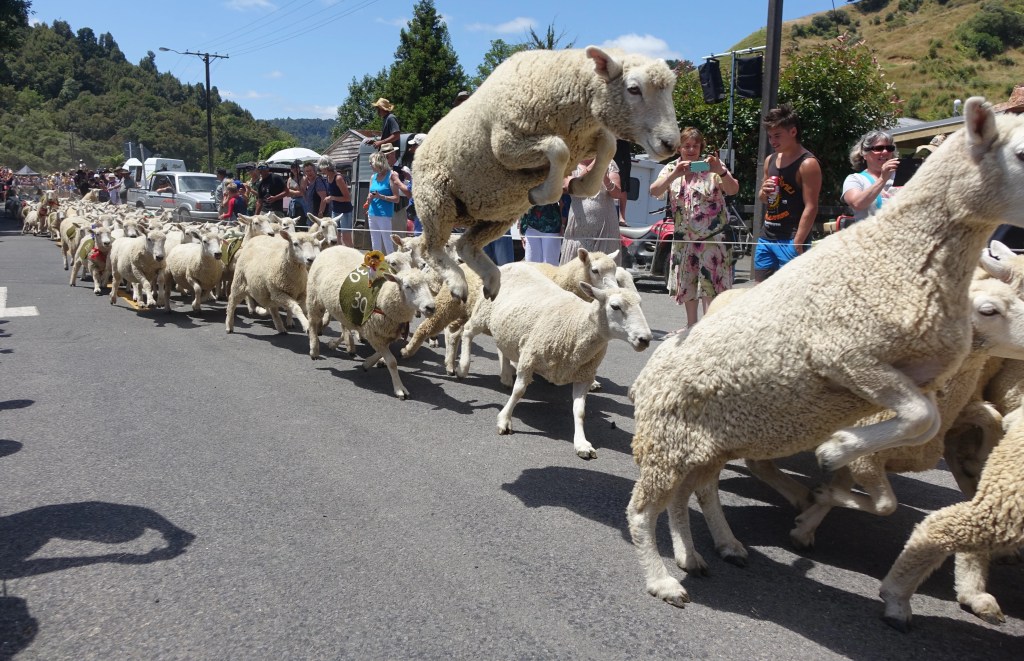
But not all Republic Days are solemn. Nor do they come every year.  Whangamōmona, a small settlement in rugged New Zealand’s North Island, celebrates Republic Day in January,  but only every two years.  It last celebtrated its Republic Day on Jan 18, 2025, marking 36 years of independence. Hundreds of visitors attended the event, which featured rural activities, a sheep race, presidential elections

Whangamōmona has a funny backstory.  It seceded from New Zealand. How and why did this come about?

In 1989, New Zealand restructured its local government boundaries. For decades, Whangamōmona had been part of the Taranaki region. But the reforms shifted it into the Manawatū-Whanganui region instead. On paper, this was administrative housekeeping. On the ground, it felt like cultural displacement.

The town identified economically and socially with Taranaki. Farming networks, community ties, supply routes were all there.  But suddenly, they were told they belonged somewhere else.

So on 1 November 1989, in response to what they saw as distant bureaucratic meddling, Whangamōmona declared itself an independent republic.

But this wasn’t angry secession. It was satire with a straight face.

The Republic of Whangamōmona established:

  • A president
  • A passport (yes, you can get it stamped)
  • A national day
  • And a constitution — loosely interpreted

The tone was tongue-in-cheek, but based very much on community pride. Every two years, on Republic Day (in January), thousands of visitors descend on this tiny town of fewer than 50 permanent residents. There are sheep races. Gumboot throwing. Debates. Parades. And, most importantly, the presidential election.

The candidates over the years have included:

  • A goat (Billy Gumboot)
  • A poodle
  • A human (briefly)
  • And even a tortoise

A race to choose the President

Billy Gumboot, the goat, was perhaps the most iconic president. He reportedly served with dignity until his untimely death in 1999. His successor? Tai the poodle.

Isolation as Identity

Whangamōmona isn’t easy to get to. It lies along the Forgotten World Highway — which is honestly one of the best road names ever conceived. The route winds through dramatic hills, misty valleys, and farmland that feels cinematic in its remoteness.

In the early 20th century, Whangamōmona was a frontier settlement, established during railway expansion. It once had a hotel, a school, a hall, and enough settlers to sustain real momentum.

Then the railway declined. Young people left. Farms consolidated. The population shrank.

Like many rural communities worldwide, it faced the existential question: how do you survive when the economic centre shifts away?

Whangamōmona’s answer was genius: if you cannot compete on scale, compete on story.

The “Republic” became a brand. Visitors stop at the Whangamōmona Hotel (the town’s social nucleus), get their passports stamped, and take photos with the republic signage.

Instead of being “a place left behind,” Whangamōmona became “that place bold enough to declare independence.”

Why This Tiny Republic Matters

In a world where declarations of independence are usually soaked in conflict, Whangamōmona offers something softer: protest through humour.

It reminds us that governance is, at some level, a social agreement — and that local identity matters deeply. The town’s mock-secession wasn’t a rejection of New Zealand. It was a wink at centralised decision-making.

There is no bitterness in it now. Only tradition.

Republic Day is less about rebellion and more about reunion. Former residents return. Visitors become temporary citizens. The town swells with life.

For one weekend, the population multiplies many times over. And the republic thrives.

Who gets to decide where we belong?

Sometimes the answer is: we do.

And maybe that’s why this story resonates so widely. It’s about scale — how small places can assert symbolic power. It’s about humour as strategy. It’s about community cohesion in the face of administrative indifference.

Whangamōmona could have quietly faded into obscurity. Instead, it elected a goat.

That choice tells you everything.

A funny story with profound lessons about identity and self-assertion.

–Meena

Pic: https://www.rnz.co.nz/news/

A Giggle of Joeys: Celebrating Clowns

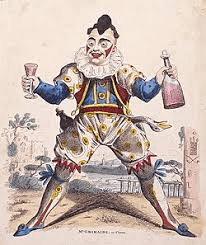
Joseph Grimaldi

This past weekend saw an unusual gathering in a church in East London. This was not a congregation of formally dressed people for a service, nor a sombre group of people attending a funeral. The church was crowded with clowns—in full ‘motley’ (costume of raggy baggy clothes and oversized shoes) and ‘slap’ (make up). The service began with a parade of the clowns down the aisle to the notes of the organ, followed by a memorial speech by the priest.

This was the Annual Grimaldi Memorial Service which takes place every year on the first Sunday of February in Haggerston, Hackney, London. The tradition began in 1946, as a memorial service to honour the greatest British clown Joseph Grimaldi, and it continues to this day as a service to celebrate all Clowns, and to honour the clowns who died in the previous year. The service used to be held at Holy Trinity Church, where there is a shrine with a commemorative stained glass window to honour Grimaldi, but has recently switched to Haggerston while the Holy Trinity Church is under renovation.

Who was Grimaldi and what is his claim to fame? Grimaldi is considered to be the greatest British clown and the father of modern European clowning.

Joseph Grimaldi was born in 1778 and brought up in the world of theatre. His father was an actor and dancer by profession, but in personal life he was cruel and sadistic with his own children, as well as his students at the dance school where he also taught. Despite a troubled childhood, Joseph grew up to be a kind-hearted and dedicated person. He did however inherit his father’s theatrical talent. He started out as an actor and a dancer in an age when pantomimes were the popular genre. Grimaldi made his first appearance as a clown in 1800 in a pantomime at Sadler’s Wells theatre. By the next season, he had made a huge impact. This was the Regency era of the early 1800s, when only three London theatres were permitted to have shows with dialogues onstage. Thus pantomimes which had only songs and physical movements were the main form of entertainment. This genre gave Grimaldi great scope for improvising, and growing as a clown. He brought something new to the traditional slapstick routine of clowns. He transformed the role of a clown from that of a rustic fool to the central character of a metropolitan pantomime. He did away with the pantomime mask which was the norm then, and wore distinctive make up with a white face, bulbous red nose and exaggerated painted facial features. He perfected slapstick antics, catchphrases, and became celebrated for his acrobatic skills, wild facial expressions, and often wicked stunts onstage. Grimaldi created the ‘modern clown’.  His pet name ‘Joey’ became the identity of all clowns and continues to be the nickname for a clown. Grimaldi’s clown transformed the pantomime into a respectable and fashionable form of theatre.

In a career spanning nearly thirty years, Grimaldi performed regularly at Sadler’s Wells, the Covent Garden Theatre, and Theatre Royal in London. He also toured across the country. Among his many admirers were Lord Byron William Hazlitt, and Charles Dickens who also wrote a biography of Grimaldi.

His success brought him great wealth but an extravagant lifestyle depleted his resources. The intense physical exertion that his performances entailed also took a toll on his health. He made his final public appearance in 1928. Subsequently he fell into poverty and depression and relied on charity for the rest of his life. Joking about his struggles he wrote in his autobiography “I may make you laugh at night, but I am Grim-all-day”.  Grimaldi died in 1837.   

While Joseph Grimaldi is credited as creating an enduring persona that is synonymous with the word ‘clown’, the character combining humour, satire and tragedy has been part of many cultures for many centuries, in one form or another. The word “clown” itself goes back at least as far as the 16th century; etymologists speculate that it comes from a German word meaning ‘country bumpkin’.

In ancient civilizations of Egypt, Greece, Rome and China these characters were integral to religious ceremonies as well as secular entertainment. They were what we describe as Jesters. The jesters of imperial courts could express their opinions freely, weaving political commentary and social satire under the guise of mockery and irony.

As the circus developed in the 19th century, the clowns with the white-faced make-up came to play a definite role in it—entertaining audiences with songs and long monologues, as well as acts that incorporated singing dancing, jokes and tricks. While animal performances have been banned in circuses today, the clown continues to have a role. However, the circus itself is losing the mass popularity it once enjoyed. But in recent times the clown as a profession is finding new avenues.

Today’s clowns may perform in a wide variety of contexts outside the circus ring. They also do more than entertain.

The medical profession is recognizing the therapeutic benefit of humour, and there is a growing band of medical clowns who support clinical and psychosocial healthcare by performing in hospitals and geriatric-care facilities. Remember Patch Adams sensitively portrayed in the film by Robin Williams? 

Rebel Clowns are found in political action. They reinterpret the act of protest through absurdity, with the objective to undermine authority and disrupt. These come together under the umbrella of groups like the Rebel Clown Collective of individuals who explore clowning as a form of creative protest.

Humanitarian Clowns go to areas of crisis and conflict to interact with communities affected by dire natural or political situations. Clowns Without Borders is one such non-profit organization that organizes such visits.

As with any other profession this one too requires training. Aspiring clowns have to learn many skills including pantomime, dance, theatrical improvisation, and acrobatics. Theatre schools and even universities offer multi-disciplinary exposure to students including classical acting techniques, interdisciplinary circus arts and dance, physical comedy, acrobatics, yoga, stage combat, juggling and storytelling.

Thus the legacy of Joseph Grimaldi continues in its traditional as well as contemporary forms. The Annual Grimaldi Memorial Service, now in its seventieth year, is a testament to this, and as the Vicar who officiated at this service reiterated “a reminder that to be able to laugh about the joys and sorrows of life is something we all appreciate, and our prayer is that clowns everywhere may help us to do this.”  

–Mamata

The Long Ride: Of Bicycles and Their Accessories

A few weeks ago, we looked into the renewed focus on cycling in India. From looking forward, this week we look back to the history of cycles and associated accessories.

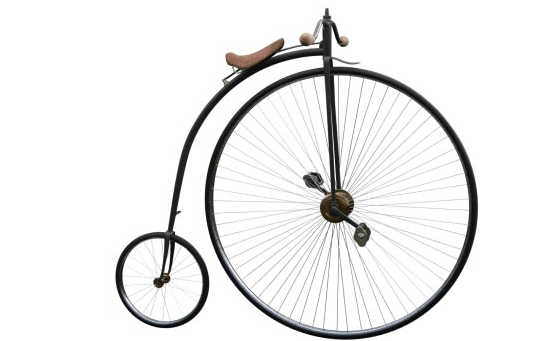
When the first velocipedes (how dinosaurish does that sound??) rattled down European streets in the mid-19th century, they were little more than mechanical curiosities. Wooden frames, iron tyres, no brakes worth the name. Riding one was only for the reckless! The penny-farthing that followed —towering front wheel and precarious balance — made cycling a performance. Only the young and fearless could mount it, and the fall was as much a part of the experience as the ride.

Everything changed with the “safety bicycle” of the 1880s: two wheels of equal size, a chain drive, pneumatic tyres. Suddenly, cycling became practical. You could ride to work, to the market, to visit a friend. No fuel, no maintenance.

And practically no special gear in those days.

But soon came the humble trouser clip did make riding more convenient for men. To modern eyes, it looks medieval: a spring-loaded strip of metal hugging the ankle, holding fabric away from a greasy chain. But for decades, it was an essential. Men could cycle to office or factory without rolling up their trousers like labourers or risking oil-stained cuffs. Infact, I remember my father had one!

In Britain and Europe, cyclists also used trouser straps made of leather, elastic bands with buckles, even improvised safety pins. In India, where bicycles quickly became tools of work — for clerks, teachers, postmen — it was a metal slip-on around the ankle.

Women faced a more complicated problem. In the West, corsets, long skirts, layers of petticoats, and in India, the sari — none were designed for pedalling. Accessories stepped in stepped in because dressing styles took their time to change. Skirt guards– mesh or wire panels fitted over the rear wheel–prevented fabric from tangling in spokes. In India, the chain guard became standard, not optional — a solid metal shield protecting sarees, dupattas, school uniforms.

Other innovations took root in India, to cater to the specific needs. Rear carriers grew wider and sturdier– for schoolbags, milk cans, whole families. Bells had loud, rings that announced presence on crowded roads.

Lighting tells another story of evolution. Early bicycles relied on oil lamps and carbide lamps — lovely if moody. Then came the dynamos.  Today’s LEDs and rechargeable lamps are brighter and lighter, and fulfil the same needs — that the cyclist be seen, that night need not be a barrier. But in India, there has been a regression. From lights being quite common specially in the South, they are seldom to be seen today.

And then there is the helmet — the most contested accessory of all.

For most of cycling history, helmets did not exist in any recognisable modern form. Riders trusted balance, experience, and luck. It was only with the rise of fast motor traffic and increasingly hostile roads in the late 20th century that helmets entered everyday cycling conversations.

Countries with strong everyday cycling cultures like the Netherlands, Denmark, Germany, and the United Kingdom tend to prioritise safer infrastructure and do not have compulsory helmet laws for cyclists.

But in most countries, there is neither a mandatory helmet rule, nor an effort towards safter infra. Very few places in the world make helmets mandatory for all bicycle riders. Nations that mandate helmets for all riders often do so in environments where cycling is seen as high-risk.

Countries with universal bicycle helmet laws — applying to adults as well as children — include Australia and New Zealand, where nationwide mandates have been in place for decades. A smaller group of countries, including Argentina, Costa Rica, Namibia, Cyprus, Singapore, and parts of the United Arab Emirates, also require cyclists to wear helmets by law, though enforcement and penalties vary.

Some countries like Japan, have introduced a legal duty to wear helmets for cyclists, but without the kind of fines or policing associated with traffic offences.

Far more common are age-based helmet laws, where children or teenagers must wear helmets but adults are exempt. Yet other countries do not require helmets in cities, but helmets are compulsory for cyclists outside urban areas.

In India, there is no nationwide law that makes helmets mandatory for people riding ordinary, non-motorised bicycles. Sadly, these laws do not even exist for motorized two-wheelers, or are not uniformly enforced even where they exist. Neither is there effort towards roads, lanes and infra to make cycling safter.

Given that India stands first in the world in absolute number of traffic deaths, and that two-wheelers including bicycles account for over 50% of these deaths, is it not time to make it mandatory of cyclists and two-wheeler drives to use helmets? And for city-planners to make roads safer for cyclists?

Safety please!

–Meena