Stupid Toy Day? Makes No Sense!

Every year on December 16, the internet celebrates something most households have tripped over, stepped on in the dark, or quietly wished would disappear: the “stupid toy.” Officially, it’s called Stupid Toy Day—a day devoted to toys that serve no obvious purpose, promise no educational outcomes, and stubbornly resist all attempts at being “enriching.” They do not teach coding. They do not build emotional intelligence. They simply… exist.

A “stupid” toy, as the internet defines it, is not broken or unsafe. It’s just inexplicable. It does one odd thing. It refuses to justify itself. It looks faintly ridiculous. Pet Rocks. Rubber chickens. Slime. Talking dolls that say things no one programmed on purpose. Lights that flash for no reason at all.

And honestly? That’s exactly why I think there is no such thing as a stupid toy. Because anything that gives joy to a child and it wants to spend time playing with, is a good toy! Whether store-bought, found at home or contrived from the most mundane things, whatever floats a child’s boat, is a toy. Entire generations have grown up playing with objects that contributed nothing measurable—and yet somehow contributed enormously to childhood.

The thing about calling a toy stupid is that the word never really belongs to the object. It belongs to the adult standing next to it and judging it.

When parents complain about “stupid toys,” they rarely mean toys that fail the child. They mean toys that fail them. Too loud. Too sticky. Too impossible to clean. Too bright. Too many pieces. Too much glitter. Too much slime. Too much mess. Too much noise. Too much… joy, possibly, expressed in a form that requires major clean-ups. Seems to me, most “stupid” toys are simply inconvenient toys. Toys which seem pointless to an adult.

AN ARVIND GUPTA TOY

But to my mind, there is one category of toys that are stupid. A toy becomes exponentially more “stupid” the minute it costs a small fortune. A plush animal that costs as much as a phone. A doll with a wardrobe bigger than yours. A remote-controlled something that breaks in three days. High price and low value—what could be stupider?

Brian Sutton-Smith’s work on toys and play is powerful. In Toys as Culture, he argues that toys don’t live in one neat category like “fun” or “education.” They exist in overlapping worlds—family, technology, education, and marketplace. Toys can be consolation, security and companionship. They can be tools, machines, friends, achievements. They are not just objects; they are emotional support.

A glitter jar might look like a mess waiting to happen.
To a child, it might be the universe in a bottle.

A noisy toy might feel like an assault on adult nerves.
To a child, it might be power.

A useless toy might be, in truth, a deeply useful one—the kind that absorbs loneliness, invents stories, and makes space for imagination.

We forget that children do not play with toys to improve themselves. They play to live inside themselves.

And children by themselves never measure toys by price or return on investment. But sadly, there is no refuting that peer pressure and media pressure have enormous influence on a child perceiving a toy as highly desirable. And that is a worry.

Stupid Toy Day, at its best, quietly reminds us that joy doesn’t require justification. It doesn’t need a developmental framework or a learning outcome chart. Play is not a performance. It is a state of being.

Basically, Stupid Toy Day is STUPID!

Honour the toy that made no sense but means everything. And remember: not everything precious needs to be practical. And in this holiday season, as we go about buying things left and right, remember, a child will be as happy playing with the cardboard carton as the toy which was packed in it. Remember Calvin, Hobbes and their time machine? And Arvind Gupta’s Toys from Trash? Money does NOT equal toy-joy.

–Meena

The Call of the Mountains: Nan Shepherd

December 11 is marked as the International Mountain Day. Mountains have always fascinated human beings not only for their sheer scale and majesty, but also as a natural element that offers a challenge, as well as a test of physical and mental strength, and the thrill of scaling the peaks. There are numerous narratives of expeditions that describe these challenges and achievements, most of these by, and about men.

The Cairngorms

A different perspective, and approach towards mountains reminds us that there is more to mountains than the thrill of conquest.

This was lyrically described by Anna (who called herself Nan) Shepherd, a Scottish poet, writer and explorer of mountains. Nan was born in February 1893, close to Aberdeen on the North East coast of Scotland. When she was one month old, her family moved to nearby Cults and lived in a house with a garden overlooking the hills. Nan continued to live in the same house almost till the end of her life. As a young girl Nan was encouraged by her father, a keen hill walker, to explore the nearby hills, and this planted in her a lifelong love for nature and the mountains. Nan was an equally avid reader, and from her early teens she would fill notebooks with passages that inspired her from the wide spectrum of her reading. After completing her schooling in 1912, Nan joined the University of Aberdeen in the first decades after women were allowed to do so. She was an outstanding student, and graduated in 1915 with an MA in literature. Following this she taught English literature at Aberdeen Training Centre for Teachers, and continued to give enthralling lectures until she was well into her eighties. She was not only an inspiring teacher but also a role model for her students, as an early feminist. She wryly described her role as “the heaven-appointed task of trying to prevent a few of the students who pass through our Institution from conforming altogether to the approved pattern.”

Although she had always enjoyed walking in the hills, Nan Shepherd became deeply engaged with climbing in the period between the two World Wars. She was thirty years old when she began her explorations in the Cairngorms in 1928. This experience was the start of a passion that came to define both her life and her writing. From then on, she sought to escape into the Cairngorms whenever her job would allow. Often she would walk alone, camping out, and wading into hidden lochs. Occasionally she was accompanied by friends and fellow walkers from the local Deeside Field Club, or by students from the university.

By the 1940s Nan had scaled some of the highest peaks in the Cairngorms, among the wildest landscapes in the British Isles. However Nan’s expeditions were not about ‘reaching the top’ but rather a spiritual journey to ‘understand herself and the world’. She became fascinated by what happened to mind and matter on this journey up and down the mountain slopes.

These experiences were reflected in her literary work. The harsh landscape, as well as the people and places she knew well, provided the background to her first three books, published while she was teaching. These novels focussed on the harsh landscape which made for a harsh way of life, and within these, complexities of women struggling with maintaining traditional roles in a dawning age which was opening up new opportunities

But Nan Shepherd never wrote for recognition. She wrote only when she felt she had something worth saying. “I don’t like writing, really. In fact, I very rarely write. No. I never do short stories and articles. I only write when I feel that there’s something that simply must be written.”

For her teaching was as, if not more, important than her writing. However she continued to document her explorations of the Cairngorms, which came together around the end of the Second World War, under the title The Living Mountain. She combined her knowledge of the mountains, her observations of their rugged beauty, and her literary skills to muse on the philosophical and spiritual offerings from mountains. She wrote of the Cairngorms as “friends” that she “visits”, and with whom her imagination is fired as if “touched by another mind.”

 Nan Shepherd completed her book in the summer of 1945, and sent her manuscript to a novelist friend. He cautioned that it may be hard to find a publisher of a book of this nature. Nan put the manuscript away in a drawer where it remained for 30 years. Towards the end of her life, Nan retrieved the manuscript from her drawer and felt that it still resonated in many ways. Given her long association with Aberdeen University, she submitted it to Aberdeen University Press. The Living Mountain was finally published in 1977.

The Living Mountain threaded together, beautifully geography, geology, history and philosophy, along with everything that she herself had experienced in the mountains that she had fallen deeply in love with. For Shepherd, the mountains were living beings, and her book describes how she nurtured her relationship with them by walking. She wholeheartedly believed that only through walking and experiencing could insight be gained. “The more one learns of this intricate interplay of soil, altitude, weather, and the living tissues of plant and insect … the more the mystery deepens.”

The Living Mountain, continues to be timeless, since its publication 30 years after Nan Shephard wrote it. It provides a rare lens into a world that has been viewed mainly through the eyes of male climbers, who focus on the challenges, and the conquests. Nan Shepherd’s lens is that of a naturalist and poet, one of contemplation, reverence, and an exploration of the profound. The book suggests that the summit should not be the organizing principle of a mountain; it urges the practice of not walking “up” a mountain, but rather “into” them, so as to explore not just the physical forms but also ourselves, peering into the nooks and crannies.

Today, mountains across the world are facing their own challenges. Climate change is melting glaciers and distorting landscapes; the surge of climbers are leaving behind manmade mountains of garbage that threaten to bury the real mountains. This is a good time to remember The Living Mountain, and a mountain lover who looked beyond the ascents to the journeys within.

–Mamata Pandya

The Joy of the Bouncy Bite

Did you know that Q is a word? No, not QUEUE, but just plain Q. It is the Taiwanese name for a range of textures best translated, imperfectly, as “bouncy.” It is the degree of chewiness of a given food and how it feels against the teeth and tongue.

If you’ve ever bitten into something that resisted you just a little—neither soft nor hard, but springy, elastic, and alive—you’ve probably encountered Q without knowing its name. Think sabudana, tapioca pearls in bubble tea, or handmade noodles that snap faintly between your teeth. That sensation—the cheerful recoil, the gentle resistance—is Q.

What makes Q fascinating is that it describes not one texture, but a spectrum. There is nen-Q, soft and tender; cui-Q, crispy-bouncy; tan-Q, chewy-springy. Noodles are Q: resilient but not rubbery, lively but not tough. (In the case of pastas, I suppose ‘al dente’ is the equivalent,) Even sweets and desserts aspire to it—marshmallows, herbal jellies or sweet potato balls.

In Taiwanese food culture, to say something is Q is high praise. Q is considered one of the keys to good food in Taiwan, on par with taste, color, and consistency. It’s not about indulgence alone; it’s about skill. Achieving Q often requires precise technique: the right ratio of starch to water, the correct kneading time, the ideal temperature.

What’s intriguing is how Q resists quick translation. “Chewy” is too blunt. “Springy” is closer, but incomplete. “Bouncy” catches the spirit but misses the nuance. Q is pleasant resistance, playful elasticity, a sassy texture. It invites you back for another bite. It’s the opposite of mushy or limp.

Q became a recognised food term in Taiwan in the late 20th century — roughly the 1980s to early 1990s,when it moved from slang into mainstream food language. Interestingly, the letter Q itself is not traditional Chinese. It entered Taiwanese usage as a borrowed symbol from English, chosen because:

  • the sound (“kyu”) suggested elasticity
  • the shape felt visually “springy”
  • and there was no single Chinese word that captured the idea precisely

At first, it was slang but now it’s formal enough to appear in Taiwanese dictionaries, culinary writing, product labels and restaurant menus

In Taiwan, the term has gone beyond the kitchen and found its way into everyday speech, where it can describe hair, skin, or even the bounce in someone’s step.

In a world increasingly obsessed with flavour profiles—smoky, umami, citrusy—we sometimes forget texture altogether. Yet Q reminds us that eating is as much about feel as it is about taste.

Q—Taiwan’s playful word for “bouncy”—captures that perfect bite: springy, chewy, lively, and irresistible. From bubble-tea pearls to handmade noodles, Q celebrates food that pushes back just enough. It’s a texture so prized in Taiwan that it’s become part of the language itself, standing alongside taste and aroma. Every culture has its version of Q—al dente pasta, mochi-mochi rice cakes—and we in India find it in sabudana, fresh idlis, rasgulla, modak and more. Q is not just what you chew, but what you feel: a small, elastic joy.

Maybe every culture has its own version of Q, a word for the textures it prizes most. Italians chase al dente, the Japanese revere mochi-mochi and kori-kori. But Taiwan’s Q feels particularly evocative—a single letter carrying a thousand sensations.

So the next time you sip a bubble tea and play absently with the pearls at the bottom, or tear into a dumpling that seems to smile back at your teeth, remember this small, clever word. Q is not just what you’re chewing. It’s what you’re feeling—a quiet, elastic joy.

And here is a tour of Indian Q foods that I can think of: sabudana, fresh idli, rasgulla, modak, noodles, dhokla,  sevai, and appam.

Any others?

–Meena

Sandow in our Lives

The end of the year is a time of going back in time and re-living memories.

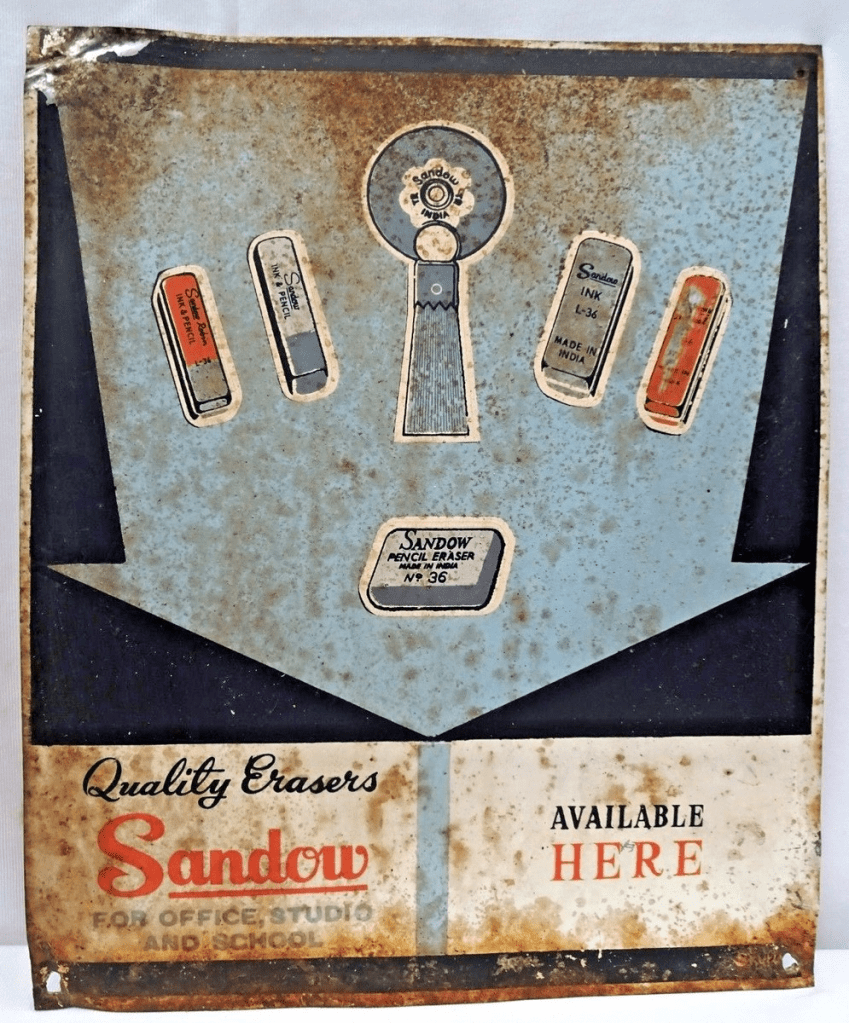
And one of the enduring memories for those of us who grew up in the  1950s, 60s and 70s, is the word Sandow. It was a part of everyday lives—an integral part of the pencil box, a dirty grey rubber that erased pencil marks.

For us in India, “rubber” was the term for eraser, a usage inherited from British English and reinforced through colonial schooling. A child did not “borrow an eraser”; they asked for a rubber. And the most trusted rubber of all in our times was the Sandow.

These erasers were made of natural vulcanised rubber, not vinyl or plastic as most modern erasers are. They were firmer, slightly gritty, and erased by abrasion — scraping graphite off paper rather than gently lifting it. They left dark crumbs behind and wore down slowly. A new Sandow rubber meant clean pages. A worn one told the story of errors made and lessons learnt.

Where did Sandow rubbers come from?

The earliest Sandow erasers were almost certainly manufactured in Britain and exported to India during the late nineteenth and early twentieth centuries through British stationery suppliers. During the colonial period, Indian schools depended heavily on imported notebooks, inks, slates and erasers.

Stupid Toy Day (December 16) is a celebration of the wonderfully useless things from childhood—rubber chickens, yo-yos, slinkies, and strange plastic objects that made no sense but brought endless joy. From ridiculous toys to unsettling antique dolls that now star in creepy museum contests, this post reflects on how toys—whether silly or sinister—stay with us long after childhood ends. A nostalgic look at why useless never really meant unimportant.

After Independence, Indian factories began manufacturing erasers using similar formulations and — crucially — the same name. By the 1950s, most Sandow erasers sold in India were produced locally. However, the word “Sandow” was never firmly trademarked in India, allowing multiple manufacturers to use it freely. Over time, it became not a brand but a category. “Sandow rubber” simply meant “the regular school rubber.”

Sandows were not the only erasers available. There were white, scented rubbers, with a gel-like coloured top. But alas, most of us never possessed one, given they were about four or five times more expensive!

And a Strongman called Sandow

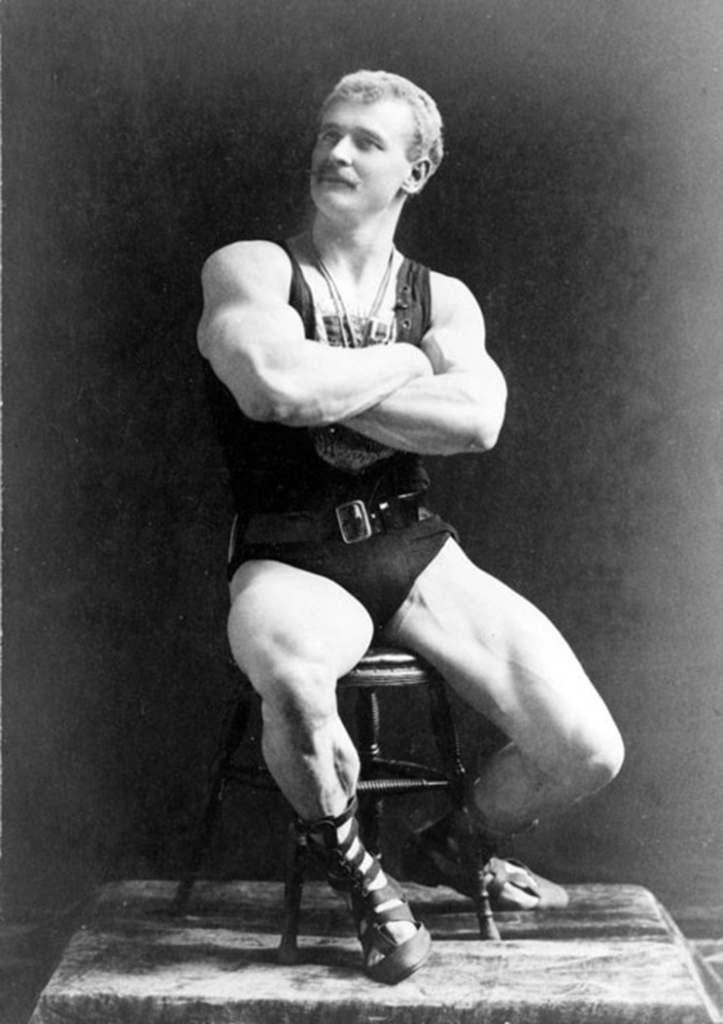
Another Sandow (though of older vintage) was part of our childhoods too. He lived on barbershop calendars and tattered posters: a muscular European strongman frozen in permanent flex.

Eugen Sandow (1867–1925) was a Prussian-born showman, athlete and entrepreneur who became the world’s first international bodybuilding celebrity. He toured Europe, Britain and America performing feats of strength before royal families and packed audiences.

Sandow was much ahead of his time, and would have done great in the current days, surely becoming a hero of Insta reels, posing as he did to deliberately display his muscularity. He was also a businessman. He published training manuals, endorsed health products, sold exercise equipment, and promoted physical culture as moral discipline. King George V even appointed him “Professor of Scientific and Physical Culture” in Britain — a title that further elevated his image as a respectable authority on fitness.

In India, encounters were through his images — black-and-white posters, calendar art, tins, and labels that travelled through imperial trade routes. But nevertheless, his name was well known, whether with urban kids or rural youth.

Were the rubber and the strongman officially connected?

There is no evidence that Sandow ever licensed his name to an eraser manufacturer. No contract, no advertisement, no endorsement exists in any reliable archive.

However, the naming may have had a connection. The two existed at around the same time, and the name ‘Sandow’ symbolised durability, strength and European modernity. Calling an eraser “Sandow” suggested that it would last, work hard and not fail easily. In an era with loose branding laws, borrowing famous names for product credibility was common.

Today…

Now, erasers come in neon colours and cartoon shapes. Eugen Sandow is remembered only by historians and fitness professionals. But for those who grew up in that older India, the word still carries a double image: fingers dusted with graphite, and a chest forever flexed on fading paper.

Sandow was never just an eraser.
And Sandow was never only a man.

Both were a part of our simple, innocent youth!

–Meena

Photocredit: Wikipedia for Mr. Sandow

ebay for the Vintage Tin advertising the eraser