Of Tongues: Tied and Twisted

Many of us have student-day memories of freezing up in the middle of an elocution competition, or as adults, not being able to converse comfortably when in a large group of people. We were told that had become “tongue-tied”. The dictionary defines this state as being ‘too shy or embarrassed to speak’.

More recently I was introduced to another, more literal, form of tongue tie. This is a medical condition where a tight band of tissue connects the underside of the tongue to the floor of the mouth, keeping it from moving freely. Nowadays, paediatricians usually check for this in new born babies, and a minor surgical procedure can cut the tight tissue to allow for a free movement of the tongue. While this is not a mandatory nor critical issue, sometimes this restrictive movement of the tongue could hamper the baby from proper breast feeding, and could (though not definitely) be an impediment to speech as the child begins to speak.

This was not a condition that I was familiar with, and I suspect that many adults have grown up unaware about this. At best, these were labelled as people with speech impediments, and either lived with it through their life, or were sent to speech therapists. Perhaps one of the exercises that they were prescribed, was to recite aloud some phrases that had alliteration, rhymes, and repetition. Speech therapists believe that such exercises help to strengthen the muscles that are used when we speak. The muscles of the mouth need to move in certain positions to create individual sounds. Tongue twisters help practice and strengthen these positions and muscles in order to perfect these sounds. 

Even without being guided by a therapist, many of us have childhood memories of getting our tongues in a twist with these lines:

She sells seas shells on the seashore

The shells she sells are seashells, I’m sure

So if she sells seashells on the seashore

Then I’m sure she sells seashore shells.

No wonder such lines were described as ‘’tongue twisters”. Such phrases have been part of the oral tradition in all cultures since early times. In ancient Russia travelling performers called skomorokhi would amuse crowds by reciting fast tricky lines and challenging the audience to repeat these. Most people couldn’t and their fumbling attempts raised a laugh from the others. Folklore in all languages has examples of such nonsense rhymes that need an acrobatic tongue to master.

In fact even today, performers use tongue twisters to loosen up before they are scheduled to go on stage. These help them warm up and get their mouth and tongues ready to perform in front of an audience. Tongue twisters are also used by voice actors before they are recorded.

The term tongue twister is believed to have appeared in print in the late 19th century to describe phrases that are difficult to articulate due to their use of similar but distinct sounds. In the English language these gained attention with the publication of a book called Peter Piper’s Practical Principles of Plain and Perfect Pronunciation, which included a tongue twister for every letter of the alphabet. The book was meant to help children learn the fundamentals of speech mechanics, but it attracted a lot of attention. The title itself garnered curiosity. The author of the book was John Harris, who then was the Peter Piper? The mystery was heightened with the inclusion of the rhyme:

Peter Piper picked a peck of pickled peppers.

A peck of pickled peppers Peter Piper picked.

If Peter Piper picked a peck of pickled peppers,

Where’s the peck of pickled peppers Peter Piper picked?

It turns out that this one was based on a French horticulturist Pierre Poivre. Pierrre is the French version of Peter, and Poivre is the French word for pepper. Pierre, it is believed, was exploring the viability of growing spices in the Seychelles. Thus the peppers, and the peck which was an old measure of weight.

Tenuous connections, at best, but they do add some spice to the story!

While tongue twisters are accepted as a part of speech therapy, people enjoy these just for the fun of fumbling and stumbling over words in absurd sentences. So much so that there is even a day designated as the International Tongue Twister Day celebrated on the second Sunday in November every year. And there is an International Tongue Twister Contest held at the Logic Puzzle Museum in Burlington, Wisconsin in the USA. First held in 2008, the contest has become an annual tradition. This invites everyone between the ages of ‘6 and 106 years of age’ to test their verbal dexterity. A joyful celebration of the playful side of language!

At the same time there is also serious research being carried out on this subject. A team of researchers from the Massachusetts Institute of Technology (MIT) have deemed that the most difficult tongue twister in the world is this one:

“Pad kid poured curd pulled cod”.

If one is not quite up to the challenge of cracking this one, here are some others to twist our tongues around:

“The sixth sick sheik’s sixth sheep’s sick.”

“Imagine an imaginary menagerie manager managing an imaginary menagerie.”

“A tutor who tooted the flute tried to teach two young tooters to toot. Said the two to the tutor, ‘Is it harder to toot, or to tutor two tooters to toot?’”

Don’t let these leave you tongue-tied!

–Mamata

Listen carefully. Listen widely. Listen without assumptions: Gallup Polls

For many of us who grew up reading international newspapers, Gallup was a familiar name—almost a synonym for “what America thinks.” Their polls were quoted in classrooms, editorials, speeches, and policy discussions. If Gallup said Americans trusted an institution, or were worried about unemployment, or supported a policy, it felt as if a nation had spoken.

November 19 marked the anniversery of the birth of the man who started it all–George Gallup, a career journalist. His interest in politics led him into the areana of forecasting polls, and he set up a company to do this. He set up the American Institute of Public Opinion in 1935 to do this, at a time when the idea of systematically measuring public opinion was almost revolutionary.

Gallup polls represent a methodology of scientific polling initiated by George S. Gallup in the 1930s, aimed at accurately assessing public sentiment. This was a significant departure from earlier, less systematic polling methods, as it emphasized the importance of selecting representative samples of the population. Gallup polls gained widespread recognition in 1936 for successfully predicting Franklin D. Roosevelt’s election victory but faced criticism in 1948 when they incorrectly forecasted Harry S. Truman’s defeat. These setbacks led to learnings, and Gallup refined his polling techniques, employing random sampling and continuous polling to enhance accuracy, particularly in presidential elections during the 1950s.

When Gallup moved to random sampling in the 1950s and began polling continuously until the eve of elections, he wasn’t chasing precision for its own sake. He recognised a deeper truth: societies shift quietly, between headlines. Polls must therefore be reliable mirrors, not hurried sketches.

Over the years, Gallup polls have become integral to political campaigns, influencing candidate nominations and public policy discussions. They have also mirrored societal changes, capturing evolving attitudes on issues such as gender equality and civil rights. Despite their utility, there is ongoing debate about the reliance on polling data by political leaders, with critics cautioning against using polls as the sole measure of success. Overall, Gallup polls continue to play a vital role in understanding public opinion and shaping political discourse.

But over the past twenty years, America has changed dramatically. People stopped answering landlines. Survey participation dropped. Voter behaviour became harder to predict. And suddenly, the organisation that once defined polling found itself struggling to keep pace with a shifting landscape.

There were headline moments—for example, missing the mark in the 2012 US presidential election—that forced painful introspection. To their credit, Gallup did omething rare: they hit pause. They stepped back from national election polling, admitted where methods were no longer working, and began a long process of rebuilding.

Today, Gallup occupies a different—but still significant—place in American public life.

They no longer dominate political horse-race coverage the way they once did. But they have pivoted towards areas where long-term, stable measurement matters more:

  • Public trust in institutions
  • Wellbeing and life evaluation
  • Workplace engagement
  • Social attitudes that evolve over years, not election cycles

Their “State of the American Workplace” and “Global Emotions Report” are now widely cited, not for predicting results, but for revealing how people feel about their lives and work. In a country where political noise can drown out quieter realities, Gallup’s longitudinal datasets offer something precious: continuity.

And that, perhaps, is Gallup’s place today. Not the sole voice of American opinion, but a steady, methodical listener in a crowded room.

And Then Comes the Indian Question…

All this inevitably leads to a Indian doubt: Do we do anything like this?

India is a nation where elections are larger than many countries, where tea stall debates spill into WhatsApp forwards, and where “sentiment” is often declared loudly—but loosely. So who is actually listening methodically?

The answer is both reassuring and sobering.

Yes, India does have organisations that follow rigorous polling practices—most famously CSDS-Lokniti, which uses sampling frames, stratified selection, field-tested questionnaires, and detailed post-poll analysis. Some private agencies also attempt scientific sampling, though with varying transparency. But polling in India faces unique challenges: population size, linguistic diversity, urban-rural divides, accessibility, and the sheer logistics of reaching voices beyond the easily reachable.

The result? While we do have pockets of high-quality research, we also have a landscape crowded with “quick polls,” “mood trackers,” and “snap surveys” whose methodology, if printed, might fit on the back of a bus ticket. Till today, election forecasts have minimum credibility.

Let’s see if all the bad press drives election forecasters to move towards more statistically sound and scientifically based approaches. Well, we can hope!

–Meena

Pic from: The India Forum

A Fool of Fruits

This morning my sisters suddenly remembered our mother’s (who had a great sweet tooth) fondness for Mango Fool. This brought back so many memories of the many sweet dishes that we used to have at home, which included lots of sugary syrupy Indian sweetmeats, as well as the more subtle English ones such as custard and pies. Our combined memories recall that Mango Fool was some form of thick milk shake. Turns out that the real Mango Fool is a more sophisticated desert that includes mangoes, and whipped cream. And, of course, so many years later, the memory nudged me to dig deeper into investigating the curious name of this dessert.

As it turns out ‘Fools’ of the fruity variety have ancient origins and a rich history. Fruit fool is a classic English dessert. Traditionally, fools were made by folding a stewed fruit (originally gooseberries) into a creamy, sweet custard. The documented origins of the desert can be traced back to the 17th century, although it is believed that some form of this existed as far back as the 15th century.

The earliest known recipe is from the time of the Merry Monarch, King Charles II in a book called The Compleat Cook published in 1665, written by an anonymous author ‘Mr WM’. The recipe was for what he called Gooseberry Foole. The recipe included cooked, mashed, and strained gooseberries, which are beaten with sugar, butter, and eggs to form a pudding-like consistency.

Take your gooseberries and put them in a silver or earthen pot, and set it in a skillet of boiling water, and when they are coddled enough, strain them; when they are scalding hot beat them well with a good piece of butter, rose-water and sugar, and put in the yolk of two or three egg, you may put rose-water into them, and so stir it altogether and serve it to the table when it is cold.  Anonymous.  London.  1658.

The recipe endured through the ages, and was almost no change in the one included 250 years later in the Victorian era cookbook The Art Of Cookery Made Easy and Refined.

But why the name Foole? The most popular theory to explain this is that the term comes from the old French term ‘fouler’ which meant to mash or crush. And this is what the recipe demands—that the cooked fruit be crushed or pressed before being folded into the custard mixture. In those days most fruits were cooked, because people thought that raw fruits were dangerous for health.

Another theory points out to the fact that it was an unpretentious dessert which ended a meal, just as a trifle did. Fool was another term for a syllabub or trifle (something of little value). As an etymological dictionary explained Fool is ‘a reallocation of a word for something light-headed or frivolous as a light dessert’. Perhaps these desserts were literally lighter than the stodgy traditional English desserts like Sticky Toffee Pudding, Steamed Syrup Sponge, Jam Roly-Poly, and Suet Pudding.  

Whatever the theory, gooseberry remained a favoured fruit for this dessert, and the Gooseberry Fool was a popular dessert for many years. So popular that Edward Lear even incorporated it into a limerick in his A Book of Nonsense published in 1846.

There was an Old Person of Leeds,
Whose head was infested with beads;
She sat on a stool,
And ate gooseberry fool,
Which agreed with that person of Leeds.

Over time, other seasonal fruits such as strawberries, raspberries, apples, apricots, and cherries, also began to be incorporated in the recipe. Also, the custard was replaced by whipped cream which made it lighter. The combination of fresh fruit and frothy cream, served chilled, makes for a refreshing summer treat.

The ‘Fool’ part was also incorporated in the names of other desserts.

Norfolk Fool as an early type of bread and butter pudding dating back to the 17th century. It included creamy custard, dates and spices.

Westminster Fool was a sweet custard with a flavouring of rose, mace and nutmeg, poured over a penny loaf cut into six slices, soaked in sherry. (Maybe the inspiration for our own Shahi Tukra, or inspired by it!)

Boodles Fool was named after Boodle’s Club, a private exclusive gentlemen’s club founded in 1762. Ironically, in the very class-conscious British society, the club was named after its head waiter Edward Boodle! His namesake dessert featured a citrus (orange and lemon) mixture whipped with cream, poured over sponge cake, served chilled, decorated with orange slices.  

Whatever the ingredients and recipe, Fruit Fools provided for a delicious finale to a meal. Today these continue to be popular as cool summer desserts. Where my mother picked up the concept and term is a mystery lost in time, and so is the actual form of her version, but the name Mango Fool is closely associated with our childhood memories of sweltering hot Delhi summers.

–Mamata

When Feet Take Flight: A Memory and the Magic of Sepak Takraw

Some memories come back vividly when there is a trigger. Sadly, the trigger for this memory was a newspaper item reporting an accident involving a Sepak Takraw team.

But the memory itself is joyful. A trip to Burma, about fifteen years ago. It was a warm afternoon in Yangon. The tea stalls were buzzing, the pagodas gleamed in the sun, and somewhere between wandering and people-watching, I found myself drawn to a small patch of open ground near a quiet lane.

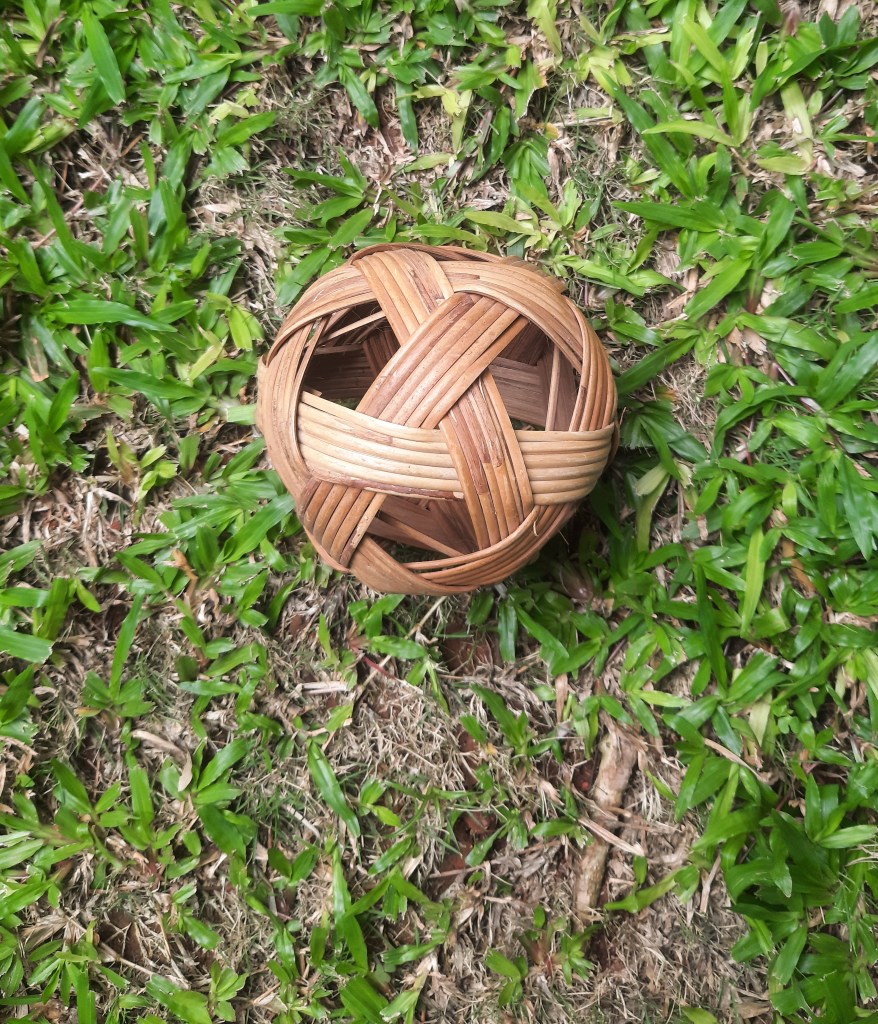
A group of young boys were playing a game I had never seen before. A boy leapt into the air, spun like a dancer mid-flight, and kicked a small rattan ball clean. I stood completely still, mesmerized. It was my first encounter with Sepak Takraw. We stood and watched for quite a while—the grace, the athleticism, the sheer joy of the players—was something amazing to watch. Fortunately on the way out, I found a Sepak Takraw at the airport and bought it.

All these years later, that moment still shines brightly in memory. Because Sepak Takraw is not a sport you easily forget.

For many of us in our generation, our playground sports were familiar—gully cricket, kho-kho, maybe a weekly volleyball session if your school had both a net and enough motivation to set it up. But Sepak Takraw feels like someone took volleyball, infused it with martial arts, added the grace of classical dance, and sprinkled it with sheer joy.

In the lanes of Myanmar, Malaysia, Thailand, and Indonesia, this sport has lived for centuries. Its early form, sepak raga, simply meant “kick the rattan ball.” Communities played in circles, keeping the woven ball aloft with feet, knees, heads—much like our own childhood attempts to keep a rubber ball bouncing on our legs, but infinitely more skillful.

Over time, the game evolved. Nets were added, rules refined, teams formed. What remained unchanged was the heart of the sport—rhythm, teamwork, and an almost balletic coordination.

What struck me in that first encounter in Burma was the joy. There was no crowd, no scoreboard, just a group of boys pushing the limits of their bodies, laughing, teasing, showing off impossible kicks.

Since then, as videos of Sepak Takraw swirl across the internet, the world has begun to share in that delight. Watching professionals play is like watching physics bend slightly. The killer kick—a full somersault that sends the ball crashing down at an angle—feels like something from a choreographed stage performance. The teamwork is intuitive, almost telepathic.

Interestingly, Sepak Takraw has been creeping into India’s sporting landscape too, especially in the Northeast. Manipur in particular has embraced it with enthusiasm, with players who train tirelessly and compete internationally. Perhaps some Indian traveller today will see a game in Imphal or Aizawl and feel the same quiet awe I felt in Yangon all those years ago.

Today the game is played at international level, and has entered the AsianGames. Efforts are on to get it into the Olympic list. 

But for me, it is the memory of that afternoon in Burma—the dusty field, the laughter of boys, the swift arc of a rattan ball against the sky. It is a reminder of how sport, in its purest form, connects us across borders and time.

–Meena

Birdwoman Jamal Ara

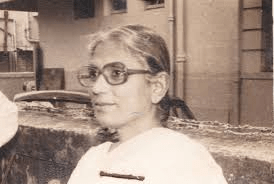
12 November marks the birthday of Salim Ali the Birdman of India. Much has been written and published by, and about, Salim Ali. However very little is known about a young woman who was recognized as the first Bird Woman of India by Salim Ali himself. This was Jamal Ara, a path breaker in more ways than one.

Jamal Ara was born in 1923 in Barh, Bihar, in a conservative Muslim family. She could study only until class ten before she was married off at a young age, much against her wishes. She moved to Calcutta with her husband where a daughter, Madhuca, was born. Sadly her marriage broke down, leaving her in dire straits. Fortunately a cousin who was in the Forest Service in Bihar, came to her aid and Jamal and her daughter moved to Ranchi. As a forest officer, her cousin was posted to different forest divisions of Bihar, and Jamal often accompanied him on his trips. This sparked in her a great love for wildlife, and Jamal would spend hours observing the flora and fauna in her surroundings. The English wife of a senior forest officer encouraged her to keep notes of her observations, and helped her to hone her writing skills. As her proficiency grew, they also encouraged her to turn her notes into articles and send them for publication.

Jamal Ara spent many years doing extensive field work in what is now Jharkhand, and her study of birds in the Chota Nagpur plateau was comprehensive and detailed. She meticulously documented her observations, and wrote prolifically from 1949 to 1988.  She contributed over 60 papers and articles to the journals of the Bombay Natural History Society and Bengal Natural History Society. She could communicate equally well with a lay audience. She wrote for The Newsletter for Birdwatchers, which was popular with amateur as well as seasoned birdwatchers, and also a book for children, Watching Birds which was published by National Book Trust, and translated into many Indian languages. I remember this book as being one of my own early introductions to nature study.

Jamal Ara was a multi-faceted writer. She wrote fiction, translated stories, and worked as a journalist for a short time. She also did programmes for All India Radio. Jamal Ara was also much more than a birdwatcher. She saw birds as an integral part of a healthy ecosystem, and advocated for a balanced conservation approach, something that was not common in an age when shikar was also a popular pastime.

After such an intense involvement in ornithology, and a prolific contribution to the field, in 1988, Jamal Ara suddenly vanished from the Indian ornithology scene. Her contributions stopped, and she herself disappeared. It is believed that a series of personal losses and setbacks affected her badly. She stopped writing, and after a few years also burnt her notes and photographs. She died in 1995.

Gradually Jamal Ara’s name and contributions sunk into oblivion. She would have been lost to the history of Indian conservation if not for a young researcher Raza Kazmi, who stumbled upon a story by Madhuca Singh, a celebrated basketball coach of Ranchi who mentioned Jamal Ara, her mother, who was a great bird lover. Raza Kazmi was intrigued by this mysterious bird lover, and embarked on a search for this woman and her work. After chasing numerous leads, he finally connected with Madhuca who shared her mother’s story.

It is thanks to Raza Kazmi’s single-minded pursuit, and the publication of Jamal Ara’s story in the book Women in the Wild edited by Anita Mani published in 2023, that we can join in celebrating this enigmatic, but brilliant bird woman of India.

It is also heartening that whatever had remained of Jamal Ara’s original work has been collected and digitized as part of the Archives at NCBS, a public centre for the history of science in contemporary India. The Jamal Ara Collection has archival papers relating to her life and work from 1940s to 1980s, including correspondence, unpublished manuscripts, field diaries and notebooks, and drafts of articles.

This week, as we celebrate Salim Ali, as well as Jamal Ara, both passionate bird watchers, here are a few words from them that remind us of the simple joys of bird watching.

”A bird’s song is a sound that touches the soul; it reminds us of the beauty of nature that we must protect. For me, birds have always been the greatest source of joy and inspiration.”  Salim Ali

“Even if you are not a birdwatcher and are not even faintly interested in them you cannot barricade yourself successfully against fugitive but striking impressions that the sight of a bird invariably leaves. The impression is not altogether fleeting although the sight may have been. It persists in memory. Colour, song, manner of flight, the build or some aspect of physiognomy may have thrust itself into your consciousness and nestles there pleasantly. That is why there is no person entirely uninterested in birds. Most persons are unattentive but a few helps to their stored memories and they start taking an interest in birds. They become attentive and surprise themselves by evolving into birdwatchers.” Jamal Ara 

–Mamata

Our Dangerous Dunning-Kruger World: Why Ignorance Wins.

Have you ever sat through a meeting where someone confidently proclaimed an idea that made you wonder if you were the only one who found it… well, questionable? Or listened to a neighbour explaining, with great authority, how to “fix the economy” or “end corruption,” in the time it takes for the traffic light to change?

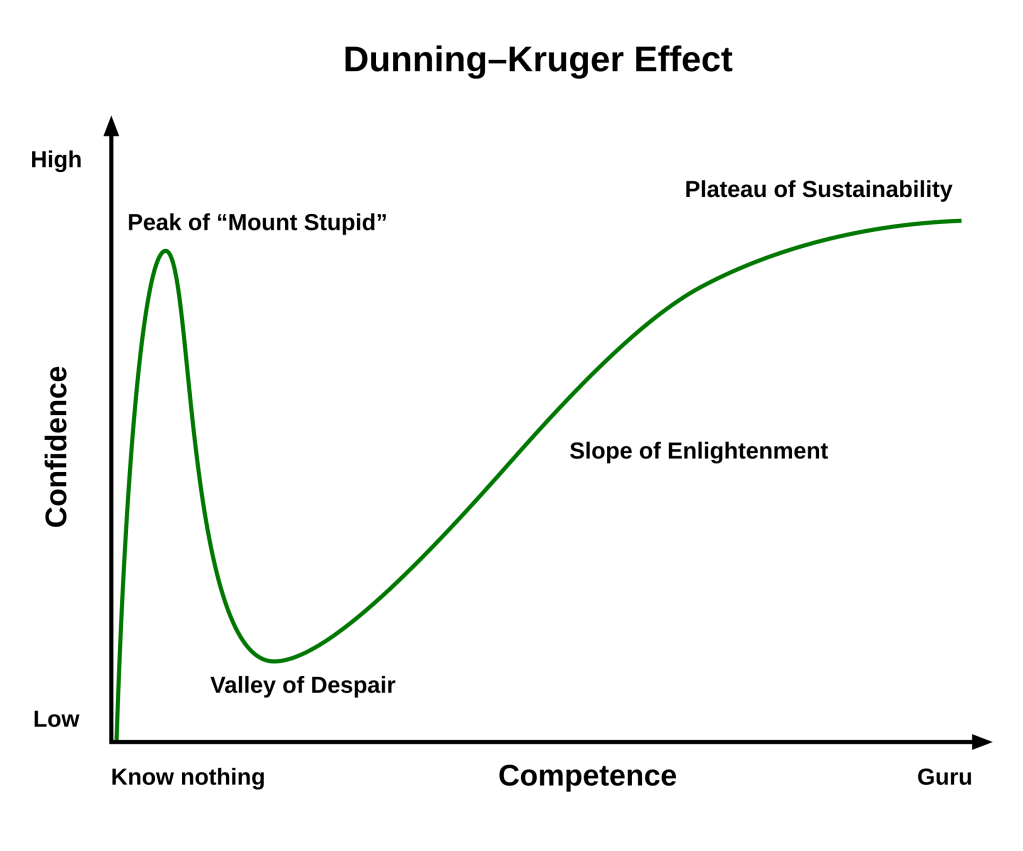
Chances are, you’ve witnessed the Dunning–Kruger Effect in action — that quirk of human psychology where people with limited knowledge or skill in an area tend to overestimate their competence. Ironically, the more ignorant we are about something, the more certain we can feel about our opinions.

The term comes from two psychologists, David Dunning and Justin Kruger, who in 1999 published a study with the rather unexciting title “Unskilled and Unaware of It.” They were intrigued by a bizarre news story about a man who robbed banks after rubbing lemon juice on his face, believing it would make him invisible to security cameras. The man wasn’t joking — he genuinely thought he had found a clever loophole. Dunning and Kruger wondered how someone could be so wrong and yet so sure.

Their research showed that people who perform poorly on tests of logic, grammar, or humour not only make more mistakes — they also lack the skill to recognise those mistakes. In contrast, the truly competent often underestimate themselves, assuming that if something is easy for them, it must be easy for everyone.

So we end up with a world divided between the confidently incompetent and the competently cautious.

If this sounds like a comment on social media, well……. Platforms like X (formerly Twitter) and Instagram stories are veritable festivals of the Dunning–Kruger Effect — where the loudest voices are often the least informed. Whether it’s miracle diets, “instant wealth” advice, or armchair experts diagnosing global issues, confidence is never in short supply. Accuracy, on the other hand, might need a search party.

But before we roll our eyes at others, it’s worth pausing. The uncomfortable truth is that we’ve all been there. Remember that time you confidently assembled a piece of IKEA furniture without reading the instructions — and then found one mysterious screw left over? Or when you tried to give a five-minute explanation of blockchain to someone who actually works in finance? Yes, that too is Dunning–Kruger territory.

What makes this effect particularly sneaky is that it feeds on self-assurance. It feels good to be certain. Admitting “I don’t know” can feel like weakness. Yet, as Socrates famously said, “The only true wisdom is in knowing you know nothing.” In other words, humility is intelligence in disguise.

The flip side of the effect is equally interesting. Those who genuinely know their stuff often hesitate to speak up. They second-guess themselves, feel like impostors, and worry that they might be wrong. This is where the Impostor Syndrome meets the Dunning–Kruger Effect — a perfect psychological storm that ensures the least qualified sometimes take charge, while the best-qualified stay silent.

So how do we guard against it? A few simple habits can help:

  • Ask questions. Even if you think you know. Especially if you think you know.
  • Seek feedback. It’s not always pleasant, but it’s the antidote to self-deception.
  • Stay curious. The more you learn, the more you realise how much there is to learn.
  • Listen before leaping. Sometimes the quietest voices in the room hold the deepest insight.

The Dunning–Kruger Effect may make for amusing anecdotes, but it also reminds us to pair confidence with curiosity. As we navigate workplaces, communities, and conversations — maybe even family and friends WhatsApp groups— it helps to remember that certainty is not the same as wisdom.

In the end, perhaps the best safeguard against foolish confidence is a dose of humble awareness — and a willingness to laugh at ourselves when we realise, as we often do, that we didn’t know as much as we thought.

–Meena

Graph: Wikimedia Commons

Riding High on the Waves: Women Pirates

This week Meena wrote about Bungaree the first Aboriginal man to circumvent the continent of Australia. His feat was amazing not only because he was the first to undertake the journey but also because he was from an indigenous tribe, in an era when sailors and adventurers were white men. Bungaree broke the mold in more ways than one, but always remained in the footnotes of the history of sailing.

There is another group that has been in a similar position in this context—women sailors. According to traditional sailing superstition, it was believed that having women on board ships could anger the Gods and lead to misfortune such as storms and shipwrecks. It was also felt that the presence of women on board would be a distraction to sailors and lead to fights and disruptions. In fact seafaring professions were officially barred to women until the 20th century. But maritime history has its own set of tales about spunky women who rode the waves over the earlier centuries, in many cases disguised as men, but also openly and boldly. The most fascinating of these are some of the women pirates who defied every established norm of the day.

Zheng Yi Sao: Queen of the South China Seas

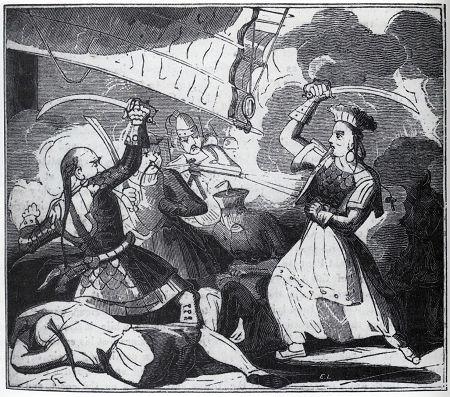
Zheng Yi Sao is described as the most successful female pirate in history. Born in 1775 into humble circumstances, she married the notorious pirate captain Zheng Yi, but on her own terms. She demanded equal partnership in his pirate fleet—an unprecedented and audacious demand. Zheng Yi was agreeable, and she took on the name Zheng Yi Sao (wife of Zheng Yi).

After her husband died when she was 32, Sao took control of his pirate fleet and transformed it into an unstoppable force in the South China Sea. She knew the coastline better than any imperial admiral, using hidden inlets and storm-lashed coves to evade capture. Sao was not just a skilled seafarer, she was a brilliant and brutal administrator. Her fleet was governed by a strict code of conduct:

Loot was divided fairly, with captains receiving a smaller share than their crew to ensure widespread loyalty. Female captives were to be treated with respect, and could only be taken as wives with mutual consent. Rape was punishable by immediate execution. All plundered goods had to be presented for group inspection, all captured goods were registered, and the punishment for disobedience was often beheading. Perhaps her most revolutionary approach was for other women within her fleet. The wives and widows of pirates were encouraged to take on leadership roles, creating an unprecedented situation where women held genuine authority in a violent, male-dominated world.

Zheng Yi Sao reigned supreme with an armada of over 300 ships and a crew of 20,000 to 40,000 pirates. Her fleet successfully defeated the navy of the ruling Qing dynasty, and even the ruling government could not destroy her power. Zheng Yi Sao’s power stemmed not just from ruthlessness and brute force, she was equally a strategic planner and shrewd negotiator. Recognizing that prolonged conflict would eventually erode her power she negotiated a surrender with the government, once again, on her own terms. She secured full amnesty for herself and almost all her crew, the right to keep her accumulated wealth; military positions for many of her top commanders.

Zheng Yi Sao eventually retired with all her loot, and continued to lead a civilian life for the next several decades. However she has gone down in the annals as the most successful pirate of all times. 

Sayyida al Hurra: Pirate Queen of the Mediterranean

Sayyida al Hurra was not just a pirate; she was a queen, a refugee, a warrior and a power broker of the 16th century Mediterranean. She was born in 1485 in a family of Andalusian nobles, but forced to flee to Morocco. While in exile there Sayyida rose to become Governor of a vital port city on the North African coast. Once in power, she decided to avenge Spain and Portugal, not through politics or war, but through piracy. She forged a strategic alliance with Barbarossa an Ottoman admiral and pirate, and together they controlled the seas, he in the east and she in the west.

Sayyida was more than a pirate commander; she was also a skilled diplomat and ruler. She negotiated directly with European monarchs, wielding influence usually denied to women of her era. She even married the Sultan of Morocco and insisted the wedding take place in her city, making her the only woman in Islamic history to have married a reigning monarch without leaving her seat of power. Thus Sayyida established rule over both land and sea, a rarity in history.

 Laskarina Bouboulina: The Pirate Admiral of Greek Independence

Laskarina Bouboulina was born defiant. Her father was a naval captain and rebel who had been imprisoned by the Ottomans. Laskarina was born in a prison cell in Constantinople in 1771, where her mother had gone to visit her imprisoned husband. After her father’s death Laskarina and her mother moved to the island of Spetses. This was no idyllic Mediterranean village, but a haven for smugglers, sailors and rebels who had fled conventional authority. The young Laskarina grew up among pirates and ship’s captains, learning about the language of the sea and sailing ships even before she could read.

By the time she was 40, Laskarina was married and widowed twice, to powerful ship owners, and inherited their fleets and fortunes. She used these resources not just for commerce but to fight the Ottoman Empire. She became a member of Filiki Eteria a secret organisation plotting to overthrow Ottoman control over Greece. Her main role was to smuggle food, weapons and ammunition into Spetses. She used her wealth to commission the construction of Agammennon, her personal warship, considered to be one of the largest and fastest Greek warships of the revolution. She commanded the rest of her fleet from this warship. Spetses was the first island to revolt against the Ottoman Empire in 1821. Laskarina then led her fleet to begin a naval blockade of the fortified city of Nafpoli, followed by the siege of other cities.  

Throughout the battle against the Ottomans, Laskarina conducted her spirited resistance with a mix of strategy, ruthless power and charisma. She was fierce, but an inspiring leader who commanded the respect of the men who willingly joined her battle. Ironically, she was killed in a family feud.

These swashbuckling buccaneers ruled the waves, broke every rule written for women, and rewrote history at sea.

–Mamata


Around a Continent in 18 Months: The First Circumnavigation of Australia

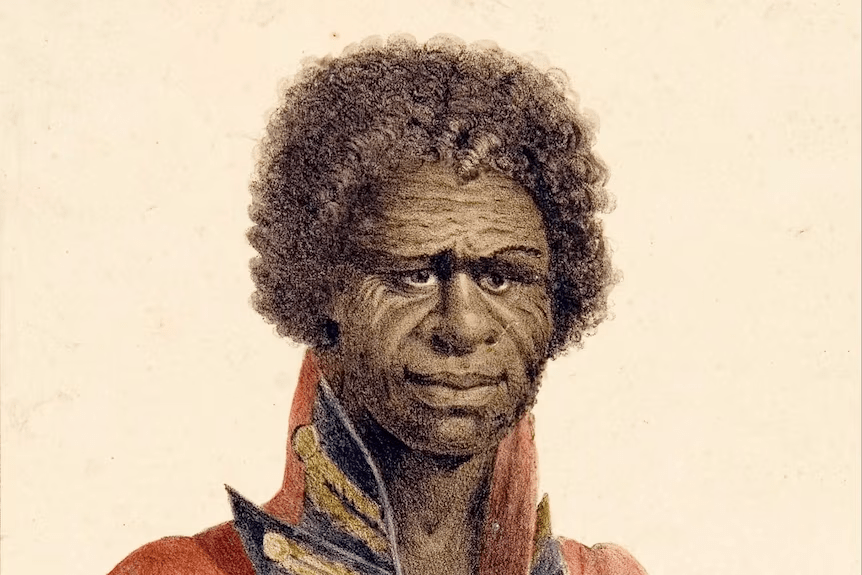
When we think of great explorers, we picture men in naval uniforms, compasses in hand, charting “new worlds.” But tucked away in the annals of Australia’s history is a story that breaks that mould. It’s the story of Bungaree—the first Aboriginal man, and indeed the first Australian, to sail right around a continent.

His name is little known today, but his contribution to one of history’s most extraordinary voyages, in an exploration led by Captain Matthew Flinders, an English navigator was extraordinary.

From Broken Bay to the World

Bungaree was a man of the sea. Born around 1775 among the Kuringgai people near Broken Bay, north of Sydney, he grew up at a time when everything around him was changing. European ships had begun to appear on the horizon; new settlements were springing up on ancient lands. While many Aboriginal communities resisted the newcomers, Bungaree was curious. Quick-witted and charismatic, he learned to move between two worlds—his own and that of the British colonists.

By the time Flinders was preparing to embark on his grand voyage of exploration, Bungaree had already earned a reputation as a skilled sailor and interpreter. Flinders, who understood the need for a knowledgeable local person on his mission, invited Bungaree to join the expedition aboard HMS Investigator in 1801.

The Journey Around a Continent

The Investigator’s mission was to chart the entire coastline of the vast southern landmass known then as New Holland. Flinders hoped to prove it was a single continent—what we now call Australia. For this, he needed not just navigational skill, but also understanding—someone who could help bridge worlds. Bungaree became that person.

Throughout the voyage –from December 1801 to June 1803–Bungaree played a vital role as peacemaker and emissary. When the Investigator anchored near Indigenous communities, it was often Bungaree who stepped ashore first—speaking to local groups in shared gestures, explaining the strangers’ peaceful intent, and easing tensions that could have turned deadly. His presence gave the expedition a human connection that maps and compasses could not.

Flinders, for his part, admired Bungaree’s warmth and humour. In his journals, he wrote that Bungaree “was always of service wherever we went,” and that his “good disposition and open, manly conduct” won respect from both shipmates and the people they met. It was a rare acknowledgment of partnership in an age otherwise defined by hierarchy and conquest.

The Man Beyond the Maps

The voyage was gruelling. The Investigator battled storms, leaks, and disease. Food was scarce; scurvy stalked the crew. Yet through months at sea and thousands of kilometres of unknown coast, Bungaree remained cheerful and steadfast—a figure of resilience and adaptability. When they finally completed the first circumnavigation of the continent in 1803, Bungaree had travelled more of Australia’s coastline than any person before him.

And yet, history gave him only a passing mention. While Flinders returned to England (and was later imprisoned by the French), Bungaree returned to Sydney. There he became something of a local character—always dignified, dressed in military uniforms, wearing his medals proudly. He was lovingly referred to as “King Bungaree,”.

An Amazing Feat

So this was the veryfirst successful circumnavigation of an entire continent in recorded history–the first time anyone had completely circumnavigated a single, continuous continental landmass on Earth.

Other earlier famous circumnavigations (like Magellan’s) went around the globe or around islands (for example, Tasmania, which Flinders himself had circumnavigated earlier with George Bass in 1798). But going around a continent — that is, a vast mainland connected by continuous coastline — was unique. (Incidentally, while one can circumnavigate Africa, the Americas through the Panama Canal, and Antarctica when the ice permits, it is not possible to circle Asia and Europe).

Remembering Bungaree

Bungaree died in 1830 and was buried at Rose Bay. His resting place, like so much of his story, is unmarked. But in recent years, there has been a growing recognition of his contribution—not just as a companion to Flinders, but as a symbol of the spirit of adventure, resilience, and bringing two worlds together.

–Meena

PIC from ABC News