Farmers of Our Forests: Hornbills

Last week saw the launch of India’s first Centre of Excellence for Hornbill Conservation. This is hosted by the Anamalai Tiger Reserve in Tamil Nadu, and will be dedicated to the long-term study and conservation of this threatened species.
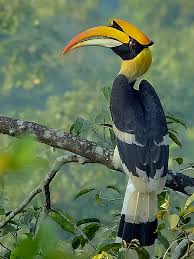
Great Hornbill

What are hornbills, and why are they threatened?

Hornbills get their name from the casque—a horn-like projection on the top of their long and downward-curving beak. While this is their defining feature, bright skin around their eyes and long eyelashes, and a brilliantly-coloured pouch of loose skin at their throat add to their striking appearance. They also have distinctive calls. Hornbills are giants among the forest birds in many ways.

There are 62 hornbill species worldwide, with 32 found in Asia and 30 in Africa. India is home to nine species. Among these: The Great Indian Hornbill or the Great Pied Hornbill is the largest among the hornbills found in India. The Malabar Pied Hornbill is endemic to tropical forests in India and Sri Lanka. The Rufous-necked Hornbill which is the most endangered, and the least studied of the nine hornbill species is found in the North-eastern parts of India.  The Narcondam Hornbill is only found in a 12 sq. km stretch in the tropical forest of the Narcondam Island in the Andaman Sea. The Malabar Grey Hornbill is endemic to the Western Ghats. The Indian Grey Hornbill is the most commonly seen hornbill species in India, and is sometimes spotted even in cities. 

Whatever the species, hornbills play a vital role in forest ecosystems as dispersers of seeds of forest plants, aiding the regeneration of forests. Hornbills are among the very few birds that can feed on fruits with large seeds. They digest only the fleshy parts of fruits that they swallow and then regurgitate the seeds, spitting them out, or defecating the seeds intact. As the hornbill flies from tree to tree, or during the nesting season flies back and forth over long distances to search for and carry food for its mate, the regurgitated cleaned seeds are dropped far and wide, enabling them to grow into trees far from the original trees from which they originated. The Namdapha National Park in Arunachal Pradesh has the highest density of hornbills across Asia. Studies have indicated that hornbills here disperse seeds at the rate of 11,000 seeds per day per sq. km! 

Thus hornbills are critical in keeping the forest alive. If we lose hornbills, many forest trees that depend on them to spread their seeds may eventually disappear from the forest too. Hornbills symbolise not only the health of a forest, but also a key to their continued survival.

Hornbills in turn, depend on a healthy tree density in the forest for their own survival. All hornbills are cavity nesters. While they cannot build their own nests or dig cavities, they use existing holes in a variety of trees to make their nest. The process begins during a month-long courtship when the male presents the female with food. As they embark on playful behaviour the pair also check out tree cavities to select their nesting site. Having done this, the two prepare the nest by cleaning it, creating the wall lining, and undertaking repair work. Once the nest is ready, the female prepares to confine herself in the nest while the male continues to provide for her needs by bringing food and nesting material. The female then seals the nest entrance with her own faeces, food and bark fragments, and mud pellets brought by the male. Only her beak protrudes out from the sealed nest. This helps to protect the eggs and chicks from predators. She lays her clutch of between two and five eggs and incubates them for over 20 days. Throughout this period the male diligently flies back and forth, feeding his mate through her protruding beak. The mother emerges from the nest shortly before the chicks themselves are ready to fly, and the chicks once again seal the nest from the inside, even as they continue to be fed. Now both the parents share in providing food and caring for the chicks. One of Nature’s many marvellous examples of nurturing the young.

This unique nesting habit of hornbills has also, in recent times, become a threat to the very existence of these birds. The fact that they use the same nests over the years makes it important to protect their nesting trees, and the habitats where they grow. The destruction of forests by habitat fragmentation, deforestation and clearance of forest areas for agriculture and dams is depriving these birds of places to nest and breed. The loss of native trees also affects their diet, posing a significant threat to their survival. Adding to these human-made threats is the impact of climate change which disrupts flowering and fruiting patterns critical to hornbill feeding and breeding. Thus it is imperative that the trees that they use, and the trees and forests that that provide them food and shelter to breed be protected. Sadly these are being rapidly depleted, thus endangering the birds

The rapidly increasing threat to these magnificent birds calls for urgent action at all levels, from the government measures to people’s efforts.

The Hornbill has great cultural symbolism among many tribes of North East India, especially in Nagaland and Arunachal Pradesh. A unique community-based initiative to protect nesting trees of hornbills is the Hornbill Nest Adoption Programme spearheaded by the Nyishi tribe in the Pakke Tiger Reserve in Arunachal Pradesh. The tribe which traditionally hunted hornbills for their casque which were a symbol of their tribal identity have become active partners in protecting and conserving the hornbill nesting areas. The programme invites donors across the world to become ‘hornbill parents’ by adopting hornbill nests. The donations help pay salaries to the local community nest protectors who patrol the area, and ensure that the habitat continues to invite these birds. What an appropriate way to celebrate a bird that is, in its unique way, a diligent nest protector and parent.

A great People’s Science initiative is Hornbill Watch, a website where anybody can share details of a hornbill sighting from anywhere in India. This user-friendly website can be accessed by people from all backgrounds to share their hornbill sightings; being a wildlife conservationist or photographer, or even an avid birder, is not a necessity. The website has information on Asian hornbills in general, and detailed descriptions of the nine species found in India, as well as photographs submitted by contributors. Over time the data collected would help in identifying and prioritizing sites for hornbill conservation.

Now the setting up of a dedicated Centre of Excellence for Hornbill Conservation is another important step. The Centre will focus on the four species that are found in the Western Ghats which is a globally recognized Biodiversity Hotspot. The four are: the Great hornbill, Malabar grey hornbill, the Malabar pied hornbill, and the Indian grey hornbill. The great hornbill and Malabar grey hornbill are categorised as vulnerable, while the Malabar pied hornbill is near threatened as per IUCN. The Centre will monitor hornbill populations, study their breeding habits, map their nesting sites and food sources, and track their movements using GPS or satellite telemetry techniques. The Centre will also engage with the local communities to work for habitat restoration and nest protection. 

The initiative looks beyond monitoring the species to protecting entire forest ecosystems upon which the hornbills depend for their survival, and which in turn are kept vibrant with help from their farmers—the Hornbills.

–Mamata
Remembrancers To Resurrectionists: A Stroll Through Forgotten Job Titles

Once upon a time—before HR departments and LinkedIn profiles—jobs came with titles so evocative, so oddly poetic, they sound like characters straight out of a Dickensian drama or a Ruskin Bond vignette. While today’s professions lean towards the ultra-pragmatic and descriptive, many titles of the past came with a whiff of romance. For example: the Remembrancer.

Yes, the Remembrancer. Not an app. Not a diary. A person. One whose very profession was to remember. Specifically, to remind monarchs and magistrates of important affairs—debts, legislation, ceremonies. A Remembrancer was originally an official tasked with reminding a monarch or government body about matters of state, legal affairs, or financial obligations. The title comes from the idea of “remembering” important business that required attention.

The City Remembrancer of London–a post dating back to 1571–still exists, quietly observing proceedings in Parliament, tucked behind the Speaker’s Chair. We can’t help but picture him as an elderly gentleman in an impeccably cut coat. who acts as a liaison between the City of London and Parliament. Their duties include monitoring legislation that might affect the City, representing the City at ceremonial functions, and advising on constitutional matters. The Remembrancer also attends the State Opening of Parliament and sits in a specially designated place in the House of Lords.

It is not just the UK. India too continues something that must have started in colonial times. We still have Legal Remembrancers in our legal system, primarily at the state level. They play a crucial role in advising the government on legal matters and representing the state in court proceedings. The Legal Remembrancer (or Remembrancer of Legal Affairs) is a government official who acts as the chief legal advisor to the state government. 

Even quainter are the roles that seem to exist simply to add charm to history books. The Ale Conner who tested beer for public consumption. The Knocker-Up who tapped windows with a stick to wake people up before alarm clocks were invented.

Saggar Maker’s Bottom Knocker is not a Victorian insult; it is an occupation. In pottery, a saggar is the box which holds the clay which is being fired. By placing various substances in a saggar, dramatic effects can be produced on the finished pottery. A master-craftsman called a saggar maker made the saggars. But bases of the saggars were produced mechanically and did not require much skill. They were left to young apprentices called bottom knockers, as they literally knocked them into shape.

While a Computist might bring visions of those working on advanced computer programmes, in the old days, these were people charged with calculating Easter based on lunar cycles—part astronomer, part theologian. An alternative term for jyotish?

A Lector was a person who used to read out Karl Marx or pulp fiction to cigar workers in Cuba while they rolled tobacco leaves by hand.

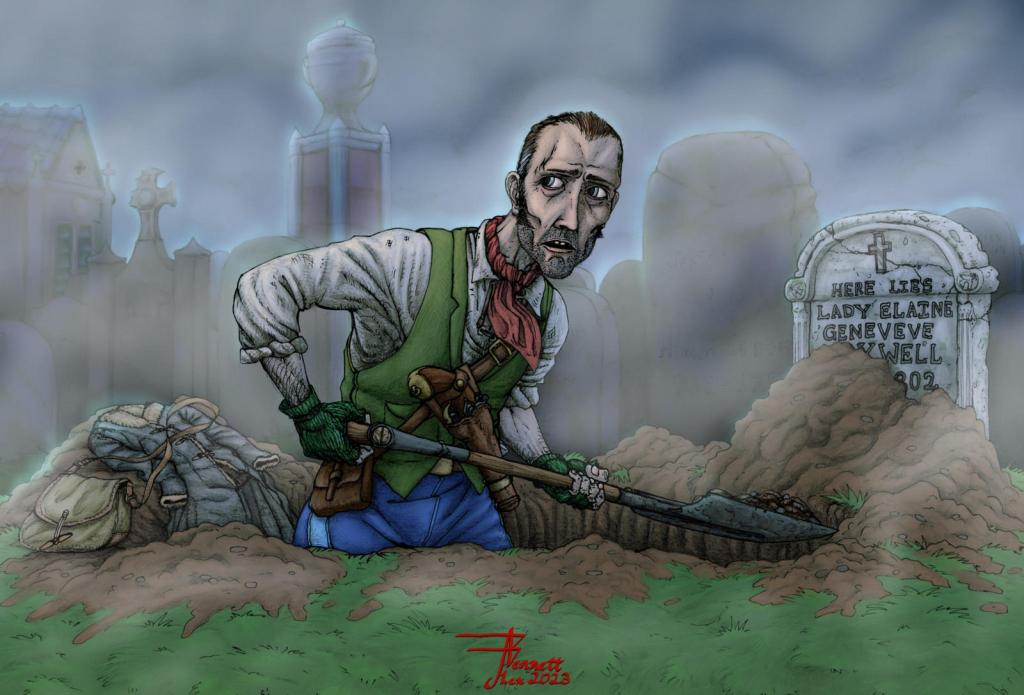
Resurrectionists or resurrection men were body-snatchers who would steal fresh corpses and sell them to medical schools for students to practice dissection. This trade flourished at the end of the 18th and beginning of the 19th centuries in Britain as a result of a lack of bodies to dissect in these schools. Organised criminal gangs would steal recently buried bodies, or acquire dead bodies before burial, and then sell them at a premium to anatomy teachers who used them to demonstrate dissection and also give students a chance to try dissecting themselves, as this was a required part of medical training. The widespread practice of body snatching led to the Anatomy Act in Britain, which legalized the use of unclaimed bodies for anatomical study.

We can’t help but wonder what future historians will make of us. “Brand Evangelist,” they might scoff. “Was that a missionary or a marketer?” “Content Creator—was that a novelist or a TikToker?”

Perhaps some titles are best left in the mists of time, to be stumbled upon in dusty libraries or trivia nights. But wouldn’t it be something to bring a few back? A ceremonial Remembrancer for family birthdays, perhaps? A Beadle to enforce silence during Zoom calls?

Till then, we’ll sip our tea like old scribes, toast to forgotten vocations, and remember to remember the Remembrancers.

My first and recent encounter with the wonderfully romantic word ‘remembrancer’ was not in a pleasant context. A Haryana committee which recommended the appointment of Vikas Barnala, an accused in a stalking case, to the position of assistant advocate general in the office of advocate general, included a Remembrancer.

–Meena

Pic credit: Our Great American Heritage

Redshirting: A Parenting Trend

My grandnephew was born on June 1. When the time came for him to be admitted to class 1 the school informed that as per rules, a child should have completed 6 years of age to be eligible for starting school. This child missed the mark by one day, and hence he had to continue in kindergarten until the next year. While this child’s parents were not unduly bothered by this, several parents in similar circumstances are greatly bothered by the fact that their child was obliged to “waste a whole year” just because of the difference of one day. In ‘the race’ as it were, for the child to be always ahead, many parents today start the child on the long journey of education that lies ahead, with an anxiety of ‘being left behind’. They are concerned that the child will be older than its peers (albeit by a few months) and that this will be a continuing concern right through its education. Some parents even resort to a variety of tactics to convince the school to relax the rule, especially in cases where the child ‘misses out’ by just a couple of days.

But if we really think about it, what exactly is the child ‘missing out’ on? An early start to the rigidity of a timetable, stress of homework and the structure of a prematurely heavy academic schedule? As compared to continuing another year of the relatively more relaxed environment of pre-school? How much of a difference will this make 17 years down the line?

This race in India and, I suspect, many other countries starts where there are pre-schools that take children in even as early as one and a half years. Parents are keen that children enter the ‘system’ as it were, asap!

I recently read about an opposite take on this approach. This approach, that has adherents in the United States, advocates postponing a child’s entrance into preschool or kindergarten. This is in cases where the child meets the official enrolment age requirement but it is the parents’ decision to postpone its school entrance.

This approach is called Redshirting.

Redshirting is different from ‘holding a child back’. It is based on the judgement of a parent, who needs to gauge whether the extra year will give a child more time to mature in emotional, social and physical areas. It is anticipating that this will compensate for baseline learning difficulties as a school may not be able to give a single child the necessary attention and support. It is also incumbent upon the parents that they have the requisite wherewithal to be able to provide this attention and support.

There has been much debate on whether or not redshirting has positive or negative long-term effects on the child. The reasoning is, that holding the child back a year means that the child may be physically stronger and bigger than its peers when in first grade. Looking ahead, it may also provide the child with an advantage in athletics when it reaches high school. But at this early stage all this would be mere speculation, or simply wishful thinking!

In terms of academics some research has shown that delaying kindergarten can give a child a temporary boost as compared with its peers, as it is a year older and (presumably) more mature. This may also give the child a competitive advantage. But research has shown that this advantage disappears by the first or second grade. What is does not seem to cover is the other advantages of peer learning and socialization that kindergarten offers.

However this delay may be a sensible choice for a child who has a genuine requirement, such as a special need, physical or intellectual, or lacks the emotional maturity to handle a more structured kindergarten environment. It is proven that brain development between the ages of five and six is very significant. In such cases coming into school with an extra year of development may be helpful for the child.

Research supports the idea that early education is critical to developing young students’ learning and social-emotional skills and also crucial to their long-term academic success. However it is controversial whether delaying a child’s entry to school helps or hinders this process.  

More intriguing is the term itself. Why ‘redshirting’? The origin can be traced back to sports, particularly college sports, where redshirting refers to the practice of student-athletes sitting out a year of competitive play to extend their eligibility or develop their skills. The term is said to have originated in the late 1930s at the University of Nebraska, where Warren Alfson, a player, wore a red practice jersey without a number, as Nebraska’s team colour was red. This practice of wearing a red shirt during practice to differentiate from players who were competing became associated with the concept of redshirting. 

Interestingly ‘redshirting’ became a popular trend following the publication, in 2008, of Malcolm Gladwell’s bestselling book Outliers. Based on data from the ages of the players for the Canadian Hockey League, the book claimed that the players who were born in the first four months of the year, and thus older than the other team members, were more likely more likely to be identified as talented and ultimately more likely to play professional hockey. Following from this Gladwell argued that the same principle extends to children who are older than their classmates, in that they may have an academic advantage.  

In a sports-crazy society like America, some parents reason that by holding the child back for a year, it will potentially be physically stronger and larger than its peers once it reaches high school, providing it with an advantage in athletics.

It is difficult to prove either way. Redshirting may have benefits for some children, but it is not a guarantee for any future advantage; it may even go the other way. Personally I find it rather difficult to make sense of this trend. And wonder if being a year younger or older than your classmates is likely to have such profound and life-changing consequences. What does ring true is this observation: ‘America is living on a calendar of age; age determines when we can start school, drop out of school, drive, vote, work, consume alcohol, buy tobacco. Age, by society’s standards determines individuals’ readiness, maturity, and ability to handle certain situations. America has let age define an individual’s experience and progression beyond just celebrating another year of life.’

–Mamata

Waxing Moon? Waning Moon?

We usually think we know what we need to about the Moon. After all, we see it almost every night—peeking between clouds, trailing us on evening walks, or gleaming quietly over exam-season all-nighters. But ask most adults how to tell if the Moon is waxing or waning, or what phase it is in, and you’re likely to get a sheepish shrug.

Moon Day (July 20) is a good time to find out more—because the Moon is more than just a pretty face.

The Moon’s Phases

As we know, the Moon doesn’t shine on its own. What we see is sunlight reflecting off its surface. As the Moon orbits Earth once every 27.3 days, the portion we see illuminated changes depending on the relative positions of the Sun, Earth, and Moon.

But because Earth is also moving around the Sun, the complete lunar cycle (from New Moon back to New Moon) takes about 29.5 days. This is called a synodic month.

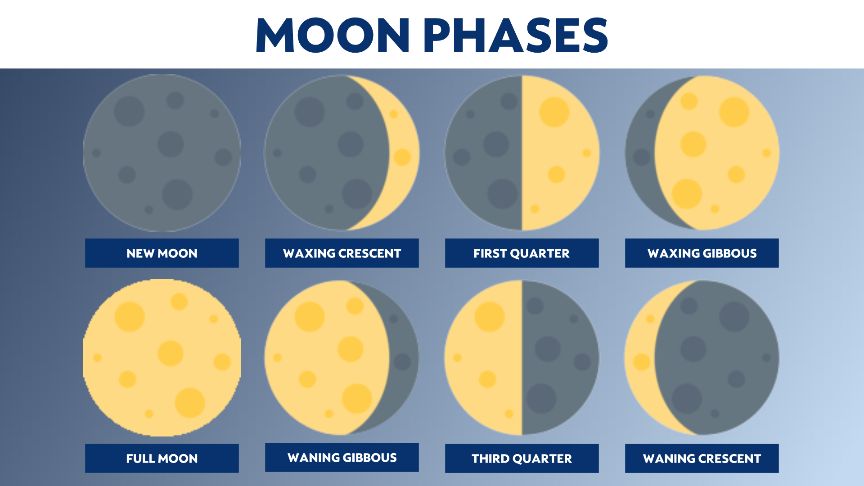
During this period, the Moon goes through eight distinct phases:

  1. New Moon – The Moon is between Earth and Sun; its illuminated side faces away from us.
  2. Waxing Crescent – A sliver appears on the right side (Northern Hemisphere). “Waxing” means it’s growing.
  3. First Quarter – Half of the Moon is visible—right half lit.
  4. Waxing Gibbous – More than half is lit, increasing toward full.
  5. Full Moon – The entire face is illuminated. Earth is between the Sun and Moon.
  6. Waning Gibbous – The light begins to shrink; left side remains lit.
  7. Last Quarter – Half again, but this time the left half.
  8. Waning Crescent – Only a small sliver remains on the left.

And then the cycle begins again.

What Does “Gibbous” Mean?

“Gibbous” comes from the Latin gibbosus, meaning hump-backed or bulging. It refers to the Moon when it’s more than half but not fully illuminated. A nearly full Moon—either on its way there (waxing) or just past (waning). So:

  • Waxing Gibbous = swelling toward full.
  • Waning Gibbous = shrinking after full.

Waxing or Waning?

If you are following the progress of the moon night after night, you will know if it is waxing of waning. But would you know if you just happened to glance up one night? Indeed there are ways to tell. In the Northern Hemisphere:

  • If the right side is lit, the Moon is waxing.
  • If the left side is lit, the Moon is waning.

This holds true whether you’re looking from a balcony in Bengaluru or walking through a park in Boston. But here’s where it gets interesting:

The Moon is Universal—but Not Identical

The same Moon is seen all over the world—but not always in the same orientation. If you’re in the Southern Hemisphere, everything flips:

  • Waxing appears with left side lit.
  • Waning shows up with right side lit.

In fact, a person in the Southern Hemisphere sees the Moon “upside down” compared to someone in the Northern Hemisphere. For example:

  • When it’s a First Quarter Moon in India, the right half of the Moon is illuminated.
    In Australia, it’s still the First Quarter—but they see the left half lit.
  • When it’s a Waxing Crescent in New Delhi, it appears on the right side.
    In Cape Town, that same sliver appears on the left side.

It’s the same phase, same Moon—but reality shifts, depending on where you stand!

Once we learn to read the Moon, it becomes a kind of nightly compass. It connects us to the rhythm of the Earth, of time itself. And yes, it’s also fun to casually identify a “waning gibbous” and enjoy the raised eyebrows from unsuspecting friends.

So the next time someone asks, “Is it waxing or waning?”—you’ll know. And if you’re feeling generous, you might just pass on that little rhyme:

🌒 “Right is bright, it’s waxing with might.”
🌘 “Left is lit, it’s waning a bit.”

–Meena

Picture source: https://spectrumnews1.com/wi/milwaukee/

Space Seeds to Moon Trees

It is Moon Week! Meena wrote about the different facets of the moon, in fact and fantasy. Just a couple of days ago, the Axiom 4 mission returned from its space sojourn with Grp. Captain Shubhanshu Shukla being a proud Indian member of the team. Much has been in the news about the experiments that the team carried out while on the International Space Station (ISS). One of these experiments was to sprout methi and moong seeds in petri dishes and then storing these sprouts in a storage freezer on the ISS. This experiment was part of the Sprouts project, designed to study how spaceflight affects food germination and plant development. Insights from this project could transform space agriculture to enable it to support a reliable supply of food for future space travelers. Some of the seeds will also be brought back to earth, and cultivated over several generations while research is carried out on the genetic, microbial and nutritional changes in these space-returned seeds. Today, astronauts on the International Space Station (ISS) regularly eat salad grown on board. Future long-duration exploration of the Moon and Mars depends on being able to grow fresh food in deep space.

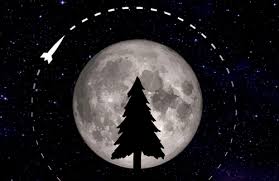
Seeds have been travelling to space since 1971 when the Apollo 14 mission was launched. The mission put two astronauts Alan Shepard and Edgar Mitchell on the moon. As they walked on the moon the third astronaut Stuart Roosa continued to orbit above in the command module. Stuart Roosa was a former US Forest Service smoke jumper (a fire-fighter who parachutes to the site of a forest fire), before becoming a military aviator and astronaut.

When Roosa was selected for the moon mission he was entrusted with another important mission—to carry hundreds of seeds of trees with him. This was part of a joint experiment of NASA and the US Forest Service which selected seeds from five different types of trees. The seeds were x-rayed, sorted and classified, and sealed in small plastic bags stored in a metal canister. Roosa, the official ‘seed ambassador’ for the project carried the canister with more than 2000 seeds in a small canvas pouch as part of his personal belongings. This was the first time that seeds were being sent into deep space and it was an experiment to study how this would affect the seeds’ health, viability and long-term genetics. The seeds under Roosa’s care successfully completed the mission to the moon, but following their return the seed bags burst open during the decontamination process, leading to fears that the experiment’s environment had been contaminated and the seeds would not be viable. Nevertheless they were sent to the Forest Service offices in several places to see if they would germinate. In fact, many did germinate and grew into viable saplings. These 450 saplings were gifted to schools, universities, parks and government offices across the United States, in suitable locations in terms of climate and soil.

The saplings grew into trees which came to be known as ‘Moon Trees’. These were planted alongside their Earth-bound counterparts in order to compare the two. Fifty years later both grew into mature trees with no discernable difference.

Subsequently the collaboration between NASA and US Forest Service has continued with more seeds traveling to space with different missions. Upon their return the space seeds have been planted, and the next generation of Moon Trees are taking root and growing in multiple places. While the seeds in space have contributed to science, the Moon Trees are playing an important role in sparking curiosity about space, fostering a deeper understanding of NASA’s missions among the new generations of students, and nurturing community connections where they thrive.

Today there is a Moon Tree Foundation which aspires to unite, inspire, and conserve by planting a Moon Tree in every corner of the world. Its mission is to inspire interest in education, science, space, conservation and peace for all mankind. Moon trees serve as a reminder to take care of our planet for future generations as “we are under the same sky, looking at the same moon.”

–Mamata

Under the Same Moon

July 20 is a day with special significance for humanity. It is Moon Day—it commemorates the day humans first set foot on the Moon in 1969—a moment that changed forever human imagination, and our relationship to the rest of the universe.

For many of us, the Moon is far more than a historic rock in the sky. It has always fascinated us. It is companion, compass, calendar, and comfort.  It’s poetic, scientific, spiritual, and personal. Whether it is its influence on tides or moods or menstrual cycles—there’s no denying its pull on our lives. It is a part of folklore—in India, a part of the family, with the moon referred to as Chanda mama.

India is writing its own Moon story, with the first manned flight planned for 2027. Grp. Captain Shukla’s sojourn at the International Space Station is part of this preparation. But we have chalked up some notches already:

  • In 2008, Chandrayaan-1 confirmed the presence of water molecules on the Moon—yes, our lunar scout found signs of water where many others hadn’t.
  • Chandrayaan-2 in 2019 didn’t land as planned, but gave us valuable data.
  • And then came Chandrayaan-3 in 2023 when India became the first country to successfully land near the Moon’s south pole—a scientific and symbolic triumph.

This is India’s contemporary moon-story. Here is a beautiful ancient one.

The Rabbit in the Moon: A Buddhist Tale

One of the most enduring tales about the moon is of the rabbit in the Moon, a story rooted in Buddhist Jataka tradition and echoed across generations.

Long ago, the story goes, a kind and gentle rabbit lived in the forest. One day, Lord Indra came down disguised as a hungry old man, asking for food. The rabbit, seeing he had nothing else to offer, jumped into the fire to offer himself as a meal. Touched by this ultimate act of generosity, Indra rescued the rabbit and immortalised him on the Moon—his shape etched forever in the lunar light.

Even today, if you look closely on a clear full moon night, you can make out the shape of a rabbit crouched gently on the surface. Some say he’s still keeping watch. Some say he’s a reminder of kindness and quiet courage.

So on the July 20th, look up at the moon, wonder at its beauty, and ponder the words of some wise people:

“Three things cannot be long hidden: the sun, the moon, and the truth.”

—Buddha

“Don’t tell me the sky is the limit when there are footprints on the moon.”

—Paul Brandt

“The moon is the first milestone on the road to the stars.”

—Arthur C. Clarke

“Always remember we are under the same sky, looking at the same moon.”

—Maxine Lee

“The moon does not fight. It attacks no one. It does not worry. It does not try to crush others. It keeps to its course, but by its very nature, it gently influences. What other body could pull an entire ocean from shore to shore? The moon is faithful to its nature and its power is never diminished.”
― Deng Ming-Dao

–Meena

Next week, some more explorations related to the moon.

Pic: nasa.gov/mission/apollo-11/

The Stroop Effect and Other Sneaky Brain Games

Having been associated for long with Vikram A. Sarabhai Community Science Centre (VASCSC), the pioneering science centre in the country, I always source STEM education materials and kits from them.

A few weeks ago, we received one such package I had ordered. The wonderful thing about VASCSC material is that they don’t let an inch of space go to waste. So the large envelope in which the kit came was also printed with any number of science games and puzzles.

The one that my 6 year old grand daughter and I really had fun with was the Stroop Effect.

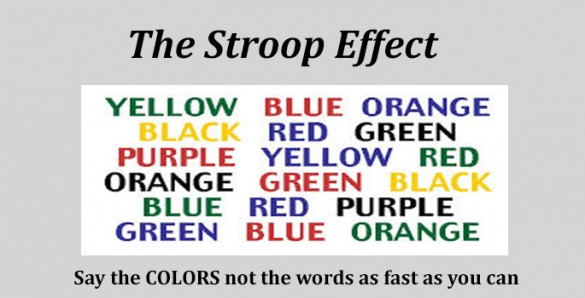
It was all giggles as she held out the sheet with a bunch of words and asked me to look at them.  The word “RED” was written in bright blue ink. She asked me to say the colour, not the word..

“Red!” I said instinctively.

“No!” she giggled. “It’s blue ! You have to say the colour of the ink!”

Oh.

And just like that, we stumbled headfirst into the Stroop Effect—a clever little quirk of our brains first identified by psychologist John Ridley Stroop in 1935. Stroop, an American psychologist conducted a series of studies as part of his PhD research. He was fascinated by how automatic processes—like reading—can interfere with other tasks, such as identifying colours. In his now-famous experiment, he showed that when colour words (like “red” or “green”) were printed in mismatched ink colours, people took longer to name the ink colour. This delay, or interference, revealed something profound about how our brains handle conflicting information.

So what is the Stroop Effect?

The classic version of the Stroop test asks you to name the colour of the ink in which a different colour name is written. Like the word “Green” printed in red ink. Sounds simple, right? But our brains are wired to read words so automatically that it slows us down, or even trips us up, when the word and the ink colour don’t match.

This interference between what we read and what we see is a fascinating peek into how our minds juggle competing bits of information.

Why does it matter?

What seems like a party trick actually has deeper implications. Psychologists use the Stroop test to study attention, processing speed, and cognitive control. In clinical settings, it helps assess brain injuries, dementia, and even ADHD. The longer it takes for a person to respond correctly, the more it can reveal about how their brain is functioning.

But even beyond labs and clinics, understanding the Stroop Effect has very real applications.

Take driving, for instance. Ever noticed how highway signs use simple fonts and colours? Imagine if a stop sign said “Go” in red letters—confusing, right? Designers rely on principles like those revealed by the Stroop Effect to make sure our brains process the right cue first.

It’s not just colours and words

Once you start noticing, these mental speed bumps are everywhere. Consider this: we all know that when we try rubbing our stomach with one hand and patting our head with the other, we run into hilarious situations. It is tricky, because your brain is trying to coordinate two conflicting patterns of movement. That’s a bit like motor interference, another cousin in the Stroop family.

Or think of the McGurk Effect, where what you see affects what you hear. If a video shows someone saying “ga,” but the sound is “ba,” your brain may hear “da.” Vision wins over sound, just like reading wins over colour in the Stroop test.

And then there is change blindness—when something in a visual scene changes, and we don’t notice because our attention is elsewhere. Magicians depend a lot on this trick, as also UX designers, who try to guide user attention in websites and apps using visual cues.

A lesson in humility

For me, discovering the Stroop Effect was a gentle reminder that our brains, for all their wonder, are not infallible. They’re predictably imperfect, prone to biases and blind spots. Well, that makes life more exciting!

–Meena

Image: Venderbilt University site

Compassion is the Answer: Dalai Lama

We live in a world that is war-worn, strife-torn, and increasingly becoming inured to the constant barrage of news and images that depict the most deplorable facets of human nature and behavior. Amidst such a depressing state of affairs, we feel helpless and downhearted; we fear that we have already reached a tipping point from where there is no way of turning back, where we seem to be hurtling towards a future which, in a sense, has no future.

There are so few today in the world who can instil a ray of light, a light that can help us navigate the seemingly impenetrable darkness that engulfs us.  In this fog of gloom and doom we yearn for some words of wisdom, a glimmer of hope, a Sherpa who can guide us through.

Who better can we turn to than His Holiness the Dalai Lama, who has dedicated his life to the cause of peace, love and compassion? As we recently celebrated the 90th birthday of this remarkable human being, it would be fitting to share some of this thoughts on love and compassion as guiding lights.

Some of my friends have told me that, while love and compassion are marvellous and good, they are not really very relevant. Our world, they say, is not a place where such beliefs have much influence or power. They claim that anger and hatred are so much a part of human nature that humanity will always be dominated by them. I do not agree.

All sentient beings, not only human beings, but birds and animals too, want to live in peace. Amongst all these beings, humans are probably the most mischievous. We have a marvellous intelligence, but sometimes it is misdirected by negative emotions. Predators such as lions and tigers have claws and fangs that equip them to hunt, kill and eat meat. However, they only prey on other animals when they need food. Human beings, on the other hand, cause trouble even when there is no justification.

Can we change this? I believe we can, because it is our essential nature to be compassionate. From the moment we’re born our mother takes care of us. Without this care we would not survive. This experience is our first opportunity to learn that compassion is the root of all happiness. However, this natural appreciation of compassion seems to fade once we go to school. We need to be reminded that good health and a peaceful state of mind are founded on love and compassion.

How can we start? We should begin by removing the greatest hindrances to compassion: anger and hatred. As we all know, these are extremely powerful emotions and they can overwhelm our entire mind. Nevertheless, they can be controlled. If, however, they are not, these negative emotions will plague us – with no extra effort on their part! – and impede our quest for the happiness of a loving mind.
 
So as a start, it is useful to investigate whether or not anger is of value. Sometimes, when we are discouraged by a difficult situation, anger does seem helpful, appearing to bring with it more energy, confidence and determination.

 
Here, though, we must examine our mental state carefully. While it is true that anger brings extra energy, if we explore the nature of this energy, we discover that it is blind: we cannot be sure whether its result will be positive or negative. This is because anger eclipses the best part of our brain: its rationality. So the energy of anger is almost always unreliable. It can cause an immense amount of destructive, unfortunate behaviour. Moreover, if anger increases to the extreme, one becomes like a mad person, acting in ways that are as damaging to oneself as they are to others.

It is possible, however, to develop an equally forceful but far more controlled energy with which to handle difficult situations.
 
This controlled energy comes not only from a compassionate attitude, but also from reason and patience. These are the most powerful antidotes to anger. Unfortunately, many people misjudge these qualities as signs of weakness. I believe the opposite to be true: that they are the true signs of inner strength. Compassion is by nature gentle, peaceful and soft, but it is very powerful. It is those who easily lose their patience who are insecure and unstable. Thus, to me, the arousal of anger is a direct sign of weakness.

So anger and hatred are always harmful, and unless we train our minds and work to reduce their negative force, they will continue to disturb us and disrupt our attempts to develop a calm mind. Anger and hatred are our real enemies. These are the forces we most need to confront and defeat, not the temporary enemies who appear intermittently throughout life.

And who creates such opportunities? Not our friends, of course, but our enemies. They are the ones who give us the most trouble, so if we truly wish to learn, we should consider enemies to be our best teacher!

 For a person who cherishes compassion and love, the practice of tolerance is essential, and for that, an enemy is indispensable. So we should feel grateful to our enemies, for it is they who can best help us develop a tranquil mind! Also, it is often the case in both personal and public life, that with a change in circumstances, enemies become friends.

You should realize that even though your opponents appear to be harming you, in the end, their destructive activity will damage only themselves. In order to check your own selfish impulse to retaliate, you should recall your desire to practice compassion and assume responsibility for helping prevent the other person from suffering the consequences of his or her acts.

So far I have been discussing mainly the mental benefits of compassion, but it contributes to good physical health as well, According to my personal experience, mental stability and physical well-being are directly related. Without question, anger and agitation make us more susceptible to illness. On the other hand, if the mind is tranquil and occupied with positive thoughts, the body will not easily fall prey to disease.

I believe that at every level of society – familial, tribal, national and international – the key to a happier and more successful world is the growth of compassion. We do not need to become religious, nor do we need to believe in an ideology. All that is necessary is for each of us to develop our good human qualities.

Ultimately, humanity is one and this small planet is our only home. If we are to protect this home of ours, each of us needs to experience a vivid sense of universal altruism. It is only this feeling that can remove the self-centred motives that cause people to deceive and misuse one another.

Much has been written about the Dalai Lama in the past few days. His birthday on 6 June is designated as the Universal Day of Compassion. What better reminder than his own words, of how compassion can be a universal guiding light. With all heartfelt wishes that we continue to be blessed by his wisdom and love for many more years to come.

Excerpts from https://www.dalailama.com/messages/compassion-and-human-values/compassion

–Mamata

The Curious Case of Poop-Eating Plants

Poop. Not a subject of polite conversation. But with a six-year-old granddaughter, this is an integral part of my daily discussions—stories and jokes which feature poop, farts, and belches, and I thought nothing could get me.

But poop-eating plants did! This is one of those bizarrely strange tales from the natural world that makes me marvel at how much we don’t know.

The next time someone tells you that plants only need sunshine, nutrients from the soil and water, its time to pop out the word coprophagy. That’s the term for poop-eating. Most often it’s associated with animals—rabbits, dung beetles, and sometimes dogs. But it turns out that some plants may also be participants in this less-than-dainty buffet. Not many, mind you. It’s an exclusive club.

The pitcher plant (genus Nepenthes) is a frontrunner in this strange category. While most carnivorous plants are famous for trapping insects, some tropical species of Nepenthes have found an alternative nutrient source—bat poop. In places like Borneo, bats roost conveniently above the pitchers, and their droppings fall right in. Scientists call it a “nutritional mutualism.” The bats get shelter; the plant gets dinner. Apart from bat-poop, plants are known to eat the poop of tree shrews, lizards, and even of birds. These flowers even resemble toilets—all the better to catch the poop as it falls.

These plants don’t actually chomp up poop. Rather, they have evolved to extract nutrients from faeces, often via mechanisms like sticky leaves, enzymes, and old-fashioned decomposition. Some even form alliances with fungi or microbes to get the job done.

But why on earth would a plant choose poop? It’s a matter of efficiency. Poop, especially from animals like bats and tree shrews, is rich in nitrogen and phosphorus—two nutrients that are vital for plant growth but maybe in short supply in nutrient-poor soils where many of these carnivorous plants grow. Insects provide these too, but poop is like a ready-made fertilizer packet, no hunting required. Poop offers a shortcut—already digested, already broken down. Though the comparitive nutritive values have not been rigourously tested, it is believed that poop is more nutritious.The bats roost above the pitchers, do their business, and the plant simply absorbs the nutrients through specialized enzymes or microbes that help break things down. Also, insects are scarce on tropical peaks above 2,200 meters, so poop provides a good alternative source.  In fact, scientists are finding that some carnivorous plants are evolving from eating bugs to eating poop! Some pitcher plants have even evolved shapes and scents to attract the animals specifically for their droppings!

Are there any Indian coprophagic plants?

Yes indeed! North East India is home to several species of pitcher plants or Nepenthes. Recent studies suggest that some species in the Nepenthes family (including those found in Southeast Asia) are more than happy to lap up the occasional faecal nutrient.

The Western Ghats, another biodiversity hotspot, also hosts a variety of unusual plants, including some that partner with fungi to decompose animal droppings in the soil. While not technically “eating” poop in the way a pitcher plant might, these interactions are still part of the larger cycle of nutrient recycling—with poop part of this circle of life.

So, the next time you see a lovely green pitcher in a botanical garden or on a damp forest trek in the North East, give it a respectful nod. It might be doing more than just sitting pretty. It might be part of a brilliant, bat-poop-powered system we’re only just beginning to understand.

Well, I know that after this story, Botany is definitely going to be my granddaughter’s favourite subject! Who knew botany could be this…entertainingly gross?

–Meena

Picture: http://www.kew.org/read-and-watch/poo-plants