The Real James Bond

Recently there was news that a woman has been appointed as the head of the British Foreign Surveillance Agency. This is the first time in its 116 year-long history. For readers of spy fiction, and even more, fans of the popular James Bond films, this may sound as a deja-vu. After all we have such a clear image of the formidable Dame Judy Dench playing this role as M, in the fictitious MI6. In many ways the intricate workings of the MI6 and its key characters have been deeply etched in several generations of Bond followers, first through the books, and subsequently through the movies. “The name is Bond. James Bond” immediately conjures up the image of the suave but tough, risk-taking, swashbuckling, gizmo-loving hero, who has been played on screen by a series of actors starting with the inimitable Sean Connery.

James Bond: a simple name that is almost synonymous with these qualities. How did this happen? The christening of Bond is a fascinating story in itself.

The creator of this character, Ian Fleming was a British Naval Intelligence Officer during World War II.  As part of his work he interacted with several spies from different countries. After the war, Fleming left the Service and decided to devote himself to writing spy novels.

He did all his writing from his winter home in Jamaica, then a British colony. He bought several acres of land and built a house mainly based on his own design. He named the house GoldenEye, named after an intelligence mission of the same name that he had overseen during his time with the Intelligence Service. This is wherehe wrote his first book Casino Royale which introduced Secret Agent 007. He named the character James Bond. This did not spring from his imagination; it was the name of an ornithologist whose books Ian Fleming, himself a birder, used to refer to while he was in Jamaica. Fleming thought that it was a perfect name for a spy as it was ‘ordinary and unromantic, but sounded masculine’. As he explained later: I was determined that my secret agent should be as anonymous a personality as possible. Even his name should be the very reverse of the kind of “Peregrine Carruthers” whom one meets in this type of fiction.

This ‘real’ James Bond was born in America but moved with his father to England when he was 14 years old, and he was educated at Harrow and Cambridge. He then returned to the United States and tried his hand at banking upon the urging of his father. But he gave this up and joined the Academy of Natural Sciences of Philadelphia as an ornithologist (self-taught). He began to focus on the birds of the Caribbean islands, undertaking long strenuous voyages on mail ships (despite being prone to seasickness), and hopping from island to island on local banana boats and tramp steamers. This is where he found his true calling. He explored the thick foliage of the islands on foot or horseback, surviving on whatever he could find. He recorded and collected bird samples. From the 1920s through the 1960s, Bond the birdman undertook more than 100 scientific expeditions to the West Indies. He collected more than 290 of the 300 bird species known to the West Indies. He wrote more than 100 scientific papers on Caribbean birds. He complied his observations in the book Birds of the West Indies. This seminal book of Caribbean bird watching was first published in 1936 and for many years remained the definitive bird watching book of the region.

It is this book that Ian Fleming, a keen bird watcher, used as a reference while he spent the winter months at GoldenEye on the north coast of Jamaica. And it is the name of the author that he gave his fictitious character. James Bond, the spy, went on to become one of the most famous names in spy fiction.

Ironically, the real James Bond did not know about this new identity for almost a decade after that. His wife found a reference to this in a magazine interview with Ian Fleming and wrote to the author. Ian Fleming admitted that he ought to have taken permission for the use of the name. To make up for this lapse, the story goes that he wrote back to ornithologist Bond with three offers: He gave Bond “unlimited use of the name Ian Fleming for any purpose he may think fit.” He suggested that Bond discover “a horrible new species” and “christen [it in] insulting fashion” as ”a way of getting back!” And he invited the Bonds to visit Goldeneye so that they could see “the shrine where the second James Bond was born.”

In 1964 the real Bonds who were in Jamaica on a research trip paid a surprise visit to Ian Fleming at GoldenEye. Ian Fleming tested his authenticity by asking Bond to identify some birds. The two went on to become good friends, although Ian Fleming died not long after.   

The ornithologist and the spy, an unusual coming together. While the James Bond franchise continues to thrive and profit, it is fitting to remember the original James Bond whose pioneering contributions to the field of ornithology and conservation have laid the foundation for all that has come after. James Bond was prophetic when he wrote in his introduction to Birds of the West Indies: “In no other part of the world … are so many birds in danger of extinction.… It is to be hoped that the island authorities will show more concern for the welfare of their birds so there may yet be a possibility to save the rare species from being annihilated. Bird sanctuaries should be created where no hunting of any kind is permitted.”

On a more personal note James Bond, the spy, entered our family in the mid-1960s. My mother was recovering from an accident and in a lot of pain. Someone (perhaps a nephew) gave her a couple of Ian Fleming books to distract her. She was soon hooked! Thereafter James Bond was ensconced on our bookshelf, and both my parents enjoyed the books. I am not sure if they saw any of the Bond movies. But I know that they would have equally enjoyed this story about the real James Bond!

— Mamata
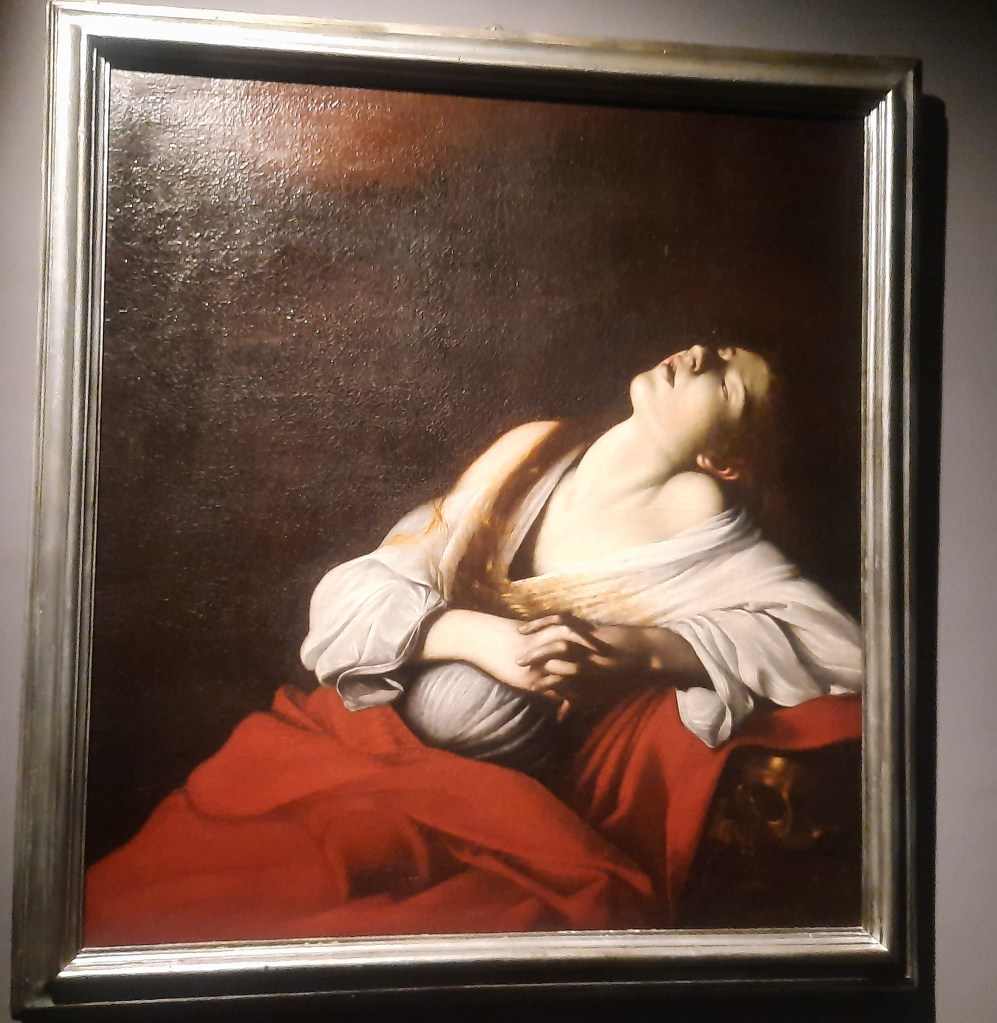
Carravaggio Crosses the Seas

When we hear the name ‘Michealangelo’, we think of the Sistine Chapel. But there was another one of the same name, Michelangelo Merisi da Caravaggio (known as Caravaggio) born a few years after the original’s death, who played own his part in significantly re-defining art.

Born in Milan, his father was an architect. The family left the city in 1576 to escape a plague and moved to Caravaggio. In 1584 our Caravaggio was apprenticed for four years Simone Peterzano, a painter. He became familiar with the works of Leonardo da Vinci, Michelangelo, Titian, Raphael, and other Renaissance masters during this time.

He moved to Rome, and set up in due course as an artist in his own right. Caravaggio’s work is known for its chiaroscuro (from Italian chiaro, “light,” and scuro, “dark”) technique—basically the use of light and shadow to define three-dimensional objects. Caravaggio and his followers used a harsh, dramatic light to isolate their figures and heighten emotional tension. Caravaggio’s use of realism and chiaroscuro helped to create a new style of painting that came to be known as Baroque, which shaped European art in the centuries to come.

One of his masterpieces has come to India. This is ‘Mary Magdalene in Ecstasy’, which was painted around 1606, and exemplifies his use of chiaroscuro. This painting was lost for centuries, re-surfacing only in 2014. It was authenticated as an original masterpiece by a team of leading art historians and is generally accepted as such today.

The painting travelled to India a few months ago, and was first exhibited in Delhi under the aegis of The Kiran Nadar Museum of Art, in partnership with The Cultural Centre of the Italian Embassy. Now it has come to Bangalore, and is exhibited at the National Gallery of Modern Art.

Three armed policemen are at the entrance to guard this $50 million work.The NGMA has also done its best to make it an enriching experience, with detailed panels about the artist and the painting, as well as a Virtual Reality experience.

Admittedly, It is a slightly strange feeling to go into a large, empty, almost-dark hall with only the one painting on the wall, with just one light focussed on it. A very different experience from seeing tens of paintings displayed in a room, with visitors filing from one to the other, and sometimes sitting on the benches provided to contemplate on something that catches their attention (or just to rest tired feet).

But all the care being taken with the work certainly proves India’s seriousness to protect and display of priceless art that comes to visit us.

It is not as if international masterpieces have not come to India before. Picasso’s works have been exhibited in India–the first exhibition of his works in South Asia was held at the National Museum in Delhi in December 2001 and featured 122 works. 

There are reports of original Botticelli paintings being exhibited in India too. For example, there are some reports that “Madonna of the Pomegranate” was displayed at an exhibition in Thiruvananthapuram. 

While no originals were physically displayed, there was an online exhibition of Raphael’s drawings by the India International Centre (IIC) IIC to commemorate the 500th death anniversary of the artist. 

Immersive, virtual experiences around Van Gogh’s work as well as da Vinci’s work have come to India in recent years.

Looks like India is now on the art-map, and we will be getting to see more such international masterpieces in the near future.

In the meantime, we can of course take in all the amazing art, craft, sculpture and architecture our own country offers!

–Meena

Wandering Violin Mantis

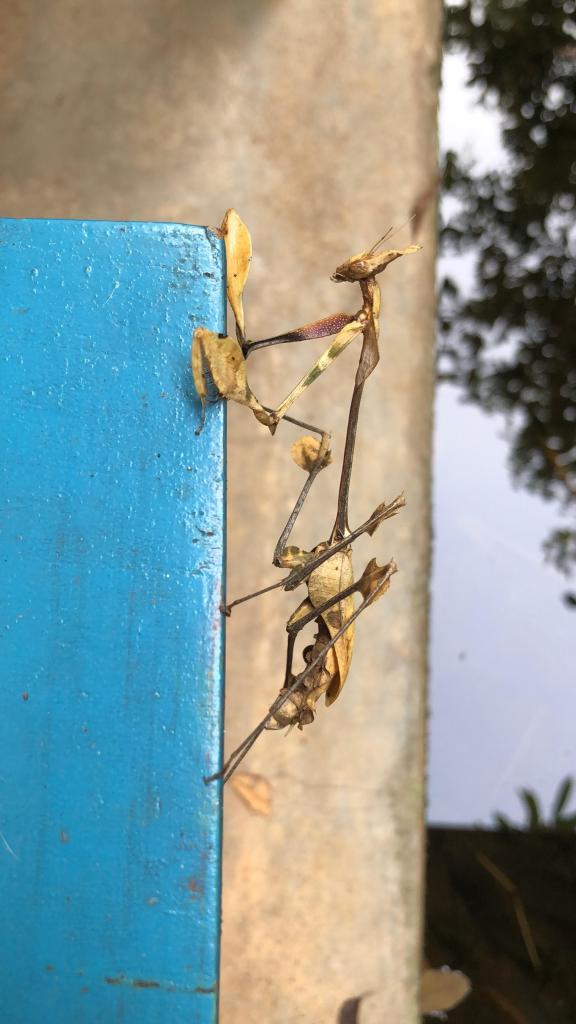
Recently my son shared a photo and asked us to guess what it was. At first glance it seems like a lovely composition of dried leaves and twigs. But a closer look revealed that this did not seem to be a random coming together of bits and pieces but a cleverly designed creature of nature. While our guesses revolved around thinking it to be some kind of stick insect, I, as usual wanted to probe deeper! To start with I asked Aditya to tell where and how he came upon this intriguing creature.

This is what Aditya shared.

The other day I was stepping out to see if the laundry was dry. As I stepped into the afternoon sunshine, over the narrow water channel circling the house — ostensibly keeping ants away but long defeated by the garden’s branches and vines that reached over and served as bridges, for not only ants but squirrels and civets too — I did a double-take of the bench by the door. This is where we spend a quiet hour every morning drinking tea and slowly waking up; by the bench is an abandoned wooden drawer set on its side, now a teapoy. From its corner hung a couple of dry leaves on a twig — the overnight cobwebs must have caught them. 

But something had made me turn and look closer, though I couldn’t say what. Perhaps it was the way the leaves dangled, defying gravity, or their neatly stacked arrangement, or simply that their brown was striking against the blue-painted face of the drawer. It took another moment, and then it was clear these were no leaves, though the disguise was commendable. The twig bobbed up and down, took a few steps along the edge of the drawer, and made for the bench. 

I recognised this bug — I had been mesmerised by it a few years before when I had encountered it just as unexpectedly in a friend’s outdoor kitchen. That’s when I had found out what it was called — the Wandering Violin Mantis — and this had tickled me especially because the kitchen belonged to a luthier and violinist, whom I was house-sitting for as he was away wandering the world. 

I called out to my partner and she rushed downstairs to see. In turns, as one of us took pictures, the other attempted to invite the mantis onto our hand. After a quick survey of the landscape with its beady eyes and a few of its legs, it climbed on. Then it was on its way, making long strides up our arms, slightly prickly and very tickly as one felt the weightless but saw-toothed limbs on the skin. The attentive head kept looking around and exploring its changing geography, as we kept twisting and turning, and giggling and marvelling at the lanky visitor. We deposited him back on the bench, where he stayed a while longer before wandering off somewhere else.

Wow! Close encounters with a Wandering Violin Mantis! While I had missed out on this first-hand experience I turned to secondary sources to find out more.

To start with my guess that it was a stick insect proved wrong. This was a mantis, which belonged to a different order (Mantodea). The name ‘mantis’ is derived from Greek, meaning ‘prophet’ or ‘diviner’, and the Wandering Violin Mantis is known scientifically as Gongylus gongylodes. Gongylus is derived from the Greek word gongylos meaning round which may refer to the shape of its appendages. This unique creature was first described by Carl Linnaeus, also known as the father of modern taxonomy.

Its common name is Wandering Violin Mantis, and it is also known as Indian Rose Mantis, Dead Leaf Mantis and Ornate Mantis. The most intriguing of the names is the first one. Look closely and one will see very long spindly legs that support the wide thorax which is shaped like the soundboard of a violin, while the long neck that ends in an arrow-shaped head resembles the neck of the violin. The thin legs that resemble dry sticks, end in large appendages. The mantis usually walks on its mid and hind legs, keeping its strong forelegs raised. Thus the moniker Violin Mantis. (I cannot find any reference to why the addition of the prefix ‘Wandering’.)

A close up of its face with its biting-chewing mouth parts demonstrates its predatory instincts. This mantid feeds exclusively on flying insects, but it is not an active hunter. The insect find a spot where it is perfectly camouflaged as dry twigs and leaves, and sits and waits for an insect to fly by, or to land nearby. With the ability to rotate its head a full 180 degrees, the mantis has a panoramic view of its surroundings. To further enhance their disguise, mantids often adopt a unique pose, tilting their body sideways and lifting their front legs. Remaining motionless, stealthily hanging upside down from a stem or sitting erect they easily pass for a twig swaying in the breeze.

In case of a flier-by, the mantis grabs it right out of the air, using its fast reflexes and remarkable accuracy to snatch its prey from mid-air. In case of an unsuspecting one that lands on a flower in search of nectar, it is efficiently snatched up by the predator. The raptorial front legs are perfect for grasping and holding the unwary prey. The mantis selects its prey wisely, avoiding insects that are too large to easily capture.

In turn the Wandering Violin Mantis is preyed upon by a variety of animals including birds, bats, spiders and lizards. I wonder how useful their camouflage is in protecting them from being spotted by these predators. I am sure that many a mantis has escaped the beady eyes looking for a meal by passing off as a sprig of dry leaves! And in case it is spotted, the mantis makes a last attempt to escape by spreading out its wings to display the brightly-coloured underside that may startle the hunter.

These masters of camouflage can be found in diverse habitats including forests, grasslands and even gardens. They are found is several parts of South and Southeast Asia, especially South India Sri Lanka, Myanmar, Thailand and Java.

Curiously these gentle and non-aggressive insects are popular as pets in the US and some other countries. Unlike other mantis species the males and females can live together (without eating each other up!). However their enclosures would require to create and maintain the temperature and humidity of their natural habitats, plenty of climbing space with foliage and sticks, and a diet of flying insects. Judging from the number of websites with tips on how to cage and keep this mantis, this seems to be a popular insect pet.

I feel sad about this confinement. Why not celebrate this fascinating creature of nature where it belongs? And feel the excitement when one has the WoW! (Wonder of Wildlife) moment of making the acquaintance of the Wandering Violin Mantis! 

— Mamata

Casting a Spell

The Indian-American domination of a peculiarly American phenomenon—the Spell Bee—is something that intrigues me no end. Not to say Indian-Americans don’t excel in many pursuits out there, but these kids winning the national level spelling competitions year after year after year after year is quite something.

The American tradition of spelling competitions may have started with the Puritans. By the mid-18th century, spelling competitions were common across the country. In 1750, Benjamin Franklin apparently recommended their use in a proposal for a school. Spelling challenges were quite the rage with both adults and children in the 19th century. Mark Twain apparently mentions ‘spelling fights’ in Adventures of Tom Sawyer!

The use of the term ‘bee’ for these competitions started in the mid 1870s. It is an unusual usage of the word, as ‘bee’ usually refers to a community activity with a shared goal—like quilting bees or knitting bees.

English, with words from various sources and a variety of languages, probably peculiarly lends itself to this pastime. Afterall, I don’t think there can be much confusion how 99% of words are spelt in Tamil or Kannada or Oriya– languages with phonetic writing systems do not have so much confusion in spelling. Moreover, because English has borrowed words from many languages through its history, the result is a diverse vocabulary with inconsistent spelling patterns which are carried over from the mother-languages.

In the US, the National Spelling Bee, as we know it today, was established in 1925. The Louisville Courier-Journal was the first sponsor, who saw it as a way to foster interest in spelling and language. 

The E.W. Scripps Company acquired the rights to the National Spelling Bee in 1941. This company was started by E.W. Scripps who founded The Penny Press, a daily newspaper in Cleveland. Today, the company is involved in investigative documentaries and enterprise journalism with the purpose to ‘…advancing understanding of the world around us.’

The Spell Bee has been held annually, in late May or early June since its inception, except for a few years during World War II and in 2020 due to COVID-19.  It has evolved over time, beyond just spelling, encompassing vocabulary development and broader language knowledge. 

The first winner of the Spell Bee, in 1925, was Frank Neuhauser of Louisville, whose winning word was “gladiolus”. The next year saw a girl winning for the first time– Pauline Bell, also of Louisville, who spelt the word “cerise”. (Incidentally, girls won nine consecutive competitions from 1932 to 1940.)

Now coming to winners of Indian origin. 30 of the last 36 competitions have been won by them. Which is surely not a chance thing. Before 1999, there were only two spelling bee winners of Indian-American descent—Balu Natarajan in 1985, with the word “milieu”, and Rageshree Ramachandran in 1989 with “elegiacal”.  Nupur Lala opened the floodgates in 1999 winning with “logorrhoea,” and there has been no looking back since then! This year of course we celebrate Faizan Zaki, a 13-year-old Indian-American student from Texas, who won with the word ‘éclaircissement”

Rebecca Sealfon who won in 1997 against Prem Murthy Trivedi, has done some analysis on the subject of Spell Bee competitors, and tells us that children practice for about 500 hours in the years in which they compete; some hire ex-competitors as coaches; and they typically and unsurprisingly relax by playing word games like Scrabble or Boogle. Some try to learn every word in the dictionary. She further tells us that double ‘ll’ words are the ones which have tripped up a large number of contestants, along with the words ‘metastasize’ and ‘metonymy’.

Since I don’t know many of these words, and would certainly not be able to spell them, I can only express my wonder at these sub-14 year olds who can.

Kudos to all of you! You have cast a spell on me!

–Meena

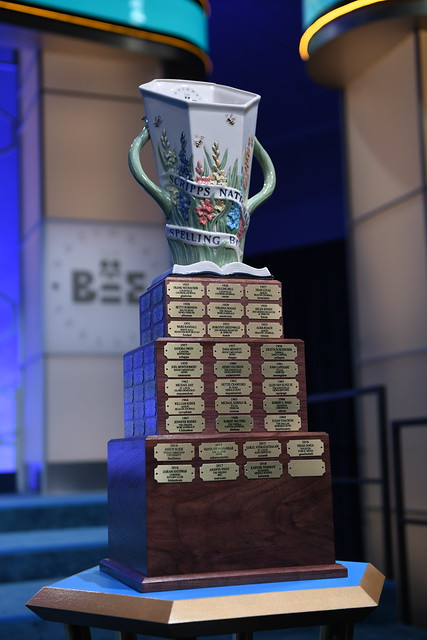
Pic: https:spellingbee.comblogscripps-cups

Plastics: From Saviour to Scourge

Last week marked World Environment Day. The theme for this year was Beat Plastic Pollution. In events around the world to mark this day, much was discussed and written about the dire state of the environment due to the over-accumulation of plastic. In recent years plastics have become the bane of the environment. It is ironic that it is this material that was once hailed as a boon! The history of this ‘wonder material’ goes back to the mid-nineteenth century. 

This was a time when elephants and turtles were becoming seriously endangered due to demand for ivory and turtle shell which were used in the making of numerous things from piano keys and billiard balls, to combs. The biggest consumers of ivory were high-quality billiard balls. Between three and five balls could be made from a tusk, and at least two elephants needed to be killed to make one set of billiard balls. The increasing popularity of billiards in England as well as America, led to the slaughter of thousands of elephants. There was a serious threat to elephants, and also there was an increasing cost of ivory to make the balls.

This led to the quest for some man-made materials which could be used as substitutes. One of the earliest such attempts was to dissolve cotton fibres in nitric and sulphuric acids, and then mix these with vegetable oil. In 1862 an English chemist Alexander Parkes was the first to patent this new material with the name Parkesine. It was presented at the Great London Exposition in 1862, but it was not a commercial success.

In the meanwhile in America, Michael Phelan ‘the father of American billiards’ took out an ad in 1863 offering a sum of $10,000 for a substitute for ivory. John Wesley Hyatt, a young printer with no formal training in chemistry took up the challenge. He spent six years experimenting with various solvents. In one experiment he blended camphor with nitrocellulose and produced a hard mouldable substance that he called ‘celluloid’. He patented this in 1869, and along with his brother began to produce it in 1871, marketing it as a substitute for natural materials like ivory and tortoiseshell.  

As it turned out celluloid was not the perfect substitute for billiard balls; when two balls collided it produced a mini explosion. But the new material had a number of properties that made it attractive. It could be moulded into any form, hardened or left flexible; it was waterproof, it would not rot or corrode like metals; it was extremely durable, and it was cheap.

Celluloid was hailed as an environmental saviour. A sales pamphlet in 1878 claimed that “it will no longer be necessary to ransack the earth in pursuit of substances which are constantly growing scarcer”.

Celluloid was the first industrial plastic that would transform the world as multiple uses were found for it. It was followed by polyvinyl chloride or PVC. Since then plastics have undergone numerous stages of development. Plastic was not immediately adopted widely. But by the mid-20th century, as the benefits of this ‘trendy, clean, cheap’ material were loudly touted, plastic became ubiquitous, and took over every aspect of daily life.

The world embraced plastic with a clear conscience. The products made of plastic provided the added attraction of being easily disposable. The convenience of single- use throw-away products were extolled and countries like the United States made a whole-hearted example of this. The use-and-throw lifestyle became the aspiration of every society.

Today we are seeing the legacy of this throw-away lifestyle. The world is producing 300 million tonnes of plastic a year, a figure expected to triple by 2050. The chemical properties that have made plastic such a multi-use and durable material also makes its disposal difficult. Plastic takes a long time to degrade, in some types even thousands of years. Thus landfills are overflowing. Even the degradation of plastic is a serious environmental issue as it breaks down into microscopic particles that pollutes the oceans, land and the air. These micro-plastics are also accumulating in our bodies, the health impacts of which are not even known as yet.

The modern plastics industry relies on fossil fuels for its raw material contributing to global CO2 production. Thus the production of plastic also has an impact on climate change.

In the oceans, plastic ingestion and entanglement is harming and killing marine creatures including turtles. On land climate change is one of the factors that is changing habitats and endangering all living things from elephants to ants. Ironically, the material that was once celebrated as the saviour of these creatures is today the scourge of the environment across the globe.

 Sadly, over these decades the state of planet Earth has only deteriorated. The issues with overuse of plastic not only remain, but have been exacerbated. While there have been efforts in terms of policy initiatives, technological advances, and even public awareness these have not been able to cope with the even faster increase in plastic consumption, pollution, and waste generation. Even after decades of advocacy for Recycle, Reuse and Refuse, the picture is grim. In 2025 the world is expected to consume 516 million tonnes of plastics. And only 9% of all plastics produced as actually being recycled globally. The theme for WED 2025 ‘Beat Plastic Pollution’ spotlights the growing scientific evidence on the impacts of plastic pollution and hopes to sustain the momentum to refuse, reduce, reuse, recycle, and rethink plastics use.

— Mamata

The Water Bear Goes to Space Again

Now what is this creature who is undertaking so many space odysseys? We don’t recall seeing a bear of any kind suited up and entering a space vehicle. And what is a water bear anyway—we’ve heard of polar bears, sloth bears, brown bears, black bears and several others; but never a water bear.

Well water bears or tardigrades are microscopic eight-legged animals. Because they look like bears under the microscope, they have been dubbed water bears. However, they don’t necessarily live in water, though they need a coating of water around themselves to prevent dehydration. They live in all kinds of places, from deep seas and hot springs to sand dunes! They also like to live in the moist environment provided by mosses and lichens and hence are also called moss piglets.

The German scientist Johann Goeze first described these creatures in 1773, and called them Kleiner Wasserbär in German, which translates to ‘little water bear’. In 1776, the Italian biologist Lazzaro Spallanzani named the phylum Tardigrada, meaning ‘slow walkers’. Today, about 1500 species of tardigrades have been documented.

They are generally about 0.5 mm in length when fully grown, short and plump, with four pairs of legs, each ending in claws or sticky pads. They are visible under low-power microscopes, so can be viewed easily even at schools or homes.

But it is not all this that makes tardigrades creatures of special interest. What sets them apart scientifically is that they belong to an elite category of animals known as extremophiles. They can survive extreme environments that most animals can’t.

For instance, tardigrades can go up to 30 years without food or a water supply. They can live even at absolute zero, and can survive above boiling temperatures. They can take pressures six times greater than the ocean’s deepest trenches, and exist in the vacuum of space. They have survived five mass extinctions!

One reason for their resilience is a unique protein in their body which protects their DNA from harmful radiation which is present all around us.  A strategy they employ in dry environments is to push all water out of their body, pull in their head and limbs, and roll up into a small ball. They go into a deep sleep until conditions improve

Tardigrade biology is unique, and scientists study tardigrades to understand their indestructibility, to transfer these learnings to many fields.  

The idea of sending tardigrades to space was first proposed in 1964. Actual experiments began in 2007 when they went up with NASA’s FOTON-M3 mission, where they were exposed to space’s vacuum for 10 days, and reanimated just by rehydration, back on Earth.

Then, in 2011, tardigrades were on board the International Space Station, and in 2019, a capsule containing tardigrades was sent on board the Israeli lunar lander Beresheet which crashed on the Moon. SpaceX-22 Commercial Resupply Services mission on June 3, 2021 also carried tardigrades to do an experiment to identify the genes involved in their ability to survive and adapt to high-stress environments, including the one astronauts experience in space. NASA hopes the findings can help guide research into protecting humans from the stresses of long-duration space travel, and ultimately help in setting up sustainable colonies on the Moon and Mars.

These space-veterans are also part of Group Captain Shubanshu Shukla’s crew! He and his fellow Polish astronaut Uzanaski-Wisniewski will study several aspects of tardigrades duing their 2-week trip–their revival, survival, and reproduction; they will count the number of eggs laid and hatched duringthe mission; compare the gene expression patterns of the astronaut-tardigrades with  those of ground populations; and identify molecular mechanisms of resilience

Thank you, Grp Captain Shukla and your brave mates on Axiom 4. Wishing you a safe journey and that you extend the boundaries of space and knowledge.

–Meena

PIC: From BBC

Libraries Take Wing

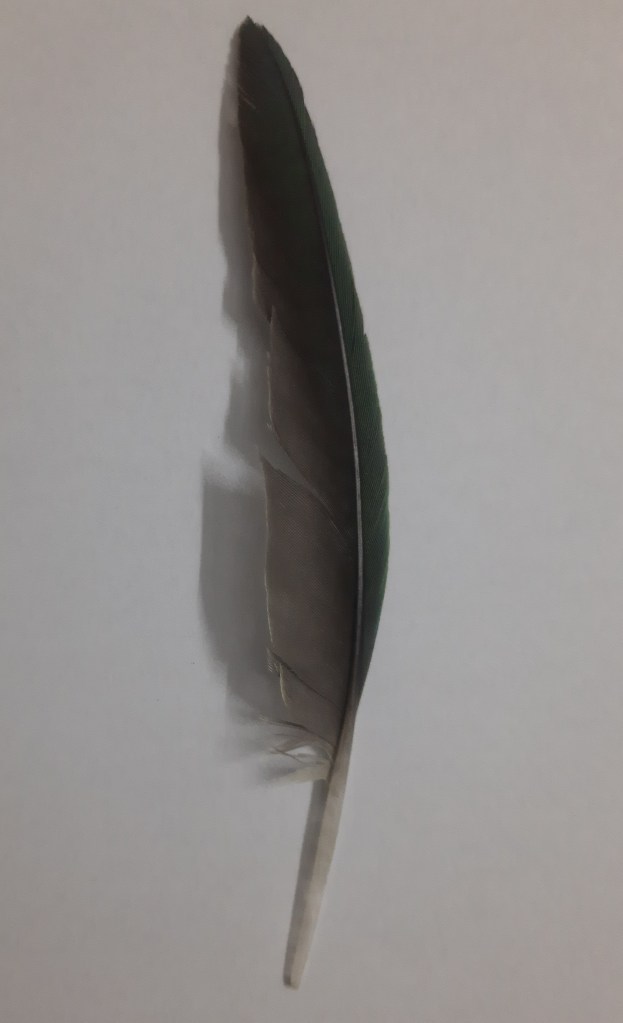
How often we randomly pick up a feather as we walk along. And wonder which bird it could belong to.

A feather library is where we can turn to for help in such a situation. These are digital or physical collections of bird feathers, used for research and education. They are an invaluable resource for understanding bird species, identifying feathers, and gathering data on bird health and natural history. These libraries are important tools for the study and conservation of bird species, offering insights into bird morphology and helping in the identification of feathers found in the wild.

There are not too many across the world. Some of the established ones include:

1. The Feather Atlas created by the U.S. Fish and Wildlife Service is a comprehensive image database of North American birds and covers about 438 species. It can be browsed by bird order, family, or species. It has an open identification tool in which one can fill in details about feather patterns, colors, size, and position, which can help you identify the bird your feather belongs to.

2.Featherbase (Germany) has been created by a working group of German feather-scientists and other collectors worldwide who have come together and contributed their personal collections. It holds close to 8000 specimens from over 1,000 bird species, with a focus on European and African birds. The collection includes high-resolution images and detailed anatomical information, and has supporeted studies in forensics, conservation, and biodiversity monitoring. It is rigorously classified and offers options of various languages so that birders from across the world can use it.

3. Found Feathers (iNaturalist Project) is a citizen science initiative where users contribute observations of feathers they find. The project encourages the collection of feather length and placement data, enhancing the database’s utility for researchers and birders. There are over 2,00,000 observations from across the world.

Special among these is India’s Feather Library. This pioneering initiative is the first of its kind in India and the world, dedicated to documenting, identifying, and studying the flight feathers of Indian birds. It is the passion project of architect Esha Munshi, a dedicated bird watcher who has seen over 1500 bird species across the world, and veterinarian Sherwin Everett who works in a bird hospital in Ahmedabad. They have created the library with the aim of having all feather-related data under one roof, fostering collaboration and advancing the collective understanding of Indian birds. In the short span of time since inception on Nov 15, 2021, 135 species have been documented.

The process is rigorous. They collect feather specimens from dead birds at rescue centres to establish a primary database of bird species. They then make detailed notes on the flight feathers, taking into account the number of Primaries, Secondaries, Tertials (Wing Feathers), and Rectrices (Tail Feathers), along with basic details such as overall length, bill length and width, leg lengths, etc. Then they stretch out one wing and fan the tail in both dorsal and ventral views to document the exact number of feathers, unique characteristics, colour, pattern, and size etc. The physical collection is housed at the National Centre for Biological Sciences (NCBS) in Bangalore.

The database is open to all and provides easy access.

Kudos to the dedication and passion of people like Esha and Sherwin who through their efforts help support avian research, conservation efforts, and educational outreach. And make a better world.

Happy Environment Day!

–Meena