Doomsday Book

No, not a book with dire predictions for 2025 aka Nostradamus, Baba Yaga etc.

The Domesday (or Doomsday) book is the 1200+ year survey record! Covering most of England and parts of Wales, it was commissioned by William the Conqueror. The survey started on Christmas of 1085 (exactly 939 years ago!) and was completed in1086. It is the oldest government record held in The National Archives of the UK.

It is an amazing piece of work, in that it surveyed almost every property in England and Wales. Using a fixed format, the survey tried to elicit who owned which property, who lived there, the livestock, how much the land was worth etc. It traced the history of the property—who had owned it before the time of William the Conqueror and who owned it now.

The whole purpose was to ensure that the King had a record of how much land was owned by whom, and therefore how much tax could be charged! It provides definitive proof of land rights and tax obligations, making it a crucial legal document even today. It covered over 13,000 places. Not only was it a foundational document for land rights, it also the socio-economic landscape of 11th-century England.

But why on earth was it called the Doomsday Book? This evolved from its association with the Last Judgment (or Doomsday). The book was the last word–once recorded, its contents could not be contested! It was the source of evidence of land titles, and hence served as a legal reference for resolving disputes over land ownership. It was the final arbiter!

Data collection for the Book was monumental for its time. Royal Commissioners travelled across the kingdom, collecting information from local juries composed of nobility and citizens convened for the purpose. These people swore in court to give correct and accurate information to the Commissioners.  They answered several questions including:

  • Who owned the land.
    • How much land there was.
    • The value of the land.
    • The number of tenants and their obligations.
    • Livestock counts.
    • How many plough teams.
    • How much wood, meadow and pasture.
    • How many mills and fisheries.

The responses gathered by the juries were meticulously recorded in Latin by one set of scribes, and checked by a second set. The data was probably cross-verified with other records and follow-up inquiries.

The information was recorded in two books—The Great Domesday, and the Little Domesday (covering different geographies). Each is arranged by county, and within each county, by landholder. Each landholder is given a number, which is written in red in roman numerals as the heading of their entry. There is a table of contents at the beginning of each county, which lists the landholders with their numbers.
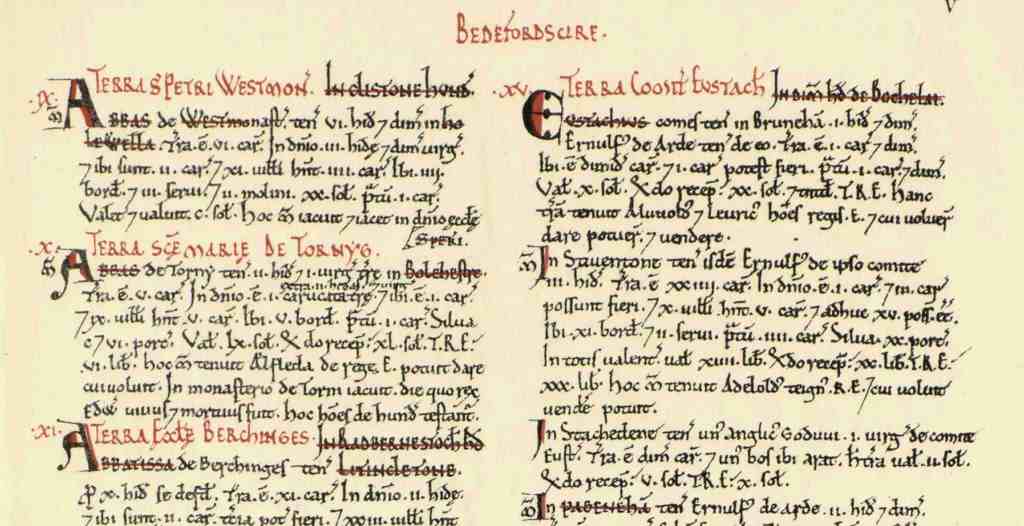
The Doomsday Book is not a census of the population, but has influenced surveys and censuses down history. The Indian census is considered a model for gathering reliable data across a large country (not of course land ownership—that is a problem yet to be cracked).  The Doomsday Book has probably also influenced our census indirectly.  Hopefully, we will have our long-delayed census in the coming year—aided by smart phones, tabs and the like. Let us hope the information collected is as authentic as the Doomsday Book managed.

In 1789 Benjamin Franklin said, ” In this world, nothing can be said to be certain, except death and taxes.” The Doomsday Book was indeed proof of that!

So here is to a Happy 2025, even though we will still have to pay our taxes!

–Meena

nationalarchives.gov.uk

Pic: Historic UK
Christmas Island: Galapagos of the Indian Ocean

This week the focus revolves around the numerous facets of Christmas–from festive decorations, to feasts and family gatherings. An appropriate week to share something that does not really share much in common with these facets except for its name. That is Christmas Island; so named because it was first discovered on Christmas day.

The island however may have been there millennia before its formal discovery and christening. A small speck in the Indian Ocean, Christmas Island is the peak of a steep basalt volcanic seamount that rose 5000 metres from the ocean floor about 60 million years ago. Located in the Indian Ocean 2600 km northwest of Perth in Australia and 350 km off Indonesia, this island is today a part of Australian territory. However it has a chequered history of human settlement.

For centuries the small island’s isolated location and its rugged coasts provided a natural barrier to human intrusion. Its sighting was recorded in the charts of British and Dutch navigators in the early seventeenth century. But it was named by Captain William Mynors of the Royal Mary a vessel of the East India Ship Company when his ship approached the island on 25 December 1643; but he was unable to land on the island. The first recorded landing on the island is believed to be by the English ship Cygnet under Captain Swan in 1688.

It was in the 19th century that several explorers visited Christmas Island. Some of these were naturalists who collected plant and animal species from the island which was rich in biodiversity. It was in 1887 during one of these collecting expeditions that the crew of a ship called HMS Egeria also discovered that the island had rich resources of phosphate which was a valuable fertilizer. This led the British to annex the island in 1888. Human settlement of Christmas Island began in 1888, when George Clunies-Ross, the owner of the Cocos Islands, sent his brother Andrew and a small party of Cocos Malay workers to form a settlement at Flying Fish Cove. He did this to pre-empt any other claim to the island’s phosphate resources.

The British leased the island to John Murray, a naturalist who had first predicted the presence of phosphates and George Clunies-Ross who initiated the first settlement on the island. Together the two set up the Christmas Island Phosphate Company which started mining and exporting phosphate from the island from 1900. The operation needed a large labour force for which they brought in Chinese, Malays and Sikhs as indentured migrant labourers. These were the early settlers who, over time, grew into a multicultural community. However at that time these workers lived in appalling conditions, and in the early years, hundreds of them died from beri-beri caused by malnutrition. But conditions gradually improved and the island’s phosphate industry continued to flourish in the period till the First World War, with Japan as the biggest customer.

During the Second World War, the island was targeted by the Japanese who wanted to capture the phosphate deposits. In 1942 Japanese troops took over the island and the phosphate mining provided rich fertilizer for the Japanese Empire. The island was an arena for several acts of war between the Allied and the Japanese forces until 1945 when Japan surrendered. The island was re-occupied by the British in October 1945.

The Australian and New Zealand governments purchased the Christmas Island Phosphate Company in 1949, and administrative responsibility for the island shifted from the UK to the British colony of Singapore. When Britain was giving up many of its colonies after World War II Australia expressed an interest in acquiring Christmas Island. In 1958, sovereignty of the island was transferred to Australia. As part of the transfer, Australia paid Singapore £2,800,000 as compensation for lost phosphate revenue. Christmas Island became an Australian Territory on 1 October 1958. This day is celebrated on the island as Territory Day.

The centuries of mining and exploitation for phosphate had left huge scars on this island which with its unique geology supported rare species of endemic plants and animals not found anywhere else. Many of the flora and fauna unique to this ecosystem had reached the point of being endangered. In the 1970s it was realized that this exploitation could have a serious impact on the Abbot’s booby a bird that nests only on Christmas Island. In 1974 a committee recommended that conservation of such endangered species was critical. This resulted, in 1980, in the creation of a national park on the south-western part of the island. This was further expanded in 1986 and 1989 to create the Christmas Island National Park. Today the park extends over 64% of the island’s land area as well as extending 50 metres offshore. The area protects rainforests, wetlands, freshwater mangroves, sea cliffs and coral reefs, each harbouring a rich diversity of life.

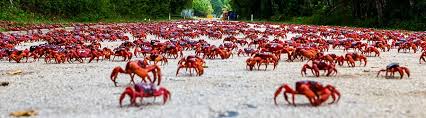
Red crab migration on Christmas Island

Perhaps the most significant of this is the great variety of crabs that have earned it the sobriquet as the kingdom of crabs. Among these crustaceans is the enormous robber crab, and the red crabs whose annual migration from the rainforest to the ocean in an unforgettable spectacle. Every year, millions of red crabs move from Christmas Island’s interior rainforests to the ocean to breed and lay eggs. A single female can lay up to 100,000 eggs. Red crabs must keep their bodies moist, so they wait for the rainy season to provide conditions that are ideal for the difficult journey. During migration, red crabs climb over and around obstacles in their way, following the same migration paths every year. 

The island’s 80 km coastline is an almost continuous sea cliff rising up to 20 metres in height. In a few places the cliff descends to shallow bays with sand and coral shingle beaches. The island is surrounded by a narrow circling reef teeming with swarms of tropical fish species. Dolphin, whale sharks, turtles and manta rays are easy to spot.  Today Christmas Island has become a naturalist’s paradise. Often described as the Galapagos of the Indian Ocean, Christmas Island has replaced phosphate mining with ecotourism. A heartening case of exploitation transformed into caring conservation.

–Mamata

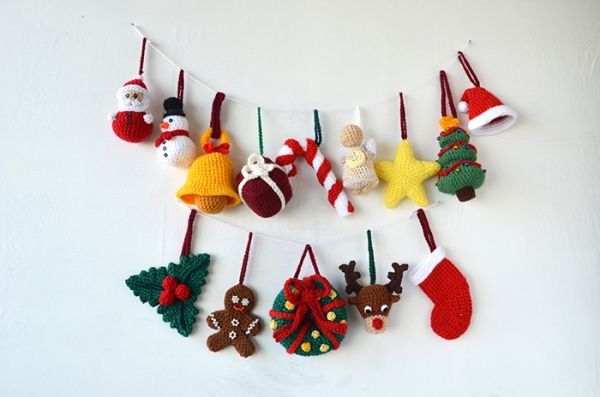
Merry Christmas with Amigurumi

Tis the season of good cheer and brotherhood.

Of celebrations and togetherness.

Of Christmas trees and ornaments.

And this last is what we are talking about today.

Photocredit: amigurumi.com

The tradition of decorating trees with ornaments is thought to have originated in Germany in the 1800s.  An enterprising gentleman by the name Hans Greiner began making glass ornaments called baubles for hanging on trees. These were the first mass-produced Christmas ornaments and were a huge commercial success.  Woolworths was the first company to import these types of decorations into the United States in 1890, from where  the custom spread to other parts of the world.

Common ornaments include globe ornaments, angels, egg ornaments, figurines, snowflakes, icicles and stars. They are made from a variety of materials, including glass, plastic, porcelain, metal, wood, and expanded polystyrene

A trend that has been popular in recent years is amigurumi Xmas ornaments. If like me, you haven’t a clue what this is, amigurumi is the art of creating crocheted or knitted stuffed creatures and objects, which has its roots in Japanese culture.

While the exact origins are not clear, it is believed to have developed from multiple influences over time. Japan has a long history of hand-made dolls and toys, such as “temari” (decorative balls made from thread) and “daruma” dolls. Amigurumi probably grew from these traditions. During the Meiji period (1868-1912), European knitting and crochet techniques were introduced to Japan and became popular. Japanese crafters combined these techniques with their traditional doll-making skills to create amigurumi,which comes from the Japanese words “ami” meaning crocheted or knitted, and “nuigurumi” meaning stuffed doll.  

Amigurumi grew more popular in Japan in the post-World War II era. As the country’s economy grew stronger, it led to increased income and leisure time, and a resurgence in crafting hobbies. It was during this time amigurumi gained recognition as a distinct art form.

A major impetus to the growth of this craft was the rise of “kawaii” culture. This Japanese aesthetic emphasizes cuteness and adorableness—think Hello Kitty.  Amigurumi lends itself to the creation of cute, whimsical, and anthropomorphic designs and hence appealed to the kawaii aesthetic.

Internet and social media brought amigurumi international attention and today, amigurumi enjoys a global following including in its use as Xmas ornaments. Amigurumi angles, cherubs, stars, elves and reindeers decorate trees across the world. Many people take pride in crocheting or knitting figures either on their own or with the help of popular amigurumi kits which include patterns, instructions, wools and needles.

A popular Xmas tree ornaments also rendered in crochet, which we are not very familiar with in India, is the Christmas Pickle. This is an American tradition. A decoration in the shape of a pickle is hidden on a Christmas tree, with the finder receiving an extra gift. It is also thought that he or she will enjoy good fortune for the next year. (While for us Indians, a pickle brings thoughts of mangoes and limes, in the West, it is often a cucumber, and that is what Christmas Pickle ornaments represent).  

The origin of the Pickle ornament is not known. Americans think it came from Germany, but Germans have no clue about this tradition. But here is one story: During the American Civil War, Bavarian-born Private John C. Lower had enlisted in the Pennsylvania Infantry. He was captured in 1864 and taken to the prison camp. On Christmas Eve he begged a guard for a pickle because he was starving. The guard provided the pickle, which Lower later credited for saving his life. After returning to his family in Bavaria, he began a tradition of hiding a pickle on their Christmas tree each year.

Even if it is not true, it is surely a story that captures the Christmas spirit!

Christmas wishes, Peace and Goodwill among all!

–Meena

The Ultimate Flower-Clock

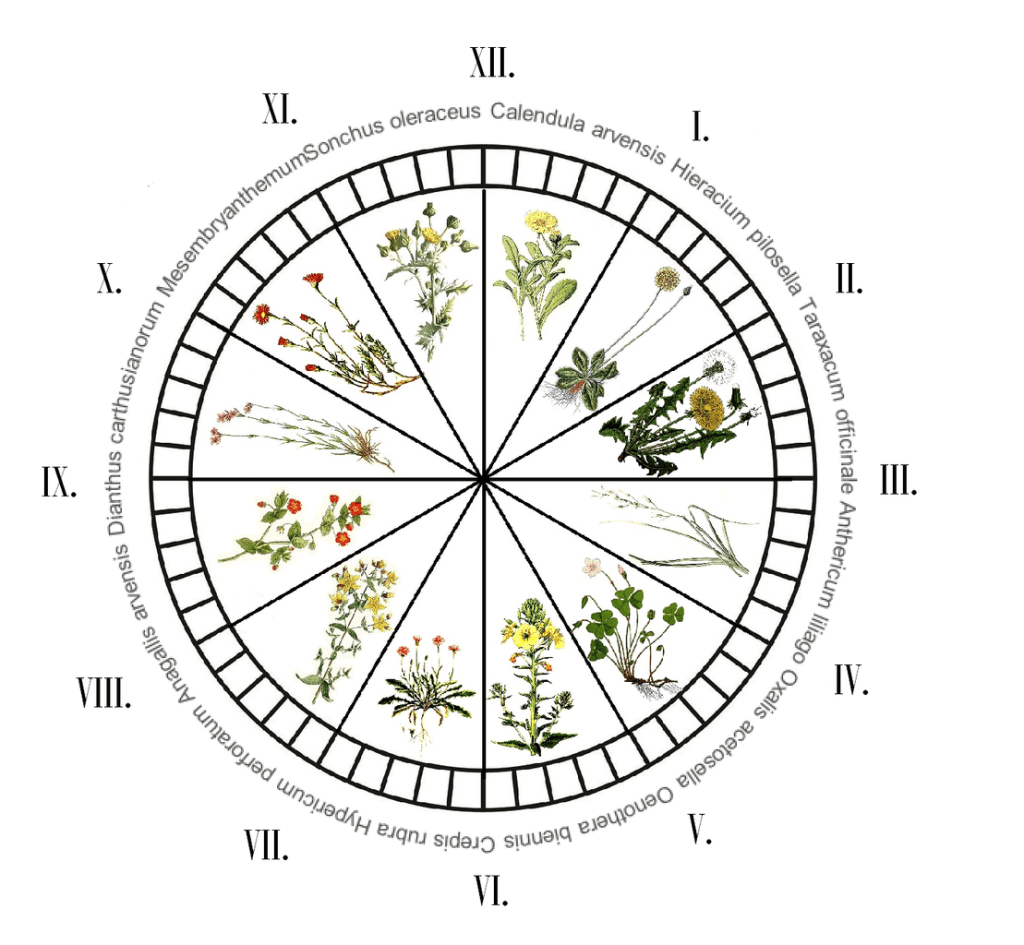
Wouldn’t it be beyond-beautiful if we had a clock which did not tell time by mundane numbers and needles, but by a particular flower blooming? Imagine if you peeped out of the window and you could look at this clock, and tell if it was 12 noon, or 1 pm or 2 pm by the flower that was blooming!

This was the kind of clock that Carl Linnaeus dreamed of.  Linnaeus’s flower clock or Horologica Floræ is a garden-plan thought up by Linnaeus that would take advantage of plants that open or close their flowers at particular times of the day, to accurately indicate the time.

As most of us would remember from school-biology, Linnaeus was the Swedish naturalist who laid down the principles for defining genera and species of organisms, and created a uniform system for naming them (the binomial nomenclature). His book, Systema Naturae (The System of Nature) consisted of only 11 pages but laid the foundations of taxonomy. It presented a hierarchical classification or taxonomy, of the three kingdoms of nature: stones, plants, and animals. Each kingdom was subdivided into classes, orders, genera, species, and varieties. All modern classification systems in biology have their roots in the Linnaean classification system which is based on similarities—for instance, Linnaeus grouped together organisms that shared obvious physical traits, such as number of legs or shape of leaves.

The Linnaean system of classification consists of a hierarchy of groupings, called taxa (singular, taxon). Taxa range from the kingdom to the species. The kingdom is the largest and most inclusive grouping. It consists of organisms that share just a few basic similarities. Examples are the plant and animal kingdoms. Then come the phylum, then the class, order, family, genus, and finally the species–the smallest and most exclusive grouping. It consists of organisms that are similar enough to produce fertile offspring together.

Linnaeus greatest contribution to science was his method of naming species. This method, called binomial nomenclature, gives each species a unique, two-word Latin name consisting of the genus name and the species name. An example is Homo sapiens, the two-word Latin name for humans, literally meaning “wise human.”

But if Linnaeus saw order in the natural world around him, he saw beauty too. In around 1748 he started thinking about the flower-clock. It builds on the fact that there are species of plants that open or close their flowers at set times of day. In his publication Philosophia Botanica, he gives 46 examples of flowering plants that are open during particular parts of the day. He brought together 43 of these under the heading Horologium Florae, or Floral Clock, arranging them in a time sequence from 3 am to 8 pm. The time at which each flower opens and closes is given in whole and half hours.

To give you a glimpse, here are a few rows from Linnaeus’ table:

Botanical nameCommon nameOpening timeClosing time
    
Tragopogon pratensisGoat’s-Beard3 a.m.
Cichorium intybus L.Chicory4–5 a.m.
Reichardia tingitana (L.) RothFalse Sow thistleby 6 a.m.10 a.m.
Taraxacum officinale WeberDandelion5 a.m.8–9 a.m.
Crepis alpina L.Hawk’s beard5 a.m.11 a.m.
Hieracium umbellatum L.Hawkweed6 a.m.5 p.m.

Though Linnaeus worked for years on this, the observations and hence selection and organization of flowers were not complete.  Linnaueus’ son Carl the Younger was given the task for completing the table so that the clock could be built. Unfortunately, Linnaeus the Younger’s floral clock was never completed, and his observations on the opening and closing of flower have not been found among his surviving papers.

Alas, no one has actually built such a clock, and it is not even clear that it is possible.  There are many practical issues to overcome. For instance, it would only function for part of the year since plants don’t flower through the year; the time shown would be indicative at best since blooming times are in a range and would vary with specifics like weather and other atmospheric conditions; many of the plants that Linnaeus observed and selected were wildflowers from Sweden and may not be found in other places, or would behave differently in other places. And then, the clock may not work at all in some seasons, if there are not enough flowers which bloom then.

Well, in this digital age, there are some ingenious people who have created an app based on the idea. They have selected 24 flowers, one for each hour that would normally flower at that time of the day or night. Floræ – Linnaeus’ flower clock app is free on appstore for Apple and iPhone.

So maybe we have make do with that, till some genious actually builds the Horologica Floræ to blow our minds!

–Meena

https://www.countrylife.co.uk/nature/curious-questions-what-is-linnaeuss-flower-clock-259032

Wikipedia

Wikimeida Commons (Picutre)

Colours of the Year

This is the time of year to look back upon the months gone by, of the highlights and the nadirs that marked the passage of time. Of the many exercises that have become a regular part of this stock-taking is the announcement of the Words of the Year by different dictionaries. Meena has just described the history, as well as the process for this selection.

There is another announcement that is perhaps not as much noticed. That is the one of the Colour of the Year. This selection is not the outcome of as long, and oftentimes, as participatory a process that the different dictionaries undertake prior to the announcement of the Word of the Year; and perhaps its history does not date as far back. The Colour of the Year is declared by the Pantone Company which is best known for its Pantone Matching System (PMS). This is a colour order system used in a variety of industries including graphic design fashion design product design and printing. Today Pantone has become the worldwide standard for selecting communicating and matching colours.

Pantone began as a commercial printing company of the Levine brothers, two advertising executives in 1950, in New Jersey. In 1956 the Levine brothers hired Lawrence Herbert who used his knowledge of chemistry to systematically order and simplify the company’s stock of pigments and production of coloured inks. By 1962, Herbert was running the ink and printing division, and was able to buy out the original owners. He renamed the company Pantone which was a combination of the words Pan (meanng All) and Tone (meaning colour).

The company’s primary products include the Pantone Guides, which consist of a large number of small (approximately 6×2 inches or 15×5 cm) cardboard or plastic sheets, printed on one side with a series of related swatches of colours in different shades and tones. Pantone colours are described by their allocated number (For example, PMS 130). The samples are bound into a deck that opens out into a fan.   

The idea behind the PMS is to allow designers to “colour match” specific colours when a design enters production stage, regardless of the equipment used to produce the colour. This system has been widely adopted by graphic designers and reproduction and printing houses. The standardization of colours is very helpful because different manufacturers in different locations can all refer to the Pantone system to make sure colours match.  

The idea of declaring a Colour of the Year was initiated by the Pantone Colour Institute in 1999 as a way to mark the entry into a new millennium, and in keeping with Pantone’s belief that colour “has always been an integral part of how a culture expresses the attitudes and emotions of the times”.

The colour selected each year was envisaged as one that captured a moment in time, tapped into collective values, and heralded the year ahead. It was also meant to reflect people’s changing attitudes and aspirations. Thus it is not randomly selected but an outcome of research that finds its way into discussions by representatives from various nation’s colour standards groups. These are at secret meetings hosted twice a year by Pantone in a European capital. The colours are chosen after two days of deliberations. With a database of thousands of colours at their fingertips, Pantone’s challenge is to narrow down a colour family and explore within it to find a hue that best expresses a widespread feeling. As the company says “We don’t simply come up with our thoughts about it; we look into our research and see what people are telling us they’re looking for.” The results of the meeting are published in Pantone View, which fashion designers, florists, and many other consumer-oriented companies purchase to help guide their designs and planning for future products.

Pantone’s Colour of the year 2024 was Peach Fuzz which was described as a light, delicate shade between pink and orange. The soft hue expresses the desire to nurture kindness, compassion, and connection. All of this helps foster a peaceful future and everlasting cosiness.

In 2024 more than ever before the world needed to be reminded of these qualities which alas were sadly lacking.

However continuing its hopeful optimism Pantone has just announced its colour for the Year 2025. It is a shade of brown that is called Mocha Mousse which, as the company reminds us, is all about thoughtful indulgence. The warm shade reflects a desire for nourishment in every facet of our lives, especially through simple pleasures like morning coffee, a chocolate treat, or taking a walk. And it’s not solely about treating ourselves but also the possibility of sharing those sweet moments with others. 

While fashion designers and architects play around with the colours of the year, for every one of us, Nature is the best reminder that every colour has its own shade and season. All we need to do is look around and marvel at its unmatchable palette.

And who better to remind us of this than the gentle author Ruskin Bond.

The Colours of Life are Everywhere

Colours are everywhere,

Bright blue the sky,

Dark green the forest,

And light the fresh grass;

Bright yellow the lights

From a train sweeping past,

The flame tree glow

At this time of year,

The mangoes burn bright

As the monsoon draws near.

A favourite colour of mine

Is the pink of the candy-floss man

As he comes down the dusty road,

Calling his wares;

And the balloon-man soon follows,

Selling his floating bright colours.

It’s early summer

And the roses blush

In the dew-drenched dawn,

And poppies sway red and white

In the invisible breeze.

Only the wind has no colour;

But if you look carefully

You will see it teasing

The colour out of the leaves.

And the rain has no colour

But it turns the bronzed grass

To emerald green,

And gives a golden sheen

To the drenched sunflower.

Look for the colours of life –

They are everywhere,

Even in your dreams.

–Mamata

Word of the Year

Come the end of the year, and we see various lists, rankings, selections ,’ Best of..’,  ‘..of the Year’, and what have you. For me, the most interesting of these is the Word of the Year, or WOTY.

Word of the Year is what is considered the most important word(s) or expression(s) in the public sphere during a specific year. It is supposed to capture the zeitgeist of the year gone by. There is no THE Word of the Year. There are several Words of the Year, assessed and declared by several bodies—dictionaries, learned societies, etc.

The tradition started in German when the first Wort des Jahres was selected in 1971. The word was aufmüpfig, meaning rebellious or insubordinate.

The first English WOTY was declared by the American Dialect Society’s in 1990, and was bushlips, meaning insincere political rhetoric (from Bush’s ‘read my lips’ comment). The American Dialect Society (ADS) is a learned society, not connected to any commercial interest, and their WOTY is picked by vote of independent linguists, though anyone can nominate a word at any time of the year. As appropirate for a seriously academic institution, ADS really gets into the issue, defining several categories apart from overall WOTY, including: Most useful/Most Likely to Succeed WOTY; Political WOTY; Digital WOTY; Informal WOTY; Acronym/Initialism of the Year; AI-related WOTY; Most Creative WOTY; and Euphemism of the Year. While all other organizations declare WOTYs at the end of the given year, ADS comes out with it’s in the beginning of the next year.

As we have seen from the newspapers, several other organizations also pick their own WOTYs, using different methodologies. Here is a look at some of the popular ones and how they are selected:

Oxford WOTY

‘The candidates for the Word of the Year are drawn from evidence gathered by our extensive language research program, including the Oxford Corpus, which gathers around 150 million words of current English from web-based publications each month. Sophisticated software allows our expert lexicographers to identify new and emerging words and examine the shifts in how more established words are being used.

Dictionary editors also flag notable words for consideration throughout the year and use other sources of data to identify contenders.

We regularly take into account the many suggestions sent to us via social media.

The final Word of the Year selection is made by the Oxford Languages team on the basis of all the information available to us.’ (https://corp.oup.com/word-of-the-year/)

Cambridge WOTY

‘The candidates for the Word of the Year are drawn from evidence gathered by our extensive language research program, including the Oxford Corpus, which gathers around 150 million words of current English from web-based publications each month. Sophisticated software allows our expert lexicographers to identify new and emerging words and examine the shifts in how more established words are being used.

Dictionary editors also flag notable words for consideration throughout the year and use other sources of data to identify contenders.

We regularly take into account the many suggestions sent to us via social media.

 The final Word of the Year selection is made by the Oxford Languages team on the basis of all the information available to us.’ (https://dictionary.cambridge.org/editorial/word-of-the-year)

Dictionary.com

‘Dictionary.com’s Word of the Year and short-listed nominees capture pivotal moments in language and culture. These words serve as a linguistic time capsule, reflecting social trends and global events that defined the year. The Word of the Year isn’t just about popular usage; it reveals the stories we tell about ourselves and how we’ve changed over the year. And for these reasons, Dictionary.com’s 2024 Word of the Year is demure.’ (https://www.dictionary.com/e/word-of-the-year)

Merriam-Webster WOTY

‘When the Word of the Year was started in 2003, Merriam-Webster determined which words would appear on the list by analyzing page hits and popular searches to its website. For example, the 2003 and 2004 lists were determined by online hits to the Merriam-Webster Online Dictionary and Online Thesaurus and to Merriam-WebsterCollegiate.com.

In 2006 and 2007, Merriam-Webster changed this practice, and the list was determined by an online poll among words that were suggested by visitors to the site. Visitors were requested to vote for one entry out of a list of twenty words and phrases. The list consisted of the words and phrases that were frequently looked up on the site and those that were submitted by many readers.

From 2008 onwards, however, user submissions have not been a deciding factor, and the list has been composed only of the words which were looked up most frequently that year. Merriam-Webster said that the reason for the change was that otherwise ordinary words were receiving so many hits that their significance could not be ignored.’ (https://www.merriam-webster.com/wordplay/word-of-the-year)

The Oxford WOTY 2024 is brain rot, which is ‘any Internet content deemed to be of low quality or value, or the supposed negative psychological and cognitive effects caused by it’.

The Cambridge WOTY for the year is manifest, meaning ‘to speak your dreams into existence. It’s also associated with the practice of visualizing goals to achieve them’.

And stop press! Merriam-Webster has just declared polarization as its WOTY. While polarization means division into two sharply contrasting group, Merriam-Webster’s editor at large clarified further that in the context of their choice. “Polarization means that we are tending toward the extremes rather than toward the center.”

If only we could ‘manifest’ ‘brain rot’ and ‘polarization’ away, wouldn’t that make for a great 2025!

–Meena