A Brush With History

A survey in America in 2003 asked people which of the following inventions would be the hardest to live without: the automobile, the personal computer, the cell phone, the microwave, and the toothbrush. The more recent inventions trailed the list; the century-old automobile came in second, and the five-century-old toothbrush came in first!
This week Meena took a walk through the history of walking sticks. Continuing a look at things that aid, and starting at the head rather than the legs, here’s looking back at the object that we start and end our day with—the toothbrush!

But cleaning teeth did not wait till the discovery of the toothbrush. From the earliest times, people used to chew on a piece of twig until it softened and became frayed. This process helped to not only reach crevices where particles hid, but also released juices in the mouth which performed the task that toothpastes do now (not to mention the regular work out for the jaws!) Twigs from aromatic shrubs or trees were also built-in mouth freshening!  Even today neem and babool twigs continue to be used by many. While one end of the twig was frayed by chewing, the other end could be niftily carved into a toothpick to pick at the more stubborn bits wedged between the teeth.  

Such tooth cleaning tools date back to 3500-3000 BC, to early Babylonians and Egyptians. Toothsticks these have been discovered as part of burial artifacts in Egyptian tombs, to enable the departed persons tooth cleaning routine even in the afterlife.

Different cultures had other cleaning techniques. Some used a rag dipped in sulfur oil or a saline solution to wipe teeth. Another practice was to just rub baking soda (sodium bicarbonate is still an ingredient in toothpastes) directly onto the teeth.

The transition from a ‘make your own bristles by chewing’ implement to the toothbrush in its early form as we know it is believed to be the invention of the Chinese in the 15th century. Using a piece of bone or bamboo, they attached, at right angles to this, stiff coarse bristles from the back of a hog’s neck, and voila! You could reach the difficult to reach crevices in the mouth, and also actually brush your teeth rather than chew with them.  

News of this nifty device reached Europe via commercial travellers during the middle ages. But it was difficult to replicate because the Siberian hog’s hair which was ideally stiff and coarse was not available; and the horsehair used as a substitute was not stiff enough.

The story goes that an Englishman named William Addis who was jailed for inciting a riot spent his time in prison experimenting with alternatives to cleaning teeth by the prevalent method of rubbing them with a rag covered in soot and salt. Addis carved a handle out of a small bone, drilled holes into it, and inserted tufts of boar bristles which were held in place by glue. He had found his replacement for the soot and rag!

After his release Addis began importing coarse boar bristles from the cold climates of Siberia and northern China. His design and the combination proved so successful that, in 1780 he founded a company called Addis to mass produce these brushes, and became a very wealthy man. The company continues to be in the brush business till today.

The expanding market gave rise to innovations in design and material. The single or double row of bristles gave way to a three-row brush with serrated bristles, and Meyer Rhein patented this design in 1844. The Chinese civil war in the latter 1800s, and later the Japanese invasion of China made it increasingly difficult to procure the boar bristles. The invention of a nylon, new synthetic material in the mid-1930s provided a timely alternative to natural bristles. This invention began a new phase in the history of the toothbrush with Dr West’s Miracle Tuft Toothbrush in 1938, the first such toothbrush with nylon bristles. And the rest, as they say is history.

While the material of the handle and the bristles continues to be plastic and nylon, today toothbrushes come in a mouth-boggling range of shapes and sizes. Handles that are straight, angled, and contoured with a variety of grips; and bristles ranging from hard to extra-soft offer something to fit every tooth. While the fundamentals of their design have not changed since the time of the Egyptians and Babylonians, today toothbrushes, like all products are marketed with labels such as ‘ergonomically designed’ to ‘dentist endorsed’.  

Even more heavily dentist-endorsed are the mouth-watering choices in toothpastes. We have come a long way from sooty rags as mouth-cleaning agents. It is believed that mouth cleaning and freshening agents were in use even before the invention of toothbrushes. Ancient Egyptians, Greeks, Romans, as well as people in China and India used a variety of ingredients to keep teeth and gums clean, as well as for whitening teeth and freshening breath. These included powdered charcoal and bark, as well as a powder of ox hooves, ashes and burnt eggshells which added abrasiveness. The Chinese added mouth-freshening components such as ginseng, herbs, mints and salt.

Before the 1850s these mouth cleaners were in powder form. Early versions of these in paste form contained soap, and in the 1850s chalk was included in the composition. During the 1850s, a new toothpaste in a jar called a Crème Dentifrice was developed; in 1873 Colgate started the mass production of toothpaste in jars. The late 1880s saw another breakthrough in toothpaste manufacturing with the invention of toothpaste tubes; making it easier to carry, and to use.  Colgate introduced its toothpaste in a tube similar to modern-day toothpaste tubes in the 1890s. Today toothpaste is always associated with the tube.

The formula of toothpaste underwent changes over time. Soap, which was initially used in toothpaste, was later replaced by other ingredients like sodium lauryl sulphate (which continues to be an ingredient in most toothpastes). This transition led to gentler toothpaste options and a wider variety of flavours.

In the second half of the twentieth century modern toothpastes were developed to help prevent or treat specific diseases and conditions such as tooth sensitivity. Fluoride toothpastes to help prevent decay were introduced in 1914. Toothpastes with very low abrasiveness were also developed, and helped prevent the problems caused by overzealous brushing. Each of these is heavily advertised and endorsed by professional ‘oral health specialists’. The new trend in toothpastes is the return to natural organic ingredients to replace the chemical components. Perhaps a return to its origins, albeit in ‘brand’-new avatars!

–Mamata
Walking Stick: Symbol of Status, Symbol of Renunciation

The walking stick may be one of the most ancient tools ever invented (or should we say ‘discovered’??!!). I can imagine my ancient-ancestress in Africa, 300,000 years ago, stopping to cut a branch and smoothen it, to help her trek and clamber over hills and rocks.

Walking sticks obviously began as mobility aids, in that they help with balance and mobility issues; reduce the risk of falling; help those recovering from injuries and those who experience pain in their hips or knees. But of course, they were also used for self-defence. Having a two-in-one is always great–my ancient grandmother would have used hers to shoo away wolves or hyenas.

What began as a very functional item would soon have become a thing of beauty and pride– my ancestress-grandmother may have spent the evenings chipping at her stick and carving wonderful designs on it.

Down the ages, these sticks became a symbol of power, authority and status. Ancient images show kings, religious leaders and authority figures holding them.

But walking sticks really came into their own in the 17th and 18th centuries, when they became an essential part of the wardrobe of fashionable men in Europe. The cult is thought to have started with Louis XIV. This royal king was conscious of his height—he was 5’4”, and so used heels (red and high). And to help him balance, he used a walking stick. Heels and walking sticks became the rage in the French court, and then spread to the rest of Europe and to England. They became prized possessions  and an oft-exchanged gift between kings and courts.

And of course, befitting the importance given to these objects, they began to be made of precious material and extravagantly decorated. The knobs or handles were carved individually, made of gold, silver, ivory, tortoise shell, or painted porcelain, and studded with precious stones or inlaid with mother of pearl. Shapes ranged from lions to dogs to rams to fantastical creatures. Louis XIV had a stick whose eagle knob was set with twenty-four diamonds!

And no one who could afford it was content to have just one.   Voltaire, the French philosopher-writer owned eighty sticks, though he considered himself a man who did not follow fashion.  Count Brühl of Dresden, owned three hundred canes to match his three hundred suits, and had a snuff-box to match each cane! Queen Victoria had a room full of canes, gifted to her from across the world, though she used only one–one of great historic value which had been presented to King Charles II. The head was made of “An idol which graced the temple of an ill-fated Indian prince… an exquisitely wrought affair in ivory… The eyes and forehead are jewelled and on the tongue is the rarest of rubies.”

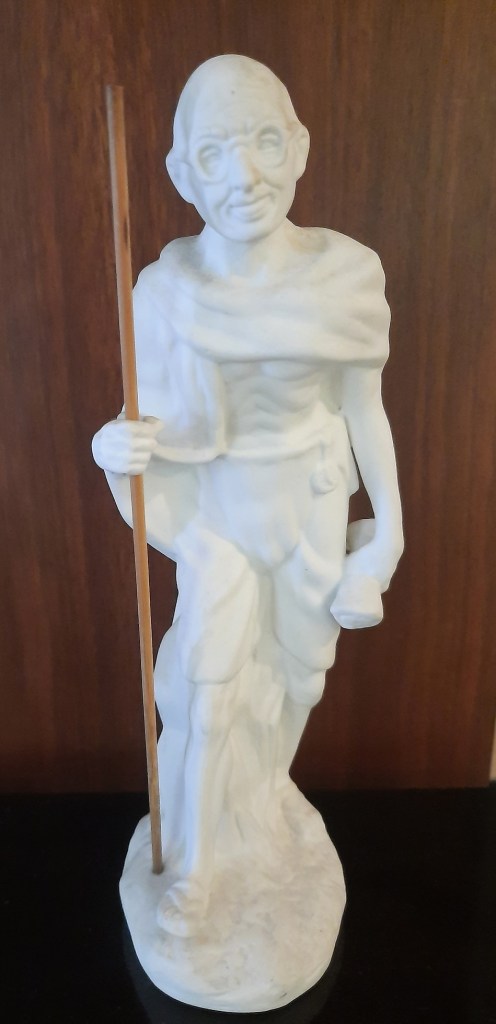
But if walking sticks were a symbol of worldly power, they were also the symbol of spirituality. They were among the few possessions of monks–Hindu, Jain and Buddhist.  A staff is part of our image of Swami Vivekananda. And of course Gandhiji! It was with the help of his lathi that Gandhi strode across the country, and walked 241 miles in 24 days to protest the British monopoly on salt in India.

There is a very interesting story about Gandhiji and his lathi. In the 1920s and 30s, Ghorghat village in Bihar made and supplied lathis all across north India, and these were essentially used by the British forces on protesting unarmed Indians. When Gandhiji visited Ghorghat in 1934, the villagers wanted to gift him a lathi. He agreed but put a condition—that they would not sell them to the British anymore. It is a symbol of those times and of Gandhiji’s influence that the villagers readily agreed to give up a means of their livelihood. Gandhi accepted their gift. Ever since, the village celebrates ‘lathi mahotsav’ to commemorate the gifting of a lathi to the Mahatma.

Walking sticks started losing their image as a fashion-accessory around the middle of the last century, but great are the advancements of walking sticks as mobility aids. So now it is about function and not art!

Well, we, especially men, may have lost a fashion accessory. But with better and more functional walking sticks on the market, senior-life is surely better!

–Meena

Ruby Bridges Walk

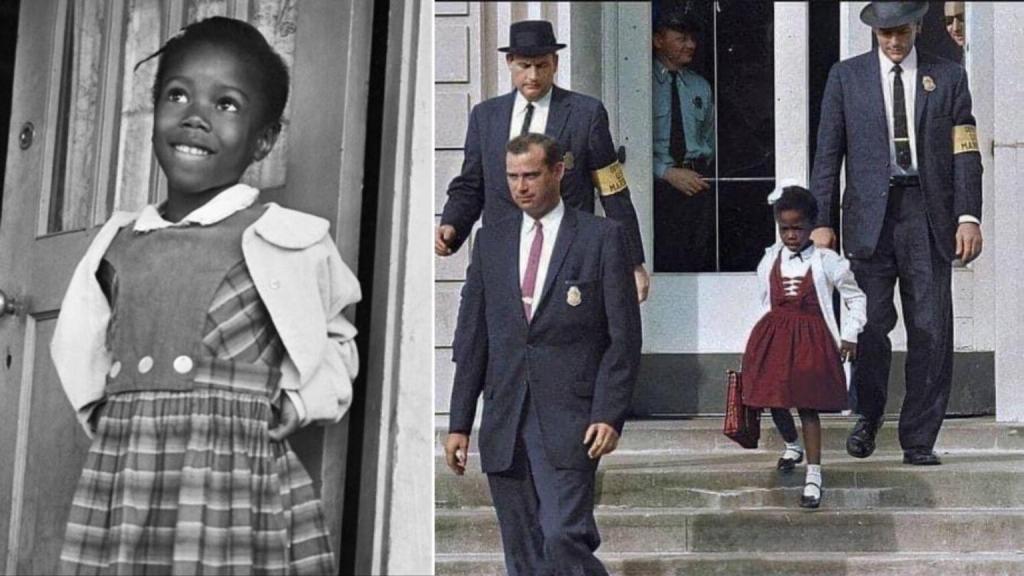
Last week my grandnephew went on a Ruby Bridges Walk with his schoolmates in California. The seven-year old also gave a stirring little speech about why Ruby Bridges was special. This was the first time that I was hearing about Ruby Bridges and I was immediately curious to know more. As I discovered, her story is indeed inspiring.

Ruby Bridges was only six years old when she made history as the first Black child to enter an all-white school in the southern state of New Orleans in America. This was not as far back as the 19th century but as recent as 1960. America was far from being an integrated society. There was blatant racism and discrimination based on the colour of the skin, and segregation, both by law and custom was the norm. Both socially and politically, African Americans were relegated to the status of second-class citizens. Restaurants, schools, businesses and other parts of the community especially in the Southern states were segregated at that time.

In 1954, as an outcome of the Brown vs. Board of Education case, the Supreme Court ruled that separating children in public schools on the basis of race was unconstitutional. This milestone decision signalled the end of legalized racial segregation in the schools of the United States. However, the implementation of this was not as smooth; states struggled to put integration into practice.

Ruby Bridges was born on September 8, 1954, the year of this landmark ruling. Her parents were at the time working as sharecroppers in Tylertown, Mississippi. Two years later her family moved to New Orleans in Louisiana for better prospects. When Ruby started kindergarten the state still had segregated schools; the school board and the state’s lawmakers defied the court order and resisted school desegregation, until a federal court ordered Louisiana to desegregate and ruled that schools were to allow both Black and white students to attend.

The city of New Orleans responded by creating entrance exams for African American students to see whether they could compete academically. Ruby was one of the only six students (all girls) who passed the test, and was eligible to attend the so-far all-white William Franz Elementary School. Of the other five eligible children two families opted to keep their children at their old school, and three were transferred to another school. Ruby was the only one to be joining William Frantz School. Her parents needed to take a big decision, knowing that it would be difficult in many ways. Ruby’s father was hesitant to send his daughter, but her mother believed that it was important for the family to take that step — not just for Ruby herself, but for the children who would come after her. Also she was keen that Ruby should get the educational opportunities that generations of her family had been denied.

A judicial order dictated that New Orleans schools be integrated by November 14, 1960, so that would be six-year-old Ruby’s first day at school. Many years later Ruby recalled how, on that day, her mother dressed her in a new outfit and told her to behave herself, and not to be afraid. She told her that there would be a lot of people outside, but that she would accompany her to school. As it turned out, the scene was a lot different. There were crowds of people all the way to school, shouting insults and throwing things, to protest against the integration. Young Ruby innocently thought that this was not unusual, as she was familiar with the crowds and noise that marked the Mardi Gras festival in New Orleans. But this was not a festive crowd. The threat was so acute that four federal marshals had to escort Ruby and her mother to school, not just on November 14, but every day of the school year. The atmosphere in the school remained largely hostile. Angry white parents protested and some even withdrew their children from the school. Several teachers also resigned as they refused to teach Black students. For a six-year old going to a strange school accompanied by officers of the law, Ruby showed remarkable courage, marching like a little soldier.

Ruby was the only student in her class for the whole school year, she ate lunch alone and had no friends. But she never gave up attending school, and never missed a day. She was lucky to have Barbara Henry, who had recently moved from Boston, to be her teacher. She took classes as if she were talking to a whole class, and remained Ruby’s friend, support and mentor all through this year. When Ruby returned the next year for second grade, more African-American students had joined the school. Ruby was the pioneer who single-handedly paved the way for this.

The family too had to bear the consequences. Her father lost his job as a gas station attendant, and her sharecropping grandparents were turned off their land. Even the grocery store where the family shopped turned them away. But inspired by their daughter’s courage and perseverance, the family retained its dignity even in the face of such blatant discrimination.

Ruby Bridges continued to study at the William Frantz School until she graduated. She was followed by more Black children whose path was clearer and less difficult than hers had been. After graduation Ruby became a travel agent and had the opportunity to travel widely. She also raised a family of four sons. She continues to support her old school, helping with creating new programmes and championing its causes in all ways. Following severe damage in the 2005 Hurricane Katrina she got the school placed on the National Register of Historic Places, which guaranteed its restoration and preservation.

Ruby had not realized, at the age of six years that she was a path-breaker who helped break many barriers; but she grew up to be a life-long activist for racial equality. Over time she became an icon for desegregation. In 1999 she established the Ruby Bridges Foundation which stands for the “values, tolerance, respect, and appreciation of all differences”. She wrote about her early experiences in a book Through My Eyes. She was awarded the Presidential Citizens Medal in 2001. Even today, Ruby Bridges continues to strive for an end to racism.

A few years ago students in California who heard her story felt that there needed to be a way to commemorate Ruby’s pioneering efforts. They proposed this to the State legislature which decided that the state of California would mark November 14 as Ruby Bridges Walk to School Day every year. Thus this day is an annual day of dialogue where students discuss and take part in their own forms of activism to end racism and all forms of bullying. India celebrates Children’s Day on 14 November. Perhaps Ruby’s story is a reminder that many forms of discrimination and bullying affect our children even today. 20 November is also an important date as it is the date in 1959 when the UN General Assembly adopted the Declaration of the Rights of the Child. It is also the date when the UN General Assembly adopted the Convention on the Rights of the Child in 1989. A good week to remember Ruby Bridges’ assertion that “All of us are standing on someone else’s shoulders. Someone else that opened the door and paved the way. And so, we have to understand that we cannot give up the fight, whether we see the fruits of our labor or not. You have a responsibility to open the door to keep this moving forward”.

Thank you Manzil for introducing me to Ruby Bridges!

–Mamata

Of Blasted Bunions and Cussed Cuboids

I was not born with beautiful feet. And they grew to a pretty unfeminine 6.5 size. I could have still lived with that. But then in my 30s, my right foot also started blooming a bunion. For those who do not suffer with this affliction, it is a word you may not even have heard. But for those of us who suffer, it an everyday reality. When will it start aching? Has it started growing again? Will I find a decent pair of footwear which accommodates the wretched bunion? Has anyone come out with yet another horrific torture-instrument that promises to solve the problem? And does it work? These are the questions we ask ourselves each day.

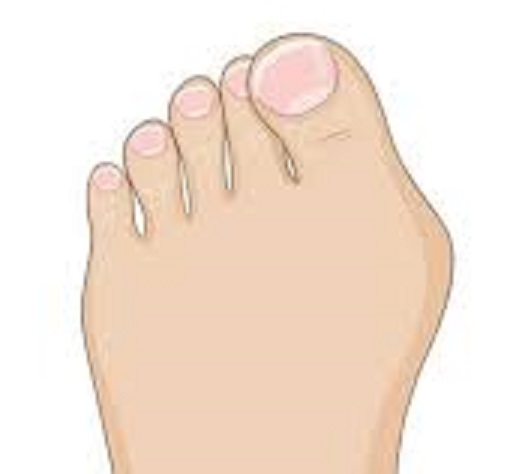
What is a bunion? Hallux valgus as it is called in medical terms, is ‘a bony bump that forms on the joint at the base of the big toe. It occurs when some of the bones in the front part of the foot move out of place, causing the tip of the big toe to get pulled toward the smaller toes and forcing the joint at the base of the big toe to stick out.’

Actually, bunions are not that uncommon. Experts estimate that about a third of the population of the US is thus afflicted. And why do they happen? Well, it is not a single reason. A combination of factors —family history, abnormal bone structure, increased motion and shoe choice — can cause them. When something puts extra pressure on the big toe joint over a long period– usually years–that can push the joint out of its natural alignment and toward the other toes, leading to bunions.  Some of the causative factors are beyond our control, but some things which we can take care of include the type of shoes we wear (narrow, pointed shoes are a no-no); the way we walk (what is called foot mechanics—though not easy, it may be possible to modify our gait so it more balanced); and how long we stand (avoid standing for extended periods of time).

And in yet another blow against the female gender, women are more prone to this! 30 per cent women versus 13 per cent men report this condition. And it is ageist too—people over 40 are more prone to it.

And can bunions be treated? Well, footwear change is recommended (but where do I go, I only wear open toe flats?); bunion pads and taping (of not too much use, believe you me); orthotics–shoe inserts that support your feet (these can help); icing and physical therapy (definitely help). If the pain and swelling are intense, painkillers or steroids are prescribed (fortunately I am not there yet). Surgery is the last resort in very severe cases, but not often resorted to for various reasons.

There are also a number of ‘correctors’ available which physically separate the toes and try to change the alignment of the big toe. These look like medieval torture instruments and have been of dubious utility to me.

Well, if there is any solace to be taken from the fact that very glamorous people have bunions, we can list several such. From Oprah Winfrey and Victoria Beckham, to Kate Middleton and Meghan Markle, from Uma Thurman to Naomi Campbell, the list is pretty long. And considering that they and their feet have to be in the glare of public and media view, we can count ourselves lucky that we can be more casual about our footwear and feet.

I had reconciled myself that I would face pain from time to time, and that I would never be able to wear dainty shoes. But then along came the cuboid! What is this very geometric sounding thing? Cuboid syndrome is a condition caused by an injury to the joint and ligaments surrounding the cuboid bone. The cuboid bone is one of the seven tarsal bones in the foot. It causes pain on the lateral side of the foot — the side of the little toe. A person often feels pain around the middle of the foot, or at the base of the fourth and fifth toes. So while the bunion hurts on the inner side of my foot, the cuboid hurts on the outside of the same foot.

And not to talk of my plantar fasciitis. The plantar fascia is a band of tissue, called fascia, that connects your heel bone to the base of your toes. It supports the arch of the foot and absorbs shock when walking. Plantar fasciitis typically causes a stabbing pain in the bottom of your foot near the heel. 

So all in all, I am definitely not Happy Feet!

I wonder why shoe-makers are not taking note of this huge market. If 30 per cent of the population suffers from bunions, surely many of them are yearning for comfortable footwear which is also half way decent looking. There is a pretty big market opportunity waiting!

Incidentally, Bunion is a cartoon strip by George Martin that was syndicated in newspapers throughout Britain and abroad (Canada, Sweden, etc.) in the 1960s and 1970s. Good to know someone found ‘Bunion’ funny!

–Meena

In solidarity with all sufferers of foot-pain, especially my bunion-sister Mamata!


A Day for Donkeys: Vautha Fair

For an animal that is usually the brunt of jokes, or the joker on the animal pack, this is the one occasion when the donkey is in the limelight. The Donkey Fair revolves around donkeys, and marks an important event in the local calendar of Gujarat. Held annually at Vautha, the fair goes back hundreds of years, and even today attracts large crowds.

The event occurs on the full-moon night of the lunar month of Kartik (October-November), which begins after Diwali. Kartik Purnima is considered as an auspicious day and is celebrated by different communities in India in different ways. A common ritual is taking a holy bath in a river. As per Hindu mythology, it is believed that this is the day on which Hindu Gods came down to earth to take a dip in a river, and even today, those who take holy dips in rivers receive the blessings of all gods, and their sins are washed away.

One such site is at Vautha in Gujarat, located near Dholka, about 50 km from  Ahmedabad. Vautha is located at the confluence of the rivers Sabarmati and Vatrak. The confluence is also called sapta sangam, which means the meeting of seven rivers. It is at Vautha that the Vatrak river merges with the smaller rivers Meshwo, Hathmati, Shedhi, Majum and Khari with the Vautha, which in turn merges with the Sabarmati.

The history of the fair goes back almost five hundred years. There are many local legends associated with it. One legend attributes the fair’s origins to the time when the sage Vashishta is believed to have performed a yagna at the confluence of the rivers. Another one claims that Vautha is one of the sites that the Pandavas stopped by at during their exile.

Legend also has it that Kartikeya or Kartik, the son of Lord Shiva and the Goddess Parvati visited this site on this full moon night. To mark this, an annual fair dedicated to Kartikeya is held on Kartik Purnima. Thousands of pilgrims from all castes and communities and professions throng here for a holy dip, and the festive atmosphere is highlighted by a fair.

The fair is a vibrant event with numerous stalls selling local food, handicrafts, and lots of other attractive ware. It is enlivened by music and local theatre performances and folk dances. There are rides and varied exciting activities. This is a major social and cultural event that villagers from far and near look forward to all year.

What makes this fair unique is that this is the major animal trading fair in Gujarat where the main animals traded are donkeys, although there is also some trade in camels, horses and goats. It is believed that this is an auspicious time for buying and selling animals.

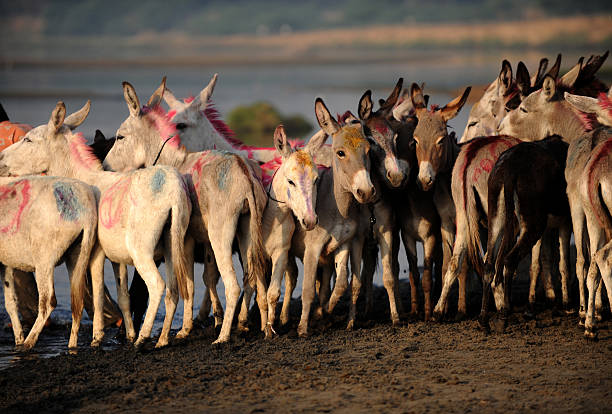
Farmers and traders from all over India bring donkeys to the fair. The animals are painted with coloured patterns and make for an attractive sight. However the buying and selling is serious business. Donkeys are closely examined to verify breed, build, fitness and health. Scrutiny of the teeth is an important part of the process. There is usually an auction to boost to competition and the prices which can range from 7,000 to 17,000 rupees or more.  

Several different breeds of donkeys make their way to this auction. Each has its own characteristics and uses. Halari donkeys from Saurashtra are white in colour and of docile temperament. They are used as pack animal during pastoralist migration, being able to walk 30-40 km a day; and also to pull carts. Kuchchhi donkeys from Kuchchh are grey, white, brown or black in colour. They are sturdy and can carry 80-100 kg and pull 200-300 kg on carts. They are used as pack animals during migration, and also for weed removal on farms. Sindhi donkeys from Barmer and Jaisalmer districts of Rajasthan are brown in colour can carry 1000-1500 kg and are used as pack animals to transport water, soil, earthenware, construction material, and fodder; as well as for pulling carts and for ploughing by small and marginal farmers. There are also donkeys from Marwad as well as other local breeds from other parts of India.

While thousands of donkeys continue to be brought and traded at this largest donkey fair, studies indicate that there is a steady decline in the donkey population in India. Increasing mechanization has replaced the need for donkeys for transporting material and as pack animals. This is also a factor for replacing donkeys in farm work. Traditional donkey-raising and herding families are moving to new occupations as demand for donkeys is going down, and the cost of maintaining the animals rises. There are also no specific government schemes or policies that promote the animal or its welfare. Donkeys are being abandoned when they are too old or feeble for hard labour. Even in Ladakh which has a tradition of donkey rearing, there is a decreasing role for donkeys in local occupations and uses. A donkey conservation park has been opened here in collaboration with communities where stray or abandoned donkeys are kept with dignity.   

In the meanwhile the donkeys still have their day at Vautha. And this year it falls on 15 November.

–Mamata

Grammarly yours…

A title itself which will be grist to the mill for the “Grammar police”, a term for people who feel compelled to correct other people’s grammar, often in public. Of course, I would rather be pulled up by the grammar police than the “Grammar nazi”—a term which originated in the 1990s to describe someone who is overly critical of others’ grammar, spelling, typos, and other writing or speech errors.  Grammar nazis are obsessed with formal grammar rules. 

The world of grammar is a contentious one, with some debate or the other making the headlines. The latest is Germany’s outrage about the increasing influence of English on their grammar. The kerfuffle is about what is called the ‘idiot’s apostrophe’ (a translation from the German Deppenapostroph).

What is this intriguing thing? Well it stems from a basic difference between the grammar of the two languages. Unlike English, German does not traditionally use apostrophes to indicate the genitive case or possession. So in German, the correct form for a shop named after its owner, say Kareena or Paul, is ‘Kareenas Kirana’ or ‘Pauls Dry-cleaning’. And this is how it has been for centuries.

However in English, as we know, the correct form is ‘Kareena’s Kirana’ or Paul’s Dry-cleaning’. And for the last several years, thanks to the influence of English, slowly the general usage in Germany has shifted from ‘Kareenas Kirana’ to ‘Kareena’s Kirana’. Which was OK with the general public.

But now the new edition of the Council for German Orthography’s style guide—the official set of rules for the use of grammar has endorsed this shift, saying ‘Kareena’s Kirana’ is perfectly acceptable. Which has set the pedants and scholars up in arms, as they see it as a dilution of the rules of their language due the pernicious influence of a foreign tongue. The controversy continues to rage there!

We in India are rather free in our misuse of apostrophes, though not quite in this way. What we often see is what is called the English greengrocer’s apostrophe, when an apostrophe before an ‘s’ is mistakenly used to form the plural of a noun (e.g., “a kilo of potato’s”). Look closely at emails you receive, menus, or local ads, and you will find plenty of examples.

It is not just the apostrophe which is at the root of grammar-controversies. The Oxford comma is a case in point. The last comma in a list of three or more things is called the Oxford comma (or the serial comma). For example, in She bought peanuts, soap, and candles, there is a comma between each item listed. The comma before and is the Oxford comma. Not everyone agrees on whether to use the Oxford comma. In this case, the comma can be deleted without changing the sense of the sentence. But there are cases when things may get confusing without it. For example, in the sentence I love my dogs, chikko, and cheese, the Oxford comma makes it clear that all three items are separate. This one could be confusing if the Oxford comma were left out: I love my dogs, chikko and cheese, might mean that the speaker’s dogs are named Chikko and Cheese. Which would also of course imply that the writer is not strong with capitalization! But there is a point there, and doing away completely with Oxford commas does not seem a good idea.

Some people have proposed that we should have Grammar Czars–benevolent dictators who would hand down rulings on ambiguous grammatical rules. The GC’s decisions would be final. All would abide by the GC’s decisions, upon penalty of death (or being banned from social media for periods ranging from a month to a year!).

In the meantime, let us enjoy the creativity of grammatical mistakes, mis-spellings and confusions arising from misunderstanding of words.  I love my neighbourhood ‘Karim Puncher Shop’. But surely an ad for a new housing society which I saw some years ago in Hyderabad, which proudly called for subscribers for ‘Mildew Apartments’,  takes the cake!

–Meena

A Pre-Titanic Disaster: SS Vaitarna

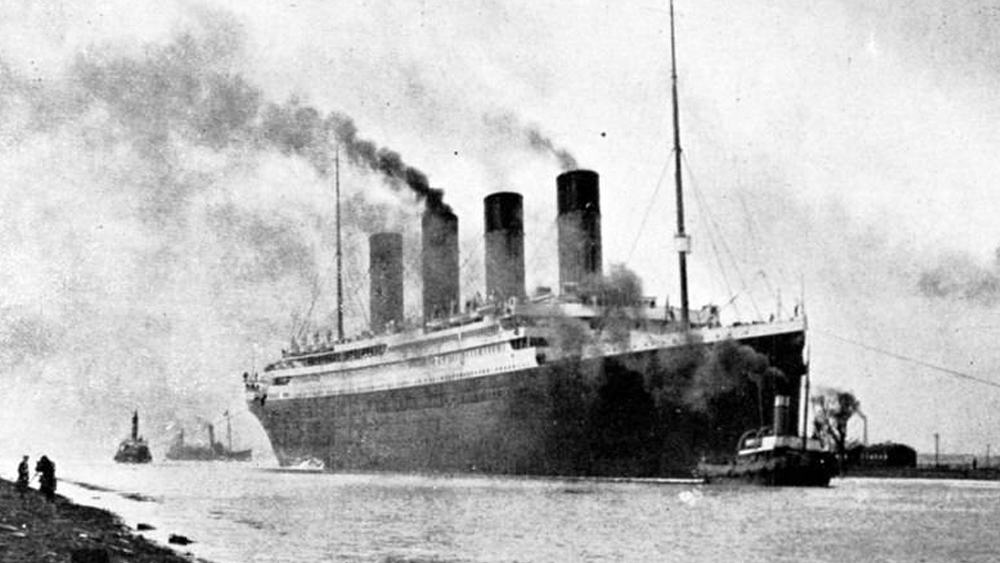
112 years after the tragedy, April 15 is still marked as the day the RMS Titanic sank. This is remembered as the biggest maritime disaster of all times. The largest and most luxurious ship in the world at the time, The Titanic was also one of the most technologically advanced for its time; its 16 watertight compartments were believed to make the ship unsinkable. But just four days into its maiden voyage, the Titanic struck an iceberg near Newfoundland, Canada, damaging its watertight compartments. Only hours after the collision the ship sank, taking 1500 passengers with her.  

SS Vaitarna

Not many are aware that twenty years before this tragedy, another ship had mysteriously vanished, taking along with her, more than a thousand people. And this little known event occurred along the coast of Gujarat in India on 8 November 1888.

The ship was SS Vaitarna, one of the earliest steamships operating on the west coast of India. It was named after the Vaitarna River which flows north of Mumbai, but was built by the Grangemouth Dockyard Co. Ltd in Scotland. It took three years to build. The 170 feet long steamer had three floors and 25 cabins. Its value was estimated to be 10,000 pounds, and it was insured for 4,500 pounds. Its maiden voyage from Scotland involved sailing around Africa to Karachi its first destination.

The Vaitarna was owned by A.J. Shepherd & Co. in Bombay. The captain of the ship was Haji Cassum, a zamindar from Kuchchh who owned large tracts of land around Mumbai.

The ship started sailing in 1885 and was used mainly for carrying cargo and passengers between the Mandvi port in Kuchchh and Bombay. Vaitarna was far from the luxury liner that the Titanic would be two decades later. But it had something that was a great novelty for the time—electricity! The ship was lit with electric bulbs, long before external lighting was made mandatory for safe navigation at sea. This was such a unique feature that the local people dubbed the ship Vijli (the Gujarati word for electricity or lightning). The lighted ship attracted scores of visitors when it used to come to Mumbai; sightseers were charged two rupees for the viewing.

Vijli regularly plied between Mandvi in Kuchchh and Bombay, ferrying passengers and goods. It took 30 hours to cover the distance, and the passenger fare was eight rupees.

On 8 November 1888, the ship was anchored at Mandvi port. At noon that day it set sail for Dwarka with 520 passengers on board. About 200 more passengers are believed to have boarded at Dwarka before the ship left for Porbandar. But as the weather was turning stormy the ship did not stop at Porbandar but headed directly for Bombay. The storm gained strength and the seas were choppy. That evening the ship was seeing off the coast of Mangrol, but that was the last sighting. Vijli never reached Mumbai. The next day SS Vaitarna was declared missing with all the passengers on board. The passengers included 13 wedding parties and a number of students who were on their way to Mumbai to appear for their matriculation exams.

While it is known that there were at least 700 passengers, plus about 40 crew members, the exact number of casualties could never be ascertained. It was common practice for ships to load far beyond their normal capacity. It has been speculated that ship could have been carrying as many as 1200 passengers.

No wreck of the ship nor remains of the passengers were ever found. Unlike the Titanic, SS Vaitarna had no survivors. The first attempt to locate the remains were by the ship SS Savitri. Its captain Mahomedbhoy Dawood, had been a friend of Haji Cassum for many years; he knew Cassum to be a careful navigator.

The cause of the wreck has also remained a mystery. A Marine Court of Inquiry was set up by the Bombay Presidency to investigate. It pointed out that the ship did not have enough lifeboats, and was not adequately equipped with safety measures. Generally the ships in this region were not designed to ply on stormy seas. They would travel along the coast from port to port during the non-monsoon seasons, and would remain moored in harbour during the rainy season. But November is not the monsoon season in the Arabian Sea.  

However another report by the then government of India claimed that the ship was in good condition and all its machinery was in good order, and that it was fully equipped and sufficiently manned. It would have taken a cyclonic storm to capsize it.

Whatever the cause, the effect was the total and complete disappearance of SS Vaitarna. However this disaster led to the realization about the need for relaying early credible forecasts about storms and led to several reforms in India’s shipbuilding and navigation systems.

No compensation was given to the families of the missing passengers. After the initial attempts at searching for the wreckage, the curtains were drawn. While the sinking of the Titanic continues to evoke interest and discussion even a century later, this early, and just as tragic, shipwreck has almost been forgotten in the annals of shipping history. The Lloyd’s Register of London recorded only one word against SS Vaitarna: Missing. 

The Vaitarna tragedy however became a part of the lore of Saurashtra. Even today stories and songs commemorate Vijli and her captain Haji Cassum.

–Mamata

The Women Who Gave the World Windshield Wipers

Imagine if you had to put your hand out and try to clean your windshield to get a clearer view. Or maybe even get out of the car to do it! Well, this was what was happening in the early part of the 20th century.

It was a woman’s eye which caught the problem, and after some thought and work, came out with a solution. And it was another woman who worked on it further.

It all started with a trolley-car ride in New York in 1902. Mary Anderson was visiting New York from Alabama on a frosty day in winter, and was in a trolley car when she noticed that the driver was struggling to see what was outside. He would frequently thrust his head out of the window, put his hand out and wipe the windshield, but it was not really effective. He sometimes even had to stop the vehicle, get down and clean.

To Mary, this seemed really a terrible way of doing things. She wanted a solution whereby the driver could clean the windshield form inside. Her brain got working on the problem. When she was back in Alabama, she worked on various possibilities, and finally came out with a design consisting of a lever inside the vehicle that controlled a spring-loaded arm with a rubber blade. The lever had a counterweight so that the wiper would remain in contact with the window, and would move the blade across the windshield, removing rain or snow. The device could be easily removed if desired after the winter was over.

She wrote up a detailed description, and hired a designer to create a prototype. She even got a local company produce a working model! She applied for a patent, and on November 10, 1903 was granted her first patent for an automatic car window cleaning device controlled from inside the car, called the windshield wiper. The patent for the Window Cleaning Device was granted for 17 years.

In the meantime, another woman came along to develop on this idea. This was In 1917, when Charlotte Bridgewood patented the “electric storm windshield cleaner,” the first automatic wiper system that used rollers instead of blades. She was an automobile enthusiast who wanted to improve Mary Anderson’s manual windshield wipers. She went on to develop the automatic windshield wipers that she called “Electric Storm Windshield Cleaner”. She patented these first electrically powered windshield wiper in 1917, improving previous manually-operated wipers.

Sadly, neither woman profited from their ingenuity. Mary could not find anyone who would manufacture it for her. Moreover, when she patented in 1903, there was no very large demand yet, as personal automobiles were yet to take off. Her patent expired in 1920, just as cars were getting popular. Her invention had obviously been before its time.

In Charlotte’s case, the wipers used rollers rather than blades and therefore did not catch on.

In both cases, their being women was probably a huge reason!

This was not an isolated achievement in case of either woman. Mary was a well-regarded real-estate developer. She successfully ran a cattle ranch and vineyard in Fresno, California. 

Charlotte was a Canadian vaudeville performer and inventor of the turn signal, traffic light, and brake light. She was president of the Bridgwood Manufacturing Company

In 1922, Cadillac became the first car company to include windshield wipers as standard equipment. Today, almost all motor vehicles, including cars, trucks, buses, train locomotives, and watercraft with a cabin—and even some aircraft—are equipped with one or more such wipers, as a legal requirement.

On the 121st anniversery of Mary’s patent, we thank you Mary Anderson and Charlotte Bridgewood for your path-breaking work. You may not have profited, but you continue to inspire all inventors, and especially women!

–Meena

The Black-eared One: Caracal

It is arguably the least-known cat-species of India. Its popular vernacular name based on the Persian words is syah (black)and gosh (ear). This is the caracal—the black-eared one. Caracals inhabit dry, arid regions and moist woodlands, living in small herds. They mark territory by clawing trees and releasing scent from glands on their faces and between their toes. They communicate with meows, hisses and spits.

A medium-sized cat (about the size of a jackal) with fur in varying shades from reddish-fawn to dull sandy, the caracal is distinguished by its ears. The ears are longer than in most felines and are pointed at the tips that end in an erect tuft of hair. The ears have almost 20 different muscles that control independently the motion of each ear and aid in their wide range of movements, which they use for a variety of communication. The ear tufts act as sensitive antennae, with the ability to detect even minute vibrations.

Strongly muscled with tall rear limbs the caracal is the athlete of the cat world. It can run at a top speed of 80 km an hour and can change direction in mid-air. It can launch its whole body as high as 10 feet above the ground in one jump, and can even catch birds in flight. This litheness enables it to be an effective predator; its diet includes rodents, rabbits and birds, it is known to subdue prey much larger than itself.

It is this ability that that made the caracal a favoured hunting or coursing animal in medieval India. The caracal was a favourite pet among royalty, dating back to the time of the Mughal emperors and on to the Maharajas in the British times. Caracals were tamed and trained to hunt game, especially birds. They used to be transported to hunting grounds hooded and leashed on a bullock cart, from where they were set after prey. Using its speed and agility, the cat would swiftly bring down large game birds like cranes, hares, antelopes and even foxes. However once it had successfully hunted the caracal would ferociously hang on to it, making it difficult to retrieve the kill. 

Caracals feature commonly in literature from the Mughal through to the British rule period, indicating that they were fairly common, and considered significant. In later years these cats began to disappear from the landscape and literature. As a result the caracal remains one of the least studied species of Indian felines. Their shy and elusive nature makes them difficult to spot in the wild; they are rarer to spot than a tiger.

Conservation biologist Dharmendra Khandal who has spent many years looking for studying this elusive creature has spotted the cat only five times in twenty years compared to the hundreds of times he has seen tigers. Today he is one of the few caracal experts in India. Research on this elusive nocturnal cat is incredibly difficult  because there are no captive caracals in the country.

Once found all across Central Asia and the Indo-Gangetic plains, today these cats are rarely, if ever, sighted in these parts. While the cheetah got hunted to extinction, the reasons for the vanishing of the caracal in India are not clear. While they may face a variety of threats. Increasing area under irrigated agriculture in the arid and semi –arid region that the caracal inhabits has led to habitat modification and loss. This has also affected its diet which earlier consisted largely of birds, but now includes rodents. Human intrusion due to increasing population, and increased activity such as large scale mining and setting up wind factories in the already fragile landscape has driven these cats to near extinction.

And indeed they have vanished. A 2015 study threw up the grave concern that only two populations of the cat remain in India. It estimated that only some 28 caracal individuals were believed to be in the Ranthambhore Tiger Reserve in Rajasthan, and around 20 in Kutch in Gujarat. Scientists fear that after the Asiatic cheetah, that was declared extinct in 1952, the caracal will be the second cat species to be wiped out from the country.

While the species is listed under “least concern” under the IUCN Red List globally, it has been listed as “near threatened” by the Conservation Assessment and Management Plan and IUCN Red List assessment in India. The species is included in the Schedule-I category of the Indian Wildlife (Protection) Act, 1972, offering it the highest possible protection.

Currently, three Protected Areas, namely, Ranthambore National Park and Kailadevi Wildlife Sanctuary in Rajasthan and Narayan Sarovar Wildlife Sanctuary in Kachchh, Gujarat are the only known strongholds of Caracals in India. Viable populations outside these protected areas remain either unknown or poorly monitored. 

In 2021, the National Board for Wildlife and the Ministry of Environment, Forest and Climate Change announced a Species Recovery Plan for the conservation and population revival of 22 species in India, including the caracal.

A ray of hope comes in the form of the recent news that the royal family of erstwhile princely state of Kachchh has transferred the ownership of Chadva Rakhal, part of their ancestral property to the state government of Gujarat for conservation of biodiversity.  The Government has transferred the 4,900-hectare woodlot to the Forest Department to support conservation efforts. The area will also include a caracal conservation breeding centre which will focus on the protection and breeding of the rare and critically endangered Caracal.

 A heartening gesture indeed. 

–Mamata