A Woman’s Voice: Saeeda Bano

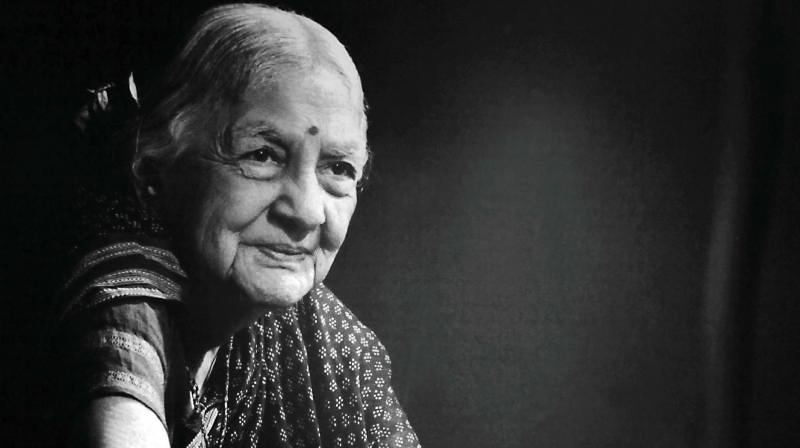
Last week I wrote about All India Radio, the voice of the nation after India gained Independence.  I also wrote about some of the newsreaders who literally gave voice to the news. The early decades were remembered by names that became synonymous with different programmes broadcast by AIR, including some well-loved women voices. Before them all, was Saeeda Bano, who was the first woman to read the news on AIR. A woman ahead of her times in more ways than one.
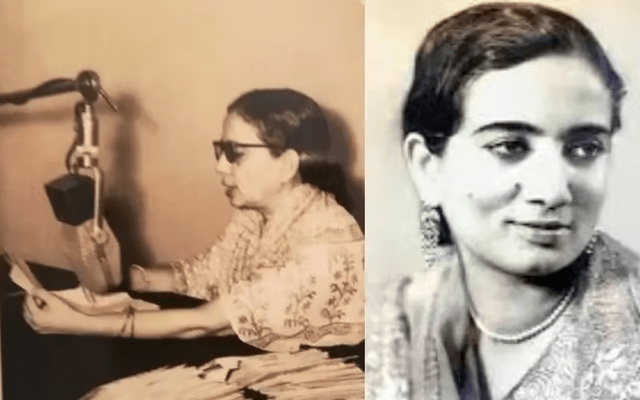
Saeeda Bano was born in Bhopal in 1913. It was the period of British rule in India but local rulers still held sway in the numerous feudal kingdoms that made up India. Bhopal was unique in that it was a city that had been ruled by women (Nawab Begums) for four generations as there had been no male heirs to the throne. It was an unusually liberal environment where women’s education was encouraged and the hold of patriarchy was not as strong. When Saeeda was born, the last of the four Nawab Begums, Begum Sultan Jahan, a great reformer, was ruling Bhopal. She was very keen that women be educated and thereby be able to come out of the darkness of ignorance.

Saeeda’s father was supportive of the idea that girls should get as best a formal education as was possible at that time. Saeeda was sent to boarding school in Lucknow in 1925, and went on to do her graduation from Isabella Thoburn College in Lucknow. But that was as far as her family would allow. In spite of her fervent pleas, she was married off, still in her teens, to a highly-respected judge in Lucknow who was many years older. The plunge into a highly-confining world, shackled by social expectations and dos and don’ts was stifling to the lively young girl who was at all times expected to play the role of a dutiful wife, and adhere to repressive norms. However she stuck it out for almost 20 years, playing the role of wife and then mother to two sons, even as the stirrings of rebellion built up. In 1938 when a radio station was set up in Lucknow, Saeeda started participating in shows for women and children. As her domestic life became more turbulent, Saeeda began looking for a way out. She sent her application to what was then still BBC in Delhi for the post of newsreader. The application was accepted. This was the impetus that propelled her to leave her husband’s house and her husband, and move to Delhi. She put her older son in boarding school and arrived in Delhi with her younger son. She was alone, in a new city, about to make a new life for herself.

Saeeda and her son arrived in Delhi on 10 August 1947, and stayed with some family friends. She reported to All India Radio the next day, met the Director of news, and spent the entire day getting familiar with the premises and the world of broadcasting. The following day when she reported for work at the radio station, a weekly roster of her duties and timings had been prepared and was handed over to her. She was to reach AIR on the 13th of August 1947 by 6 am and read the news bulletin in Urdu at 8 o’clock thereby becoming the ‘first female voice, news anchor of All India Radio’s Urdu news bulletins’.

As she recalled in her memoir: I was the first woman AIR considered good enough to read radio news. Prior to this, no woman had been employed by either the BBC (British Broadcasting Corporation) or AIR Delhi to work as a news broadcaster. Of course they had to train me and I was taught how to first introduce myself on air with my name and then start reading the bulletin.

Thus Saeeda Bano became the first woman newsreader on All India Radio, two days before India gained Independence. She was proud to be a member of the AIR team that broadcast, live, to the nation, the momentous transition of power.

While she broke barriers in broadcasting, Saeeda continued to face challenges as a single woman in a big city. She looked for accommodation, and moved to YMCA, after a struggle to obtain special permission to keep her son with her.  Saeeda Bano grew with her job and went on to research and anchor other programmes also. But it was not all smooth sailing.

The dawn of Independence also unleashed the fury of violence in the aftermath of Partition. As a Muslim woman whose voice was becoming heard and known, she was the target of hate mail and threats. She was forced into taking refuge with other Muslim personalities of the time, and was witness to many distressing situations. 

Perhaps the most distressing event that left a deep impression on her was the assassination of Mahatma Gandhi. Saeeda Bano had in fact been to Birla House to listen to Gandhiji in person, on the very day that he was killed. She later wrote how she had felt a note of despair in his voice. The shock of his death was so great that she was unable to read the news that day, and the news director had to hurriedly change the shifts.

Saeeda Bano’s in-built reliance and ability to face challenges remained with her through her life. She retired as news reader from AIR in 1965, and was appointed as producer for AIR’s Urdu Service and continued till the 1970s. She passed away in 2001. 

Saeeda Bano’s achievements are much greater than her ‘first’ as a newsreader. In 1994 she wrote her memoir Dagar Se Hat Kar in Urdu where she described the ups and downs of her life, candidly and without bitterness nor self-praise. She simply described herself as one of those people who “chose a road less travelled“. The  book was translated into English by her granddaughter Shahana Raza and published in 2020 as Off the Beaten Track: The Story of my Unconventional Life.

Remembering her grandmother, Shahana described how Saeeda Bano or Bibi as she was affectionately called, was a woman who lived life on her own terms. She lived independently, and didn’t seek support from anyone, even in the lowest phases of her life. Her sheer determination always stood out, as she never looked back and regretted any of her decisions.

Today as so many women confidently anchor news and other shows, especially on the numerous television channels, they face their own challenges and new glass ceilings to break. But it is always humbling to remember and celebrate those who took the first steps in clearing untrodden paths.

–Mamata
A Library Crying for a Librarian

So many of India’s treasures are hidden, waiting to be discovered. No, it’s not just old monuments or beautiful sights.

It includes—wait for it—libraries too!

The Bhadariya Library is a prime example. Bhadariya is a tiny village, near Pokhran, with a population of less than 2000. Situated about 76 kilometres from Jaisalmer, off the Jaisalmer-Jodhpur highway—it remains a hidden gem, with only a fleeting mention on travel sites.

Once off the highway, there is quiet road flanked on both sides by vast cow shelters, leading to the serene Shri Bhadariya Mata Ji temple. Originally erected in 1831 by Maharawal Gaj Singh of Jaisalmer, it commemorates his victory in a bloody battle against Bikaner.

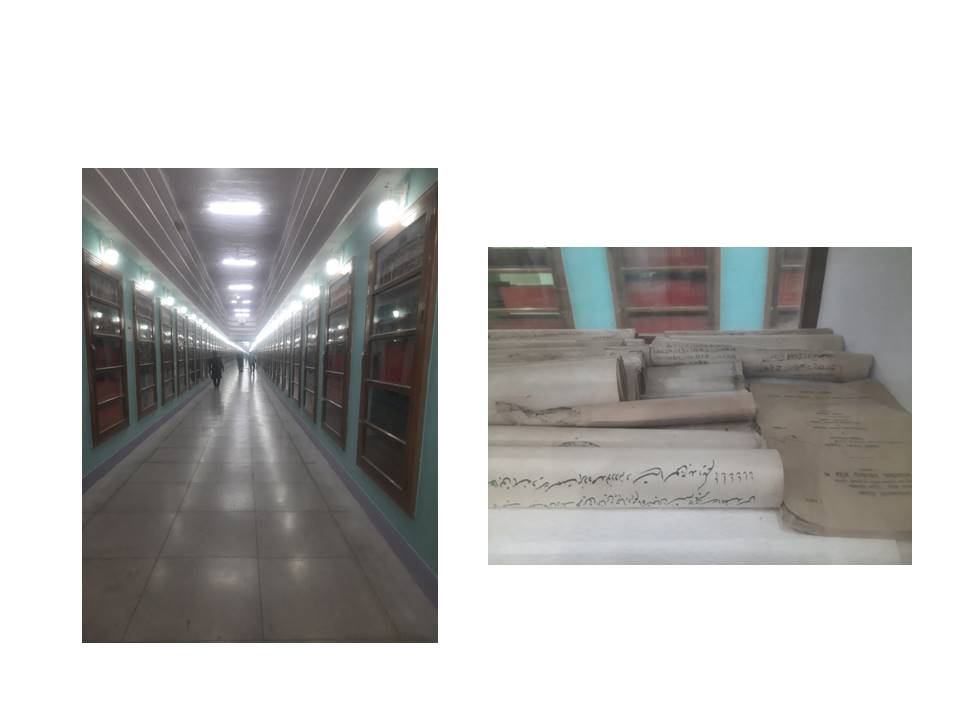
And underneath the temple lies a humungous 50,000 square feet underground library—probably Asia’s largest. It houses the personal collection of one man–Harbansh Singh Maharaj, a social reformer from Punjab who moved to Rajasthan in the 1960s. Built in 1998. It houses around 200,000 different titles and a total of 900,000 volumes, with seating for 4,000 individuals.

As one climbs down a flight of steps to the library, there is an unusually long corridor, probably some 150 metres in length. Closed glass shelves line either side. As one continues onwards, each corridor leads to the next and then to the next identical corridor. The illusion of immensity is compounded by the mirrored walls at each end of every corridor. There are eight such corridors with 562 spotlessly clean glass shelves.

These shelves are filled with a rich and varied but largely random collection. It is obviously the work of a person passionate about books and education, but untrained as a librarian. The books range from British-era gazetteers and law books, to a vast collection of mythological works, books in English, Urdu, Sanskrit, Tamil, and various other languages. It contains some rare manuscripts which may be over a thousand years old.

Harbansh Singh Maharaj or Sri Bhadariyaji Maharaj as he was called, built the library to encourage reading and education in a place where there was little interest in either. He wanted readers to have a cool, sheltered place to sit and study, and so choose to have an underground facility. The local communities contributed shramdaan to do the excavations. His ambition was to start a University, but alas, this could not happen.

Today, the library has neither a librarian nor any staff to manage it. The sole caretaker of the library is an attendant from the Jagdamba Seva Committee Trust’s office. The immaculate condition of the interiors and the shelves speak volumes about the love the staff of the Trust have for the library.  It is no mean feat to maintain such a large facility of this nature, in such a location absolutely dust-free.

But they can do only what they can do. Professionals and resources are needed–the books are not even catalogued and carry no library classification numbers, hindering their integration into any library network.

And even more sadly, there are no readers either. Apart from locals, no one really knows about the facility or the treasures it offers. The attendant told us that the library was hardly ever used by anyone. It is in a remote location, and there is no really convenient accommodation for scholars who may come from far away. Moreover the library lacks a system to assist visiting scholars.

But yes, the potential for scholars to come from far and wide exists. As a visitor to the library has mentioned ‘Bhadariyaji Maharaj has left a vision. If someone could resurrect it, it would uplift the field of education,’

This was Bhadaria Maharaj’s life’s work, which he carried out with the vision to spread education. It is now our responsibility to build on this invaluable legacy.

–Meena

“This is All India Radio”

“This is All India Radio, and here is the news read by Melville de Mello.” Nine p.m. and the family is gathered around the radio, as the deep baritone voice begins to read the news of the day–news from home and abroad; the only news that the nation absorbed and digested before retiring for the night. The radio was the meeting point for all generations, and the source of connection to national and international events. And indeed, it was All India Radio that defined this coming together.

Radio broadcasting services started in India during the British rule in 1922-23 under the initiative of the Bombay Presidency Radio Club.  In 1927, the Indian Broadcasting Company (IBC) was set up as a private entity and was granted permission to operate two radio stations. On 23 July 1927 the IBC made the first ever radio broadcast in the country from the Bombay Station.This event marked the start of organised radio broadcasting in India. The Calcutta Radio Club came into existence five months later. IBC dissolved its operations on 1 March 1930; thereafter the Imperial Government took over the broadcasting operations. The Indian State Broadcasting Service (ISBS) was started on 1 April 1930 on an experimental basis for two years, and then permanently from May 1932. Eventually on 8 June 1936, it became what came to be known as All India Radio. It was also in 1936 that the first daily news bulletin was introduced.

All India Radio’s signature tune was synonymous with the name AIR. It was composed in 1936 by Walter Kaufmann, a Czech Jew who was one of the many Jewish refugees fleeing Nazi persecution in Europe who sought refuge in India. Kaufmann became the director of music at AIR. Kuaffman was a serious western music scholar and performer, but the tune he composed for AIR was based on the Indian raga Shivranjani. It remained the identity of AIR, and was the ‘pied piper’ tune that drew the millions of listeners to the radio as the broadcasts began.

During World War II radio was being used for Nazi propaganda and there was a strong need to counter it. Hence, the practice of broadcasting all news bulletins from one central newsroom started. Around 27 bulletins were being broadcasted every day during the war years. In a time when the press was supressed, and news censored, radio broadcasts from underground radio stations played a significant role. The radio was used by nationalists to share news about the real situation on the ground, spread the message of Swadeshi, and rally the people in the non-violent struggle against British rule. These radio broadcasts had an immense impact in rousing Indians and to step up the demands of Indian freedom in the pre-independence era.  One such story on https://millennialmatriarchs.com/2021/10/07/gandhis-women-warriors-usha-mehta/

When India attained Independence on 15 August 1947, there were six radio stations: Delhi, Calcutta, Madras, Bombay, Tiruchirapalli, and Lucknow. In 1956 AIR formally adopted the name Akashvani. The word Akashvani which means ‘voice from the sky’ was derived from the title of Rabindranath Tagore’s poem written in 1938 for the inauguration of Calcutta All India radio’s shortwave transmission service. AIR and Akashvani were used interchangeably until 3 May 2023 when Akashvani became the exclusive name.

After Independence, AIR’s offerings began to expand beyond news and important announcements to a wide range of programmes—music, drama, live commentaries, and more. It was the primary source of news as well as entertainment. Radio continued to be the favourite companion of old and young, initially as the focal point of a household. With the advent of transistors, it became a trusty companion which accompanied wherever one went. It was the provider of songs, weather bulletins and live cricket scores. AIR’s simple listener-friendly format, its ABC of Authenticity, Brevity and Clarity became its USP. The news readers became household names, and the ultimate examples of proper diction and high quality commentary—from the Republic Day parade to cricket matches. The anchors of music programmes (today’s RJs) were popular idols with big fan clubs. Radio became a quintessential way of life for Indians.

This role is beautifully summed by Santosh Desai who grew up in the golden age of AIR: ‘All India Radio had many moods and played different kinds of roles in our lives. It was the official voice of state, the keeper of cultural standards, the chronicler of the times, the certifier of reality, the breathless commentator of the current, the receptacle of small desires of its viewers and an entertainer allowing escape into an imagined world.’

88 years after its first broadcast, AIR remains steadfast, with a widely expanded canvas. It is one of the largest broadcasting organisations in the world in terms of the number of languages of broadcast and the spectrum of socio-economic and cultural diversity it serves. AIR’s home service comprises of 591 broadcasting centres located across the country, covering nearly 90% of the country’s area and 98% of the total population. Terrestrially, AIR originates programming in 23 languages and 179 dialects.

Today as we once more salute the national flag to mark 77 years as an independent nation, it is a good time to remember that it was on AIR that the nation heard Jawaharlal Nehru’s emotional Tryst With Destiny speech, live at midnight of 14th August 1947. And when, for the first time when Nehru hoisted the Indian flag from the ramparts of the Red Fort in Delhi, it was the minute-to-minute narration that the proud nation followed on AIR.

Happy Independence Day!

–Mamata

Celebrating Librarians

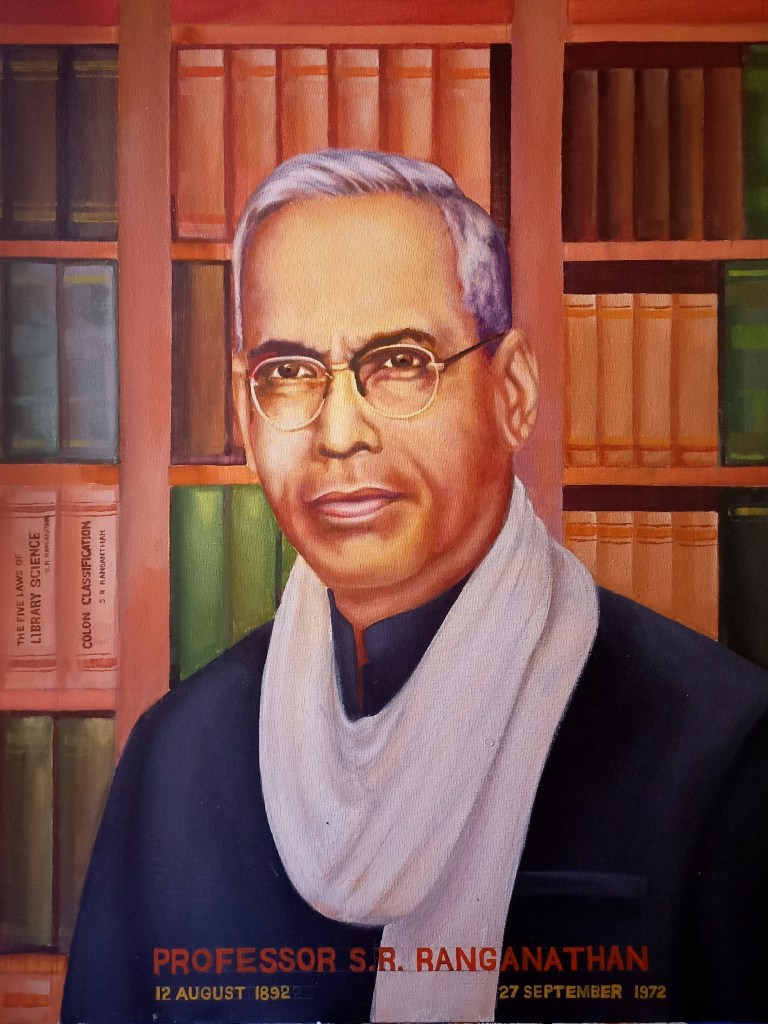
National Librarian’s Day is observed on August 12 every year to commemorate the birthday of Padma Shri Dr S. R. Ranganathan (1892-1972), who is considered not only as the father of library science in India, but who has made immense contributions with worldwide impacts to the development of the discipline.

Dr Ranganathan’s academic journey did not indicate that he would end up as the country’s most significant librarian. He did his B.A. and M.A. in mathematics at the Madras Christian College. He was a brilliant student, and aspired to teach mathematics. He therefore went on to take a degree from the Teachers’ College Saidapet. He started his career at Government College Mangalore in 1917. From there on, he went on to teach at Government College Coimbatore and Presidency College, Madras.

In 1924, he was appointed the first librarian of the University of Madras. He was a reluctant librarian who at first hated to be cooped up in a room with just books and a few staff members. He missed the interactions with students and his colleagues and pleaded to come back to teaching. But other people saw something in him and knew he would do a great job. He was selected to go to the UK to be trained in library science. His principal Mr Duncan assured him that if he still wanted to give up librarianship after his UK visit, he could go back to teaching.

The experiences in the UK transformed Dr Ranganathan’s view of this profession. When he saw the difference that libraries could make in the lives of people, and how they could serve different sections of the community, he discovered a social mission for libraries, and for himself.

Dr Ranganathan served as Librarian and Professor of Library Science for over three decades, at some the largest and most prestigious universities of India.  In 1962, he founded the Documentation Research and Training Centre in Bangalore, and was associated with it through his life.

His major technical contribution to the world of librarianship was the Colon Classification system, which is even now one of the major classifications used in libraries across the world.

But as a lay-person and user of libraries, what deeply fascinates me is the ‘Five Laws of Library Science’, which he first proposed in 1924, and after several iterations, finally published in 1931. These sum up the foundational philosophy on which libraries must be run.

These laws are:

1. Books Are For Use: We have all experienced how some librarians are more concerned that their books not be ‘spoilt’, dog-eared or lost, rather than that they be read. The first law addresses this concern—the primary purpose of a library is not to store and preserve books, but rather to ensure that they are used. With this Law, Dr. Ranganathan refocused the attention on access-related issues, such as the library’s location, loan policies, hours and days of operation; and as importantly, the quality of staffing. Practical matters like library furniture, temperature control, and lighting too fall in this purview.

2. Every Reader His/Her Book: The Second Law recognizes that readers have different interests, and stresses that every reader has the right to read what he or she wants. They have equal rights to be able to access material of their interest. It fixes the responsibilities of the state, the library authority, the library staff, and the readers, and clarifies that a library must serve all users, irrespective of age, social background, or economic status.

3. Every Book Its Reader: Related to the previous Law, the practical implication of the third Law is that there should be a variety of books and that the library needs to figure out ways to ensure that each item finds its appropriate reader. This points to making the collection accessible, including open shelving. Importantly, it means that even if there are few readers for a book, each book has its place in the library.

4. Save The Time Of The Reader: This law is a recognition that library services must meet the needs of library users efficiently. One requirement for this is that the library staff must have strong reference skills, as well as strong technical skills in cataloguing, cross-referencing, ordering, accessioning, and the circulation of materials.

5. The Library Is A Growing Organism: A library is a social institution and will keep growing in terms of documents, readers, and staff. Even when a library seems to have reached its capacity, the growth would be in terms of replacing old books by new books and new users will continuously replace old users. So a library needs to be a continually changing institution, never static in its outlook.

At a time when the reading habit seems to be on the decline, and many libraries are floundering to re-define themselves, it would be a good idea to revisit Dr Ranganathan’s vision of libraries and his Five Laws. They will help us find a new direction in this rapidly changing landscape.

–Meena

Reviving Crafts: Kamaladevi Chattopadhyay

As the country gears up to celebrate India’s 77th Independence Day, memories are revived of the significant events and persons in the unique movement that led India to her ‘tryst with destiny’ to become a free nation on 15 August 1947.

Among the innumerable individuals who contributed in different ways to reaching this  momentous moment, is a name of a woman whose contributions were not limited to a single area, but spanned a wide range of fields, all of which coalesced into the empowerment and enrichment of the newly-independent nation. She was Kamaladevi Chattopadhyay—freedom fighter, actor, social activist, art connoisseur, and driving force behind the renaissance of Indian handlooms and handicrafts.

Kamaladevi’s interest in the area of crafts was nurtured in her childhood when she had participated in the creation of objects for the innumerable rituals, which were part of the daily life in many homes. She was drawn to the simplicity as well beauty in these everyday objects. But it was after she met Gandhiji that she understood this deep relationship between these objects and our daily lives. As she wrote: “How beneficial it was for us to live with them and make them an integral part of our daily existence”. She quoted Gandhiji: “Association is the essence of relationship which endears articles of everyday use to the user. This endearment finds a way of enhancing the aesthetic values in these articles, just as we love to dress up our loved ones, so we love to embellish our homes. Here, the Craftsman employs his ingenuity through creative imagination. We are mostly carried away by a finished product, may be excited by watching the process, but remain unmindful of the deep chords within us that are stimulated when we create something with our own hands. Therefore, in the Indian tradition, creation does not mean making novel and exotic articles to please one’s fancy, but endowing everything we use in our daily life with beauty. Therefore, nothing is created without a purpose”. Thus there was an inextricable link between form and function.

Khadi was more than a political symbol for Gandhiji; by making spinning an essential part of the process, he brought in respect for working with hands, and the act of creation, as well as a form of meditation and unification. Gandhiji also made the regeneration of crafts an integral part of the freedom movement. According to him, freedom was not to be defined in political and military terms only, but also in the social patterns that would lead to building inner personality, the spiritual content of the nation.

Kamaladevi was deeply moved by this philosophy. At the time, the long tradition of indigenous crafts was threatened by the rise of factory-made goods and mass production; many crafts were rapidly disappearing. For her, crafts revival and independence from British rule were interlinked agendas. Kamaladevi made it her mission to champion the cause of handicrafts and handlooms. She saw crafts not in isolation, but as a part of the rich fabric of our life involving all the creative expressions of people interwoven in their daily lives.  She began at the grassroots, travelling to the remotest villages, getting to know the crafts people and understanding their issues. She formed crafts communities, involved the crafts people in training programmes, and opened up their work for a wider audience through exhibitions and exports of handicrafts. Thus she also supported the notion that crafts could have contemporary significance. Craftsmanship need not, however, be bound up wholly with tradition. While it continues to draw strength from the past, it has also to be tuned to the present, evolve a new relationship with the current flow of life.            

Kamaladevi perceived that cottage industries had an important socio-economic and political role as these led to the decentralization of social and economic power, as well as providing employment and economic security to rural communities. Her efforts towards a crafts renaissance in India were multi-pronged. She made great efforts to rehabilitate women with craft-based livelihoods, in the refugee camps following Partition. She helped establish institutions and systems to empower artisans and to sustain their crafts: The Cottage Industries Board (CIB), the Indian Cooperative Union (ICU), the All India Handicrafts & Handloom Board, the Cottage Industries Emporium, Regional Design Centres, the Crafts Council of India (CCI), and the Crafts Museum, among others. She was appointed the chairperson of the All India Handicrafts Board in 1952.

For Kamaladevi, crafts were not only a way of recognising the significance of one’s own culture but also, of developing a sense of appreciation of other world cultures as well. It was her inspiration that created the World Crafts Council in affiliation with UNESCO. The Crafts Councils became an instrument of the different governments across the world to reach to the masters of their traditions.

Besides her seminal contribution to the revival of handlooms and handicrafts Kamaladevi was instrumental in the creation of several other initiatives and institutions in the field of the performing arts, music, and fine arts, as well as the All India Women’s Conference (AIWC) a national organization of repute that worked for legislative reforms and women’s empowerment. She is remembered not just for espousing the cause of craftspeople, but as a person whose vision was that every human being should live a life of dignity; and one who wanted to enrich the lives of people irrespective of caste, creed or nationhood.

Among the many awards that she was bestowed, the most fitting was the Charles Eames’ Award which honoured her as the one individual, who had contributed to the Quality of Life in India in this era.

Almost a century after Kamaladevi sparked the renaissance in Indian handicrafts and handlooms the country continues to celebrate their creators. 7 August is marked as National Handloom Day to remind us of their contribution to the cultural and economic landscape of the country. The date also commemorates the launch of the Swadeshi Movement in 1905, which emphasized self-reliance and indigenous craftsmanship.  

–Mamata

More on Kamaladevi:  https://millennialmatriarchs.com/2021/03/30/multi-faceted-nation-builder-remembering-kamaladevi-chattopadhyay

Symbolizing the Olympics

Continuing in the spirit of the Olympics—after all, they will come back only after four years—today I thought we could take a random walk through things other than the mascot which symbolize the Games.

The Olympic Rings of course are the most widely recognizable symbol of the Games. The five interlaced rings are of equal size, and are in five colours–from left to right: blue, yellow, black, green and red. The five rings stand for the five continents. One or more of the five colours is present in the flag of every country. The Olympic rings appeared for the first time as a graphic symbol for the Olympic Games in Antwerp 1920.
As per the Olympic Charter, The Olympic symbol expresses the activity of the Olympic Movement and represents the union of the five continents and the meeting of athletes from throughout the world at the Olympic Games.
Each edition of the Games has its own emblem, which integrates the five rings. These usually combine an edition-specific characteristic symbol, lettering naming the event location and year, and of course the Olympic rings.
Another strong identity of the Games is the motto or slogan. The original motto Citius, Altius, Fortius (Faster-Higher-Stronger) was modified in 2021 to Citius, Altius, Fortius–Communiter (Faster, Higher, Stronger—Together). The Games’ motto or slogan is an integrating part of the emblem and is to be used only in the in the context of the Games. The motto is to be displayed, as far as possible, together with the Games emblem. Apart from this, individual Games may have their own taglines—the one for Paris being Games Wide Open.
Apart from these, each Olympics has a ‘Look’. This is the visual identity of that edition of the Games, and tries to capture the zeitgeist of the Games, differentiating one edition from another.  It is designed to promote the culture of the host country and celebrates the spirit of its people. The Look is displayed on sporting and non-sporting facilities, the city, uniforms, tickets, credentials, products, shops, medals, etc., giving a unique identity to wherever the Games are happening. The Look of the Paris Games has been designed to celebrate sport and the festive atmosphere of the Games. It has French sense of style and elegance. The major colours are blue, red, green and purple.
Olympic Pictograms or icons are stylised, non-verbal representations or instructions that help people to find their way and provide information, even if those people cannot read the language. Since athletes come from all corners of the world, there is need for commonly understood signs. Olympic sport pictograms help with their simple, unambiguous representation of athletes, typical poses and/or sports equipment, and have been a key element of all Olympic Games.  The Paris Olympics have 62 pictograms for the various events in the Olympics and Paralympics, which ‘symbolise not only the different sports, but also pride, values, and a large and diverse family’. 
 The Games also have an anthem. A Greek anthem was created for the 1896 Games but was not, at that stage, adopted as the official all-time anthem. For several editions of the Games, there were different anthems. However, in 1960, the original Olympic anthem with lyrics by Palamas and music by Samaras was adopted as the Olympics anthem. Appropriately, it speaks of achievement and of beauty, of greatness and of truth. Again, there is a theme song for the different Games, with the one for Paris being Parade, composed by Vector le Manse.
 The Paris Olympics have seen plenty of controversies, mess-ups and disappointments, as well as moments of joy, splendour, camaraderie and achievement.
2028 will see Los Angles hosting the Games.
Well, what to say but “Faster, Higher, Stronger–Together”!
–Meena

Blending Two Cultures: Anglo-Indians

What do Ben Kingsley, Engelbert Humperdinck, Cliff Richard, Sebastian Coe and Derek O’Brien have in common? While they have each made a name in different spheres from entertainment to sport, they are all described by a common word ‘Anglo-Indian’.

This word which was more often heard when we were young, as compared with today, was used to refer broadly to people who were ‘anglicised’ in the way they looked, and the way they lived. They were often better English-language speakers, wore ‘western’ clothes and ate food that combined local as well as ‘foreign’ flavours. They appeared in literature as ‘gora memsaabs and sahebs’.

The term Anglo-Indian commonly refers to people with British and Indian parentage. Legally, it means Indian citizens who are of European descent on their father’s side – which means that their paternal ancestors could be British, French or Portuguese. Thus the history of this community is tied with the history of colonialism in India. It goes back to the 16th century when the Portuguese colonised parts of India. It is believed that the Portuguese encouraged their soldiers to marry local women to “create a community that would be loyal to the colonisers, yet comfortable living in the colonies”. The offspring of these couples were called Luso-Indians, and then Eurasians. Later, the Dutch and British traders and colonists also adopted this strategy. In the early years East India Company employees and British officials who came to India left their families behind. The men had relationships with Indian women resulting in mixed-race children.

The East India Company directors in the seventeenth century paid one gold mohur as family allowance, for each child born to an Indian mother and a European father. Children with British or European fathers and Indian mothers were called “country-born” and included those with Portuguese, Dutch or French fathers. These offspring grew to become what was called the Anglo-Indian community, which was a kind of middle population between the British rulers and native subjects.

The term “Anglo-Indian” was first used by Warren Hastings in the eighteenth century to describe both the British in India and their Indian-born children. Once English women also started accompanying their men and living in India, the racial lines became more defined. In the nineteenth century the British in India still separated themselves from coloured people but accepted fairer (and often wealthier) people of dual heritage as “Anglo-Indian”. Darker (and usually poorer) people were given the name “Eurasian”. From 1791 the Anglo-Indians were debarred from the East India Company’s armies and many trained the armies of the Indian princes.

The Anglo-Indian identity originally developed out of this fusing together of eastern and western cultures. But this blending of cultures over time also became a source of discomfort and alienation. Historically, the community was discriminated against by the British for their skin colour and mixed race. They were also viewed with suspicion by native Indians because of their loyalty to the crown.

In the Indian census of 1911 the term ‘Anglo Indian’ was used as a category denoting persons of mixed ethnicity. Being defined as a separate group from both white Europeans and Indians had its advantages and disadvantages. They were put in a superior group from the general Indian population, but remained inferior to the white-skinned British. Within the group itself those with lighter skin had better access to white spaces and privileges. Many secured jobs on the British civil service, trade and industry. They were described as the wheels, the cranks and the levers of the Empire-building machinery. They were employed in large numbers to work on the railways, working in many associated fields from engine driver to fire-fighter. These “railway people” as they were called, lived in railway towns built for them by the British. Later it was the Anglo-Indian girls who were the forerunners in a number of professions, from being one the first air hostesses, to teachers, nurses and secretarial assistants who were skilled at their work. They also evolved their own culture with distinct style, cuisine, and music.

In the early 1930s Ernest Timothy McCluskie, an Anglo-Indian businessman from Calcutta, approached the erstwhile King of Ratu for a 10,000-acre land to establish a settlement, or ‘mooluk’ for the Anglo-Indian community. He was granted land about 65 km from Ranchi in what is now Jharkhand, on a perpetual lease. It was a beautiful location amidst forests and rivers and more than 400 Anglo-Indian families from across the country moved to settle there. Here they created a ‘mini England’ and lived a luxurious life. This continued till the mid-1960s. The lack of livelihood options, and adequate facilities for education and healthcare led to most of the people moving out, and McCluskieganj or the “Gunj” as it was called became a ghost town. Today this almost forgotten town has some educational institutions and is an out-of-the-way tourist spot.  

In 1926 Henry Gidney, who had an Irish father and Indian mother founded the All India Anglo-Indian Association to represent and campaign for the interests of this mixed-race group.

The Government of India Act of 1935 defined an Anglo-Indian as “a person whose father or any of whose other male progenitors in the male line is or was of European descent but who is a native of India.”

When India attained freedom from British rule this community was placed in a dilemma. Those with lighter skin returned to Britain and gradually integrated into British society. Many also chose to migrate to other countries of the Commonwealth, especially Canada and Australia where they set down roots. Most of these immigrants went on to marry the within the population of those countries, and in a couple of generations were completely absorbed within the culture of the country where they had settled. However a section of the Anglo-Indian community continued to remain in India and like their immigrant fellows went on to marry Indians and gradually merge into the mainstream. However they also retained some of the characteristics of their distinct culture.

Meanwhile the All India Anglo-Indian Association, headed by Frank Anthony since 1942, lobbied for an official recognition of the group in India, and secured special provisions for Anglo-Indians in the constitution of the newly independent country. Article 366 of the Constitution defined Anglo-Indian as “a person whose father or any of whose other male progenitors in the male line is or was of European descent”. The key points of this definition were retained when Anglo-Indians were listed as an official minority group in India’s constitution in 1950. Two seats were reserved for Anglo-Indians in the Lok Sabha, and in the Legislative Assemblies of the States. These members were to be nominated by the President of India. The reservation continued until 2020 when the clause was amended, and the special status was removed.

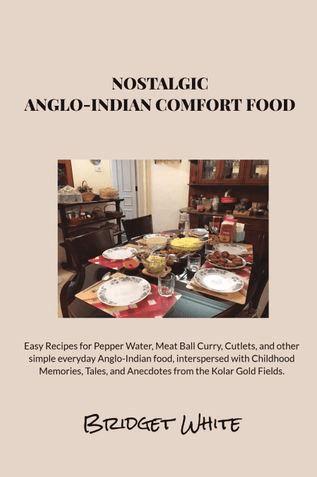
Today the original Anglo-Indian community has dwindled considerably. New generations with Anglo-Indian roots have fully assimilated into the culture of the countries or communities that they have settled in. However in recent times there has been a growing curiosity among these to trace their ancestry and heritage. Today there are internet communities that are inviting people to contribute family histories and memories. Cookbooks with revived recipes of the distinctive dishes like Jalfrezi, country Captain Chicken and Railway Lamb Curry and pepper water are becoming popular. Community gatherings in places where there are still pockets of Anglo-Indian populations are an occasion for the elders to share reminiscences of childhood meals of yellow rice and meatball curry, lively dance parties and perhaps “the good old days.” There is a special celebration every year on 2 August which is as World Anglo-Indian Day. This was the day when the definition of Anglo-Indian featured for the first time as part of the India Act 1935.

–Mamata