Happy Birthday To You!

This month we had a family get together bringing together members from different parts of the world, as well as different generations. It was also an occasion to celebrate together, several birthdays of the gathered family members—from the first birthday to the seventieth birthday. Topping up all the celebrations including cake-cutting and candle blowing, was a lusty rendering of the song Happy Birthday to You.

It is quite incredible how this song has transcended time and space to become a universal symbol of birthday celebrations. It is said to be the most frequently-sung English song in the world. And it is sung quite comfortably by people who may otherwise not know any other word of English. What most people do not know is that this song has an interesting history which dates back over a hundred years.

The creators were Patty and Mildred Hill, two sisters who were kindergarten teachers in Louisville, Kentucky, USA. Patty was not just a teacher, she was one of the pioneers who introduced what was then, a progressive philosophy of early childhood education in America. She stressed that in the early years supporting creativity, and social and emotional development of children were as important as academic learning. This could be provided by good kindergartens. The Hill sisters themselves grew up in a progressive family which supported and encouraged the daughters to have a complete education and have a career—both unconventional approaches for that period. Their parents believed that children should be free to play and follow their own pursuits as well as learn the value of hard work. Growing up in such a home had a profound influence on Patty whose future career choice would manifest her beliefs on the kind of education every child deserved. She had a strong commitment to and the importance of self-determination in activity, especially in childhood, as a means of empowering individuals to overcome social and economic disadvantages.

Patty Hill graduated from Louisville Collegiate Institute in 1887 after which she joined the Louisville Kindergarten Training School where the students were encouraged to experiment with different classroom techniques. Patty Hill began her kindergarten work as a teacher, and then became director of the Louisville Free Kindergarten Association in Kentucky in 1893. During her time at the Louisville Kindergarten Training Schools, Hill was very active in the Kindergarten Movement. She participated in numerous conferences and organized events that discussed alternative methods of early childhood education. She developed curricula that encouraged children to learn through play, music, free play, and contact with nature. The Louisville Kindergarten Training Schools became famous in the United States as the centre of innovative ideas about early childhood education. In 1906 Patty was appointed to the faculty of Columbia University Teachers College, where she taught for the next 30 years. There she developed a curriculum that emphasized the importance of a child’s first-hand contact with nature for creative expression. In 1908 she was elected president of the International Kindergarten Union. In 1924 Patty helped to found the Institute of Child Welfare Research at Columbia and also promoted the extension of nursery schools through her work with the National Association for Nursery Education, which she helped to organize in 1925.

Patty Hill served on the faculty of Teachers College at Columbia University until she retired in 1935. After her retirement she continued to give lectures and public speeches until her death in 1946 in New York City.  

Despite her significant contribution to early childhood education, Patty’s claim to fame however lies more in her links with the Happy Birthday Song. In early 1893, when she was at Louisville Kindergarten Training Schools, Patty and her sister Mildred, who was a pianist and performer, composed a simple 4-line song for the kindergarten students which had “words and emotions and ideas” that they felt were suitable for the limited musical ability of a young child. Patti wrote the words and Mildred composed the score. It had only six notes, six words, and four lines, three of them the same. They would work at night on the tune, and the next morning try out the song in the classroom. The lyrics were simple: “Good morning to you / Good morning to you / Good morning, dear children / Good morning to all.” The tune had a simple, repetitive beat, and was easy for children to follow. They tested the song with their young students until they found a combination that children caught onto easily, as they enjoyed the words as well as the rhythm.

The sisters published Good Morning in 1893 in a book of sheet music called Song Stories for Children, which they copyrighted and exhibited that year at the World’s Fair in Chicago.

How did the words ‘Good Morning’ transform into Happy Birthday, even as the tune remained the same? There are many theories, of which one is that the sisters themselves changed the words at a birthday party that they attended. In fact, the tune was amenable to easy exchange of words, and children at the Louisville Experimental Kindergarten School where Patty taught would substitute the words with Goodbye to You, Happy Vacation to You, and other variations.

By 1924, the song appeared in another songbook edited by Robert Coleman with the Hill sisters’ original lyrics as the first verse, and “Happy Birthday to You” as the second. As the song started to appear more in print, it caught on like wildfire and became hugely popular from coast-to-coast. It began to be used in movies and Broadway musicals. Ironically the sisters never published or copyrighted the lyrics to Happy Birthday to You.

There followed a long and complex battle of claims for copyright and licencing of the song. None of the legal battles produced a conclusive verdict on the song’s authorship or ownership. In the 1930s, the Hill sisters won the copyright for the song as it appeared in a songbook for children published by The Summy Co. But in 1988 Warner Communications acquired the rights to the tune. This meant that anyone who wanted to use the song in a movie or TV show would have to pay thousands of dollars. To avoid the high royalty fees, many movies and TV shows figured out creative ways to portray birthday celebration scenes without actually using the ‘Happy Birthday’ song. Despite this, at one time, Warner/Chappell Music was earning as much as $2 million per year in licensing fees from the birthday song.

In 2016, a group of artists and filmmakers filed a lawsuit which challenged Warner’s claim to the copyright of the happy birthday song, and claimed that they should not be allowed to charge licensing fees for use of the musical work. Warner Music Group lost the case, and as part of the class settlement, the company had to pay $14 million to people and organizations that had paid royalties to use “Happy Birthday” since 1949.

As of 2016, the famous Happy Birthday Song is in the public domain, meaning that it can be sung anywhere. The next time we sing Happy Birthday to You to celebrate a birthday, let’s also celebrate its interesting roots and long history.

–Mamata
Crabby, Crabby…

At the moment–June 22 to July 22—we are in the zodiac sign of Cancer. The sign is called Cancer from the Greek word for crab. Cancer constellation represents the giant crab that attacked Hercules during the second of his twelve labours. It was sent by the goddess Hera to distract Hercules as he battled the water serpent Hydra. Hercules ended up killing the giant crab with his club. In the skies, the crab constellation is a medium-sized one which has ten suns with their own planets.

Down on earth, crabs are members of the animal group called crustaceans—creatures which mostly live in water, have a hard shell, a segmented body, and jointed appendages. Lobsters, shrimps, barnacles are also members of this group. Crabs have five pairs of legs. The first pair has large pinching claws that help with feeding and defence. Three pairs help the crab walk, and last pair may be broad and flattened to serve as paddles for crabs that swim. Though crabs can walk forwards, they generally walk sideways. This is because they have stiff, jointed legs, and find it easier and faster to walk sideways.

There are at least 7,000 species of crab, and they can be found in all oceans and in fresh water. Some crabs even live on land, often several miles from water. They come in a great range of sizes from tiny pea crabs measuring about 2.5 centimeters across, to the giant crab of Japan which may span over 30 centimeters across and measure 4 meters from tip to tip of its stretched out legs.

Some types, including the blue crab, the Dungeness crab, and the king crab, are often eaten by humans. But apart from their nutritional value to humans, and economic value as a major industry, they play a key role in the ecosystem. They are vital food sources for sea animals. The smaller ones recycle nutrients as filter feeders, and the larger ones serve as food for large aquatic mammals. Terrestrial crustaceans are important because they are decomposers of dead organisms. Small crustaceans eat substantial amounts of algae keeping the plant in check, which helps keep the water clear and ensures that sea-grass beds can access to light and oxygen.

crab
Ghatiana dvivarna

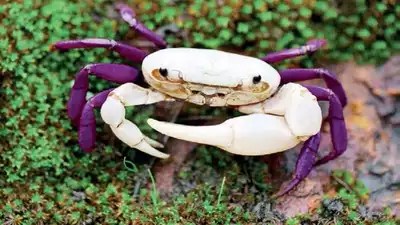
India has about 125 species of crabs. The Western Ghats alone, a biodiversity hotspot, is home to 75 species. A new species was discovered here as recently as 2022.

Belonging to Ghatiana genus of fresh water crabs, the new species is called ‘Ghatiana dvivarna’, the name being a combination of the Sanskrit words dvi (two) and varna (colour). The crab is a beautiful white and red-violet.

All this information is very important. But surely there could be more interesting ways to present it?

That is what the Crab Museum in Margate UK tries to do! This museum’s objective is ‘to roll science, humour and philosophy into a unique and satisfyingly baffling day out’! The founders of the museum believe that ‘“’everyone learns better when they’re laughing’”’, and take a goofy approach to their displays. And it seems to be working! The Museum saw over 80,000 visitors last year, and parents report that their children are more engaged here than in many other conventional institutions.

The dioramas, exhibits, text-labels are all planned with humour in mind, even as they are informing the viewers about crab anatomy, mating habits and the importance of these creatures to marine ecosystems. But the Museum goes further—it uses crabs as an entry point to discussing bigger issues, including environmental issues, climate change, capitalism and colonialism.

Other museums are taking note of these unconventional approaches. As reported in the New York Times, ‘Chris Stringer, of the Natural History Museum in London, said in an email that the museum’s silly approach leads to learning “by stealth.” It “teaches more in a small space and short time than many others with far larger budgets.’

We may not be able to visit the Crab Museum at Margate but crab-lovers can participate in their annual Crab Joke Competition. Last year, there were 700 entries, so the competition is quite stiff. One of the top shortlists was:

Why did the crab get bad grades? Because it was below C level!


Jokes apart, we must be aware that various environmental dangers beset crabs. Research says about one-sixth of all freshwater crab species have an elevated risk of extinction, and there are any number of ‘threats to marine species, including illegal and unsustainable fishing, pollution, climate change and disease’. 

So in this month of Cancer, let’s spare a thought for crabs and their well-being.

–Meena

Pic acknowledgement: TOI

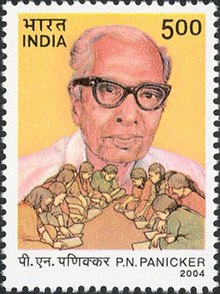
Father of the Library Movement: PN Panicker

The last few days, newspapers have been carrying a number of pieces promoting the joy of reading physical books, in an age when the printed word is rapidly being buried under the digital avalanche. As a person who has never abandoned the physical avatars, these reminders of the very different experience of physically turning the pages of a ‘real’ book make me smile! All this hype culminated with the announcement of National Reading Day on 19 June.

I have written frequently about books, and was aware of a couple of international days of books, and reading. However this was the first time that National Reading Day was taking up so much column space. I was naturally curious to know more about this day. And I discovered that there is much more behind this day than reading. It is the story of a man with a mission, who laid the foundation of the library movement in India.

Puthuvayil Narayana Panicker was born on 1 March 1909 to Govinda Pillai and Janaki Amma at Neelamperoor in Kerala. As a youth he used to read the daily newspapers to groups of illiterate people of different ages. He began his career as a teacher, but moved beyond his designated duties to set up the Sanadanadhramam Library in 1926, in a small room provided by the local cooperative society in his village. This was the first step in what was to become beginning of a life-long passion and mission with a simple but powerful message: Vayichu Valaruku meaning Read and Grow.

Panicker held Mahatma Gandhi in very high esteem; and like him, felt that illiteracy was a curse and a shame. He believed in a holistic approach to human resources development, the foundation of which was literacy. Towards this, Panicker initiated a literacy movement across the state. He also believed that libraries could provide a stable scaffolding for encouraging and sustaining the literacy movement. He made the literacy movement into a cultural movement where people could feel the emotional connect with the library in their village or town, just as they connected with their place or worship or school or college. Libraries created by this movement later became the nerve centres of local social and cultural activities; children would come and read, older people would gather to meet and discuss issues relevant to them. When he visited a leprosy sanatorium at Nooranad, the inmates requested him to set up a library there. The library was established as LS Library on 1 July 1949. It was one of the first libraries in the district and housed a unique collection including over 25000 books and rare palm-leaf manuscripts. It was extensively used by the sanatorium residents as well as visiting researchers and scholars.

Panicker led the formation of Thiruvithaamkoor Granthsala Sangham (Travancore Library Association) in 1945 with 47 rural libraries. The slogan of the organization was Read and Grow. He travelled to Kerala villages proclaiming the value of reading and succeeded in bringing some 6000 libraries in his network. The Travancore Library Association expanded to become Kerala Granthasala Sangham (KGS) in 1956.  KGS was awarded the UNESCO Nadezha K. Krupskaya Literacy Prize in 1975.

Panicker was the General Secretary of Sangham for 32 years, until 1977, when it was taken over by the State Government and it became the Kerala State Library Council.

In 1977 Panicker founded the Kerala Association for Non-formal Education and Development (KANFED) with the objective to help universalize education by stepping up propaganda for it, and by the institution of non-formal education activities supplementary to the formal education system. This led to the establishment of institutes for research and training in all aspects of non-formal education, publishing houses for the production of literacy materials, and centres for the eradication of illiteracy.

These were operationalized through Committees which were set up in all districts of the state at Block and Panchayat levels to organize, conduct and supervise literacy centres; Regional Resource Centres were set up to store books, teaching aids and other materials necessary for adult education and make them available at all literacy centres.  

Primers for beginners, and books and periodicals and other useful material such a maps and wall charts for neo-literates were prepared through workshops for young writers, and published. The Primers included Alphabet Primer, Science Primer, Health Primer, as well as Primer for Women, Prier for Agriculturists, and Primer for Tribals. There were books on agriculture and animal husbandry; books on health and hygiene, and books for neo-literates. There were also biographies of inspiring national and international personalities, as well as books describing civic institutions, rights and duties, and promoting scientific temperament.

Resource material for adult literacy workers, instructors, project officers and organizers was supported and supplemented with seminars, workshops and training.  Plans for monitoring and evaluation of the literacy centres were also included.

Panicker’s vision and the state-wide mission of KANFED played a significant role in Kerala’s successful literacy movement–the Sakshara Keralam Movement. The first 100 percent literate city in India, and first 100 percent literate district have been from Kerala. Kerala was also the first state to attain 100 percent primary education. Some of the oldest colleges, schools and libraries of the country are also situated in Kerala.

In addition to literacy centres, Panicker also took keen interest in promoting Agricultural Books Corners, The Friendship Village Movement (Sauhrdagramam), and Reading Programmes for Families.

The life-long crusader for literacy and libraries passed away on 19 June 1995. Since 1996, this day is marked as Vayanadinam (Reading Day) in Kerala. It is a reminder to encourage the movement to promote a culture of reading, to inculcate the habit of reading and promote book-mindedness among school children, youth as well as the underprivileged population of the country. The Department of Education, Kerala also observes Vayana Varam Week (Reading Week) from June 19 to June 25 in schools across the state.

The Department of Posts honoured PN Panicker by issuing a commemorative postage stamp on 21 June 2004.

In 2017 PM Narendra Modi declared June 19, Kerala’s Reading Day as National Reading Day in India. The following month is also observed as National Reading Month.

The PN Panicker Foundation continues the mission to enhance lives and livelihoods through various targeted initiatives ranging from education, skill development, health, and need based programmes with the efficient use of technology. In keeping with the need of the hour, it is supporting digital learning in rural areas and has established thousands of home digital libraries across the state. PN Panicker’s vision continues to guide and inspire the new generations.   

–Mamata

Juneteenth

That is not a word that we in India are very familiar with. Not surprising. Though the ‘Day’ is about a historical event that took place over 150 years back, it officially became a federal holiday in the US only in 2021.

It goes back to the American Civil War. After the Union won, President Abraham Lincoln issued the Emancipation Proclamation which declared the over three million enslaved people living in the Confederate states to be free. However, those were not the days of instant communication. It took over two years before the news reached the people of Texas! It was when Union soldiers arrived in Galveston, Texas, on June 19, 1865, that the state’s residents finally learned that slavery had been abolished. The formerly enslaved African-American community immediately started celebrations with prayer, feasting song, and dance. Over time, the name ‘Juneteenth’ a portmanteau of the words “June” and “nineteenth” started being used for this day.

Since then, the day has been celebrated in Texas, with the first official Juneteenth celebrations held on June 19, 1866, marked by prayer meetings and the singing of spirituals. People wore new clothes as a way of marking their newfound freedom. Over the next few years, African-Americans in other states started celebrating the day as well, making it an annual tradition. Celebrations continued to spread across the United States and typically include prayer and religious services, speeches, educational events, family gatherings and picnics, and festivals with music, food, and dancing. Juneteenth became a state holiday in Texas in 1980, and a number of other states subsequently followed suit.

It still took a long time for it to be recognized at the national level. It was only in 2021 that Juneteenth was made a federal holiday. Activist Opal Lee played a huge part in making this happen. Born in 1926 in Texas, Opal Lee was a teacher. One of the formative events of her life was when her house was burnt down in 1939. The house was in a predominantly white area, and obviously, the fact that a black family had bought a house there was uncomfortable for some people. On June 19, 1939, 500 white rioters vandalized and burned down the home. Opal realized that 19 June had been chosen for a reason and was very symbolic.

Opal was always at the forefront of organizing the community, and played a lead role in Juneteenth celebrations. This gathered momentum when she retired, and she became a relentless campaigner for having Juneteenth declared a federal holiday. For many years, she organized a march of 2.5 miles, to represent the 2.5 years it took for the news of their emancipation to reach the African-Americans in Texas. She promoted a petition for a Juneteenth federal holiday at Change.org, and the petition received 1.6 million signatures. In 2021, when Opal was 94, her dream came true and President Biden finally signed the Bill. Opal was an honoured guest at the function. Slowly, over time, the day started being celebrated outside the United States too, to recognize the end of slavery and to honor the culture and achievements of African Americans.

Here is something that Lincoln wrote about slavery, which is worth pondering:

If A. can prove, however conclusively, that he may, of right, enslave B. — why may not B. snatch the same argument, and prove equally, that he may enslave A?–

You say A. is white, and B. is black. It is color, then; the lighter, having the right to enslave the darker? Take care. By this rule, you are to be slave to the first man you meet, with a fairer skin than your own.

You do not mean color exactly?–You mean the whites are intellectually the superiors of the blacks, and, therefore have the right to enslave them? Take care again. By this rule, you are to be slave to the first man you meet, with an intellect superior to your own.

But, say you, it is a question of interest; and, if you can make it your interest, you have the right to enslave another. Very well. And if he can make it his interest, he has the right to enslave you.’

And to see how he relates it to democracy:

‘As I would not be a slave, so I would not be a master. This expresses my idea of democracy. Whatever differs from this, to the extent of the difference, is no democracy.’

Wise men know how to capture universal truth in a few words!

–Meena

CELEBRATING OCEANS: RACHEL CARSON

The first week of June has two significant days that relate to the environment. World Environment Day (WED) on 5 June and World Oceans Day (WOD) on June 8. While desertification was the focus of WED, the themes of WOD emphasized the importance of working together to find solutions to ocean challenges.

Historically one name has been associated both with WED as well as WOD. Rachel Carson is probably best known for her book Silent Spring, one of the first that warned of dangers to all natural systems from the misuse of chemical pesticides such as DDT. Published in 1962, this initiated the contemporary environmental movement. Over the years Silent Spring became one of the essential readings and references for environmentalists and ecologists.

What is perhaps less known is that for a decade before she wrote Silent Spring, Rachel had already published three books, as well as numerous articles, on the subject that was dear to her heart—the Seas and Oceans. Rachel’s work was unusual in that it combined a solid base of science that she communicated in beautiful language and style, making for a rare combination of nature and literature.

Rachel’s love for nature stemmed from her early years in a rural community where she freely explored her surroundings, and also expressed her thoughts through her other passion—writing. Rachel Carson was born on 27 May 1907 in Springdale, Pennsylvania. After High School, in 1925, Rachel joined Pennsylvania College for Women as an English major determined to become a writer. Midway through her studies, however, she switched to biology. A summer fellowship at the U.S. Marine Laboratory in Woods Hole, Massachusetts was her first close experience with the ocean. In 1929, Carson was awarded a scholarship to study at Johns Hopkins University in Baltimore, an enormous accomplishment for a woman at that time. Graduating with a Master’s degree in Zoology in 1932, and with a flair for writing, Rachel began to work for the public education department of the US Bureau of Fisheries writing pamphlets on conservation and natural resources. This was the start of her long career as scientist and editor, eventually rising to become Editor-in-Chief of all publications for the US Fish and Wildlife Service.

In 1935 she was asked to create a series of short radio programmes on marine life called Romance Under the Waters. Her growing interest in oceans and marine life was supported by the opportunity to visit waterfronts and marine environments, access to scientific information, and interaction with a range of people associated with different aspects of the oceans as part of her work. During World War II, Rachel Carson was part of a programme to investigate undersea life, terrain and sounds, designed to assist the Navy in developing techniques and equipment for submarine detection. Thus Rachel had the opportunity to study many aspects of oceans.

In her free time, Rachel also wrote about findings from this research in a language and style that would reach beyond the academics to a larger audience. She wrote several articles for popular magazines, designed to create wider awareness about the wonder and beauty of the living world. As she once said: I have always wanted to write. Biology has given me something to write about. She also believed that science and literature could meld harmoniously. The winds, the sea, and the moving tides are what they are. If there is wonder and beauty and majesty in them, science will discover these qualities… If there is poetry in my book about the sea, it is not because I deliberately put it there, but because no one could write truthfully about the sea and leave out the poetry.


Rachel Carson’s first book, Under the Sea-Wind, was published in 1941. In 1951 she published her prize-winning study of the ocean, The Sea Around Us. The book remained on the New York Times bestseller list for 81 weeks.

In 1952 Carson resigned from government service to devote herself to her writing, but also for the freedom that she would have as not being a part of the government, to raise issues, question government policies, and use her public voice to create awareness and encourage action.

In 1955 she published The Edge of the Sea. These books established Rachel Carson as both a naturalist and science writer for the public. But it was her final book, Silent Spring, published in 1962, that awakened society to a responsibility to other forms of life. In it, Carson documented in minute biological detail the harm caused to the ecosystem by harmful pesticides, especially DDT. The book was based on years of her research which indicated that the abnormalities caused by the pesticide showed up first in fish and wildlife, and went on to endanger the overall environment. As expected, Carson’s book provoked a huge controversy, as well as personal attacks on her professional integrity. The pesticide industry mounted a massive campaign to discredit her. The federal government, however, ordered a complete review of its pesticide policy and Rachel Carson testified before a Congressional committee, calling for new policies to protect human health and the environment. As a direct result of the Carson’s study and her making it public through Silent Spring, DDT was banned in the United States.

Despite her earlier noteworthy studies of the marine environment Rachel Carson’s name became synonymous with Silent Spring and DDT.

Rachel Carson died in 1964 after a long battle against breast cancer.

The theme for this year’s World Oceans Day is Waves of Change: Collective Actions for the Ocean. It would be worthwhile this year to revisit Rachel Carson’s books on the sea which seem as relevant today as they were when she wrote them in the 1950s. Carson’s ecological vision of the oceans demonstrates a larger environmental ethic which drew attention to the threats to the sustainability of nature’s interactive and interdependent systems. Her writing presages Climate change, rising sea-levels, melting Arctic glaciers, collapsing bird and animal populations, crumbling geological faults. All of which are dire realities today.

–Mamata

AJT Johnsingh: The Highest Standards of Wildlife Research

A few days ago came the sad news of Dr. AJT Johnsingh’s passing. And for once, mainstream media covered this event—from AIR to Times of India to Hindu to several other national and regional papers. 

For media to so widely cover the passing of a wildlife researcher is sure indication that there was something special about him. And indeed there was.  He was one of India’s best and most respected field researchers. And even more, he put all that knowledge into practice in conservation.  He strongly believed that knowledge should not lie in books, but be used to develop better policies and practices to support conservation on the ground.

Born to teachers who were both nature-lovers and outdoor people, he grew up in a small town called Nanguneri in Tirunelveli district of Tamil Nadu. His parents encouraged him to be outdoors, and family outings generally meant picnics in the wilderness areas of the Western Ghats. They were early and important influences in his love for nature. Another source of inspiration was Jim Corbett, whom he read avidly when young, and whose approach to conservation he admired—it was an approach that was unsentimental, and doing what needed to be done, extending to killing maneaters when there was no other way out.

JC Daniel of BNHS whom he first met when trekking up in the Kalakad hills in 1971, and who mentored him at various stages in his career, was a great influence.  George Schaller,  American mammalogistbiologistconservationist and author recognized by many as the world’s preeminent field biologist, studying wildlife throughout Africa, Asia and South America, was a role model for Johnsingh.

AJT went to St. Xavier’s College, Palayankottai, and then Madras Christian College, Tambaram. He started his career as a professor at Ayya Nadar Janaki Ammal CollegeSivakasi, He worked as a postdoctoral fellow at the Smithsonian Institution in Washington, D.C. He returned to India in 1981 to work with the Bombay Natural History Society. In 1985, he joined the faculty of newly-established Wildlife Institute of IndiaDehradun, and helped shape this premier institute which has developed the cadre of India’s current wildlife professionals. He retired as the Dean WII in 2005. In this period WII trained over 300 managers and several M.Sc Wildlife and PHD students.

He was the first Indian to carry out field research on free-ranging large wild mammals. He focussed particularly on the dhole (wild dog) in Indian forests. His research in the early years focused on the ecology and prey-predator relationships of dhole, other carnivores and ungulates in Bandipur National Park. His interest and research covered several large mammals, and his knowledge of many species saw him on the IUCN Asian Elephant Specialist Group, as well as the Cat, Canid, Bear, and Caprinae Specialist Groups. He also researched the Mahseer fish.

Tigers also fascinated him. He is credited with having taken the first good photo of a tiger in Bandipur. Talking about this photo in an interview to Sanctuary, he said: ‘ For years, no one had been able to take a clear picture of a tiger in Bandipur. Because my dhole study area was littered with tiger spoor, I always carried a camera around ‘just in case’. On May 23, 1978, around 7 a.m., I was sitting eight metres up on a mango tree in the Ministerguthi nullah, which was frequented by tigers whose pugmarks could easily be seen and whose spray markings, I could smell. I sat for around 45 minutes, barely breathing when a movement in the tall grass caught my eye. The tiger walked towards a clearing right in front of me and when it reached a patch of sunlight, I whistled and with a perplexed look on its face, it froze staring straight at me. But the moment it heard my camera shutter, it vanished. Interestingly, I cannot stop smiling whenever I see this picture.’

He authored several research papers, but what got him know widely across the general public where his three popular books: ‘Field Days: A Naturalist’s Journey through South and Southeast Asia’ (2005), ‘Walking the Western Ghats’ (2015) and ‘On Jim Corbett’s Trail and Other Tales From the Jungle’ (2018). He also edited two volumes of The Mammals of South Asia which in total has 69 chapters.

AJT was decorated with many honours including the Distinguished Service Award by the Society for Conservation Biology, the Carl Zeiss Wildlife Conservation Award, the ABN AMRO Sanctuary Lifetime Wildlife Service Award, ‘Kirloskar Vasundhara Sanman’ and Salim Ali Conservation Award.

The government also respected and valued his expertise. He was on the Standing Committee on the National Board for Wildlife, Government of India, and served for three years as a member of the National Tiger Conservation Authority. He was also a Padma Shri awardee. His voice, opinion and work contributed to the creation of wildlife areas including the Kalakkad-Mundanthurai Tiger Reserve.

We at CEE had the opportunity to interact with Dr. Johnsingh on different occasions when we sought his expertise on various projects. Two in which I was personally involved where he was on the Advisory Committee were the Snow Leopard Education project, and the ‘School Education to Support Asian Elephant Conservation’ project. In the days prior to Zoom and video calls, we could not get into discussions with him, but sent him drafts on which he gave his insightful comments.

The conservation world and India have lost a unique researcher and spokesperson who had the knowledge and courage to speak out, and the stature to be listened to. As a message from his family puts it: ‘The Green Warrior has landed safely in his Valhalla, after a war well fought, to save mother nature, for all mankind.’

And to end with a quote from him which underlines the spirit behind his research: “I used to ask questions about wildlife that no one could answer. So I began to search for answers myself by observing animals. Curiosity is the greatest trigger for good science.

RIP, Dr. AJT Johnsingh.  Your passing is personal loss to your family and friends, and as great a loss to the wildlife and environment you worked so hard to protect.

–Meena

.

A Tree for all Reasons: Khejri

5 June has been marked annually as World Environment Day (WED). First held in 1973, and led by the United Nations Environment Programme (UNEP), WED is the largest global platform for environmental public outreach and is celebrated by millions of people across the world. This year, 2024, the kingdom of Saudi Arabia is hosting the global celebrations.

The focus of this year’s WED is land restoration, desertification and drought resilience.

As the world is seeing rapid advances in desertification, and land degradation, propelled by climate change, it is useful to go back and see nature’s in-built mechanisms for coping with such conditions. 

Khejri tree

Plants that grow in arid areas have special ways of dealing with extreme heat or cold, and other desert conditions.  Desert plants fall into three categories according to the way they deal with the problem of surviving in arid or extremely arid conditions.

Drought evaders: Plants which remain as seeds in the sand, but are ready to spring up when it rains, to flower quickly, to produce another crop of seeds and die again. These are known as ephemerals.

Drought resisters: Plants which have evolved various ways of storing water, locating underground water or reducing their need for water by such methods as shedding their leaves. These are known as perennials. They manage to live from one rainy season to another.

Drought-endurers: Plants which have the capacity to tolerate drought for a longer period by adapting through condensed growth, small-sized leaves and very deep root system.

These natural adaptations have enabled these plants, over millennia, to grow in some of the toughest of conditions. In turn, these plants have also played an important role in supporting other life, including human life, in desert conditions. Perhaps no plant better exemplifies this than the Khejri tree.  

Khejri or Prosopis cineraria is a tree that grows in the dry and arid regions of India and West Pakistan, Afghanistan and Iran where summers are very hot, winters are harsh, and rainfall is scant. It has a variety of common names in different states of India. Khejri or sangria (Rajasthan), jand (Punjab), kandi (Sindh), sami, sumri (Gujarat). Its trade name is kandri.

A moderate-sized evergreen thorny tree, with light bluish-green foliage, its sturdy older branches, and slender tender branches have conical thorns. It sprouts freely from the base, producing a fresh growth of leaves around March. Soon after the new leaves, the small yellow, creamy white flowers appear. These, in turn, give way to pods.

This drought-resister tree has a range of adaptations that enable it to grow well in highly arid and harsh conditions, where other plants cannot survive. It grows on a variety of soils, including moderately saline soils. It has a long and well-developed root system. This serves two purposes; it provides firm anchorage and also aids in obtaining moisture supplies from deep down. Its foliage also helps to absorb moisture from the rains, as and when there is rainfall. 

The roots are a life saver not only for the tree, but are equally valuable for the environment in which the tree lives. The extensive root system helps to stabilize shifting sand dunes. The tree is useful as a windbreak shelter, and in afforestation of dry areas. It fixes nitrogen through microbial activity, and its leaf litter decomposition adds organic matter thus rejuvenating poor soils.

Often being the only kind of tree that grows in the arid conditions, the tree also provides much needed shade and shelter to local farmers, as well as livestock. Prosopis cineraria is a much valued fodder tree, which provides nutritious and highly palatable green as well as dry fodder which is readily eaten by camels, cattle, sheep and goats. Its dead leaves are fed to cattle to improve milk yield. Its dry pods are also nutritious animal feed. The pods are also eaten, in green as well as dry forms, by people who have scant access to a variety of fresh vegetables for much of the year.

The tree’s wood is suitable for construction, and is used locally for numerous purposes including making agricultural implements and tool handles, water pipes, yoke and spokes of carts. The high calorific value of the wood also makes it an efficient fuel wood. The bark of the tree is dry and acrid with a sharp taste. The bark extract is believed to have anti-inflammatory properties, and is used in traditional medicine to treat rheumatism, cough and colds, and asthma, as well as scorpion sting. The pod is also believed to have astringent properties.

A popular saying in the Thar desert encapsulates the value of the khejri. Death will not visit humans, even at the time of famine, if they have a khejri, a goat and a camel, since the three together help sustain humans even under the most trying conditions. 

Thus for millennia the people of the Thar have revered the khejri as such a critical part of their lives. And they have given up their own lives to save the trees that sustain their lives.

Nothing highlights this better than the story of Amrita Devi and the Bishnois, or Twenty-niners, a sect that lived by simple tenets: Do not cut any green tree, do not kill any animal or bird, respect every living being, it has as much right to life as we humans do.

Amrita Devi’s story dates back to 1730.  The then Maharaja of Jodhpur, Abhay Singh, wanted to build a new palace for which he required wood. He sent his soldiers to a village to cut down some khejri trees. But this was a Bishnoi village. For hundreds of years, generations of villagers had nurtured and protected their vegetation, land and wildlife. One of the villagers was churning butter when she heard the commotion. Her name was Amrita Devi. She saw the men sharpening their axes and her mind flashed back to her childhood. She remembered how, every morning, she would respectfully greet  all the khejri trees and choose a special one for that day; she would hug it and thank it for all the gifts that it gave her and her people. Every child in the village had their own special tree.

Now the trees were in danger. Amrita Devi ran and confronted the axe men. She pleaded with them: “Leave our trees. They are our brothers and sisters, our village protectors. They are the breath of life, the water we drink, and our food.”

The axe men paid her no heed. They continued with their task. Amrita Devi hugged a tree. “Chop me first” she said, “take my life and leave my tree.” The axe men tore her away, but Amrita Devi was back at her tree, clinging for dear life. She did not let go of her tree; the axe men had to chop through her body to get to the tree. No sooner did Amrita fall than hundreds of villagers, young and old, rushed to the trees. Each one hugged a khejri tree. The king’s men continued to chop through them, until 363 people lay dead at the feet of the trees they hugged to save.

When the king heard of the incident, he could not believe that people would lay down their lives for trees. He personally visited the village to meet these people. They said: “The trees can survive without us, but we cannot survive without the trees.” The king was deeply moved the faith and humility of these people. He proclaimed that from then on no Bishnoi village would be called upon to provide timber or wildlife by hunting. Almost three centuries later, the Bishnoi community is intact. The twenty-nine tenets continue to live, even as the khejri trees give life to the land and its people. Amrita’s village came to be known as Khejarli after the trees she gave her life for.

Amrita Devi’s name is synonymous with her sacrifice. In 2001, a national award (the Amrita Devi Bishnoi Wildlife Protection Award) was created in her honour, to recognize people who had contributed to environmental conservation.

This World Environment Day, as the world looks ahead to combatting desertification, it is humbling to look back and remember the story of Amrita Devi and the khejri trees.

–Mamata

Shady Environment-Talk

June 5: Marked as Environment Day across the world since 1973.

The world has come a long way since the time in 1972 when such a day was mooted. Not only in terms of becoming more aware about the environment and taking action, but also in terms of the planetary boundaries being pushed to the brink through not taking enough action!

With the environment being such a widely talked-about issue, every actor—governments, businesses, civil society– have taken these issues on board.

Which is very good.

Till it is not.

The ‘till it is not’ includes corporates and other entities passing themselves off as environmentally or socially friendly when they are not. How do they do this? Here are a few terms that are used in the context of the many, many shades of these tricks:

  • Green Washing is undertaking misleading promotion of products or policies as environmentally friendly when in reality, they are not—often exaggerating the benefits while hiding the true or non-existent environmental impact. Common and insidious, such examples may range from misleading ads, to misleading recycling claims, to unverifiable carbon footprint claims, and every PR stunt in the book.
  • Blue Washing, indulged in by some of the largest corporations across the world, is the practice of businesses to sign up for the UN Global Compact and use their association with the United Nations to enhance their image and shift attention from their controversial business practices.
  • Carbon Washing is when companies make misleading or unsubstantiated claims about their carbon impacts or initiatives.
  • Social washing is similar to green washing, but in the context of being socially conscious–corporations wrongfully trying to market themselves as socially responsible.
  • Purple Washing is when a state or organization appeals to women’s rights and feminism in order to deflect attention from its doing nothing, or in fact actually harming these rights. 
  • Pink Washing is when companies try to create a false impression of being LGBTQ friendly while doing nothing to make life for their LGBTQ employees easier.
  • Rainbow Washing is similar to the above, when corporations use the rainbow symbol or colours, while being involved in activities that are damaging to LGBTQIA+ community 
  • Vegan Washing is when companies promote their products through appeals to compassion for animals, while actually causing animal suffering

Of recent times, the vocabulary of Green Washing has got even more nuanced! Here are some subtle variations:

  • Green Shifting: This is a subtle move, wherein companies highlight consumer choices, thus transferring responsibility to them, rather than highlighting their sustainability efforts.
  • Green Lighting: This trend is about corporations highlighting a particularly environmentally friendly aspect of their operations, in an effort to divert attention from less sustainable practices elsewhere in the company.
  • Green Rinsing: This involves businesses frequently changing ESG targets without genuine accomplishment, thereby making it hard for stakeholders to track their progress.

The UN warns about the seriousness of the harm that Green Washing (and allied colour-washes) can cause. In the context of climate change, the UN points out that: ‘Greenwashing presents a significant obstacle to tackling climate change. By misleading the public to believe that a company or other entity is doing more to protect the environment than it is, greenwashing promotes false solutions to the climate crisis that distract from and delay concrete and credible action.’

They identify many tactics of green washing including:

  • :‘Claiming to be on track to reduce a company’s polluting emissions when no credible plan is actually in place.
  • Being purposely vague or non-specific about a company’s operations or materials used.
  • Applying intentionally misleading labels such as “green” or “eco-friendly,” which do not have standard definitions and can be easily misinterpreted.
  • Implying that a minor improvement has a major impact or promoting a product that meets the minimum regulatory requirements as if it is significantly better than the standard.
  • Emphasizing a single environmental attribute while ignoring other impacts.
  • Claiming to avoid illegal or non-standard practices that are irrelevant to a product.
  • Communicating the sustainability attributes of a product in isolation of brand activities (and vice versa) – e.g. a garment made from recycled materials that is produced in a high-emitting factory that pollutes the air and nearby waterways.’

The UN urges us all to be more responsible by:

  • Learning more about green washing techniques so that we are more discerning
  • Make better consumer choices by buying only from companies whose green claims have been substantiated
  • Taking into account a product’s lifecycle and its environmental impact through every stage of making, use and disposal.

This Environment Day, let’s become better watch-dogs for the environment by getting more savvy about this colour palatte!

–Meena