Cicada Summer

In many countries, ranging from America to Japan, the song of the cicadas heralds summer. This summer, cicadas are making headlines in the United States which is bracing up for a cacophony of noise as trillions of cicadas are due to emerge in a rare synchronized event that occurs only once in a couple of hundred years.
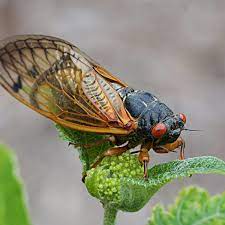
Periodical cicada
Source: Getty images

Cicada species have been around for a long time. The oldest cicada fossils are from the Triassic period, where they may have buzzed around the dinosaurs. Cicadas are members of the superfamily Cicadoidea. A cicada has a stout body, a broad head with two large compound eyes on both sides, and clear-membraned wings. Cicadas have modified mouthparts to feed on liquids rather than solid material. Larvae suck juices from plant roots, while adults suck fluids from woody shrubs and trees. While all cicadas have the same basic body shape, they come in all sorts of sizes and colour.

The most defining feature of cicadas is not in their form but in the sound that the male cicadas make to attract female partners. This sound is produced by the movement of specialized structures on each side of the abdomen called tymbals. Tymbals are thin membranous structures streaked with marginally thicker ribs. A muscle pulls these ribs inward and then releases them, resulting in a sharp sound. Rapid repetition of this action at a speed of 300 to 400 times per second generates the distinctive song of the cicada. The cicada’s body is like a hollow musical instrument, similar to a violin or guitar, with air-filled pockets that act like echo chambers, amplifying the sound. Varying body sizes produce different sound frequencies. Each species has its own specific call. In answer to the male’s song, the female cicada replies with a soft click.

Despite having no vocal chords and no lungs, male cicadas are the loudest insects in the world. While poets may wax eloquent about the song of the cicada, the decibel level of the cicada chorus can be deafening. The intensity of the sound can be as high 120 decibels, the decibel level of a jet engine!

Cicadas have a fascinating lifecycle. The male attracts the female with his powerful song which reverberates through the air. The female arrives, and after the mating, she makes slits in tree branches and lays her eggs. The eggs hatch six to seven weeks later. The emerging young ones look like termites, and stay on the plant, feeding on sap till they are ready to drop down to the ground. This marks the beginning of the next stage of their lifecycle. Tunnelling through the earth with their powerful front legs, the nymphs burrow and build chambers deep in the soil, living a major part of their lives underground, feeding on roots, till they are finally ready to emerge as adults. Once they crawl back onto the surface, the nymphs shed their exoskeletons, and start flapping their wings. They spend the next six weeks or so of their adult life, making a cacophony to attract mates, so that the eggs can be laid before they die

This trait of disappearing distinguishes cicadas from most other insects. While all species of cicadas disappear underground, different species have different cycles of emergence. There are annual cicadas which emerge once a year, or once very couple of years, and periodical cicadas which spend most of their lives underground, and emerge, en masse every 13 or 17 years to mate and start the cycle over again. Of the 3,400 species of cicadas in the world, only nine species are known to have developed the habit of disappearing underground for years at a time and then emerging en masse simultaneously.

It is this cycle of disappearance and reappearance that has symbolically linked cicadas with rebirth and transformation in some cultures. In China during the Han Dynasty, jade cicadas were placed on the tongue as part of the burial ceremony to ensure that the departed have voices in their afterlife. Some Native American tribes believe that cicadas emerge from the earth, bringing with them an opportunity to renew their relationship with nature and their ancestors.

India has approximately 250 species of annual cicadas, but only one species of periodic cicada, the Chremista ribhoi in Meghalaya that emerges once in four years. Forests in all parts of India are abuzz with cicada sounds, especially before the rains begin, thus here cicadas are associated with the monsoon. A curious tale related to cicadas is that when, in 1847, an Englishman discovered a forest area in Kerala, he found it to be completely devoid of cicada sounds, and thus so quiet, that he named it Silent Valley.

This summer several parts of the United States will witness the once-in-lifetime phenomenon of the simultaneous emergence of billions of cicadas from two different broods of cicadas—one that lives a 13-year cycle and one that has a 17-year cycle. This rare synchronized event last occurred in 1803. This is causing much excitement among scientists as well as others, who will witness (as well as hear) this rare event—a cicada summer to remember!

–Mamata
Wise Words on Democracy

Election fever is well upon us. Not just us in India. An estimated third of the world goes to the polls this year.

A good time to pause and reflect on what people who have contributed so much to the shaping of our nation have said about democracy?

The first section is devoted to quotes taken from the discussions in the Constituent Assembly of India in 1949. The later section reflects Gandhiji’s thoughts on the subject.

‘What is democracy? I define it, in one word. Democracy is accommodation. Any person who does not understand this small definition of democracy, cannot be a democrat at all. ‘(Shri R. V. Dhulekar)

‘If we are going to have a democratic form of Government we should have as real democracy as possible by giving as much power to as small a unit as practicable so that the individuals composing the unit may have easy and ready remedy ..’. ( Shri B. P. Jhunjhunwal)

‘..the strength of democracy lies in the character of the people and their representatives.’ (Shri B. M. Gupte)

Constitution of India
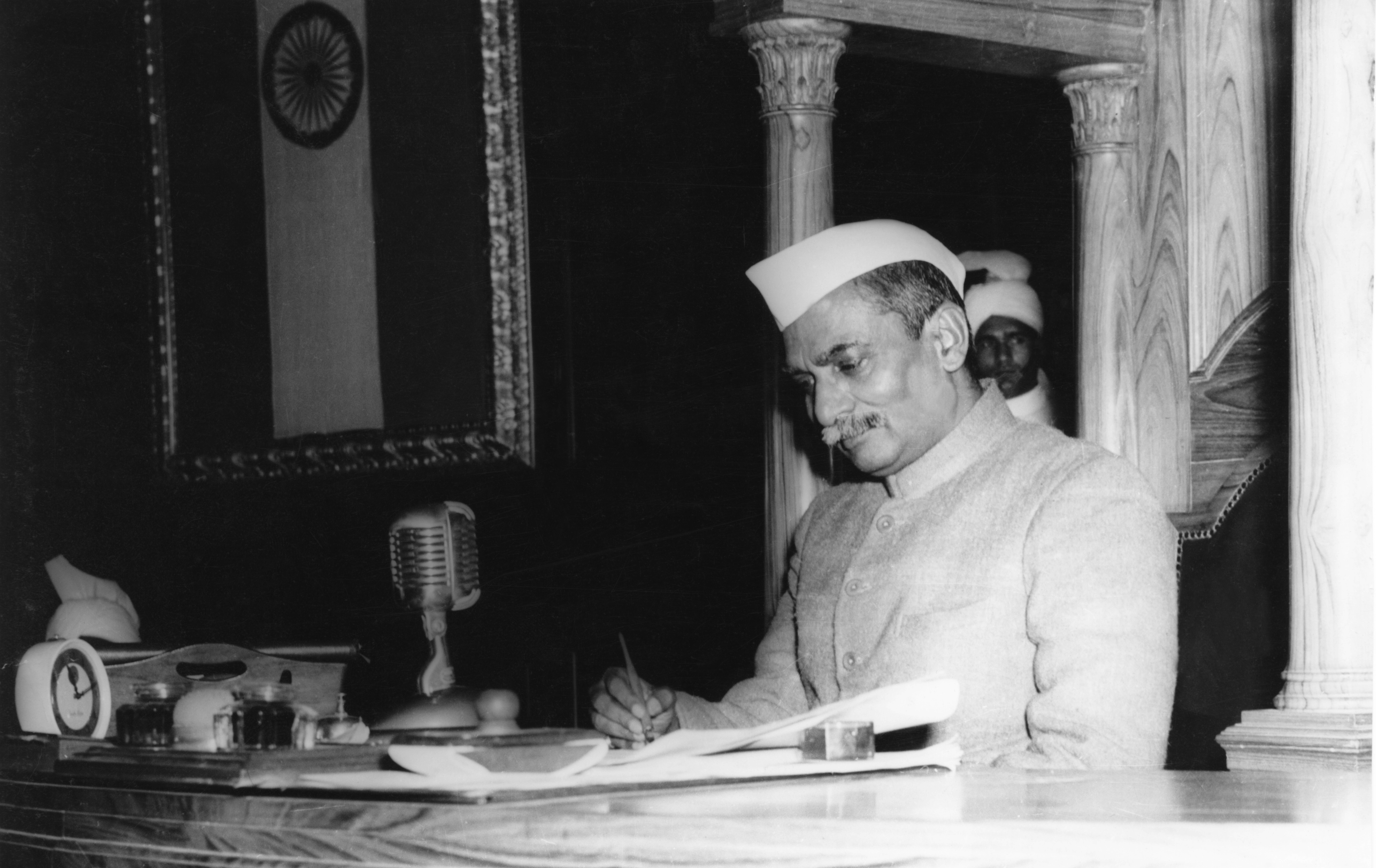
Dr. Rajendra Prasad, President of the Constituent Assembly, signing the Constitution of India.

‘The essence of democracy is not so much the existence of what are called political parties, etc., but the essence of democracy is the effective participation of the individual in the actual government of the country. The greater and more effective the participation of the individual in the government, the greater is the democracy, because democracy is still only an ideal which has yet to be reached by humanity.’ (TJM Wilson)

‘..Gandhiji  said that true democracy rose not from the top but from the bottom. Power and authority should not be centered at the top but should be distributed among the people at the base of society. Then alone can true democracy be established and then alone can people enjoy freedom.’ (Shri Kamlapati Tiwari)

‘We must observe the caution which John Stuart Mill has given to all who are interested in the maintenance of democracy, namely, not “to lay their liberties at the feet of even a great man, or to trust him with powers which enable him to subvert their institutions“. There is nothing wrong in being grateful to great men who have rendered life-long services to the country. But there are limits to gratefulness. As has been well said by the Irish Patriot Daniel O’Connel.. no nation can be grateful at the cost of its liberty. This caution is far more necessary in the case of India than in the case of any other country. For in India, Bhakti or what may be called the path of devotion or hero-worship, plays a part in its politics unequalled in magnitude by the part it plays in the politics of any other country in the world. Bhakti in religion may be a road to the salvation of the soul. But in politics, Bhakti or hero-worship is a sure road to degradation and to eventual dictatorship. (BR Ambedkar)

‘We must not to be content with mere political democracy. We must make our political democracy a social democracy as well. Political democracy cannot last unless there lies at the base of it social democracy. What does social democracy mean? It means a way of life which recognizes liberty, equality and fraternity as the principles of life.’  (BR Ambedkar)

From: Discussion in the Constituent Assembly of India. 1949.

Gandhiji on Democracy

‘I understand democracy as something that gives the weak the same chance as the strong.’

Democarcy is ‘..”the art and science of mobilizing the entire physical, economic and spiritual resources of all….in the service of the common good of all”

‘There is no human institution but has its dangers. The greater the institution the greater the chances of abuse.  Democracy is a great institution and therefore it is liable to be greatly abused. The remedy, therefore, is not avoidance of democracy but reduction of possibility of abuse to a minimum.’

‘..if individual liberty goes, then surely all is lost, for, if the individual ceases to count, what is left of society? Individual freedom also can make a man voluntarily surrender himself completely to the service of society. If it is wrested from him, he becomes automation and society is ruined. No society can possibly be built on denial of individual freedom.’ ‘In the democracy which I have envisaged, a democracy established by nonviolence, there will be equal freedom for all. Everybody will be his own master.’

Profound perspectives indeed, and we would do well to reflect on them, and to think about the fundamentals of democracy, which are:
1) Respect for basic human rights,
2) A multi-party political system paired with political tolerance,
3) A democratic voting system,
4) Respect for the rule of law,
5) Democratic governance, and
6) Citizen participation

Democracy is much more than election day and inking the finger!

–Meena

Pic: http://www.nbpgr.ernet.in

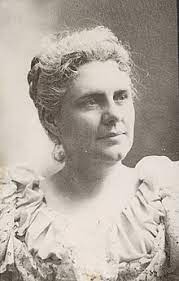
Nature Education Pioneer: Anna Botsford Comstock

In 2005 a book titled Last Child in the Woods: Saving Our Children from Nature Deficit Disorder became a best-selling ‘bible’ for the environmental movement. In a society where an entire new generation of children was spending all their time indoors, hooked to virtual devices for entertainment, the book by Richard Louv rang alarm bells. It brought together research that indicated that this alienation from the natural world was creating a phenomenon called Nature Deficit Disorder, and urging that direct exposure to nature was essential for healthy childhood development, and for the physical and emotional health of children, as well as adults. The book spurred an international movement to connect children, families and communities to the natural world.

Today the value of direct exposure to the natural environment is recognized as an important input for a healthy life. Educational curricula at all levels are formally introducing opportunities for this, emphasising the need for learning-by-doing in natural settings. Not many today are aware that more than a century-and-a-half before this ‘trend’, there was a strong advocate for ‘connecting with nature’. She was Anna Botsford Comstock. Indeed, she may be called the pioneer of nature education.

Anna was more than this; a woman of many achievements. Born in 1854 in a Quaker family, Anna grew up in an environment which encouraged appreciation and exploration of the natural world. She spent her childhood on a farm which was largely self-sufficient, guided by her mother in observing different aspects of nature, and getting some formal education in a single teacher rural schoolhouse. A voracious reader, she grew up with the influence of the writings of Ralph Waldo Emerson, William Wordsworth and Henry David Thoreau. When she was 13 the family moved to a place closer to a town, where she graduated from high school. She then applied to Cornell University which had recently begun to admit women.

Anna Botsford was interested in English and history, but took a course in invertebrate zoology to balance her curriculum. As part of this she attended the lectures of a young entomologist John Henry Comstock, who encouraged her to cultivate her already strong interest in nature, as well as her skills as an illustrator. He also asked her to assist him in his research. The working partnership blossomed into romance and the two were married in1878. Anna had to discontinue her studies, when Henry was appointed chief entomologist for the U.S. Department of Agriculture, and they moved to Washington, D.C. where she also worked for the same department. Anna returned to Cornell to complete her degree, side-by-side with working in the lab, and graduated in 1885 with a Bachelor of Science degree.

Anna’s additional career as a nature educator began in the early 1890s. This was a period when there was a large migration of rural youth to urban areas in search for employment, leaving a shortage of labour in rural agricultural communities. One school of thought believed that if young people were taught to appreciate the wonders of nature, it would encourage them to stay on in their family farms, and also others to migrate to rural areas. This gave rise to the Nature Study Movement which began in New York and soon became a nationwide movement. Anna was attracted by this approach. She believed that ‘future citizens should be set on inheriting our Earth by learning of its environments, and of the interactions of the living systems therein’. Anna emphasized that children should discover their environment through the use of their five senses and careful observation. Through their own individual investigations, children could thereby cultivate a sense of connection and responsibility for our Earth. She began promoting nature study programmes in public schools throughout Westchester County, often leading lessons and training teachers in subjects related to the natural sciences.

Serendipitously, the Cornell College of Agriculture got a grant to carry out a pilot project under the Nature Study programme, and Anna plunged into this with passion and conviction. She continued to lecture and promote nature study in local schools as she had been doing. In order to reach a larger audience Anna began lecturing and training teachers at other institutions across the nation. She also wrote and published a series of Nature Study Leaflets that were distributed to schools and teaching programs. The Nature Study Leaflets were in fact succinctly written and beautifully illustrated Lesson Plans for self-led or teacher-guided instruction. Her detailed notes, language and observations were reminiscent of the writing of Henry David Thoreau who had been one of her early inspirations.

Anna began with botanical lessons, but soon included all species from microbes to mammals, as well as natural resources and ecosystems. The pedagogy encouraged the development of a child’s curiosity by “opening one’s eyes to our natural surroundings.” Having developed hundreds of such Nature Study Leaflets, Anna felt that it would be useful to compile these into a comprehensive manual. In 1909 she began work on this comprehensive manual which grew into a nearly 1000-page document. No commercial publisher was willing to publish it, so it was published by Anna and her husband. Published in 1911 as Handbook of Nature Study, the book was a huge success, going into over twenty reprints, and being translated into eight languages. It remains a timeless resource and continues to inspire new generations of nature lovers.

In 1899, Anna Comstock was made assistant professor of nature study at the Cornell University Extension Division, the first woman to hold the title of professor at Cornell. But conservative trustees objected to a woman professor, and her title was revoked. Instead, she was named as lecturer with the same salary. Anna did retire from Cornell University with full professorship in 1922. She continued to teach, lecture, and publish materials related to nature studies until she passed away in 1930.

Her pioneering Lesson Plans and her vision for nature education for children supported and inspired generations of students and teachers in nature study.

Anna was also a pioneer in advocating for introducing ‘nature study’ as part of the school curriculum. This continues to be a challenge even today; not many curricula have effectively integrated and infused this; nor accepted that nature study can plant the seeds of valuable life skills.

May 22 is marked as International day for Biological Diversity. A good day to remember Anna Botsworth Comford, one of the early advocates for celebrating biodiversity, and pioneers in biodiversity education.  

–Mamata

Vasco da Gama Lands in India

526 years ago to the day yesterday (May 20), the first European made it by the sea route to India. This was the Portuguese Vasco da Gama who landed in Kozhikode (Calicut), Kerala. And the history of globalization and the colonization of India by Europeans started.

The discovery of the sea route to India was a milestone in world affairs. It provided access to the spice trade, which otherwise happened overland—more time consuming, more risky and more expensive. Vasco da Gama first came to India via the Cape of Good Hope, and became the first to link Europe and Asia by an ocean route—one that traversed the Atlantic and the Indian oceans. This enabled Portugal to establish colonies all the way from Africa to Asia, and dominate the trade between Asia and Europe for decades. The Dutch, the English, the French and the Danish lagged by almost a century before they could challenge the Portuguese for supremacy in these seas.

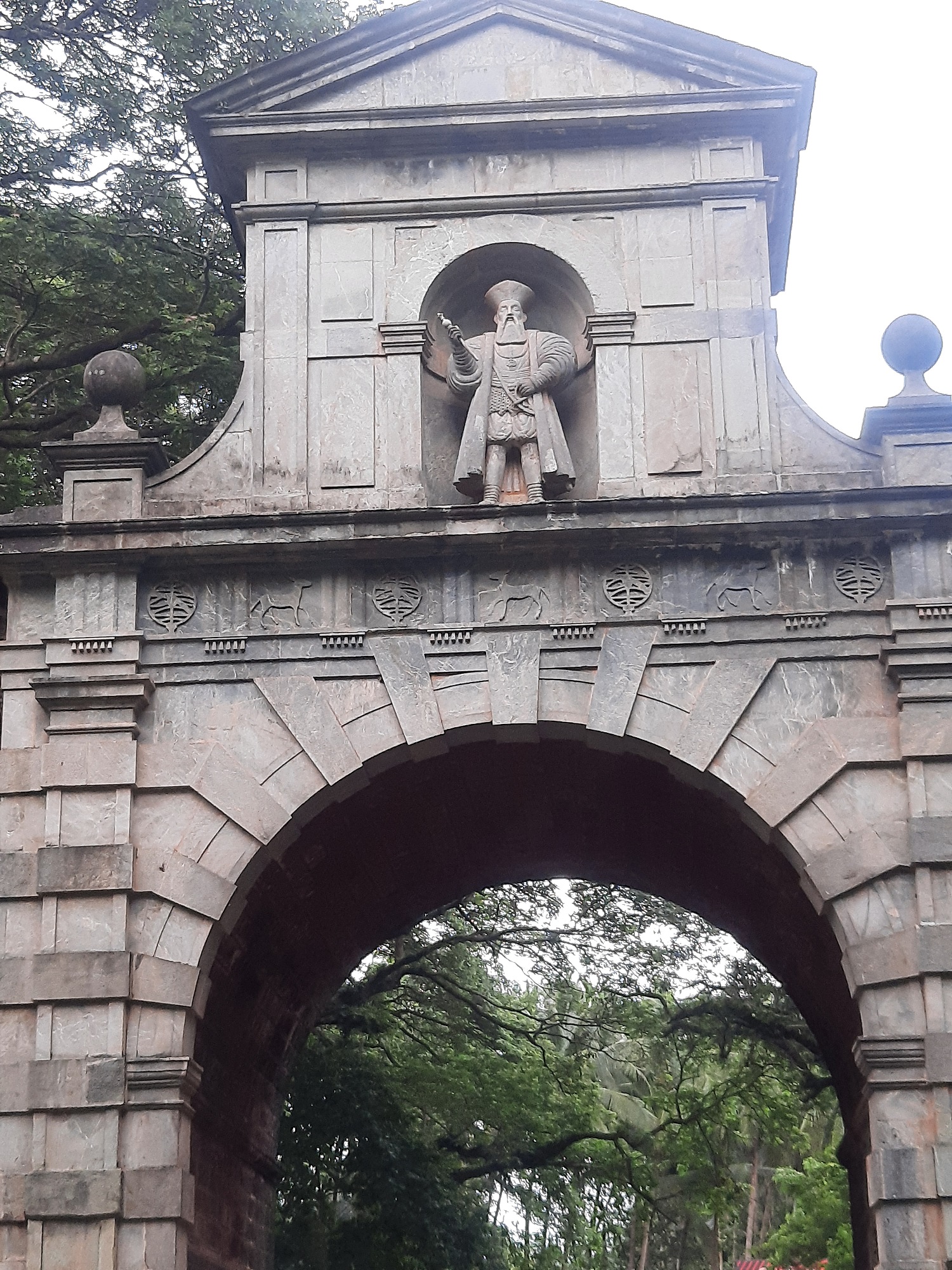
Vasco da Gama
Statue of Vasco da Gama, Viceroy’s Arch, Old Goa, Velha Goa

There can be no questions about da Gama’s courage, enterprise, skills and sheer sense of adventure in venturing out into unknown waters, and persisting for almost two years in the voyage to finally make it to India.

But even as one celebrates this spirit of human endeavor, it is necessary to question many of the motives and actions.

Da Gama, in his interactions with the Zamorin (ruler) of Calicut was always less than respectful. The Zomorin received da Gama with the respect due to a visitor from foreign shores, but da Gama had no clear answers to why he was visiting India, and gave the Zamorin such trivial gifts from the Portuguese king that no one would quite believe that da Gama was a royal ambassador and not some small-time merchant. This resulted in the Zomorin refusing Vasco da Gama’s request for permission to leave a representative behind to look after the merchandise he had not been able to sell. Further, local officials insisted on his paying customs duty like any other trader. This irritated the entitled da Gama, and he kidnapped and carried away some Nairs and sixteen fishermen when he left the shores.

But the most damning incident occurred during his next visit—the Second Armada. His ships reached India in October 1502. At the same time, a ship named Mirim carrying about 400 Muslim pilgrims including 50 women, had set out from Calicut for Mecca. Da Gama’s ships intercepted Mirim, looted the ship, locked in the passengers including the owner and an ambassador from Egypt, and burned them to death. Only about 20 children were spared on the condition that they would convert to Christianity. Da Gama watched the whole gory incident through the porthole of his ship.

Da Gama had come this time with the objective of signing a trade treaty with the Zamorin. After the pilgrim ship incident, the Zamorin hesitated to take on the Portuguese head-on and indicated his willingness to sign a treaty. But Da Gama had an atrocious condition—that the Hindu Zamorin expel all Muslims from his territory before negotiating the treaty. The Zamorin was appalled and refused. A very senior priest, Talappana Namboodri, known to both sides was sent to Da Gama to try to sort out things. But da Gama labelled him a spy, and had the priest’s lips and ears cut off. He had a pair of dog’s ears to his head before sending him away. But this was not the end of the matter. So infuriated was da Gama that he had the Portuguese fleet bombard the unfortified city of Calicut for nearly two days from the sea, severely damaging it. He also captured several ships, cut off the crew’s hands, ears and noses, dispatching them to the Zamorin with a note wherein he said that he would be happy to reset the relationship to a positive note once the Zamorin had paid for the items plundered well as the gunpowder and cannonballs used to bombard Calicut! Things escalated, and there was a sea battle which da Gama won. He also started trade with Cochin and Cannanore which were at war with Calicut.

Da Gama’s fortunes in Portugal declined for some decades after this journey, and he lay low. In 1594, with the new King’s blessings, he set out again for India, now with the title of Viceroy. This time he landed in Goa. He set out immediately to strengthen the Portuguese domination along the East Coast. However, it was not for long. He contracted malaria and died three months later in Kochi.

The Portuguese were the first Europeans to colonize India, and the last to leave! Vasco da Gama not only laid the foundation for this, but also for the ‘divide and rule’ strategy—turning one religion against another, one kingdom against another– which served future colonizers well.

Heroes in their time and country, leaving behind troubling legacies.

–Meena

Tree Architecture

About three decades ago, a new colleague joined our organization. During introductions, obviously the topic of what he had done-where he had done came up. It was an impressive pedigree—a Ph.D from JNU, under the legendary professor of ecology Dr. P.S. Ramakrishna. So far, so good. But his elaboration of what he had done his Ph.D on was what threw all of us. ‘Tree architecture’, he said casually, as if was a term we used day in and day out.  And embarrassing to admit, though we worked at Centre for Environment Education and should have been up with all terms ecological, none of us had heard this one. Dr. Ram Boojh Yadav, our new colleague educated us.

Last week, as I was doing my piece on topiary or tree-shaping, not surprisingly these memories came back to me. If topiary is about humans shaping trees as per their whims, tree architecture is about trees growing as they are destined to. So I thought I should re-visit that term which mystified me so many years ago, and try to learn a little more about it. So here goes…

When you look at a tree that you are familiar with, even from a distance and maybe even without leaves and flowers, you usually know what tree it is, e.g., mango vs. neem vs. Ashoka. And when it comes to botanists and arborists, obviously they can distinguish and identify many more just by looking at the silhouette.

Tree silhouttes

How does this happen? The answer is tree architecture or the study of the form of trees, which started gaining ground as a formal discipline in the 1970s, and has been use for a long time in management of trees. It is the branch of science that explains why a tree looks how it looks.

Tree architectures studies characteristics like type of branching, type of extension growth, branch orientation, flowering position etc. This is done by observing and schematising many individuals of the same species, in all life stages, to try to identify the ‘building plan’ of that species.’   To cite a researcher: ‘Plant architecture tries to identify fixed and repetitive phenomena in plant structures, valid for all individuals of the same species or even valid for multiple species.

So why does a tree look how it looks? Well the basic reason is genetics. Each tree species has a genetic blueprint of how it would ideally develop. And this goes back to its evolutionary history. For instance, the higher mechanical stresses imposed on trees that are native to windy areas makes them put down more wood to strengthen their structure, and consequently trees growing in such areas develop shorter but thicker trunks, branches, and roots. In contrast, trees that grow in sheltered areas will grow taller and thinner to improve their chances of reaching the light.

But the expression of this genetic blueprint depends on the site where an individual tree is growing—the soil, light, water, wind and other such factors that it finds there. These are the site conditions.

And the last are the environmental influences—has it experienced lightning, storms, insect infestations, human interactions, etc.

The science of tree architecture is based on subdividing trees into groups with similar characteristics (e.g., type of branching, type of extension growth, branch orientation, flowering position). Research has shown that all trees in the world fall into one of 23 architectural models—in other words, there are 23 tree building plans in the world!

Go on out there. Take a walk, get some exercise, breathe in some fresh air. And look at tree building-plans!

–Meena

Thanks: https://www.validtreerisk.com/resources/Documents/News/Tree%20Architecture%20

Lady With the Lens: Homai Vyarawalla

The past few weeks, as India goes through its massive election exercise, the newspapers have been carrying iconic photographs that show glimpses from past elections. For many of us who are firmly part of the ‘morning newspaper’ generation, these black and white images bring back memories of what feels like another age. These pictures capture not only candid shots that evoke nostalgia, but are also telling stories of different life and times. The people behind most of these have been photojournalists. Photojournalists are described as visual storytellers who use photography to document and report on news events, current affairs, and human interest stories. While their camera lens captures, and freezes a particular moment, it is the record of these intrepid storytellers that make history.

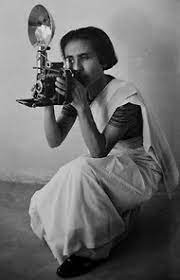
A recent exhibition of one of India’s most renowned photojournalists, Raghu Rai presents some pages from this history. But this also reminds one of another name that made her own history. This is Homai Vyarawalla, India’s first woman photojournalist.

Homai Vyarawalla was born on 9 December 1913 in Navsari in Gujarat, in a Parsi family. She had a peripatetic childhood as her father was an actor with a traveling theatre group. The family eventually settled in Mumbai where Homai enrolled in the JJ School of Arts. When she was in her early teens Homai met Manekshaw Vyarawalla, a freelance photographer who first introduced her to photography. The two initially shared a Rollieflex camera, and developed their own films in a dark bathroom. Homai started taking pictures of her friends as she starting learning the ropes. Manekshaw submitted some of her photographs of a local picnic to The Bombay Chronicle for which he then worked, and these were published. Homai began to get some photographic assignments; however some of her works was published under Manekshaw’s name, as a woman photographer was not something people respected professionally. She began to draw more attention after her photographs of life in Mumbai were published in The Illustrated Weekly of India magazine. Later Homai also used the pseudonym Dalda 13 (DALD from the number plate of her car, and 13 which she believed was her lucky number!). Homai and Manekshaw were married in 1941.

With the outbreak of World War II, the British Information Services (BIS) relocated to India, and were recruiting photographers on the ground. The Vyarawallas were recommended for the job by the then editor of the Illustrated Weekly. The couple moved to Delhi in 1942, with Homai joining as a full-time employee, with freedom to also take on freelance projects. Homai’s art school training in visual composition added to her skills as a photographer. She worked for the BIS as an official press photographer till 1951, and as a freelancer till 1970. Always humble and polite, clad in a khadi sari and carrying a Rollieflex camera, Homai was indeed an unusual sight on the streets of Delhi.

Homai began covering not only events and ceremonies at the British High Commission, but also chronicling significant moments in the transitional phase from the end of the British Raj to India becoming an independent nation. Some of these events included the swearing in of Lord Mountbatten as the first Governor General of India in 1947, the first Republic Day Parade in 1950, visit of Jacqueline Kennedy’s visit to India in 1962. She covered Mahatma Gandhi’s funeral in 1948 but was regretful till the end of her life at having missed his last prayer meeting when he was assassinated.

Besides events, Homai’s camera captured nuances of faces and expressions of a host of personalities that shaped the 20th century. From Lord Mountbatten to Queen Elizabeth, Krushchev to Nixon, Sardar Patel to Dr Ambedkar, Mahatma Gandhi to Indira Gandhi, visiting personalities and their hosts were frozen for posterity in Homai’s frames. Jawaharlal Nehru was a favourite subject of Homai’s. Homai was still the rarity in India—a female photojournalist, and her work did not get the kind of attention that the work of a contemporary, Margaret Bourke-White, did for her pictures of Gandhiji.

Homai herself did not seek the limelight, she preferred that her photographs spoke for themselves. And indeed these pictures that span the first three decades of an Independent India continue to tell the stories that defined that era. In fact Homai never travelled out of India. Her first trip to the USA and UK  was when she accompanied her biographer on a speaking tour, at the age of 95 years.

Homai’s husband Manekshaw passed away in 1979. Losing her companion of forty years, Homai also gave up photography totally. She spent the last two decades of her life in Vadodara, leading a simple, quiet, secluded life until she passed away on 15 January 2012, at the age of 98. Homai was the recipients of several awards including the Padma Vibhushan in 2011. Homai gave away her entire collection of prints, negatives, cameras and other memorabilia to the Alkai Foundation for the Arts, on permanent loan for safekeeping and documentation.

As Raghu Rai said in a recent interview “If responsible journalism is the first draft of history, then photojournalism is the first evidence of that history being lived.” Homai Vyarawalla will always remain a preeminent chronicler of that history.

–Mamata

Celebrating Tree-shapers: World Topiary Day

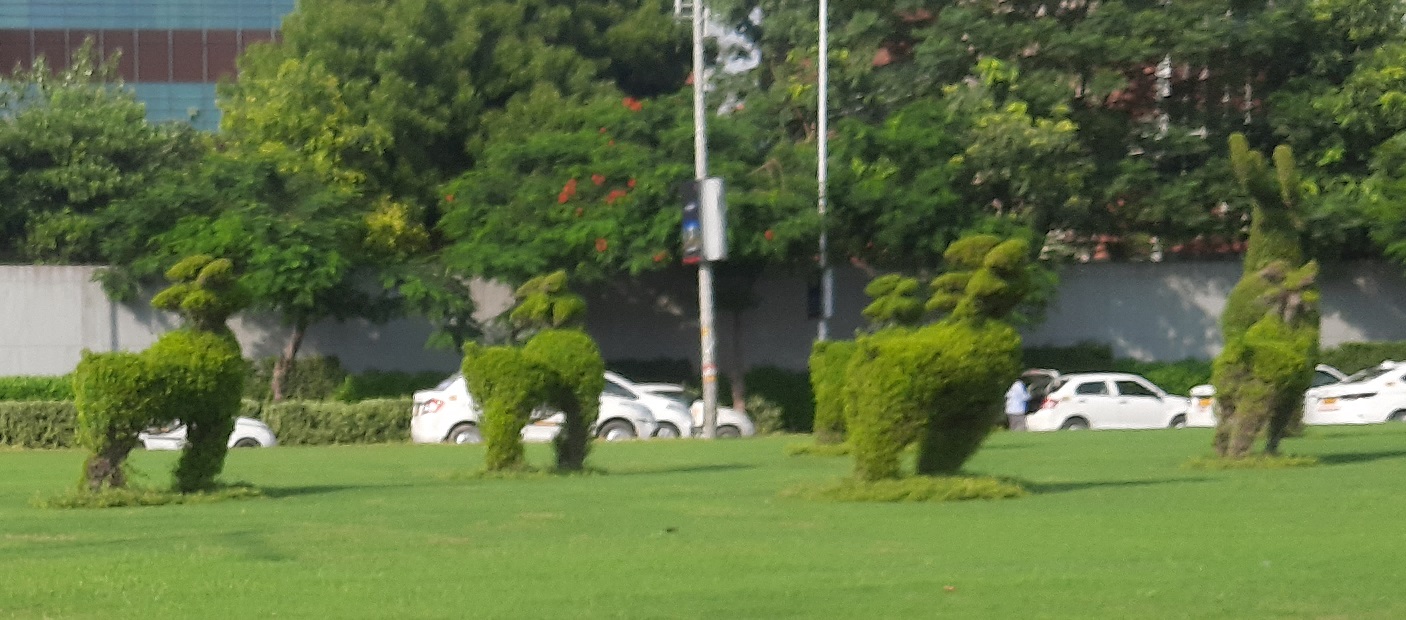
Have you seen deer walking across a traffic island in the middle of a crowded urban space? Or perhaps elephants in your city garden? Well, that is topiary.

Topiary, as per the Britannica, is ‘the training of living trees and shrubs into artificial, decorative shapes’. It is an ancient art, going back to the time of the Romans. In fact, Gaius Matius Calvinus, a contemporary of Julius Caesar is supposed to have been one of the first practitioners, and Caesar is said to have popularized it all over the Roman Empire.

There are three fundamental types of topiary:

  • Shrub topiary which consists of shrubs which are designed and shaped in various shapes and sizes. Very experienced gardeners do the cutting freehand, while others use frames.
  • Vine topiary, wherein vines and climbers are encouraged and shaped to grow in various topiary forms
  • Moss topiary where a frame is filled with wet moss and the chosen plant, and grown in the desired shape.

Whatever the type of topiary, it is an endeavour which requires ongoing work, care, patience and expertise

The fortunes of topiary have waxed and waned. After a long lull, the Italian Renaissance, which saw the flowering of many arts, also saw the revival of topiary. It became the rage in Italy, France (including in the Versailles), and with the Dutch and English.  The British took to it with passion, and it was found not only in the homes of the rich and the famous, but also in the modest gardens of peasants and tradesmen. Imagination was the only limit, with ships, fantastical beasts and human figures, all roaming the lawns.

Till topiary went overboard. And it was the mighty pen which defeated the scissors. Alexander Pope wrote a satirical essay “Verdant Sculpture” criticizing over-the-top topiary, and as a result, by the 1720s and ‘30s, topiary fell out of favour and was cleared from most prominent English gardens. The Levens Hall Garden was one of the few which escaped, and is today the oldest topiary gardens, with 30,000 bedding plants carved in a variety of shapes.

Till topiary was again revived in the 1840s. Not at the same scale, but it became moderately popular.

In its own unique forms, topiary has been quite popular in Asia too. China and Japan have practiced it for many centuries, with the objective of helping the trees achieve their “natural” form. Even the popular bonsai is a form of topiary.  Japanese Zen Gardens make extensive use of different topiary techniques.

Topiary
Topiary at Delhi Airport

In 2021, a new event, World Topiary Day, was created by the owners of one of the world’s oldest topiary gardens, the Levens Hall and Gardens in Cumbria, UK, which dates from 1694. World Topiary Day marked on May 12th every year, celebrates ‘… the fantastic art of topiary (shaping and cutting particular types of tree into geometric shapes and forms that resemble common objects and people) and its heritage within the world of gardening’, and seeks to inspire ‘…keen gardeners and lovers of al fresco living to adopt topiary’s style and structure within their own private gardens.’

A new award for topiary has also been announced as recently as this year and the ‘…search is on for Britain’s best topiary artists thanks to the inaugural Topiary Awards, which are now open for entries until May 31.’

In India too, many gardens and public spaces have examples of topiary. But sadly, after the initial enthusiasm, they are not maintained well, and therefore go out of shape. 

India is however home to the tallest topiary as per the Guinness Book of Records. This is the Samban-Lei-Sekpil in Manipur, started in 1983, which has now reached 18.6 m (61 ft) in height. The plant used is Duranta erecta, a shrub common in Manipuri gardens. It is shaped into a tiered structure called ‘sekpil’ that honours Umang Lei, the forest god.

Here is to tree-shapers, tree-barbers, tree-architects and their tribe, for adding green landmarks and a touch of whimsy to our lives.

–Meena

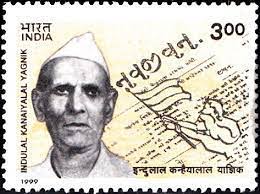
A Man of Many Parts

May 1 is marked as International Labour Day to commemorate the struggles of workers, and labour movements, and celebrate their role in society. In Gujarat the day has an added significance as Gujarat Foundation Day. May 1 marks the day that two new states–Gujarat and Maharashtra were carved out of the erstwhile Bombay state in 1960.

One name that it intrinsically linked with this historic moment is that of Indulal Yagnik who spearheaded the movement for a separate state of Gujarat. Indulal was the founder president of the Mahagujarat Janata Parishad that launched the movement which came to be known as the Mahagujarat Movement, in 1956. But Indulal’s activism well preceded this phase of his life which spanned many significant periods in Indian political life. A life that was not limited to public engagement, but also covered a wide range of interests, and contributions including to journalism, literature, and films. 

Indulal was born in 1892 in Nadiad in Gujarat, and completed his higher education in Bombay, graduating with BA as well as LLB degrees. He chose the world of words rather than laws, and started his journey as a translator with Mumbai Samachar, a Gujarati daily, and as contributor to a well-known Gujarati monthly magazine. He began to associate with radical nationalists like Shankarlal Banker, and young lawyers like KM Munshi and BG Kher. He was also deeply influenced by Annie Besant and the Home Rule League, which advocated for self-government for India within the British Empire. In the meanwhile his own thinking was becoming more nonconformist in terms of social norms.

He was always a risk-taker. When Madam Bhikaji Cama became the first person to hoist the Indian tricolour on foreign soil at the International Socialist Conference at Stuttgart in Germany, on 22 August 1907, it was the young socialist Indulal Yagnik who smuggled that flag back to India.

Gandhi’s return to India from South Africa in 1914 drew Indulal into a new cause. By 1915, Indulal launched a Gujarati monthly along with his friends Shankarlal Banker, KM Munshi and Ranjitram Mehta. He contributed to the English magazine Young India and when Gandhi it took over, Indulal moved to Ahmedabad in 1915 to work for him.  

When the British government decided to dispatch a team of eight editors—four English and four Indians to Mesopotamia (now Iraq) in 1917 to investigate allegations of mistreatment of Indian soldiers during World War I, Indulal was selected as one of them.

In 1917, he was involved in famine relief in the villages of Ahmedabad district. Indulal was an active participant in Gandhi’s 1918 Kheda Satyagraha, a resistance movement against oppressive land taxes for farmers. He was also, with Gandhi, a part of the move to establish Gujarat Vidyapith, an institution of higher learning. He made Ahmedabad the base for his public and political activities, even as he travelled widely, connecting with the most downtrodden and oppressed communities.

While he was close to Gandhi and Sardar Patel, and worked tirelessly for the ongoing satyagraha movement, Indulal was a much more vociferous advocate of the rights of the marginalized and oppressed communities. This often created clashes of opinion and approach. He also had a fiery and mercurial temperament which led him to act impulsively. While in 1923 he had shared a prison cell with Gandhiji, in 1924 Indulal completely withdrew from nationalist activities and relocated to Bombay where he became editor of a communist-published paper. His socialist-communist perspective led him to write a harsh critique of the 1928 Bardoli Satyagraha in this paper.

Subsequently, he distanced himself from both communism as well as the nationalist struggle and the Congress party, and forayed into films. He began in 1926, by translating the titles for the film The Light of Asia into Gujarati. He then began writing about films for different magazines and newspapers, and himself wrote short stories for a few silent films. He even produced a few films. However his stint as a producer was neither successful nor profitable.

Indulal returned to the nationalist movement. This time he took on the role of championing its cause abroad. He travelled to Britain and Germany where he wrote articles and pamphlets. He also got involved with revolutionaries in Ireland and activists in England. He was in England when Gandhiji was attending the Second Round Table Conference in 1931.

After five years abroad Indulal returned to India in 1935. Now he became an active advocate for famers’ rights, and in 1936 was instrumental in the formation of the All India Kisan Sabha, and led the Gujarat chapter of the Kisan Sabha. The world was in the throes of the Second World War. His anti-war activities were deemed disruptive to public order and he was imprisoned in 1940. Upon release in 1941, he dedicated himself to establishing ashrams and schools in areas where there were none. The ashram that he established on the banks of the Vatrak river became his own base, and it is here that he celebrated India’s Independence on 15 August 1947.

When the movement for a separate state of Gujarat was gaining momentum in 1956, the activist in Indulal surfaced again. ‘Indu Chacha’ became the mover and shaker of the Mahagujarat Movement. During this period he once again distanced himself from the Congress party, and established a political party called Mahagujarat Janata Parishad, which achieved significant electoral success. The party was dissolved after the formation of Gujarat state on 1 May 1960. Indulal then founded the Nutan Mahagujarat Janata Parishad.

Indu Chacha was very popular himself, appealing to working class and middle class voters alike. He was elected from the Ahmedabad constituency to the Lok Sabha for four consecutive terms starting from 1957 to 1971. He continued to maintain his almost spartan lifestyle until he passed away in 1972.

Indulal’s life story was closely linked to the political events of Gujarat and the world of that time. His six-volume autobiography Atmakatha, written in phases at different points of his life, is a valuable resource to understand the socio-cultural and political history of Gujarat. He dedicated the book to the “bright and fragrant flower-like people” of Gujarat. As a fellow Gujarati, Indu Chacha’s story gives a peep into the people and events that led to the creation of Gujarat.

On a more personal note, Indu Chacha was a friend of my parents, and I have memories of his dropping in to see them when we lived in Delhi in the late sixties, and relishing hot jalebis with milk! He must have been in his last term as member of the Lok Sabha then. As the state of Gujarat goes to the polls next week, Indu Chacha is still remembered.

–Mamata