
Dutch tears—that is an intriguing term I came across recently. At first I thought it was an idiom, like Dutch courage or Dutch comfort. But turns out Dutch tears are a real physical thing–toughened glass beads created by dripping molten glass into cold water! When glass is dripped into water, it solidifies into tadpole-shaped drops with thin, long tails. These were first produced in the Netherlands in the early 17th century. These tadpoles exhibit unusual characteristics—the bulbous part of the drop can withstand being hit by a hammer without breaking, but even a small pressure of the fingers to the tail-end will dramatically shatter the whole drop.
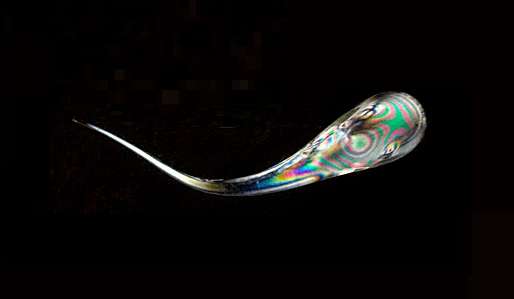
These very contrary properties led to a great amount of scientific curiosity and they were the subject of much research in the 1700s and 1800s. But it was not till recently that the mystery was solved. One breakthrough came in 1994, when Prof. S. Chandrasekar of Purdue University and Prof. M. M. Chaudhri of University of Cambridge used high-speed framing photography to observe the drop-shattering process and concluded that the surface of each drop experiences highly compressive stresses, while the interior experiences high tension forces. So the drop is in a state of unstable equilibrium, which can be easily disturbed by breaking the tail. But the complete explanation came in 2017 when these scientists collaborated with Prof. Hillar Aben, of Tallinn University of Technology in Estonia and found that heads of the drops have a much higher surface compressive stress than previously thought—nearly 7,000 times atmospheric pressure. This gives the droplet-heads a very high fracture strength. (For a proper understanding of the science, please go to https://phys.org/news/2017-05-scientists-year-old-mystery-prince-rupert.html, rather than depending on my précis from there! Photocredit also to this page.)
But to get back to my original thought process: When I had tried to think of possible meanings of Dutch tears , so many idioms featuring the Dutch came to mind. We are very familiar with some:
When someone speaks very fast or unintelligibly, we say they are speaking Double Dutch–in other words, nonsense.
When one takes a shot of alcohol to boost up one’s courage before doing something one is afraid to do, it is called Dutch courage.
And of course, the Dutch treat, where each one finds they have to pay for whatever they consume.
And if you talk to someone like a Dutch uncle, you are giving them stern and serious talking-to.
And here is a small sample out of a range of many lesser-used ones:
Dutch agreement, where the parties making the agreement are drunk. And the related Dutch bargain—a bargain settled when the parties are intoxicated.
A Dutch headache is a hangover. And a Dutch concert is a very noisy situation, as would be made by a lot of drunken Dutchmen.
Dutch comfort is comfort which comes from the feeling that things could have been much worse.
Dutch reckoning is a very high bill that’s neither itemised nor detailed, and hence a bit of a con.
Dutch gold is a yellow-coloured alloy of copper and zinc from which imitation gold leaf is made.
HR persons should not go looking for Dutch talent, which is more brawn than brain. And they should be wary of employees who take Dutch leave, i.e., leave without permission.
Readers would have noticed that most of these idioms show the Dutch in a bad light. And apparently, there is good reason for this. Most of these came into being about 1665 and later, when the Netherlands and England were vying with each other both on land (England won a Dutch colony what is currently New York), and on sea for the control of trade routes. During the 17th century, the Netherlands and Britain waged three wars against each other over 20 years. The deep-seated animosity must have spilt over to language, and given the number of such idioms, the English must have vied with each other to come with nasty expressions about the enemy. (While this explanation seems logical, there don’t seem to be such expressions which feature the Spanish. And England and Spain were enemies and rivals for a good long time too. Maybe there is a Ph.D. thesis for someone here!).
Fortunately, many of these mean-idioms are falling out of use. And we have the rise of the Dutch oven—the most sought after cooking device; and of Dutch auctions–a type of open auction where the price starts high and decreases until the first bidder accepts it—which are seen as fast and efficient, as they end as soon as the first bid is made.
Here’s to many more Dutch-positives!
–Meena

 Millennial Matriarchs