Fighting the Disease, Fighting the Stigma: Marking Leprosy Day

Humanity spent a few years in fear of Covid. A few decades were spent in fear of AIDS. But millennia have been spent in fear of leprosy.

Leprosy is oft-mentioned in texts of yore. In Hindu mythology, it is often the result of a curse. Samba, son of Krishna and Jambavati, was cursed with the disease by his own father for constantly harassing his stepmothers (even otherwise, he seems to have been a pretty painful character). Later, when Krishna learnt that Samba was himself led into the misdemeanor by Narada, he wanted to take back the curse, but could not. Krishna advised Samba to pray to the Sun God for a cure. Samba did so—in fact, the Sun Temple at Konark and Multan (the temple does not exist and its exact location is unknown, but may have been in present-day Pakistan) are supposed to have been built by him. As a result of his devotions, he was cured.

The tale of Reunka is a fairly typical misogynistic one. She was the devoted wife of Sage Jamadagni, cursed with leprosy by her husband for a momentary lapse—for a moment being attracted to the Gandharva King. She was advised to bathe in Jogala Bhavi a nearby lake, and was cured. But sadly, when she returned home, her husband was still furious, and commanded his sons to kill her. The first four refused and were cursed by their father to die, but the fifth, Parashuram (yes, he who was an Avatar), obeyed his father. Jamadagni, pleased with Parashuram, granted him a boon. Good sense prevailed and Parashuram begged for the revival of his mother and brothers. A repentant Jamadagni is supposed to have foresworn anger, and lived happily with his wife ever after.

Leprosy also plays a key role in the Mahabharatha. Shantanu, father of Bhisma, Chitrangada and Vishitravirya came to the throne because his elder brother Devapi had leprosy. If it had not been for Shantanu’s attraction first to Ganga and then to Satyavati, the Mahabharat war may never have taken place.

Islamic and Biblical references to leprosy also abound, and Jesus is supposed to have cured the disease with his touch.

Through the ages, leprosy was feared as a curse of the Gods, and the only salvation was a boon from them. The social ostracism and rejection by friends and family was as much a suffering as the disease itself.
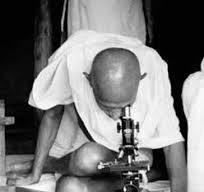
Gandhiji Leprosy
Gandhiji viewing what is presumed to be Mycobacterium leprae

In the last few centuries, many brave souls have worked hard for the relief of these sufferings. Gandhiji was at the forefront of the fight against the fear of leprosy. Pictures of him tending to Shri Parchure Sastry, a learned man whom Gandhiji respected very much, are often seen. Sastry even made his home in Sewagram with the agreement of all the Ashram inmates.

Vinobha Bhave was another Gandhian leader who worked in this field. He and Manoharji Diwan established Kushthadham (Leprosy Centre) at Dattapur in 1936.

And of course, the selfless work of Baba Amte and his wife Sadhantai, is legendary. He was a Gandhian and active in the freedom struggle. But how he came to leprosy work is interesting. He encountered a leprosy patient one day, and it is the fear and revulsion he felt that led to deep introspection, and the decision to devote his life to this work. He not only wanted to help the patients, but also create a society free of “Mental Leprosy”, ie., the fear and misunderstandings associated with disease. He founded three ashrams for patients and devoted his life to them. The Gandhi Peace Prize and the Ramon Magsaysay award were only a few recognitions of his service.

Dr. Noshir Antia is another individual who contributed enormously to the rehabilitation of leprosy patients. He is known as the father of Plastic Surgery in India and established the first department in the country devoted to this—the Tata Department of Plastic Surgery at the J.J. Hospital in Mumbai. . His interest in this subject began when he saw the disfigurement of leprosy patients, and started to pioneer surgical techniques for correcting these. Apart from surgery, he also started research facilities to study the disease and fought against the discrimination against the sufferers of this disease, and for their rehabilitation. Dr. Antia passed away in 2007, but his legacy continues not only through the generations of doctors and surgeons trained by him, but also through the NGO he founded—the Foundation for Research in Community Health

World Leprosy Day is observed on the last Sunday of January. In India, with a slight tweak, and to mark Gandhiji’s contribution in this field, it is observed on 30 January, coinciding with his death anniversary.   

The theme for the day this year is “Beat Leprosy” which calls attention to the dual objectives of the day: to eradicate the stigma associated with leprosy and to promote the dignity of people affected by the disease.

As Vinobhaji put it, the critical thing is to beat mental leprosy—the fear of leprosy. And our experience of recent diseases has shown us that fear is not the way to react to any disease. Scientific understanding and empathy are!

–Meena

Two books which may be of interest:

‘Autobiography of a Doctor’ is Noshir Antia’s tale of his life.

‘Covenant of Water’ by Verghese Abraham has leprosy, its treatment and the social discrimination as an important theme.

A Special Date: Kuchchhi Kharek

It is perhaps the most ancient cultivated tree in the world. Fossil evidence indicates that the date palm has been cultivated in the Middle East and North Africa for at least 5000 years. The tree has a place in mythology of several cultures. The Sumerians believed that the palm tree was the first tree ever created and that it was tended by a godly raven. In ancient Mesopotamia it was called the ‘road to the moon’ and associated with lunar worship. In Egyptian hieroglyphs the tree was used as symbol for year, and its frond as the symbol for a month. The Roman author and naturalist Pliny the Elder believed the tree to be the nesting site of the Phoenix, the self-resurrecting mythological bird.

There are several special botanical features that make the date palm unique among fruit trees. The height can exceed 20 m, and trees survive over a hundred years, and a tree can produce more than 70 kg of fruit a year. To grow and thrive, date palms require scorching dry summers, low humidity, no frost and ample sunshine. As a saying in the Middle East says: The date palm needs for its feet to be in running water and its head in the fires of the sky.

In practical terms, almost every part of the tree provided useful material for construction, roofing and ropes and baskets. Popularly referred to as the ‘tree of life’, ancient civilisations once looked to the date palm for life’s necessities.The soft wood, with its ability to withstand hot, dry conditions was useful for construction of houses, as well as certain parts of dhows, the traditional sailing vessels that carried out much of the maritime trade across the Indian Ocean. The fronds were used for roofing.  The tree also inspired architectural elements. Capitals of columns were carved to resemble palm trees, the form features in artistic mosaics, weaves and embroideries in many ancient cultures.   

And the fruit has long been recognized as a concentrated powerhouse of nutrients. The date has provided vital nourishment for generations living in the hot arid climes of the Middle East and North Africa. Dates are rich in vitamins, high in antioxidants and loaded with fibre. Dates are resilient to pests, do not rot when ripe and can be transported easily. Thus the old Arabic saying: The uses of dates are as many as the days of the year.

The date fruit itself gives the name to its parent tree the date palm—Phoenix dactylifera derived from the Phoenix (perhaps a reference to the mythical bird, as this tree can also regrow after a fire) and dactylifera meaning finger. The date’s English name comes from the Greek word dactulos meaning finger referring to its elongated shape and form.

Dates hold significance in major religions and cultures. In the Middle East and South Asia the fruits symbolize gratitude, generosity and good health and are served at weddings, religious ceremonies and festivals. The Jews considered dates as one of the seven holy fruits and paid special attention to it during their auspicious occasions and festivals. Dates are mentioned more than 50 times in the Bible. In the Holy Bible, palm trees are associated with symbols of prosperity and triumph. One legend says that the date palm was the tree of knowledge of good and evil and the date was the actual fruit (not the apple) that Eve offered to Adam in the Garden of Eden. In Islam the Prophet Muhammad considered dates to be a superior food and encouraged people to break their fasts with them. The date palm is mentioned 22 times in the Quran. Dates are considered a fruit, food, medicine, drink and sweetmeat. Their high sugar content makes them self-preserving and long-lasting. Dried dates can be stored for a long time, and transported easily across seas and deserts. They can be boiled and strained to produce a honey-like syrup, they can be fermented to make date wine. Desert nomads have used dates in traditional health remedies for thousands of years.

While not among the group of highest date growers, India grows 40-50 varieties of dates, both of the soft and dry type. One of the key date-producing regions in the country is Kuchchh in Gujarat. Date palms are believed to have been established in this region around 400-00 years ago. It is speculated that these grew from seeds thrown by pilgrims who visited the Middle East countries for Haj, and traders who also brought back these plants; or Arab gardeners working in the palaces of the local rulers who may have acquired and planted date seeds or shoots. Date varieties have been developed by thousands of years of selection of seedlings and only those possessing desirable characteristics have been propagated. Today there are believed to be around 1.7 million date palms in the area propagated from indigenous seedlings.

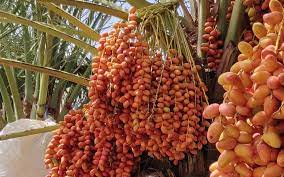
While the history of date cultivation here is not as old as that in other parts of the world,Kuchchh is probably the only place in the world where fresh dates are economically cultivated, marketed and consumed. The Kachchhi Kharek or Khalela as it is locally called is unique in that it is the fresh fruit that is eaten. While in most parts of the world dates are allowed to ripen until they become soft, and dark brown or black in colour, the Kuchchhi dates are harvested at the stage when the fruits have matured, accumulated sucrose, and have turned yellow or red, but are still crisp. This stage of harvesting is called the khalal stage. It is usually done just before the monsoon rains reach the region. The colour and crispness gives these dates a distinctive identity, and make for a delicious eating experience.

This identity has been formally recognized with the awarding of the GI Tag to this indigenous variety of dates—the Kuchchhi Kharek. The Geographical Indication Tag (GI Tag) is a sign assigned to products that have a specific geographical origin and possess intrinsic qualities due to said origin. This date is the second fruit from Gujarat to get a GI Tag, the first being the Gir Kesar mango grown in some districts of Saurashtra. The Kesar mango makes the intense heat of the summer bearable, while the Kuchchhi date adds energy and warmth to the nippy days of winter.

A special date indeed!   

–Mamata

Oh Sh*t!

The last few weeks have been peppered with cleaning cat-poop of the lawn. A particular cat has taken to using our garden as its favoured toilet. Now we are spraying the lawn with a suspension of coffee grounds and haven’t had an episode in the last few days. Fingers crossed.

But the whole trauma got me thinking about poop in general.

And I realized how many words there were for this. In fact, the number of synonyms for faeces is proof of human fascination for the subject.

There is wide variety of terms for poop, and though some of them are interchangeable, there are also very specific ones– for certain types of animals or species or used in certain circumstances. Here are some of them so our vocabulary in this area can go beyond shit and crap!

Faeces is the most generic term, and the word comes from the Latin word faex, meaning “dregs”. Excrement, Excreta and Stool are also fairly generic and mean the solid wast released solid waste from the bowels of a person or animal. bowels of a person or animal Ordure too is similar—the solid waste solid from the bowels of people or animals.  

Here is a look at a few other terms:

Droppings: Faeces of animals.

Dung: Solid waste from animals, especially cattle and horses

Scat: Animal faeces, particularly of wild carnivores

Spraint:  This is the dung of otters.

Fras: These are the droppings/faeces of insect larvae

Manure: Manure is organic matter that is used as fertilizer in agriculture. Most manure consists of animal faeces but may also include compost and green.

Guano: This is accumulated excrement and remains of birds, bats, and seals, valued as fertilizer. 

Worm casts: These are the excrement of worms. Earthworm casts are prized as fertilizer.

Fecal Pellets: An organic excrement, mainly of invertebrates.

Fewmets: In hunting terminology, these are the droppings of deer and other quarry animals by which a hunter identifies his targets. Another term used in hunting is Spoor which can indicate a track, a trail, a scent, or droppings especially of a wild animal

Fewments: For science fiction fans, this is the term for dragon droppings!

Coprolite: Fossilised faeces of animals that lived millions of years ago.

Paleofaeces: Ancient faeces, often found as part of archaeological excavations or surveys.

Rabbits, hares and related species produce two types of fecal pellets: hard ones, which are the real poop; and soft ones or cecotropes, which are partially digested food which they eject, and eat again!

In medicine and biology, scatology or coprology is the study of faeces.

poop
Looking forward to reading this fascinating picture book for adults!

The study of such excrement is of course of use to doctors in the diagnosis of various medical conditions. It is also of great importance in obtaining an understanding of wildlife behavior, and the environment as a whole. Scat analysis can yield useful information on animal populations and their distribution across a habitat, how many males and females there are, what they are eating, their health condition and from all these, information on the health of the habitat itself can be deduced. Scat analysis is sometimes faster, easier and cheaper than many other means of studying animal populations, and it is possible to get a lot of information about animals non-invasively.  It is also possible to extract DNA from poop and this has helped identify species characteristics.

So it’s not just 4-year olds who have a fascination for this subject. Many adults make it their life’s work, and their chosen tool in getting to know more about the world!

–Meena

Timeless Friendship: Pooh and Pals

The little bear and his small gang of Hundred Acre Wood friends have captivated children’s imagination for nearly a hundred years. Pooh, along with Tigger, Eeyore, Piglet, Rabbit, Kanga, Roo, Owl, and the little boy Christopher Robin were the literary creations of English writer AA Milne.

Alexander Alan Milne was born in London on 18 January 1882. He studied at Henley House School, a small independent school run by his father. One of the teachers at the school was HG Wells. After earning a degree in mathematics from Cambridge University, AA Milne moved back to London where we worked as assistant editor of the humour magazine Punch for eight years. Despite being a staunch pacifist he was drafted in World War 1 and served for the British army. He was injured in the Battle of Somme; and returned to England suffering from post-traumatic stress caused by his experience in the war. He could not take the busy life of London and moved his family to the countryside outside of East Sussex. As he slowly recovered, he spent a lot of time in the woods in the area with his only son Christopher Robin, nicknamed Billy Moon. These woods became the setting for the forthcoming adventures of the Hundred Acre gang of friends. And the woodland walks planted in AA Milne the roots of the tales of the motley group of anthropomorphic animals. 

How did the woods become populated with these characters whose charm has remained undiminished for a hundred years? Christopher Robin himself was introduced by his father in a poem titled Vespers which was published in 1923. Another poem mentions a Mr Edward Bear, which was the name of the toy bear that Milne had given his son on his first birthday. But a visit to London Zoo where Christopher saw a black bear rescued from Winnipeg in Canada, led to the renaming of Edward the toy bear as Winnie. The christening was complete when Christopher told his father about a swan that he fed every morning, and how, if the swan did not come, Christopher would say “pooh” implying ‘I don’t care!’ Thus, on Christmas Eve 1925, AA Milne’s short story The Wrong Sort of Bees formally introduced Winnie the Pooh, the teddy bear often dragged down the stairs by his owner Christopher Robin. In no time, the big-hearted but slightly slow-witted bear won the hearts of all children, and the child-at-heart. In the stories that followed, the little boy and his bear were joined in their woodland adventures by their equally quirky, but loving, furry and feathered friends.

The pencil illustrations by Milne’s friend Ernest E Shepard brought the characters to life. The association between writer and artist (his old friend who had served together with him in the war) continued through all the books. Shepard based his drawings also on some other stuffed toys that Christopher played with in his childhood. However Pooh bear was based on his own son’s teddy bear named Growler. The original stuffed toys that gave form to Tigger, Eeyore, Piglet, and Kanga are still preserved in the New York Public Library, a bit bedraggled over time, but still tugging at heartstrings. The baby kangaroo stuffed animal (named Roo) was lost in an apple orchard during the 1930s. The toys were taken to the United States in 1947, and remained with Milne’s American publisher EP Dutton until 1987 when they were donated to the New York Public Library to add to its renowned collection of children’s literature. Here they remain in the Library’s permanent exhibition, a bit bedraggled over time, but still tugging at heartstrings.

The first collection of stories Winnie the Pooh was published in October 1926. It was a huge success and helped to introduce the characters to audiences beyond England. The stories with their innate innocence, childhood joys, and idyllic countryside provided comfort in times that still echoed with the brutality of World War I. They also touched upon universal sentiments of friendship and bonding.

The unprecedented success of the books however impacted the childhood of the real Christopher Robin. He was thrust into the discomforting limelight, and grew up resenting the fallout of early fame. This led AA Milne to stop writing Pooh stories after his fourth book, The House at Pooh Corner. However the damage had been done and the relations between father and son continued to remain strained till the end.   

Milne wrote four children’s books that made up the Winnie the Pooh anthology, beginning with the poetry series When We Were Young published in 1924, and the final book The House at Pooh Corner, published in 1928. In the nearly hundred years since, the books have sold millions of copies worldwide, and the characters remain evergreen, and ubiquitous, through animated versions and merchandise which have earned billions of dollars. The exclusive media ownership of the brand was with Disney and Warner Brothers until 2022 when the 95-year copyright lapsed. Pooh and friends are now in the public domain. May they continue to charm and endear themselves for the next hundred years.

So they went off together. But wherever they 
go, and whatever happens to them on the way, in
that enchanted place on the top of the Forest a
little boy and his Bear will always be playing.

The House at Pooh Corner

–Mamata

Sun, Giver of Light and Life

Makar Sankaranthi is linked to the solar calendar, and marks the beginning of the annual  transit of the Sun from the Southern Hemisphere to the Northern Hemisphere. Sankaranthi is also called ‘Uttarayan’—deriving from ‘uttar’—North, and ‘aayan’—movement.  The Sun moves from the Tropic of Cancer to the Tropic of Capricorn that day.

Makar Sankaranthi is celebrated across the country, but in different ways. In Tamilnadu, it is a harvest festival, and three days of Pongal celebrations mark worship of the sun, the rain and cattle—all fundamental to agricultural economies. It is a wonderful occasion to remind ourselves of how much we owe Nature, and that without the energy of the Sun, we can do nothing. ‘Pongal’ itself means overflowing, and the pot with rice, jaggery and milk is allowed to overflow to calls of ‘pongal-o-pongal’—welcoming abundance in the coming year.

The fundamental importance of the Sun has been recognized by many ancient cultures, and in many of them, kings ruled by the power of the sun and claimed descent from the sun.

In ancient Egypt, the sun god Re was dominant among the higher gods. The sun was not one entity– he sets out on his journey in the East as the young god Kheper; he appears at noon in the zenith as the full-grown sun, Re; and by the evening, when he is in the West he is in the shape of the old sun god, Atum.  When the Pharaoh Akhnaton (husband of the famed Queen Nefertiti) reformed Egyptian religion somewhere around 1350 BC, he took Sun worship to the next level by making it the official religion and the sun’s qualities as creator and nourisher of the Earth and its inhabitants were worshipped.

As far as Roman history is concerned, sun worship became fairly important in the later period.

Both Sumerian and Akkadian religions put sun worship at the centre of their belief system, and in Iran, sun festivals were celebrated as a heritage from pre-Islamic times.

In North America, the Plains Indians followed a solar cult with the Sun Dance as an important ritual. In South America, especially Mexico and Peru, sun worship was widely prevalent.  The ruler of Peru was believed to an incarnation of the sun god, Inti. The Aztecs worshipped Huitzilopochtli, the Sun God who was one of their most powerful and most revered gods. In fact, Aztec people considered themselves to be ‘the people of the sun’.

The sun goddess Amaterasu  played an important role in ancient Japanese mythology and was considered to be the supreme ruler of the world and the guiding deity for the imperial rulers. 

Sankaranthi
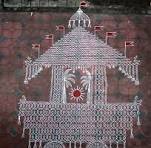
Sun Chariot Kolam

In many of these ancient traditions, the Sun God rides in a chariot drawn by horses. In Hindu mythology too, he rides chariot drawn by seven horses—which are said to stand for the seven colours of visible light or the seven days of the week. There are different versions of the names of the seven horses. In some traditions, they are named after the seven meters of Sanskrit poetry: Gayatri, Brihati, Ushnih, Jagati, Trishtubha, Anushtubha and Pankti. In others, they are called Jaya, Vijaya, Ajaya, Jitapraṇa, Jitasrama, Manojava and Jitakrodha , which are different phases of light transmission through the length of the day.

The most traditional rangoli or kolam made in Tamilnadu for Pongal is the Ratham or Sun’s chariot. While there are 5×5 dot ratham kolams for amateurs, these designs can become incredibly complex and set off a competitive spirit across streets!

So let us rejoice in the spirit of Sankaranthi, and pray for abundance, peace and prosperity in the coming year!

–Meena

PS: The beautiful kolam is from the Net. I can claim no credit!

Window to the World: National Geographic

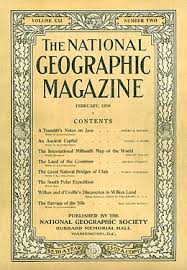
They were probably our first glimpse of the wonders of the natural world. As children we eagerly awaited the arrival of the yellow cover magazines with their breathtaking pictures. My father, a lover of maps found a wealth of meticulous cartography in the maps that often accompanied the magazines. The glossy pages with fantastic photographs were the hallmark of the National Geographic Magazine. The magazine has maintained the same level of excellence for the last 136 years!

This month marks the important milestones that led to the launch of this enduring visual record of the world. This began with the founding of the National Geographic Society. The journey started in early January 1888 when a small group of gentlemen prominent in the scientific and intellectual circles of Washington DC received an invitation that read: Dear Sir: You are invited to be present at a meeting to be held in the Assembly Hall of the Cosmos Club, Friday evening, January 13, at 8 o’clock, for the purpose of considering the advisability of organizing a society for the increase and diffusion of geographic knowledge.

On the given date, 33 gentlemen who were sufficiently intrigued by the invitation to brave the fog and rain, gathered at the Cosmos Club. The guiding spirit leading the discussion was Boston lawyer Gardiner Greene Hubbard, supported by explorers John Wesley Powell and Adolphus Greely, as well as geographer Henry Gannett. The topic of discussion was the organization of a society for the increase and diffusion of geographic knowledge. One week later on 20 January the second meeting had twice the original number of participants, who agreed to incorporate themselves as a geographical society, and just one week later the Certificate of Incorporation of the National Geographic Society was formally signed on 27 January 1888. Interestingly, the average age of the founding group was around 40 years, and half of these were in their late 20s to 30s, several working for the US Geological Survey or the US Coast and Geodetic Survey. And, they were all male. Ironically, only one member was a journalist, and there is no photograph of any of the three occasions that led to the birth of the iconic magazine. National Geographic Magazine started publication in October 1888 as the official journal of the National Geographic Society.

The original issues were all text articles. The magazine began the transition from a text-oriented publication to including pictorial content with its January 1905 issue which had several full-page pictures of Tibet. By 1908 more than half the magazine’s pages were photographs.  

One of the founding objectives of the non-profit Society was to fund science and exploration across the planet. The first scientific expedition supported by the Society was to survey and map the Mount St. Elias region in North America, which led to the discovery of Mount Logan, Canada’s highest peak. Initiated in 1890, and led by explorer Israel Russell, this marked the beginning of thousands of explorer-led National Geographic expeditions. Significant among the early expeditions supported by the National Geographic Society were Robert Peary’s which was the first to reach the North Pole in 1909, and expeditions (1912-1915) to excavate Machu Pichu the lost city of the Incas in the Peruvian Andes. Since the first expedition, the Society has provided more than 15,000 grants to explorers to work across the world.

The earliest natural-colour underwater pictures were taken by the National Geographic staff photographers in 1926. The magazine continued to bring to the readers hidden deep sea treasures with a series of articles by Jacques-Yves Cousteau in the mid-1950s, including the deepest undersea photos from 25,000 under the sea in 1956. From deep sea to outer space, the National Geographic Society flag was carried by John Glenn on the first US orbital space fight in June 1962; and it reached the moon with the Apollo 11 astronauts in July 1969. The exploration of forest ecosystems also got Society support, with funding to Jane Goodall and Dian Fossey’s intensive work with chimpanzees and mountain gorillas in the African jungles. Over the decades, the Society has continued to support explorations in varied ecosystems, and in all spheres from ocean depths to outer space. The discoveries of these incredible missions are shared through the National Geographic Magazine, opening windows and vistas to millions of armchair travellers across the globe. The excellence of standards of journalism and photography are backed with the passion and commitment of documenting the wonders of history, science, anthropology and nature, while also bringing to the fore serious environmental and human rights issues.

The National Geographic Magazine has continued to inspire generations for over a century, reaching out to 60 million readers worldwide each month, including 40 local-language editions. Keeping step with changing times and technology, in January 2001 National Geographic Channel was launched on cable and satellite television in the United States. The channel has expanded the scope of visual storytelling. Nat Geo continues to provide new digital experiences to find new ways of documenting the world and allowing readers to interact with content. In a rapidly changing world, the Society has stayed true to its original mission ‘to pursue and celebrate exploration, scientific excellence, education, and unforgettable storytelling’. National Geographic has remained a vibrant, relevant, world-class brand at the forefront of exploration and knowledge. However, the changing times are making their mark felt even here. Until 2015, the magazine was completely owned and managed by the National Geographic Society. Since 2019 the Walt Disney Company has taken over controlling interest. In June 2023, National geographic announced that it will focus on digital publication and subscribers. The magazine also laid off all of its staff writers, shifting to an entirely freelance-based writing model. Starting 2024, the hard copy will no longer be available on newsstands, while old subscribers will receive hard copies till their subscription runs.

Truly the end of an era. And a time to revisit the family collection of National Geographic Magazines (dating back to the mid-1950s) and enjoy the nostalgic savour of rediscovering the wonders of the world.   

–Mamata

Kuldhara: Ghosts of the Past, Vandals of the Present

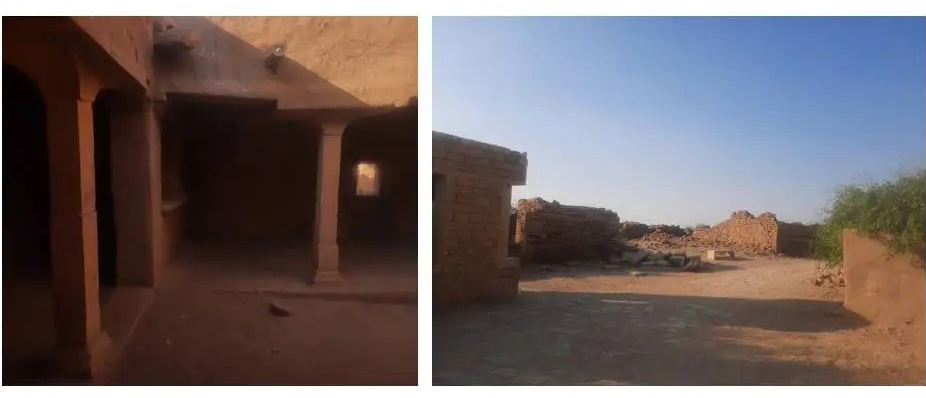
Kuldhara is on the tourist map of Jaisalmer district. On the way to Sam where the desert starts, is this ‘ghost town’ abandoned by its inhabitants about 200 years ago. The history of the town goes back to the 13th century when it was first settled by Paliwals, people from Pali district. Over the centuries, it grew into a prosperous place, with about 400 houses and over 1500 inhabitants at the peak. It had a pond, Udhansar, excavated by one of the first inhabitants, and at least one temple dedicated to Vishnu, as well as several wells and a step-well. It is actually a planned city, with proper layouts and a place for everything.

Till it was suddenly abandoned. It is not clear why the inhabitants left, but many reasons are given. Was it dwindling water supplies? Was it an earthquake? Or, more dramatically, was it the unwanted pursuit of one of the beautiful girls of the town by a local minister?

Well, whatever the reason or combination of them, it is a fact that people started leaving the place, probably not fleeing overnight as the tourist guides will tell you, but probably in trickles.

The mud-brick houses, temple and various other structures still stand in fairly good condition. Local legend of course goes that the township is haunted, and visitors are assured it is a dangerous place at night! The legend also says that the Paliwals while leaving the place, placed a curse on it, saying that anyone who tried to occupy it would meet dire consequences. All this led to its attracting tourists.

Kuldhara

The Rajasthan government decided to develop this as a tourist site around 2015. This is definitely a strategic move, given that it is just 18 kms away from Jaisalmer, and makes for a comfortable half-day trip, and it had already gained notoriety for its ghosts.

It is well-maintained by the Archeological Survey of India. There are of course guides. And importantly, fairly clean toilets. To this day, the neighbouring villages insist the gates be closed in the evening, so the Kuldhara ghosts don’t wander into their houses!

Of course, a lot more could be done—more signage, re-creation of a typical house, visualization of the town as it must have originally been, a more serious delve into the reasons for its abandonment, etc.

All of this will hopefully be done by the authorities in due course.

But an extremely disturbing incident that happened last week brings to fore the need for us as citizens and tourists to be more responsible. Newspapers report on a video that went viral. The video shows two tourists holding hands and kicking down the ancient brick wall of one the houses in Kuldhara. They were apparently doing this for putting up the video on social media.

The police are waiting for a formal complaint to be filed before taking action. Hopefully, this will be done fairly soon and action will be taken. The penalty for those who deface structures of national and historical importance has fortunately been enhanced in 2010 vide an amendment to the Ancient Monuments and Archaeological Sites and Remains Act. Now, such vandals will have to face imprisonment up to 2 years and/or a fine of up to Rs. 1 lakh.

Sadly, very few cases actually come to the stage where the punishment is given. Often, even the FIR is not registered—though in this case, the police seem to be ready to do this.

Kuldhara is just the latest example—from tourists knocking down pillars at Hampi to graffiti in Golconda, we have a long sad story of vandalism at cultural heritage sites.  If our monuments are to have a chance, punishment in these cases needs to swift, exemplary and well-publicized. Maybe there needs to be a sign outside the monument as to how someone tried to vandalize and what punishment they got!

And of course our educational institutions need to instill respect for our cultural and natural heritage, and strongly din home the need to take the greatest care of them.

The responsibility rests with each and every one of us.

­­–Meena

Fireworks: Sound and Light Show

If bells are the traditional symbols that ring out the old, and ring in the new, perhaps the other thing that, across the world, opens the New Year with the dazzle of light and sound, is firecrackers. From the first display that lights up the sky in New Zealand, till 12 hours later, the sparkle that ushers in a new year in South America, firecrackers are almost a universal symbol of celebration of special occasions.

The history of fireworks goes back almost 2000 years ago, and the story of the first combination of crackle and bang, began almost as an accident. People in China used to throw bamboo stalks into the fire; the overheating of hollow air pockets in the bamboo would cause them to explode with a bang. The Chinese believed that this bang would ward off evil spirits. These are believed to be the first natural crackers. The human intervention began when, as the story goes, a Chinese alchemist mixed three common kitchen ingredients: sulfur, charcoal and potassium nitrate (saltpeter, a food preservative) and heated these over the fire, to make black flaky powder that ignited with a loud bang. The local people called this fascinating black powder huo yao (fire chemical). This was the first crude formulation of what came to be known to the rest of the world as ‘gunpowder’. People began to experiment further with the use of this powder. It was inserted into hollow bamboo tubes which were thrown into the fire. The ignited powder produced gases that caused so much pressure to build up in the tube that it blasted open with a loud bang. The first basic manmade ‘firecracker’ was born. In time the bamboo stalks were replaced with paper tubes, and instead of throwing the tubes into the fire, people added fuses made from tissue paper so that these could be lit from the outside.  

Firecrackers became an integral part of all Chinese celebrations—festivals, weddings and religious rituals. In the meanwhile the Chinese also realized that the black powder could be put to other, less ceremonial, uses. They attached the firecrackers to arrows that they shot at their enemies. Thus began the use of gunpowder in warfare that continues, in more sophisticated forms, to this day.

The knowledge of fireworks using gunpowder began to travel westwards with traders and travelers. It is believed that Marco Polo, one on of his many trips to China brought back this invention to the Middle East, from where the European crusaders brought it to Europe. An English scholar Roger Bacon is believed to be the first European to have analyzed the black powder from China, as he was intrigued why the mixture of ingredients exploded rather than burned. He also recognized that this quality of the powder could potentially be very dangerous, so he wrote the formula in secret code, to keep it secret as long as possible. Despite Bacon’s best efforts, Europeans discovered the formula, and a variety of weapons using gunpowder were developed. By the sixteenth century gunpowder completely transformed the nature of medieval warfare where chain armour and castle moats could not withstand the power and penetration of muskets and cannons.

While firepower was being used to develop weapons for warfare, the sound of fireworks began to become part of celebrations and festivals in Europe by the fifteenth century. It is the Italians who added the spectacle of light and colour by developing aerial shells that launched upwards and exploded into a fountain of colour lighting up the night sky. For nearly 2000 years the early colours were produced were yellows and oranges. It was only in the nineteenth century that the technology was developed that could produce reds, greens and blues to firework displays. In the meanwhile European rulers widely used displays of fireworks to “enchant their subjects and illuminate their castles on important occasions.”    

Early settlers to The New World carried with them their love of fireworks as they settled into what became the United States of America. Fireworks displays were part of the very first American Independence Day. Even today the Fourth of July fireworks tradition remains an integral part of the celebrations.

Today firework displays are a part of celebrations in almost every country and culture across the world. What appears to be a dazzle of colour, light and sound is in fact, a precise packaging of chemistry and engineering. Each modern firework consists of a tube that contains gunpowder (called an aerial shell), and dozens of small pods about 3-4 cm in diameter (each called a star). These stars hold a combination of fuel, an oxidizing agent, a binder, and metal salts or metal oxides for colour.

A firework also has a fuse that is lit to ignite the gunpowder. Each star makes one dot in the fireworks explosion. When the colorants are heated, their atoms absorb energy and then produce light as they lose excess energy. Different chemicals produce different amounts of energy, creating different colours. For example: Blues are made with copper-chloride compounds. Reds are made with strontium salts, strontium carbonate and lithium salts. Purple is made with a mix of blue-producing copper compounds and red-producing strontium compounds. Orange is created with calcium salts and calcium chloride. Green is made with barium chloride and other barium compounds. 

From alchemy to chemistry, the dazzle and fascination of pyrotechnics has travelled across centuries and continents to become a symbol of celebration. In India, despite concerns of the adverse impacts of the noise and smoke on health and the environment, and in spite of legal restrictions, crackers are getting louder and smokier, even as the sparkling lights in the night sky take our breath away. As the reverberations of the New Year fireworks linger in the air, the wedding season lies ahead, and also cricket matches and other celebrations that ensure that the crackle never fades.   

–Mamata

Ring in the New!

Welcoming the new year with the ringing of bells is an old tradition, immortalized by the lines from the familiar lines by Alfred Lord Tennyson.

‘Ring out the old, ring in the new,

Ring, happy bells, across the snow;

The year is going, let him go;

Ring out the false, ring in the true.’

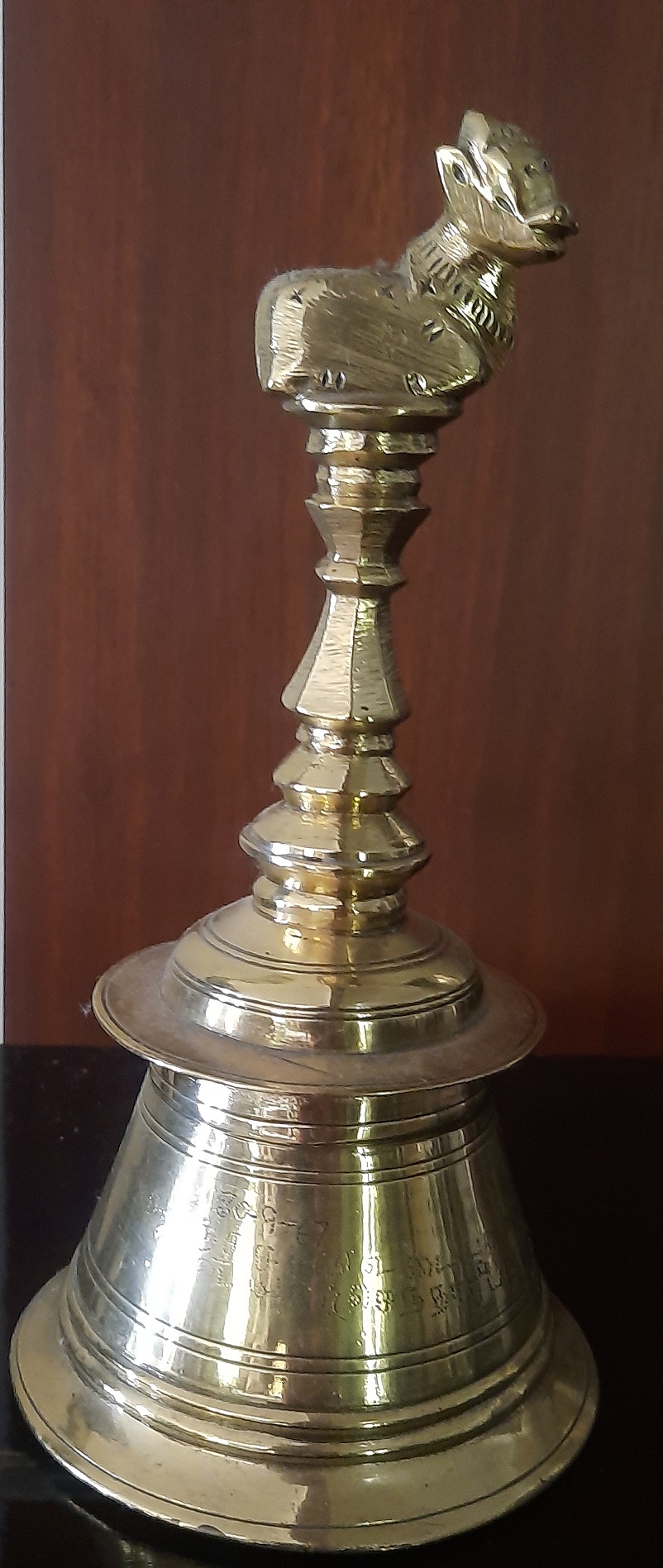
Down the ages and across the world, bells have played an important role—from summoning people to a gathering place, to a role in religious rituals, to announcing danger, to attracting attention. And importantly, to summon children to school, and provide them joyful reprieve at the end of classes! I am talking of course of traditional metal bells which are rung manually.  These traditional bells are ‘melodic percussive musical instruments usually made of metal (bronze, copper, or tin) but sometimes made of glass, wood, clay, or horn. When a bell is struck by a clapper (an interior object) or an exterior mallet or hammer, the bell, constructed of solid, resonant material, vibrates and produces a sonorous ringing sound’. Each bell is unique, depending on the material it is made of, how thick it is and its size and shape. Based on these factors, it resonates at certain harmonic frequencies and pitches. 

bell

A bell is usually suspended from a yoke– a cross piece that allows the bell to hang freely. The top of the bell is known as the crown and the middle portion is called the waist. The lower open section is known as the mouth, and the lower edge of the bell is called a lip. The part of the bell which is struck with a clapper is the thickest part of it, and is called the sound bow. Some bells are rung with clappers, a metal sphere that swings inside the bell Others are struck with a mallet or stick externally.

Gungroos represent a variation. Rather than being bell-shaped, they are orbs, with a few openings, which have small metal balls or even tiny stones enclosed within, which rattle and produce a tinkling sound.

With new technologies and means of communications, traditional bells and the traditional role of bells is diminishing. But interest in these bells and bell-ringing is alive. Many thousands of people around the world practice bell-ringing as hobby!

In fact, January 1 is observed as Bell Ringing in some countries. Many universities in the UK have bell-ringing clubs. When you join such a club, you first have to master the technique of pulling the rope attached to the clapper in a rhythmic way. Once you have mastered this, you can start “change ringing”–rhythmically ringing in a descending scale and then changing the order in which the bells ring in various different ways. Team bell-ringing is an activity which requires immense amount of coordination, and is a competitive event!

Bell Ringing Day not only sets out to encourage bell-ringers, but also to focus attention on the need to restore and maintain bells.

Our temples have beautiful bells which devotees ring as they go in. Most homes have small bells, and pujas are accompanied by the chiming of bells. Dancers wear ghungroos or rows of bells on their ankles. Cows are adorned with bells which chime as they move.

A cheery note to begin the year!

Happy New Year, and may the chiming of bells bring in good tidings!

Peace on earth, and goodwill to all.

–Meena