War and Peace

What can one say about the year that is winding to a close? Sadly, despite many stories of achievements and accomplishments across the world, and even into space, perhaps the images that will haunt us the most will be those of the ravages of war. A frightening reminder of human’s inhumanity to humans. While the voices of the war-mongers are louder and more strident, there are, in every time and generation a few who gently, but passionately, fight the non-violent battles for peace.

One among these was Daisaku Ikeda, the Buddhist philosopher, educator, author, poet, and above all, peace-builder. Ikeda was born in Tokyo, Japan, on January 2, 1928, the fifth of eight children, to a family of seaweed farmers. He grew up in a period when Japan was in an authoritarian and militaristic phase of expansion, and heading towards World War II. As a teenager Ikeda was witness to the devastation and suffering of the war, including the death of his elder brother in action. The young Ikeda was deeply disturbed by the seemingly meaningless human conflict.

At the age of 19, Ikeda met Josei Tado, an educator, pacifist and leader of the Soka Gakka, a Japanese Buddhist religious movement based on the teachings of the 13th-century Japanese priest Nichiren. Toda had been imprisoned during the war together with his mentor Tsunesaburo Makiguchi. Both had held firm to their religious convictions in the face of oppression by the military authorities who had imposed the Shinto ideology as a means of sanctifying their war of aggression. Makiguchi had died in prison, and Toda had resolved to stand up to the militarist regime. This greatly impressed Ikeda who was drawn to the Buddhist philosophy of peace and non-violence. The seeds of Ikeda’s passion for peace were firmly sown.

Toda was engaged in the process of rebuilding the Soka Gakkai which had been all but destroyed as a result of wartime persecution. The young Ikeda shared Toda’s conviction that the philosophy of Nichiren Buddhism, with its focus on the limitless potential of the individual, cultivated through an inner-directed revolution, could help revive society in the devastation of post-war Japan.

Ikeda accepted Toda as his mentor, and the next ten years became as he described, ‘the defining experience of his life and the source of everything he later did and became.’ Toda died in 1958, and in May 1960, Ikeda succeeded him as president of the Soka Gakkai. He was 32 years old. In 1975, Ikeda became the founding president of Soka Gakkai International (SGI), which grew into a global network that brings people of goodwill and conscience together. Under his leadership, the movement began an era of innovation and expansion, becoming actively engaged in initiatives promoting peace, culture, human rights, sustainability and education worldwide. He established the Soka (value-creation) schools system, a non-denominational educational system based on an ideal of fostering each student’s unique creative potential and cultivating an ethos of peace, social contribution and global citizenship.

Ikeda’s philosophy is grounded in Buddhist humanism; the central value being the fundamental dignity of life, which is the key to lasting peace and human happiness. In his view, global peace relies ultimately on a self-directed transformation within the life of the individual, rather than on societal or structural reforms alone.

From a healed, peaceful heart, humility is born; from humility, a willingness to listen to others is born; from a willingness to listen to others, mutual understanding is born; and from mutual understanding, a peaceful society will be born. Nonviolence is the highest form of humility; it is supreme courage.

Ikeda also firmly believed that the foundation of peace lay in dialogue. Dialogue and education for peace can help free our hearts from the impulse toward intolerance and the rejection of others. People need to be made conscious of a very simple reality: we have no choice but to share this planet, this small blue sphere floating in the vast reaches of space, with all of our fellow “passengers.”

Dialogue and the promotion of cultural exchange became the basis of his efforts to build trust and foster friendship in contexts of historical division and conflict. In order to discover common ground and identify ways of tackling the complex problems facing humanity, Ikeda pursued dialogue with individuals from diverse backgrounds—prominent figures from around the world in the humanities, politics, faith traditions, culture, education and various academic fields. Over 80 of these dialogues have been published in book form. Through his writings and actions Ikeda became a pioneering practitioner of the concept of ‘a culture of peace’.

Ikeda also founded a number of independent, non-profit research institutes to promote peace through cross-cultural, interdisciplinary collaboration: the Boston Research Center for the 21st Century (renamed Ikeda Center for Peace, Learning, and Dialogue in 2009), the Toda Institute for Global Peace and Policy Research (renamed Toda Peace Institute in 2017) and the Institute of Oriental Philosophy. The Min-On Concert Association and the Tokyo Fuji Art Museum promote mutual understanding and friendship between different cultures through the arts.

Ikeda was a multi-faceted personality—philosopher, educator, writer and peace-builder. But all his endeavours were rooted in his strong faith in the positive potential inherent in the life of every person. Ikeda was convinced that peace is ultimately inseparable from enabling the flourishing of each person’s individuality. A great inner revolution in just a single individual will help achieve a change in the destiny of a nation and, further, will enable a change in the destiny of all humankind.

For Ikeda, peace was far more than the mere absence of war. He saw this as a set of conditions in which cultural differences are embraced and appreciated and in which dialogue is firmly established as the means of choice for resolving conflict. In the end, peace will not be realized by politicians signing treaties. True and lasting peace will only be realized by forging life-to-life bonds of trust and friendship among the world’s people. Human solidarity is built by opening our hearts to each other. This is the power of dialogue.

Daisaku Ikeda passed away on 18 November 2023, at the age of 95 years. As another war rages on, the world is in dire need of the wisdom of men such as him, to remind us again and again of the futility of violence. Peace is not simply the absence of war; it is a state in which people come together in mutual trust and live with joy, energy and hope. This is the polar opposite of war―where people live plagued by hatred and the fear of death.

With hope and a prayer that the year ahead may lead humanity from war to peace.

Peace is not found somewhere far away. Peace is found where there is caring. Peace is found when you bring joy to your mother instead of suffering. Peace is found when you reach out and make an effort to understand and embrace someone who is different from you. Daisaku Ikeda

–Mamata
It’s Still Christmas!

We are somewhere in the first quarter of the Twelvetide—the 12 days following Christmas. In the old days, December 25 was only the beginning of Christmas which started on that day, and went on till January 6th, which was considered by some to be more important than Christmas day itself! The 12 days mark the journey of the Magi, the three wise men, who set out to see the Baby Jesus on seeing the star, and ends at the feast of Epiphany, on Jan 6th, when they actually met Him.

The Christmas song ‘The Twelve Days of Christmas’ has always intrigued me as I could never make head or tail of the strange array of gifts given on each day. And I am sure that many others are confused as well. But things started falling into place after I realized that each gift was symbolic of something in Christian belief or ritual, and is linked to Twelvetide. And what exactly are these gifts?

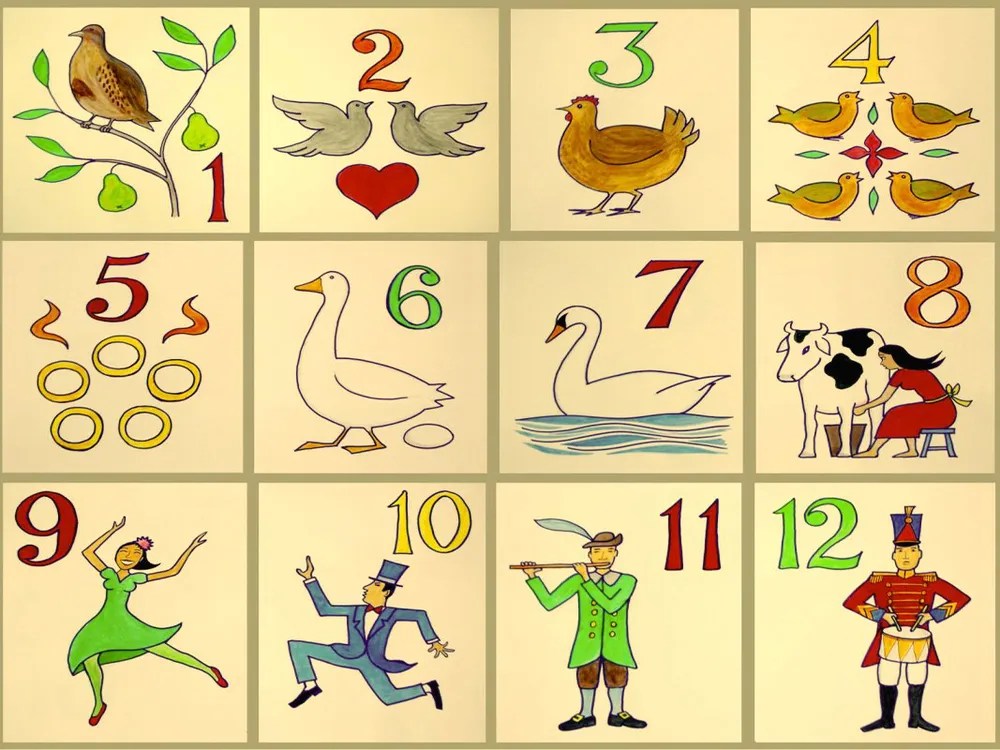
On the first day, someone’s true love gives her a partridge in a pear tree. Apparently, this symbolizes Jesus Christ himself.

12 days of Christmas

The second day brings a gift of 2 turtle doves—which stand for the Old and New Testaments.

The 3 French hens of Day 3 are the virtues of faith, hope and charity.

Particularly confusing are the gifts of the fourth day—viz, 4 calling birds. What on earth are calling birds? Well, opinion is divided. They could be blackbirds or starlings or crows! But the number 4 stands for the 4 gospels.

The 5 golden rings of the fifth day are a more conventional gift and stand of the five books of the Old Testament.

6 geese-a-laying symbolize the 6 days of creation, and this, in some weird way, seems to make some sense!

The day after that brings 7 swans-a-swimming. These stand for the seven sacraments recognized by the Catholic Church —Baptism, Eucharist, Confirmation, Reconciliation, Anointing of the sick, Marriage and Holy orders.

The intriguing 8 maids-a-milking symbolize the eight beatitudes or the sacred blessings which mark the opening of the Sermon on the Mount.

Continuing with pretty ladies, the next day brings 9 ladies dancing, which are the nine fruits of the Holy Spirit, namely love, joy, peace, forbearance, kindness, goodness, faithfulness, gentleness and self-control.

The nimbleness of the ladies is matched by 10 lords-a-leaping who come along on the tenth day. These symbolize the Ten Commandments.

The 11th day brings along accompaniments for the dancers and prancers in the shape of 11 pipers piping, who represent the 11 faithful apostles. I do feel the pipers could have come ahead of the ladies dancing.

And the last noisy day brings along 12 drummers drumming—symbolizing the 12 points of the apostle’s, i.e., the 12 points of faith that Christians believe in.

This carol was first published in 1780, but is believed to be much older.

Someone has gone to the trouble of calculating the cost of these gifts and has estimated the total for 2022 at a whopping $45,523.27. And this is when each gift is counted only once (i.e., assuming that the second day brings only the 2 turtle doves, and not another partridge in a pear tree).

Here is to the continuing spirit of Christmas—peace and joy to all our fellow-people!

–Meena

Santa the Traveller

Tis the season to be jolly, and the jollity is best symbolized by the iconic Santa Claus. As Meena wrote this week, the legend of Santa dates back to fourth century AD. A bishop named Nicholas, in what is now modern-day Turkey, became known for his kindness and generosity to the deprived and needy. He was later canonised, and St Nicholas became one of the most popular saints in Christianity. He also became the patron saint of many European countries. Every year he was honoured during the Feast of Sint Nicholas where parents would leave gifts for their children who believed that he had paid them a visit during the night. The Dutch version of the saint rode a donkey and wore a tall pointy Bishop’s hat. On St. Nicholas Day a person dressed up as the saint went from house to house with a servant, either rewarding or punishing children depending on the work they had done. The good students got a gift meant to resemble a sack of gold, while the bad ones got lumps of coal.

The story of St Nicholas evolved over the years, with local embellishments, in different countries of Europe. In some parts of 16th and 17th century Europe, St. Nicholas was depicted as someone who handed out apples, nuts and baked goods, symbols of a bountiful harvest. In France and England, books became the gift of choice as more people became literate.  Gradually, small jewellery, wine and luxury foods became gifts of choice as well.

There were similar figures and Christmas traditions in many parts of Europe. Christkind or Kris Kringle meaning ‘Christ Child’, an angel like figure who often accompanied St. Nicholas was believed to deliver presents to well-behaved Swiss and German children. In Scandinavia, a jolly elf named Jultomten was thought to deliver gifts in a sleigh drawn by goats. English legend explains that Father Christmas visits each home on Christmas Eve to fill children’s stockings with holiday treats. Père Noël is responsible for filling the shoes of French children. In Italy, there is a story of a woman called La Befana, a kindly witch who rides a broomstick down the chimneys of Italian homes to deliver toys into the stockings of lucky children.

It is only in 1664 that the legend of Saint Nicholas crossed the Atlantic, to the Dutch settlement of New Amsterdam, what is today New York City. For the next 200 years the legend of Sint Nikolas or Sinter Klaas (in adaptation) was preserved and protected by the Dutch settlers in America, along with his tradition of giving gifts.

In 1822 a poem, inspired by the Dutch legend, and originally titled A Visit From St Nicholas was published, which provided a more graphic description, (adapted to the new country and culture) of Santa Claus. The adaptation also included the pronunciation of the name in the New York accent, where Sinter Claus became Santa Claus. This poem by Clement Clark Moore, retitled as The Night Before Christmas became a classic. It is upon this, that the image of Santa as we know him today became firmly established.

To promote the tradition of gift giving, stores in America began to advertise Christmas shopping in 1820, and by the 1840s, newspapers were creating separate sections for holiday advertisements, which often featured images of the newly-popular Santa Claus. They also added to the attraction by introducing “live” Santas who would meet children and encourage them to share their “wish list’ for presents.  

Santa thus found a new identity in America. In 1863 a young artist Thomas Nast was commissioned to draw a picture of Santa Claus bringing gifts to the troops fighting in the American Civil War. He drew upon Clement’s description to depict a roly-poly, white bearded, cheerful figure in red clothes, to boost the troop morale.

Perhaps the large-scale commercialization of Santa as a ‘sales agent’ began in the 1920s with Coca Cola first using the red clad Nast figure to advertise Coke. In 1931 the company commissioned an advertising agency to create special Christmas sales campaigns using the Santa image. Santa was the key figure in Coca Cola advertising up to 1964. He appeared in magazines, on billboards, and shop counters, encouraging Americans to see Coke as the solution to “a thirst for all seasons.” By the 1950s Santa Claus became a popular endorser of a wide range of consumer products.

Today Santa Claus has once more crossed the Atlantic to become a global icon of contemporary commercial culture. St. Nicolas has indeed travelled a long way from being a kindly benefactor of the needy, to the ubiquitous jolly Santa Claus selling every dream and product imaginable—while the promoters jingle all the way to the bank.

This is a good time to remind ourselves that Christmas is a season of giving, before it became a season of acquiring and owning more and more. Merry Christmas and warm greetings of the festive season.

–Mamata

‘Tis the Season to Rejoice. And Make Santas!

With a 5-year old to entertain, I am always looking for suitable activities. And Christmas brings not only joy but a host of Santa crafts too. Like Ganesh, Santa lends himself to being rendered in paper, board, foil, plastacine, with balloons, with cotton wool….you name it. The ability to cut out circle-ish shapes is the main criterion for being able to undertake Santa-crafts. My house is currently filled with good, bad and indifferent renditions of Santa!

Santa

As a corollary, I was curious to learn about Santa sculptures. I did not recall seeing any statues of this beloved character. And they seem to be surprisingly few in number—or at least, they don’t seem to be well documented.

But there is one very well-known sculpture—famous in some eyes, infamous in others!

This is the piece by the American artist Paul McCarthy. Always controversial, McCarthy works in several media—performance, sculpture, painting, installation and ‘painting in action’. He is an analyst and commenter on mass media, consumerism, contemporary society and the hypocrisy, double standards and repression of American society. His objective is to showcase everyday activities and the mess they create.

In 2001, the city of Rotterdam commissioned McCarthy to create a Santa to be placed at the prominent Schouwburgplein square near De Doelen, the city’s orchestra building. He was paid 180,000 euros, a very reasonable amount for a large sculpture by such a prominent artist.

McCarthy delivered the bronze sculpture—and controversy started. Santa was supposedly holding a pine tree in his hand. But many saw the object in his hand as having sexual overtones, and the statue gained the nickname of Butt Plug Gnome.

There were protests by the people of Rotterdam who refused to allow the sculpture to be installed in Schouwburgplein. City officials then tried to install it in Rotterdam’s main shopping street, but this plan also met with resistance. It was four years before McCarthy’s sculpture was set up and unveiled in the city’s Museum Park. It stayed at that spot for three years. However, thanks to general discontent about its highly-visible location, it was moved to a less prominent location within the Museum Park itself.

It was only on November 28, 2008 that the sculpture, which was intended by the artist to critique the consumer culture that surrounds Christmas,  and  is supposed to depict the king of instant satisfaction, symbol of consumer enjoyment, found a permanent home in the Eendrachtsplein Square in Rotterdam.

Another well-known statue of Santa which again has a complicated story is in Turkey. The original Santa was St. Nicholas who was born in 270 AD, in Patara, a small town in Antalya province in modern-day Turkey. He accepted the Christian faith and became the bishop of the nearby town of Demre. The story goes that he used to be so upset by poverty and unhappiness that he used all his wealth to combat it. He dropped bags gold coins down chimneys and gave nuts and fruit to good children, and often helped to look after the sick and elderly—one can see the linkages with activities associated with present-day Santa. Various generations of Santa statues stood in Demre for many years.  But in 2008, the then-standing statue was removed during some construction work by city officials, and has not been replaced despite protests. Authorities say they will re-install the statue when they find an appropriate spot for it!

Nearer home, there are less controversial, though also less permanent Santas. India’s well-known sand artist Sudharshan Patnaik has made sand sculptures of the beloved figure for the holiday season over the last few years.  Last year he created a giant 1.5 tonnes , 60-feet wide sand-and-tomato Santa Claus on Gopalpur Beach. Before this, during Covid in December 2020, he created a giant three-dimensional sand installation of two Santas holding a mask, carrying the message of wearing masks.

May this holiday season bring peace, health and happiness to all!

Meena


Forts, forts, forts…

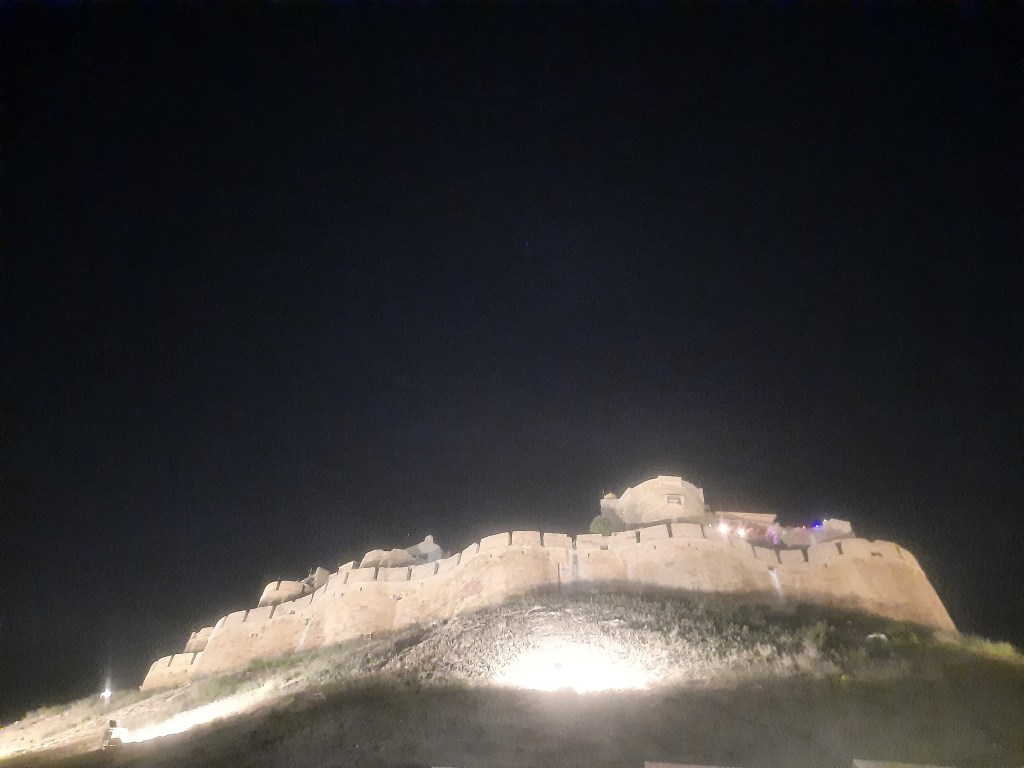
A visit to Rajasthan leaves one with a head swimming with visions of elephants and camels, turbans and bandhini saries, sweets and more sweets .  And of course forts and palaces. I spent last week at Rajasthan, and so obviously these grandiose structures are very much on my mind.

Jaisalmer Fort by Night

Which got me wandering: what are forts vs. fortresses vs. castles vs. palaces,? Well, here we go:

A fort is not a residence, but rather a military fortification. These structures were built specifically for war situations, and used to defend specific territories. A fortress is similar, but it is a larger fortified area than a fort.

A palace is primarily a residential place, occupied by royalty, heads of state, or very rich and important people. They are not fortified against attacks, but rather designed for comfort and elegance, and are often status symbols. 

Castles are large residences or a group of large buildings that have been constructed with strong walls to protect against attacks. Basically, castles are fortified residences. 

Apparently, there are about a thousand forts in India. Going strictly by the book, most forts in India are either fortresses or castles. But the British when classifying them, used the conventional British system and called them all forts.  The oldest surviving fort is thought to be the Qila Mubarak in Bathinda, Punjab, whose origins go back to the period 90-110 AD. This Qila was built by Raja Deb, a Rajput king.

That is a pretty ancient fort! But the thinking about forts goes back to even earlier times. Kautilya, the man who wrote prodigiously on all aspects of governing kingdoms, as far as the 3rd Century BC, had discussed various types of forts and fortifications.

‘On all the four quarters of the boundaries of the kingdom, defensive fortifications against an enemy in war shall be constructed on grounds best fitted for the purpose: a water-fortification (audaka) such as an island in the midst of a river, or a plain surrounded by low ground; a mountainous fortification (párvata) such as a rocky tract or a cave; a desert (dhánvana) such as a wild tract devoid of water and overgrown with thicket growing in barren soil; or a forest fortification (vanadurga) full of wagtail (khajana), water and thickets.’ he says in Book II of the Arthashastra in a section which elaborates “The Duties of Government Superintendents”. He goes into great detail not only about the construction of the fort, ramparts, towers, turrets, gates  and staircases, but even to the extent of specifying the width of various types of roads within the forts which would make for easy movement in war and peace. He details out how the spaces within the fort should be planned, and where which facility should be set up.`

However strongly fortified a fort, the danger of sieges was always present. It was for this reason that Chanakya laid down that: ‘There shall be a water-well for every ten houses. Oils, grains, sugar, salt, medicinal articles, dry or fresh vegetables, meadow grass, dried flesh, haystock, firewood, metals, skins, charcoal, tendons (snáyu), poison, horns, bamboo, fibrous garments, strong timber, weapons, armour, and stones shall also be stored (in the fort) in such quantities as can be enjoyed for years together without feeling any want. Of such collection, old things shall be replaced by new ones when received.’

Well, I suppose all this detailing could possibly have been done by any conscientious bureaucrat. What really gives the Chanakya twist to the discussion on forts is Book XIII, “Strategic Means to Capture a Fortress”. It mentions such tactics as: Sowing the Seeds Of Dissension; Enticement Of Kings By Secret Contrivances; The Work Of Spies in a Siege; The Operation of a Siege; etc.!

Wow! India not only has the most amazing forts, it probably has the oldest document guiding their conception!

–Meena

Nan Shepherd and The Living Mountain

George Mallory, when he was asked why he wanted to climb Mount Everest, is said to have replied: “Because it’s there”. Mallory was the only climber to take part in three of the British pioneering expeditions to climb Mount Everest in the 1920s. Mountains have always “been there” and have over centuries, challenged humans to ascend and ‘conquer’ them. Hundreds of books have been written about mountains, mostly by men. The books are characterised by the language of conquest and victory, and propelled by the goal of reaching the summit.

In the period when men were racing to scale and conquer the highest peaks, was a young woman who perceived, and described, mountains not in terms of heights but in terms of depths. This was Nan Shepherd, not only an explorer of mountains, but also one of the great early 20th century writers of nature, landscape and the Scottish mountains that she so loved.

 Anna (she called herself Nan) Shepherd was born in February 1893 near Aberdeen on the North East coast of Scotland. Not long after she was born her family moved to Cults (now a suburb of Aberdeen). The hills of Deeside close by, were her natural playground, and her love for walking in the hills was encouraged by her father who was a keen hill walker. Nan was also an avid reader, and at the age of fourteen started filling notebooks with quotations and citations from her readings. She attended Aberdeen High School for Girls and studied at Aberdeen University, graduating with an MA in 1915. She went on to teach English literature at the Aberdeen Training Centre for Teachers (later the College of Education). She remained there for the next forty-one years, until her retirement in 1956, having become known as an inspiring teacher with a feminist slant to her work. Although she did travel extensively, she continued to live in her childhood home until she died in 1981.

Having explored the local hills almost from the time that she could walk, Nan ventured further afield, to the Cairngorms. These formidable mountains to the west of Aberdeen, are amongst the wildest landscapes in the British Isles. This was in June 1928, Nan was 35 years old. This first experience of the mountains was the start of a passion that came to define both her life and her writing. From then on, she would head for the Cairngorms whenever her job would allow, often alone, or occasionally with friends and fellow walkers.

For Nan, who conquered all six of the major peaks in the Cairngorms while still a young woman the goal was never to reach the summit of a mountain: it was not climbing up that excited her so much as “clambering down,” discovering all the hidden parts of the mountain that only an attentive walker would notice. It was this perspective of ‘looking within’ both at the mountain, and herself, that inspired Nan to also write copiously during the period between 1928 and 1933. During this time, she published three novels: The Quarry Wood, The Weatherhouse, and A Pass in the Grampians. As she said: “It simply must be written”. Shepherd drew inspiration from the places and people she knew well, setting her stories in the North East of Scotland, with a focus on country communities and the harsh way of life imposed by the landscape. Above all, what shone through was her deep love for the Scottish mountains and her knowledge of these through walking. 

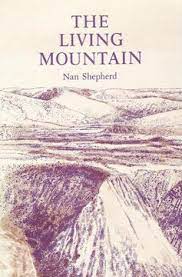
While Nan published these books, the book that was most inspired by these mountains, and her most inspirational piece of writing, was called The Living Mountain. The book, written in 1940, describes Nan’s explorations, as a walker and as a writer, of the Cairngorm Mountains. Nan sent her manuscript to a novelist and publisher friend Neil Gunn who appreciated it, but felt that it was not fit for publication unless she added photographs and a map. Nan put away the manuscript in a drawer and there it remained for over 30 years. It was finally published by the Aberdeen University Press in 1977.

The publication of The Living Mountain revealed Nan as one of the earliest ‘Nature writers’ who brilliantly captured the Cairngorms in their various seasonal moods. Her descriptions emerged out of her own immersion in the experience of walking in every kind of weather, swimming in the lochs, dipping in the streams, and camping under the sky. It also showed her incisive eye for detail, and her profound understanding not only of the geography and geology of the mountains, but equally of the living elements that made it a vibrant ecosystem. Long before ecology became a buzzword, Nan was acutely aware of the interconnections. 

Shepherd was interested in the ‘essential nature’ of the mountain: in understanding it from all angles and in all seasons. She viewed the mountains not as looming objects of sublime terror, but as acquaintances. She wrote: Often the mountain gives itself most completely when I have no destination but have gone out merely to be with the mountain as one visits a friend, with no intention but to be with him.

The poetic descriptions of the routes are so vivid that the readers can literally walk these with Nan. But Nan Shepherd’s writing is not simply a description, it is equally an introspection. While most mountaineers think in terms of peaks, plateaus and cliffs, Nan looks within, “into” cracks in rocks, and the depths of lochs and rivers. Her prose is philosophical and often meditative: One does not look upwards to spectacular peaks but downwards from the peaks to spectacular chasms, for a mountain has an inside.

Although it was written nearly a century ago, The Living Mountain is today acclaimed as “one of the most brilliant works of modern landscape literature”. It is a lyrical memoir that combines field notes, natural history, and oral history. One of its most profound tenets is that we should not walk “up” a mountain but “into” mountains, thus exploring ourselves as well as them.

December 11 is celebrated as International Mountain Day. The theme for this year is Restoring Mountain Ecosystems. Nan Shepherd’s The Living Mountain is a reminder that healthy mountain ecosystems can restore us: in body and spirit.

–Mamata