Dusshera is celebrated in a myriad ways across the country. In Tamil Nadu, Karnataka, Andhra Pradesh and Telangana, it is marked with a beautiful display of dolls called golu (with state-specific variations of the name).
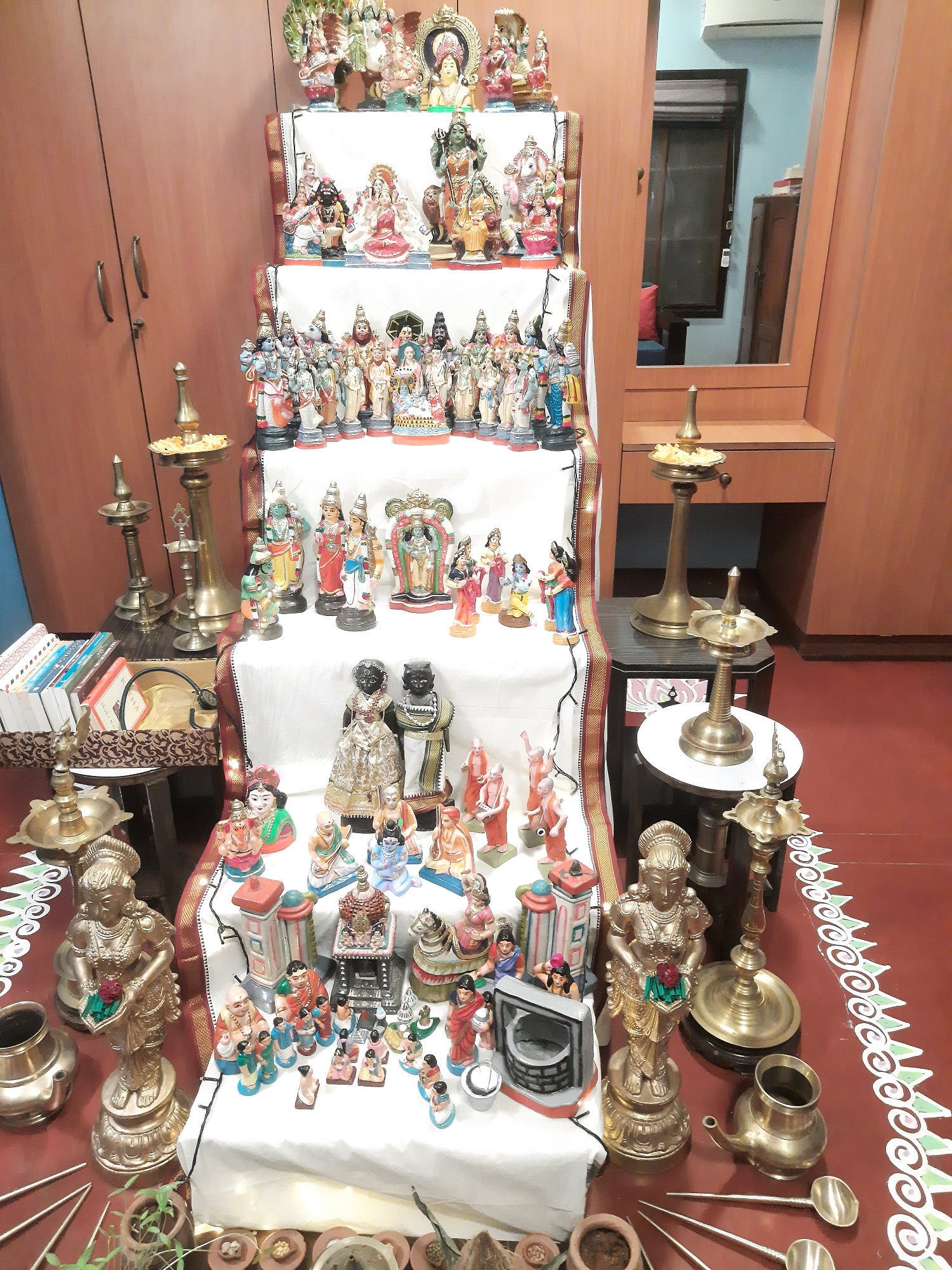
Golu is an elaborate set-up wherein dozens of dolls are exhibited for the period of the nine days. Traditionally ladies and children would visit each other’s houses in the evenings (nowadays, it has become more inclusive with men joining in too). The displays would be praised, the new dolls and arrangements oohed and aahed over; those who could sing would be persuaded to do so; and then they would depart with vatalai-paaku (paan and betel nut), sundal (legume soaked-boiled and tempered with mustard, chilly, curry leaves and coconut), and maybe a coconut, fruit, flowers and a blouse piece. Nowadays, the party favours run into sophisticatedly-packed lamps, candles or agarbatti; organic cosmetics; millet-based snacks and sweets, etc.
The dolls in the golu display are arranged in steps—the ideal is nine, but smaller odd numbers are also acceptable. Some super-extravagant displays go up to eleven, but this is not usual. What exactly the standard nine steps represent is not quite clear: The steps to moksha? The nine nights of the festival? Three steps for each of the Goddesses Lakshmi, Parvati and Saraswathi?
Whatever the number of steps, the convention is to place the major Gods and Goddesses on the top-step. While the details of the displays differ from family to family, often Ganesha, Vishnu, Shiva, Parvati, Lakshmi, etc. are on the top step. On the step below this, some people display the eight forms of Lakshmi, and then come the avatars of Vishnu.
Below come the humans, with a hierarchy. On the step closest to the Gods are the sages and saints: Sankaracharya, Meerabai, Sai Baba etc., as also revered leaders from Mahatma Gandhi to Netaji Subhas Chandra Bose.
And below these are normal people—shopkeepers, doctors, musicians, kings, queens; and thematic displays. These thematic displaysiare where most households put their creative energies, and these scenes could range from agricultural scenes, to weddings, processions, etc. Often a contemporary note is struck with displays of cricket matches, the launch of Chandrayaan—the imagination being the only constraint. Somewhere in all this would be animals, fruits and vegetables, etc. And below on the floor would be gardens, ponds, zoos, airports and other outdoor scenes. Somewhere in the display, marapaachies—traditional wooden man and woman dolls—must find a prominent place.
While this is a puja essentially celebrated by women, the putting up of the golu is an enterprise involving the whole family. The complex exercise—from taking down the steps or ladder from its storage place, to assembling it, to choosing the themes and dolls, doing the lighting, to creating elaborate structures like ponds and lakes and parks—requires all hands onboard. It is also customary for families to buy a few new dolls for the display every year. So while golus may have dolls which may be a century-old, there are also the latest fashions, including sometimes the newest Barbies!
I have of course been seeing golus for many decades now, but have taken it for granted that it is how Tamilians celebrate Navartri, never questioning why the occasion was marked with a display of dolls. It is only recently that I learnt the story and significance behind the doll display. Dusshera marks the triumph of Devi Durga over the wicked, demonic Mahishasura who had the boon that he could not be killed by any male—human or divine. The Gods had sent many an army to fight this buffalo-demon, but he had decimated all of them. Things were getting really serious and the Gods were at their wits’ end. And that was probably the dawn of woman-power! The Gods and Goddesses all came together to create the Goddess Durga, imbuing her with all their powers. And she went out, fought the demon in a bloody battle for 10 days, finally defeating and killing him on Vijayadashami. Once the Gods and Goddesses had given Durga their powers, they became lifeless and powerless. It is to honour them that they are represented as statues or dolls in the golu, and they are contributions are acknowledged in the 10-day celebration.
This Navaratri, may good once again prevail over evil, and may woman-power be a force for good in the world.
Happy Dusshera!
Meena

 Millennial Matriarchs