
Aristotle called them the ‘intestines of the earth’. Cleopatra declared them to be sacred and forbade Egyptian farmers from removing them from the land. Japanese religious lore has a story about them. Certain of the Shinto gods decided to create the world’s creatures from living clay; formulating, in turn, animals, birds, fish and insects. At each stage their creations asked: ‘What shall we eat?’ When they created Man, he was told to eat everything. Then, the gods noticed some small clay scraps that had been dropped and decided to create worms, which they instructed to live underground and eat soil – although they could come to the surface from time to time in search of anything they found edible.
These creatures are what we call earthworms. Archaeological evidence suggests that worms have been around for 600 million years. These underground creatures hardly made news or were subjects of serious scientific research. It was Charles Darwin who studied earthworms for 39 years, who reaffirmed the value of these lowly creatures when he said, “It may be doubted whether there are many other animals in the world which have played so important a part in the history of the world than the earthworm. Worms are more powerful than the African Elephant and are more important to the economy than the cow.”
Darwin’s observations, investigations, conclusions and pronouncements were published in 1881, six months before his death under the title The Formation of Vegetable Mould through the Action of Worms. Darwin estimated that an acre of mid-19th-century arable land, the result of centuries of gentle pummelling and fertilisation by farm animals and traditional toil by countrymen, contained 53,000 earthworms. He further calculated that, over the course of a year, the worms moved 15 tons of soil to the surface – a process known to agrology as bioturbation.
Many years later, in more recent times, when much of the soil surface has been degraded from the onslaught of chemicals and industrial agricultural processes, scientists have once again recognized that the presence and activities of earthworms have a dramatic effect on the soil habitat.
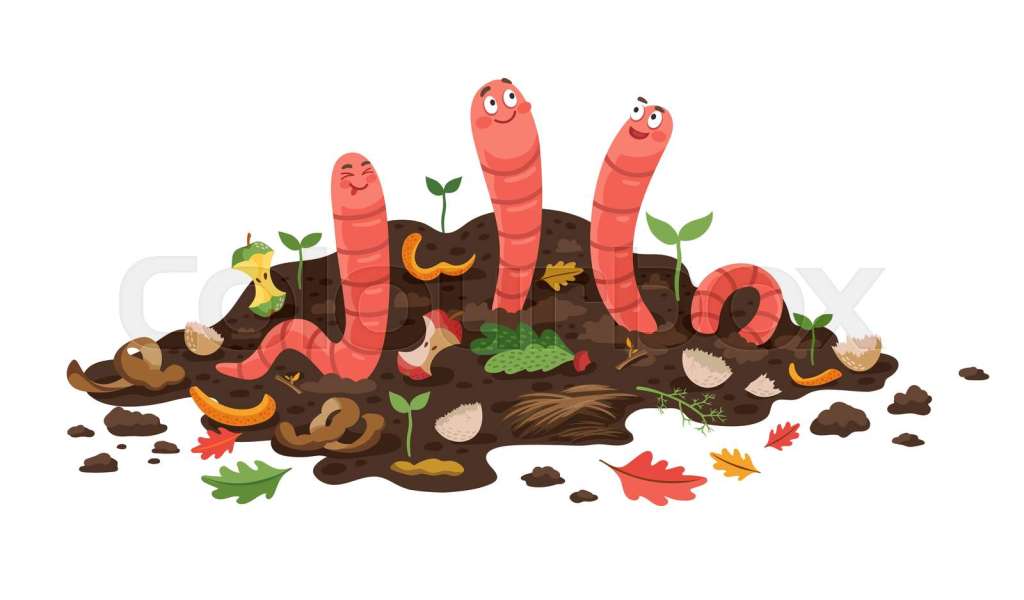
While eating the soil, the earthworm absorbs the nutrients it needs and casts off the rest. Under ideal conditions, earthworms are believed to eat and digest their entire weight in castings in a mere 24 hours. The nutrient content of the castings, which have gone through the earthworm’s digestive system, was found to have 5 times more soluble nitrogen, 7 times the soluble phosphorus, 11 times the soluble potassium, and 3 times the soluble magnesium plus a smaller amount of calcium. Most earthworms also mix the plant litter and organic matter into the soil, increasing the speed at which they decay and release nutrients into the soil. In these ways, earthworms recycle nutrients from dead plants and other soil organisms so that they can be used again.
Earthworms are also incomparable builders of soils. Their means of travel thorough the soil — pushing, tunnelling and eating their way through all kinds of organic matter. soil opens it up for the benefit of aeration and water seepage. The underground burrowing systems that they create increase the amount of water and air that reaches the plant roots and other soil organisms, helping their growth. Soil that has a good population of earthworms is always easier to work and plants seem to thrive in it. Thus earthworms have been given new sobriquets such as “farmers’ friends’ and ‘ecosystem engineers’.
Earthworms are getting their due. One of the quirky celebrations of these usually hidden-from-sight creatures is a festival held in some parts of England–the Festival of Worm Charming. While we know of snake charming and snake charmers, this one is certainly not part of a regular vocabulary.
Traditionally worm charming, worm grunting and worm fiddling refer to methods of attracting earthworms from the ground, mainly through creating vibrations on the ground.
Darwin was perhaps the first to study earthworm sensitivity or otherwise to light, warmth and sound. His experiments included placing lamps, candles and hot pokers close to them, blowing tobacco smoke over them, sounding a tin whistle and playing a piano close by and having his son play a bassoon loudly. He observed that it was only vibrations that caused them to become active.
Scientific experiments apart, using vibrations to bring worms to the surface has been traditionally used by fishermen to collect worms as bait. In recent years, this activity has taken the form of a competitive sport.
An International Worm Charming festival is held every year June in Devon in England. As with all competitions, this one has its rules and etiquette.
The aim of the competition is to “charm” the earthworms to come to the surface of the soil by creating vibrations on the ground. Traditionally this was done by sticking a rod called a ‘stob’ (like a pitchfork) in the dirt and smacking it with a simple rod known as a ‘rooping iron’. This competition allows different ways of creating the vibrations—tapping the soil with feet, “twanging” the ground with a fork in the soil, but strictly no digging.
The wormers are given a 3×3 meter square of land to fiddle, grunt, and charm their way to championship glory by collecting more worms than anyone else.
Each teams comprises 3 members: a Charmerer, a Pickerer and a Counterer.
Once all teams have found their plot everyone is allowed to begin “Worming Up”. This is doing whatever you need to do to get the worms out of the ground without digging, forking or pouring harmful liquids onto plots.
“Worming Up” lasts for 5 minutes after which the competition really gets underway.
15 minutes are allotted to all teams to get as many worms charmed out of the ground.
Any team or competitor caught cheating will be publicly humiliated and almost certainly disqualified.
The International Judges’ decision is final.
All worms must be returned unharmed to the ground after the competition.
The Worm Master presides over the Festival. The Official Cheat tempts entrants by offering them worms so that they can cheat. Old Father Worm Charming offers advice and guidance to would be worm charmers. Finally, there’s the International Judge who is the rule of law in all things to do with arbitration in worm charming disputes.
What a way to spend a sunny summer’s day! While India is known as the ‘land of snake charmers’, this festival may well lead England to be known as the ‘land of worm charmers’!
–Mamata





 Millennial Matriarchs