
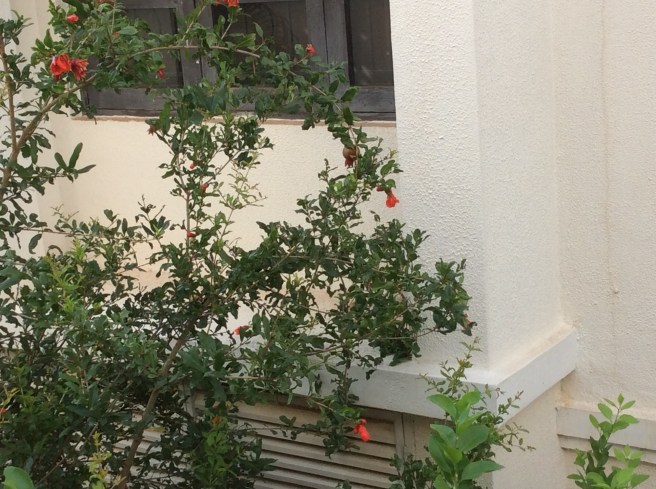
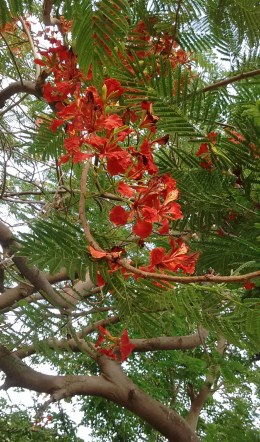
 Lockdown has certainly make us more observant and has given us new ways of looking at things. There is a pomegranate tree whose top I can see from my window—and considering I spend eight or nine hours working in that room, it is very central to my vision! It is currently flowering, abuzz with bees, and fruits have started forming.
I have always wondered why Anarkali*, the beauty who stole the to-be Emperor Jahangir’s heart and brought him to loggerheads with his father Emperor Akbar, was called so. Was the flower so beautiful that our most famous beauty was named for it? I never did think so.
Well, my recent close encounters with the tree and flowers have given me a greater appreciation of the beauty of the flower. Bright waxy orange blossoms which stand out against the green of the leaves, and a nice shape. And bees drawn to them by the dozens, as maybe men, young and old, were drawn to Anarkali (one version is that she was part of Akbar’s harem, and that rivalry between father and son for her favours was at the heart of the dispute).
But maybe more than just the beauty of the flowers, it is the associations that the ancient fruit has, that makes the pomegranate so much part of the imagination. It is one of the few fruits which is mentioned in the texts of many religions.
Starting from ancient Greek mythology–in the story of Persephone’s abduction by Hades, lord of the underworld, the pomegranate represents life, regeneration, and the permanence of marriage.The story is that one day while out gathering flowers, Persephone was kidnapped by Hades and taken down to his kingdom. By eating a few pomegranate seeds, Persephone tied herself to Hades.
Pomegranate is mentioned in the Vedas and is an important part of Ayurveda. It is a symbol of fertility and abundance, and one of the nine fruits offered to Goddess Durga.
In Buddhism too, it is significant. The Buddha received many valuable gifts from wealthy disciples. But it is said that a poor old woman’s gift of a small pomegranate was the one that delighted him most. It is also said that he once offered a pomegranate to the demon Hariti, which cured her of her alarming habit of eating children.
It finds a place in Zoroastrianism too. In Persian mythology, Isfandiyar eats a pomegranate and becomes invincible.
In Islam, the fruit is considered a symbol of harvests, wealth, and wellness. Legend has it that each pomegranate contains one seed that has come down from paradise. Along with olive, dates and figs, it is one of the four sacred fruits in Islam.
In Judaism, it is believed that each pomegranate has 613 seeds—one for each of the Bible’s Commandments. The Song of Solomon compares the veiled cheeks of a bride to the two halves of a pomegranate.
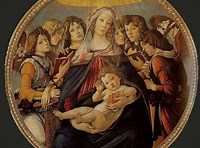 The pomegranate is a symbol of resurrection and life everlasting in Christian art, and the pomegranate is often found in devotional statues and paintings of the Virgin and Child, as in Bottecelli’s ‘Madonna of the Pomegranate’ shown here.
I shall delight in the beauty of the pomegranate flowers for now. I shall try to get a few fruits before the parakeets get them all. And I shall let thoughts of all the health and prosperity they will bring me help me through the Lockdown!
–Meena
*Anar= Pomegranate. Kali= Flower


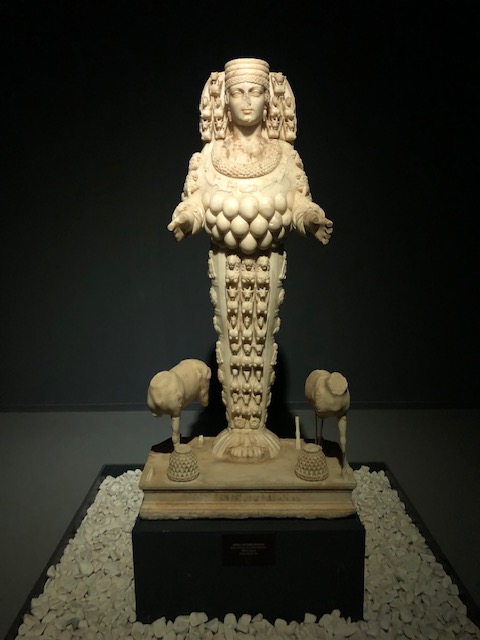 Why the sudden question? Well, because May 18th is International Museum Day—observed as such since since 1977. The idea is that on this day, museums engage with their stakeholders and highlight the importance of the role of museums as institutions and the role they play in society.
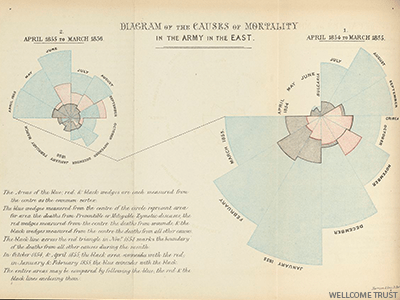 Florence was also one who shook up systems and brought in systemic changes. She battled with entrenched bureaucracies most of her working life, in order to bring about these changes. She was aware that it would be difficult to convince decision makers of the need for change, and maybe out of this requirement was born what is today counted as her major contribution to statistics—the first infographics ever made. The best-known of the infographics she invented are what are called the “coxcomb” diagrams, understandable by even the public. ‘The coxcomb is similar to a pie chart, but more intricate. In a pie chart the size of the ‘slices’ represent a proportion of data, while in a coxcomb the length which the slice extends radially from the center-point, represents the first layer of data. The specific organization of Nightingale’s chart allowed her to represent more complex information layered in a single space. In her coxcomb during the Crimean War, the chart was divided evenly into 12 slices representing months of the year, with the shaded area of each month’s slice proportional to the death rate that month. Her color-coding shading indicated the cause of death in each area of the diagram.’*
 In the case of demarcation of COVID zones in India, Orange is the New Freedom! Lucky enough to fall into this zone, I can now do some things I could not last week. But since my neighbouring zone 5 kms away is Red, there is nothing very exciting I can do. But I suppose it is all in the mind.
 Millennial Matriarchs