
Tonk tonk tonk…it starts before dawn has broken. Even before the crows start their warm-up caw-caws, and the magpie robin tunes up to launch into its melodious repertoire.
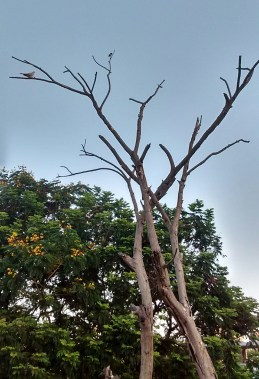
A steady metronomic metallic sound—like the hammer of a coppersmith softly hitting the metal. The Coppersmith of the avian world is awake and ready for another call-marathon.
Last week when it first began calling, I rushed out to look for the source of the sound. It seemed to be all around—almost like sound-surround! But I know where look for it–the remains of the big rain tree that once overlooked my kitchen wash area. The tree died naturally last year, but its skeletal remains continue to invite so much other life–to perch, to play, and to pause awhile. This is the Coppersmith’s favourite post. And sure enough there it was—on the highest point of the tallest bare branch—a speck against the blue sky. Almost invisible, but certainly not inaudible. It puffed up its chest, and raising and bobbing its head from side to side (perhaps the secret of the sound surround!) called out like a muezzin from the minaret.
The Crimsonbreasted Barbet, as it is ornithologically called,
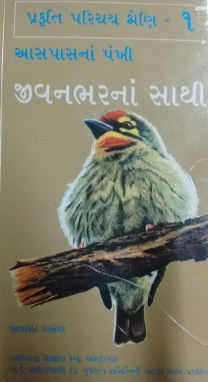
is a small bird with a loud call. It is just a little bigger, but chunkier, than a sparrow, but certainly not as drab. It dons a striking combination of brilliant colours—grass-green top feathers and green-streaked yellowish underparts; a crimson forehead and patch on its breast; vibrant yellow throat, and concentric eye rings of red and yellow. It has distinctive whisker-like feathers around its stout black beak, and a short truncated tail.
My bird book tells me that this bird is mainly a fruit eater, and is commonly found wherever there are fruiting trees, especially fig or banyan. The closest trees around my house are Gulmohar and Copper pod, which are also in full bloom, but not with the fruits and berries that this bird likes so much. Perhaps it finds these in the park next door. Although it baffles me, given the very short breaks between the continuous metronomes, how it manages to partake of sufficient nourishment to sustain its energy to call non-stop.
As the sun climbs higher, other birds fall silent as they seek refuge from the heat in the foliage of trees and hedges. But not our relentless caller. Under the blazing sun, on a high bare treetop, it goes on and on. Funnily, nowhere could I find out why it calls—is it to attract a mate? Difficult to know as both male and female look alike! Is it to warn of predators and danger? But then, why call continuously? Or is it for the sheer joy of being alive and and sharing its song each day? I rather like to think of it this way!
Last evening during a lull, I scanned the tree and spotted it perched woodpecker-like, using its strong beak to excavate a hole in the dry branch. I discovered that it nests and roosts in these small holes. I am glad though that it has chosen to make its look-out point, and perhaps its home, on our tree. It is nice to have a Tuk Tuk for a neighbour!
Tuk Tuk is one of the common Gujarati names for the Coppersmith.
–Mamata
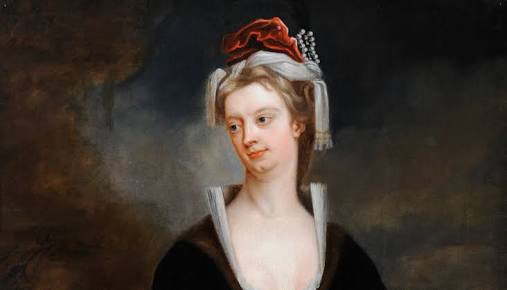
 Polio was a dreaded disease in the early 20th century. It left death in its wake, but even more, it paralysed. Till date, there is no cure for polio, and the only defence is vaccination. Jonas Salk rightly deserves the credit for the polio vaccine, but there were two women, without whose work things would not have happened as they happened, when they happened. One was Dr. Isabel Morgan of Johns Hopkins University, whose work was a turning point in understanding host immunity to polio and on use of killed-virus (vs. live-virus) as the basis of vaccines for this disease. The other was Dr. Dorothy Horstmann of Yale and her team, whose work is said to have paved the way for oral polio vaccines.
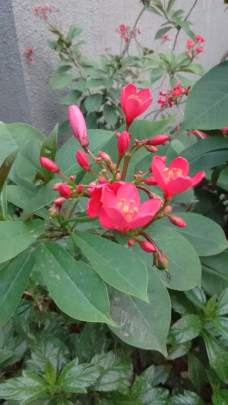 hile these are great to reach out to other humans, they are also a wonderful opportunity to be inside looking out, at nature. One does not have to be in the countryside to see Nature. Even in the midst of the urban jungle, look from the same balcony or window, and you will discover—a bird, a butterfly a bumblebee, a spider. A patch of sky and a puff of cloud. The branches of a tree with fresh green leaves, a bird call, a shaft of sunlight on a wall, or the stars on a clear night.
 But that is not the subject of the blog today. April 25th is marked as World Penguin Day, and that is the occasion of the blog. This day coincides with the annual northern migration of Adelie penguins.
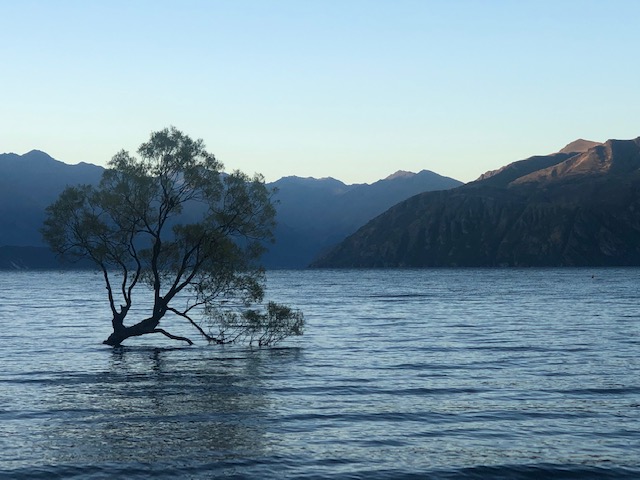 The connection is a tree that is reputed to be the most instagrammed tree in New Zealand, almost a symbol of NZ tourism. On a recent trip there, we were urged to set aside time to see the tree, specifically around sunset. So we worked around our program to ensure we got to the spot—a stretch of a beach—well ahead. We drove past a few times, keenly looking at the beach. We could see some people, but nothing special in the way of trees. We asked natives and tourists alike, and they all pointed us to the same area which our GPS had shown us, and which we had passed, looking in vain for a landmark. We decided to make our way down to the beach anyway. Lo and behold, there were many, many people there, jostling for some spot (we could not figure out what the spot was for), all setting up professional looking camera equipment. It came to a pass when we had to ask a friendly-looking lady what everyone was waiting to photograph, where the famous tree was, and what it was about. She kindly pointed to this spindly willow tree, standing a few feet into the waters of the beautiful Wanaka Lake, against a beautiful background of majestic mountains. But the tree itself? In my mind, this will forever define and exemplify ‘under-whelming’. ‘Why is the tree famous’, we asked many around us in bewilderment. While there was some story of how it was part of a fence and had survived in the water for several years, the general consensus was that it was famous because it was famous! So famous , it even has its own insta handle #ThatWanakaTree.
 d midwife spent in the poor slums of the East End of London. 23 years old and newly qualified she lived and trained as a midwife with a dedicated group of nuns St Raymond Nonnatus.
 ay of Hans Christian Anderson one of the best known children’s writer who was born on 2 April 1805 in Denmark.
 Millennial Matriarchs