
Not many may have heard of it, but 30 March is observed as National Pencil day in the US. If you think of it, the humble pencil is an implement that needs to be celebrated. There is not a single child who has not begun its education without a pencil. Even with all the new and emerging means for ‘writing’ every teacher believes that the pencil is with what it all starts—working with pencils gives the child the motor coordination necessary for more advanced tasks.
Pencils started being used sometime in the mid-1500s, when a large deposit of graphite was discovered in Cumbria, England. The particular deposit of graphite was extremely pure and solid, and could easily be sawn into sticks, and people started to do so, using the sticks for writing. However, graphite being very soft, it needed some casing. Initially, the sticks of graphite were wrapped in thread or sheepskin. In the 1560s, a couple in Italy started hollowing out bits of wood and putting sticks of graphite into them. Shortly after, the idea of making two halves of a cylinder of wood and sandwiching the graphite seems to have dawned and so the pencil, as we know it, was born. Today pencils are made by mixing fine ground graphite and clay powder with water to form strings which are then placed in a kiln to harden, then dipped in oil or wax, which seeps into the tiny holes to make it smoother for writing. These are then encased in wooden cylinders.
So which of these landmarks does March 30 celebrate? None really, because all these specific dates are lost in history. March 30 of 1858 is the day on which Hymen Lipman of the USA received the first patent for attaching an eraser to the end of a pencil. And USA decided to mark this day in his honour as Pencil Day.
Apparently, the pencil business in India is controlled by four major players—Doms Industries which make Doms pencils; Hindustan Pencils, which makes the familiar Apsara and Natraj brands; Camlin (now Kokuyo Camlin) is another significant presence; and finally Maharashtra Pencils, which is the smallest of them. The market leader is Hindustan Pencils, which has 45 per cent of the market share. It produces about 8 million pencils a day!
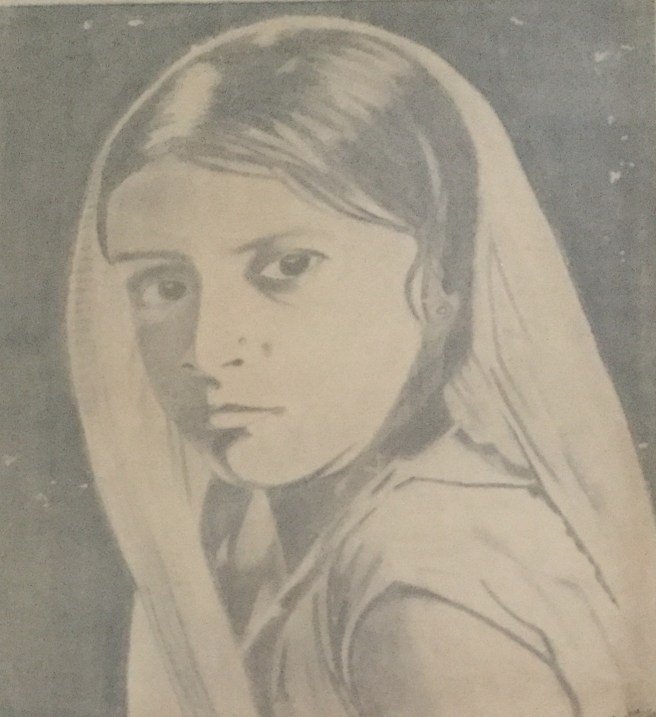 Pencil sketch, V. Raghunathan, using 3B and 4B pencils. 1980.
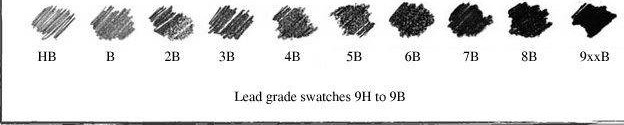
HB pencils were the pencils most of us used. In fact, anything else was left to the more ‘arty’ types. The notation ‘HB’ is a part of the European system of classification, using a continuum from “H” (for hardness) to “B” (for blackness), as well as “F” (for fine point). The system was developed in the early 20th century by Brookman, an English pencil maker. The US of course must be different from the rest of the world, and uses a numeric system of #1 to #4 to classify pencils.
So on this Pencil Day, make sure to write a few lines with a pencil. Believe me, it is a very special feeling, and you will realize how much you miss it! Not only the hand-feel, may be it will bring back memories of school and childhood!
And to end, some Pencil Facts:
Chemistry was not very well developed in the 1500s when the graphite mine was discovered and the substance was thought to be lead. Hence it was called plumbago (Latin for “lead ore”), and even today, though pencils don’t have any lead, they are called lead pencils.
Every year, about 82,000 trees are cut down to make the close to 2 billion pencils manufactured worldwide. Each tree can yield about 1,70,000 pencils.
A typical pencil can draw a line about 55 km long.
–Meena
 to Eureka moments, ideas keep our little grey cells ticking away. Sometimes we let these slip away because we are preoccupied with what we feel are more serious or important matters, and sometimes because we feel that the ideas is too inane to pursue.
 AESTIVATION, lesser known cousin of hibernation, is ‘summer sleep’– a survival strategy used by many vertebrates and invertebrates to endure arid environmental conditions. Key features of aestivation, like hibernation (winter dormancy) include significant metabolic rate suppression, conservation of energy , altered nitrogen metabolism, and mechanisms to preserve and stabilize organs and cells over many weeks or months of dormancy. Even more than in hibernation, strategies to retain body water are important in aestivation, as dryness or aridity is the key trigger for the summer sleep.
 But for a South Indian like me, the most important person-colour association has of course to be ‘MS Blue’, said to be a favourite of legendary singer M.S. Subbalakshmi. This colour became synonymous with her after she started wearing Kanchipuram silk saris of this shade at her concerts. These were specially made for her by Muthu Chettiar, a weaver from Madurai. The savvy businessman that he was, he carefully regulated supplies to ensure enduring demand from Madras high society ladies! It has been clarified that MS Blue is not peacock blue but ‘mid-sea blue’.
 ife Day. This marks the day of signature of the Convention on International Trade in Endangered Species of Wild Fauna and Flora (CITES) in 1973. Every year on this day, events are held around the world to celebrate and raise awareness of the world’s wild animals and plants.
 Millennial Matriarchs